
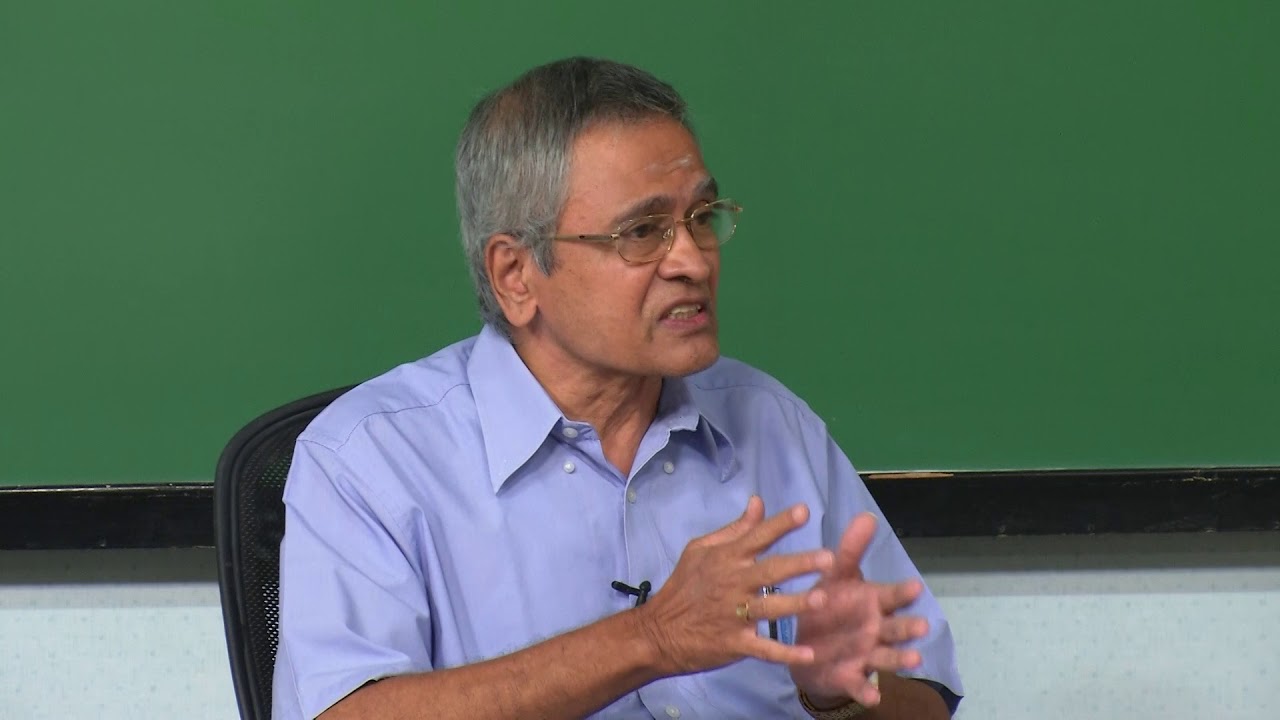
Prof. G. Subramanian (Retd. faculty, Aerospace Engineering) in conversation with Hari Ramachandran (student)
Good morning Professor Subramanian.
Yes.
Now, let us begin.
You joined IIT Madras in 1966
as a lecturer in the Department of Aeronautics and Applied Mechanics.
What made you join this department
that was so young and so small and just upcoming?
Yeah, I was young myself.
Yes, sir.
And, the young department where I could enter,
there was an opportunity available,
and I had just finished my master's programme
in Aerospace Engineering from IISC, Bangalore.
When the advertisement came,
it looked a good opportunity for me to join the programme. Yeah.
Another reason also is there,
I always liked to do research
and then, I found research and teaching had to go together.
So, I had to look for a teaching position in order to do research,
and this turned out to be a nice opportunity.
I was able to convince my interviewers that I was good
and so, I got it,
that is the way it was.
Yes.
So, you had completed your PhD under Dr. K. A. V. Pandalai.
Yes. So, could you could you describe him
as a teacher and as a person and some of your memorable learning experiences with him?
Yeah, Professor Pandalai was an extremely nice person,
and he was a great mentor for me,
but originally, I was not planning to do PhD with him,
because in 1966, when I joined the department,
the department was called Aeronautical Engineering and Applied Mechanics.
In fact, the German aid was not available
for the Applied Mechanics department-for the Aerospace department,
but, for the Applied Mechanics department it was available therefore,
the aerospace-that is the Aeronautical Engineering programme was
brought under the Applied Mechanics department
for the BTech Programme.
Even the BTech students started joining this programme at their 3rd year
because Mr. Shantha Kumar,
Professor Shantha Kumar, who was interviewed a few..some time back.
He was in the Civil Engineering programme and then, in his 3rd year,
he moved over to the Aerospace department-Aerospace programme.
So, likewise, a few students who liked the aerospace idea,
Aeronautical Engineering idea in that day, in those days,
they moved over to-
they moved over to the
Aerospace programme or Aeronautical Engineering programme
as it was...because, I want to make a difference between-distinction between
aerospace and aeronautical engineering.
It was started as an Aeronautical Engineering programme
later on, called as a Aerospace Engineering
with the aerospace content introduced in it.
So, in the first...about 2 or 3 years,
the Head of the Department of Applied Mechanics was Professor D. V. Reddy.
My plan was to work with him
because he was the head of the department, he was the
only available PhD scholar at that time for doing PhD.
So, I moved in with him,
and I started working in the area which was closed to him,
difference equation methods in structural mechanics.
But then, what happened was,
he for some reasons he
left the institute and then went to Canada,
and what he said was that,
he had spoken to Professor Pandalai who had joined in,
and that he could take me as a
PhD scholar.
So, that is how it happened. The transition took place
and Professor Pandalai also was an Aeronautical Engineer
from VPI - Virginia polytechnic,
and so, it all just came about that way.
So, I began working with him,
you asked me about his characteristics.
Right.
Extremely brilliant teacher.
Many things I learnt from him,
with just one course he taught on applied essentials.
And, in fact, teaching itself I started honing
when I looked at him, the way he presented.
So, that way he was good.
He also, was taking over the job of editing
aeronautical..that journal of aeronautical engineering,
we used to produce some publications for it,
I went and submitted a paper, of course, him and me as the authors.
And he said, "why are you working in exact solutions all the time?"
But, that was my favourite.
I said, "I like it." No, but in practic,e exact solutions are usually not enough,
you have to go in for even approximate solutions," that is what he said.
So, that triggered me.
Another time, what he did was
we were working with him and initially,
I was planning to work in the area of shells,
and what happened was,
some time in between, he was planning to leave and go to US for a year.
He called me and said,
"why you want to work in the area of shells?
you already have publications in your own area
which you started with Professor Reddy,
go ahead and do it, that is also structural mechanics," he said.
And so, he completely handed over the freedom to do research in this area,
I appreciate it because,
he found that I was able to do something in that area,
and that was his brilliance -
he could identify who could do what,
and that gave me so much freedom and also convenience that
before he returned,
I really came up with lot of material for PhD.
And he said, I gave it to him,
he looked at it and he is a mathematics person basically,
who became an engineer later
when he went to be VPI.
"These are all mathematics,
put in some applications-
engineering applications," he said. I took another year to do the applications.
It also happened that,
those days, computers were not available.
Some computers were available in Guindy Engineering College,
and also AC-Tech.
And whenever we wanted to do some computation,
we had to prepare decks of cards
send it through a messenger who was available in the library,
it will go there and get examined,
the output will come,
we will look at it make corrections and the next day we send.
So, this is the way.
In fact, it took me a nearly year before I completed my work,
and presented it for a PhD.
But then, he was a great person.
He also understood what I was capable of, I did not know myself.
He made me the joint secretary of the Joint Entrance Examination programme.
In fact, I became a joint secretary then, became a secretary
then completed my exercise
with the joint. In those days, the programme was,
there will be a chairman and secretary.
The chairman, at that time, when I was involved
in IIT Madras, was Professor Chandrashekhar Swami,
who became the director later.
So, we were the team,
and in 1975, I was involved with the joint entrance examination work.
He could see
that, I was able to do it, most of the time I did not see many things myself,
others started seeing many things in me.
Is it also true that
Dr. A. P. J. Abdul Kalam is a student under him at some point of time?
Yes, he...Dr. Abdul Kalam,
he did his BTech Programme at MIT -
Madras Institute of Technology.
He was doing his aerospace engineering, at that time,
Kalam was one of the students.
So, many of your early publications were based on Moire’s method.
Please tell us
how this came to be and how extensively was this method used?
I was not confining myself to only experimental work,
as it seems to look, the way you are asking me.
I did both experimental and theoretical work.
Theoretical work was, I had shifted to..
like Professor Pandalai said, I had shifted to approximate methods,
finite element method is an approximate method,
but, it has potential to give very good results,
and that was the one which was computer oriented
and I had begun working in that area.
Whereas, Moire method is the experimental one.
We had to develop the laboratory and Professor Pandalai said,
to every one of the faculty members,
"all of you must come up with
two or three experiments in the laboratory
and put up an experimental facility.
And, every one of us began planning some experiments
and so, the workshop was at our disposal,
we went in and then, started designing and putting up an experimental setup.
So, that way, I would design three,
another colleague of mine would design three,
like that about 30 experimental things were brought up, built up
and later on, when I took over as the
in charge of the laboratory-structure laboratory,
we weeded out some of the experiments which could not be really sustained
and then, selected about 8 to 10 experiments which were okay
and then, that became the basis for
the laboratory experiments for the students subsequently.
That means that, I got involved in the laboratory development.
And, there was always a talk saying that, if we purchase a photo elastic
bench or something, they say, because funds were limited in those days,
they say, it is there in the Physics lab
it is also there in the Civil Engineering department
why do you want to duplicate like that.
So, what I thought was, let us do something where
it will be different.
So, I thought up about that,
and Moire became my kind of a starting point.
So, I liked it and I also gave couple of lectures for Professor Sirohi.
Professor Sirohi is the person
who became the director of IIT Delhi subsequently.
He was in charge of the Engineering Design Centre
which was having a lot of equipment
brought in by German interaction.
And they make lenses, they have..a lot of optical work they could do,
the fine work, fine techniques, that is what it was.
He used to invite me to give lectures in the area of Moire
for his summer programmes.
So, that way I started interacting with him.
I thought, why not I develop Moire laboratory?
And, that became the basis for that.
Then, I engaged some of the BTech students and MTech students to
interact with me and also develop some things,
in the process, we started also publishing a few basic things,
that is how it began.
But, the important thing that came about in Moire method was,
one with Krishna Kumar,
MS student,
who went on later to Australia and he is a professor somewhere,
and we came up with a nondestructive testing idea
using the Moire method, which is still an unusual method
which really shows the
defects in the products
easily by an optical procedure -
reflective Moire, that is what it is called
so, that is what came up.
During the early and developing stages of the department
what difficulties did you face in your research while
the structural labs had to come up,
and where was most of the experimental work conducted
in the early few years considering that funds were low?
You see, it is true,
but, my experimental work I did in the department,
we built up the facilities,
basic facilities which were needed were not so much,
ordinary lenses
and some things like that we started working.
And, this fine techniques laboratory,
they used to supplement us with some equipment,
I mean, the small ones I needed. Really, Professor Sirohi and Kothiyal,
they were very helpful.
But the structures laboratory was coming up,
and in the initial stages,
the Department of Metallurgy and the Department of Applied Mechanics,
Civil Engineering, in those places where giving..
facility offering or
making available the facilities of their laboratories
for our students to go and do work.
So, that is the way it happen.
So, these people, when they had this laboratory work to be done,
some of the basic work
was being done in the metallurgy laboratory
for structures and things like.
So, Applied Mechanics and Metallurgy department
and Civil Engineering department,
they were able to offer facilities for the students in the initial stages
and then, we were developing our own laboratories and then bringing it up.
So, tell us about the number of projects
that came to your department during your career,
and among the projects that you were associated with
which were the more interesting and the challenging ones?
Yeah,
not many projects came about,
I mean, involving me directly.
But, there were many colleagues who were having plenty of employees.
But, during the period,
you know, the German aid was not available to the department,
but then, a French aid was available which Professor Pandalai saw through.
In fact, he was instrumental in getting the French aid
as well as certain award from the government
with which he began a setting up the FRP centre.
It is his brain child, it is his own thing,
I was not involved in that.
But, you were asking me about the
I just missed the point.
Interesting and challenging projects.
Yeah, project, challenging projects.
See, the AIRDB was starting to allot projects, allot funds for projects,
when we made a request for project funds.
It was just coming up,
even these ideas were only coming up at that time,
you know, the institute used to get some funds from the government,
institute apportion funds to the various departments,
and depending on the departments ability to grab funds,
things were coming into the to the various departments at that point.
The question of projects and things like that,
those ideas started culminating into projects,
for funds, funds for projects only later.
So,
you cannot say many projects came about during that period,
but then, later on, the trend became
rampant and then projects came about.
So, that is the way it was.
So, with, with whatever we had we started working with it,
with whatever funds we could get.
So, our experiments were done in such a manner that they required
minimum, minimum expenditure and also maximum benefit
as it were. Therefore, the fundamental work was being done
where we needed much less input in the form of funds.
So, that is a way we managed the whole issue.
So, so the FRP centre, you said it to was Professor Pandalai's brainchild.
Yes. But, who..like, how did it come about?
Was it was it purely his idea and not the other faculties associated with it,
how did it come about?
No, it was he wanted a composite centre and therefore,
he, he thought about it and then got funds for it.
The French group could give some support
and the he, what happened was,
the Department of Aerospace Engineering had its own workshop
and the facilities of the workshop were also made available to the FRP centre
because it was his centre,
and that is the way it started growing.
Then, it became somewhat independent centre subsequently.
Professor N. G. Nair was involved in that,
Dr. N. G. Nair - N. Gopalakrishnan Nair.
So, he was made in charge.
Professor Pandalai was controlling from the other side
so, that particular centre began growing up.
I didn't have much to do with that.
So, were there any special projects
that you that you worked with with other departments?
Are there any faculty members from other departments
that you remember working with?
No,
I did not have any other department faculty working directly with me,
but we had interactions, alright.
For example, Professor Sirohi and Professor Kothiyal
they were the ones who were
giving me a lot of support
when I was building up the Optics Laboratory in the department,
that is Moire Laboratory in the department.
I had a separate dark room and all those things
and then, we were working in a time
when the digital approach, digital methods were not available.
But then, slowly the Moire methods..
I started moving it into the computer applications
and now, I would say I moved over to digital image correlation techniques
from Moire methods, because they all are optical methods.
So, that is the way it started growing.
I will not say, I was directly involved
with any other faculty member in any other department seriously,
I mean you will find that.
So, that is.
Ok.
Sir, so, this is the question we ask most of the people who we interviewed,
throughout your journey here at IIT
do you have any memory
that is very close to your heart,
maybe inside the department or even outside,
that you would like to share with us?
I, really do not have such a very serious thing
that happened during my...because, I have been just going moving forward,
I was not planning anything very big,
but I was-it was happening,
most of the time it was happening,
that is the way I always felt. See, something was happening and therefore,
I was joining the stream and I was providing support.
I was provided support and that is the way I grew.
Nothing fantastic happened that I could really share with you.
All the students in Research College
that you have taught or have been acquainted with,
can you name a few who are inarguably exceptional
and what qualities did they have
that you want current or new researchers to imbibe?
Yeah, I can say the following,
Professor Shriram who is your dean administration was my student,
at the BTech level, he did his BTech project with me on Moire.
Well, he has scaled greater heights.
He is one person whom I think has got
a motivation and wants to do really very well, you know him right?
Yes, sir. P. Sriram. Professor P. Sriram, Dean Administration.
Administration. Yes, sir, we heard about him. Yeah, he was he was my student.
Then, another student who I remember very well,
I mean, only about one or two students only I want to mention,
is Krishna Kumar Shankar, who was completely involved in the Moire methods
in the initial stages when I was building up the laboratory,
and he was doing his masters by research,
and then, later on moved over to Australia
to do further research and PhD and then get into the academic line.
Day and night he used to live in the laboratory and I also used to join,
that is the way we built the whole thing, ideas were developed,
enjoyed the whole thing.
We had within the laboratory I think a dark room also.
So that, then and there we could watch the films,
see the results, print the films, everything we could do it,
because those days, it was.. that is the way it was.
Another person who I remember very well is at the PhD level,
one Mr. V. V. S. Ravindra - Varanasi V. S. Ravindra is his name,
he did his MS as well as PhD with me continuously,
and he has joined the TATA Consulting Centre
he is in one of the top positions in that place
and he is growing very fast.
Compared to others who join with him
he has grown much faster,
he is a very dedicated person.
He did many things, very serious person and unassuming person,
something like that, that is something which I like most.
So, these are the people who come to my mind immediately when I talk
about these students who worked with me.
There are many others, many, many others,
but, I think these three, I think, in particular I can mention.
So sir, how did your research work
directly or indirectly foster solutions
for the problems that were faced by the industry?
I dont know.
It's, you know,
industry grows from inputs from several directions,
any particular one research does not contribute to the growth of the industry.
So, we tried to do some research,
we try to do in a way, fortunately for us, in those days,
we could do research in an area of our own interest.
So, we could choose a topic we could work with it,
but then, that slowly changed, towards the end
when I was leaving,
the projects were dictated by the consumer,
and one had to dance to the tunes of the dictator.
So, that is the way it was.
So, that way we were working in the areas
which we liked most, where we thought we could contribute something.
So, it is in the area of fundamental work, fundamental research
where I had contributed a lot.
In fact, in mathematics, mathematical areas,
I had the difference equations I had spent a lot of time in those days,
for my PhD, it was difference equation methods,
but then, I completely left it behind.
I consider PhD is a kind of a stamp
which you get in order to say
that you are now independent, you can do independent research.
Because up till now
you are having a guide,
you are having people who are monitoring your work, saying
it's good or not good and so on,
but from that shackles you remove, you get away completely
and then, move to doing something independently.
That is a time when I started working in both Moire and finite element methods,
the numerical methods as well as the experimental methods.
I could start
dealing with
a few PhD students in this area,
a set of PhD students in the other area and things like that,
but then, we are contributing something to this research as such.
So, it manifests in the form of publications,
which in turn fosters further research,
that is the way I look at it.
Sir, according to you, what defines a a true researcher
or a true academician, give us your thoughts on that?
See, first of all one must have some motivation to do research,
I mean, you must think that there is something to do,
and you must also be willing to look at what has been already done.
He must painstakingly go through
everything that is already available in the area,
research is not something you
discover
already, and then try to say,
you are proving it.
When we try to pursue something,
you dont necessarily have to get the answer
which you are thinking is the answer,
that is not research.
See Wernher von Braun was saying this,
"basic research is what I am doing,
when I dont know what I am doing."
So, that is the way it is.
Research is something where you do not have
a final product in mind completely
for which you know everything and then, you say that you are doing research.
So, that kind of an ability must be there
and also,
failure in doing research is a stepping stone for something good,
because, when you have failed to do,
when you, when you are doing something and the result is not good,
you should find out why the result is not good. Many times,
it opens up fresh areas of research,
because it tells you
where you did not look at, therefore, it is also opening up another door.
So, it's very likely that,
you started working in one direction
and then, it tells you something else which is much more
fruitful, functional, very exhilarating, this is exciting, this is possible.
So, that is what I would like student to keep in mind.
You should be prepared to take failure
and look at the failure itself as a stepping stone for success.
So sir, as someone who shaped the department in its early years,
do you think there were things that you unable
to do at the brink of your retirement,
and you think that should be done in the future with the department?
Not really.
I was quite happy with whatever I did,
I was willing to retire too.
So, there is nothing wrong about that,
whatever was possible I tried to always do.
So, that way,
I am not thinking that it should have been done,
that should have been...I have I have no such feeling,
but, I am still willing to do many things.
In fact, I am trying to do it.
I am trying to do it in another place, another place
where I am visiting,
I have a couple of research scholars, with them I am doing it,
I am trying to do further.
If it is possible, I do it,
if I do not, if it is not possible, I do not want to feel bad about it.
Sir, what your thoughts on the flora and fauna in the campus during
your early years,
and how has that changed throughout this part of your career?
August 1, 1966,
when I was getting into the institute for joining the institute,
it was raining heavily.
In fact, I told them that one day before,
I told them that I wanted to join the department on August 1st,
I had written a letter, those days only letters
and what happened was, the previous day
was a convocation day
and the next day had been declared a holiday
and I had no place to go.
So, fortunately I had a
classmate of mine at the undergraduate years, who was an assistant warden in the hostels,
at that time he had joined Civil Engineering department and he was there.
So, I just dumped myself on him
and then, stayed with him for a couple of days
and then, on August 3rd I joined the institute
and then, immediately asked for accommodation
and they gave me accommodation in Taramani house.
Those days Taramani house
was a temporary accommodation, we joined there,
that is how it started.
Plenty of days, plenty of them,
many of them used to cross the roads regularly at nights
and the students also used to cross the roads at night very fast
and it used to be a nightmare.
So, that is used to be the...
So, how it is now I dont know, it should still be happening,
I mean, blind driving here is a very dangerous thing,
but, they dont know what they are doing, they try to escape.
The only difference is, the animals try to go only in one direction whereas,
a human being tries to go forward
and then, again go backward, this is the only thing, therefore,
you can take a good decision and then avoid the animals too.
Many things are here,
this is a forest, continues to be a forest,
and herbs and everything is there, everything is..you have to look for it.
Many things were here which you have to look for it,
you have to go and look for it, banyan trees were plenty.
In fact, I would say, Professor Sengupto was
very kind to make sure that banyan trees were not cut
when he joined as a first director
and then, made the roads turn this way and that way
so, that the banyans are really kept.
But, some my vague feeling is, apart from the banyan trees,
the entire place was just a lot of these thorny trees only.
I dont think we had such a huge beautiful campus like
what we have here with shrubs and things like that,
we have grown them subsequently, many of them we have planned.
Actually, we tried to live here better,
we also allowed the trees and other things also to grow better,
that is the way we have done; we are really doing a good job here,
that is the feeling I get.
Sir, so, as you said, the department when it started, it
did not receive German support unlike the rest of the institute,
so, what was the main source of funding the department
received and support?
The Indian government was supporting the institute anyway,
the Indian government
had planned to put up a Aerospace Aeronautical Engineering department.
So, there was always funding for the department and also,
the department was carved out of the Applied Mechanics department.
So, it was originally associated with the Applied Mechanics department;
the Applied Mechanics department was the mother department
which fostered the growth of the Aerospace department.
So, that way it grew.
But then, that was because
initially, the Aeronautics department could not exist under the
bilateral agreement between the government of Germany and India,
because it was a political reason
therefore, the German government could not afford to
consider developing an aeronautics department at that time.
But then, many things
that we needed for the Aeronautical Engineering department like
the wind tunnels and other things are already available
in the Applied Mechanics department.
Many of the students even today from the Aeronautics department
go to the Applied Mechanics department to do wind tunnel work.
Though, of course, subsonic wind tunnels and a few wind tunnel are available
which are developed by the faculty members
who joined the department subsequently.
And, the main the standard wind tunnel,
the original, one meter open floor wind tunnel was actually the German aid.
Sir, what can you tell us about
Professor Sengupto, the first director of IIT Madras?
Well, I had a very minimal, I mean, time,
when he was a director here.
I mean, he was a director for only a short time when I was there,
because I think, he became..he left the institute later
and then, the next director took over.
I only have this much impression,
he was a nice gentleman
who made sure that the
the infrastructure was built up and the Indo-German sponsorship
and the contract was established beautifully.
At that time, when I came in, there were something like
60 or 70 German professors in the department in the institute
and it was swarming with those people at that time.
So, that was the time
when Professor Sengupto was there,
and not much I can say about,
I mean, I dont have so much, so many memories about
Professor Sengupto, because I was a very young faculty member
and mostly I was concentrating on the local situation.
Sir, so, this is a, this is a question that I had.
So, when you, when you joined the institute,
how would you describe the way
the student-teacher relationship changed over the years in your career,
did you observe changes like how it all started and when you left?
Well, I started teaching Mechanical Engineering students.
First for Applied Mechanics,
there used to be about 60 students
because the Department of Mechanical Engineering had the maximum input;
even today it is. Even today, yes.
And I was asked to teach the first class to those fellows.
Well, I did not find any difficulty, I was going through it very well
and then, later on, I also was the
assistant warden in one of the hostels where they were staying,
they came to me and said,
"did you teach anywhere before?" That was the question.
I did not teach anywhere before,
I said, "no." "But, you looked like that you are teaching somewhere before,
you seemed to handle the class very well."
That probably was because their previous teachers were not that great.
So, I just turned out to be good, that is how I think about it.
Students were good, they were intelligent.
And, one of the five Srinivasans; there is J. Srinivasan, who is the
professor in mechanic engineering at IISC,
and he was the topper,
he was known as the S Grade fellow,
only S, every subject, every time, he used to be only S Grade.
So, that is the kind of person.
What I found was, in those days the students were
from various places in India.
The method of attracting students
through JEE platform was peculiar.
The only thing is that it had a slight legal setback,
but then, they were doing it in that fashion.
So, they were able to attract students from Delhi, Bombay, anywhere.
So, it was a cosmopolitan atmosphere that was there at that point.
Subsequently, I spoiled everything.
What I did was, I said,
"we have to have a programme where the nth rank student
should get the opportunity to choose what he wants
before the nth+1 rank student exercises in option.
So, that was the one which I insisted,
I think, when I started doing that the things came around,
and they said they would have a counseling and other thing...all those things
were my proposal,
and my chairman, Professor N. V. C. Swamy took it to the directors
and the chairman of the audit.
And then, subsequently in another two years the whole thing changed,
and they started asking the students to fill up the forms
and then tell what they wanted
and then, in two days they will
put together everything,
go to all the institutes, everything, pool together every information,
and then start
giving the students what they want, depending on their choice
as well as on the availability.
So, these are the things which happened.
Somebody was mentioning,
if you do like this,
people from the South will like to go to IITs in the South
and North..maybe that was happening.
So, that is the difference that started settling in here,
but I think, that is changing now.
But as far as the students are concerned,
they are good students,
but then, when the number increased,
I find that the
the brilliance of the students which I found in the previous sets,
the same kind of rewarding experience
I was not getting from the students in the later years.
It's unfair to them,
but it is what I felt about it,
but that is an honest opinion about me;
but that is a compulsion, political as well as reality,
that is due to that it is happening.
So, these things we have to live with,
we change our tactics,
we change our strategies and start meeting the situation,
and do better.
So, there is nothing wrong.
But basically, the students are students,
and IIT students are always a cut above the rest,
that is definitely issue.
Before you introduced the counseling procedure
of giving a choice, how was it before that then?
I do not want to describe it,
it's not good,
I did not think it was good. Okay.
So, where does IIT Madras stand
in terms of teaching and research in Aerospace Engineering
and why is this a good field for young researchers to get into?
Well, I'll split it into two parts.
Is the department good? Is the aeronautical engineering subject good?
Well, the Aerospace Engineering subjects are very good because
they consider leading edge research in every area,
because if an airplane has to fly, it has to meet a lot of conditions
that means, we have to be as precise as we can,
as far as the design is concerned.
Whereas, a like..a certain amount of leeway
we can give, when we come to other structures.
We can take care of,
I mean, we can increase and factor safety considerably,
and we can work with it,
because a little extra weight extra load it doesn't matter
in the others.
Whereas, in the case of aerospace structure or for example,
the aircraft itself, it has to be as light as possible and yet strong,
which means, we have to really use high end technologies,
understanding, philosophies in order to
design these things and make them work better.
So, the area of aeronautic engineering should interest
people who want to do research,
and it is not necessary that you have to only design airplanes,
you can design ships too,
you can design anything.
These aeronautical engineers are a selling product,
they can do anywhere, they can go anywhere, they can do anything they want
almost like that; because they have to learn
high end differential equations, solve Navier-Stokes equations,
and things like that,
which are pretty difficult.
The Department of Aeronautical Engineering, the faculty are good
because for the same reason,
they have to be good.
They, they just have to survive like that and therefore,
they have to learn this, they have to live with it and they will be good,
there is no question about that,
it is simply required of them and therefore,
they are dumped with that particular task, they will be good.
So, what was the last question?
Sir, where does IIT Madras stand in terms of teaching and
research in aerospace engineering?
Very good. I would say just very good.
Sir, last, last question.
Yeah, so sir we like to end the interview on the...
if, if you..if you would like to convey some words of wisdom
to the current students of IIT Madras
and the researchers here, what would you say to them?
Rote learning they should avoid, they should diversify,
they should engage in learning from others also,
they themselves wont be able to learn everything,
they should have an open mind.
So, these are the things which are essential.
So, once they do that,
intrinsically they are good, that is how IITs draw them
and therefore, they can make use of it.
I always say to students, "use your head."
So, that is my rule of thumb.
"Use your head."
Thank you.
Thank you so much sir.


- Contribute
to the Centre -
 Monetary
Support  Digital
Material
