
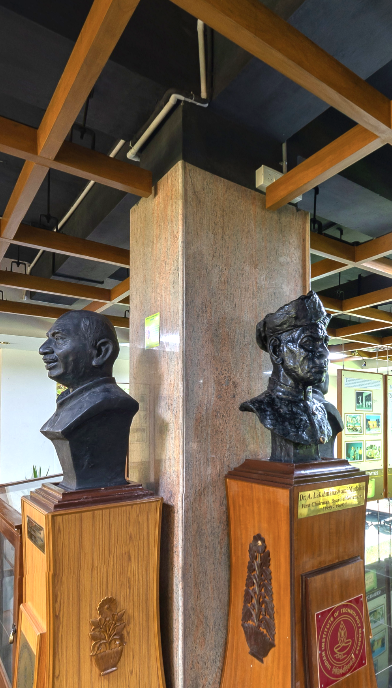
Prof. C. P. Vendhan in conversation with Prof. V. Anantha Subramanian
It's my pleasure today to have a few words
of exchanges with my dear old colleague Professor Vendhan.
So, we were not only colleagues,
I was also a student under him while I was doing my PhD
and we have come to know each other very well.
So, with this brief introduction
I would like to get this interview going,
I would like to have a conversation with Professor Vendhan.
Morning, Professor Vendhan.
Good morning. Good morning.
So, this heritage series is supposed to bring out something interesting
for the viewers with regard to your own work and background,
your interests, your experiences at IIT Madras.
So, I should start by asking, please tell us a little bit of your
background from the school days on to graduation
and how you reached IIT Madras.
Ok. Schooling there is nothing much, I come from a village school,
but then I had my Bachelor's and Master's in engineering
from the Anna University College of Engineering, Guindy,
where I finished my masters in 1970; I joined IIT Kanpur for my PhD.
And, then when I finished 1975,
I went away to United States as a postdoctoral
fellow - University of Massachusetts at Amherst, Massachusetts.
I would say looking back, my career at IIT Kanpur as a student
probably one of the best in sense, that
I've learnt a lot and the academic freedom that
I enjoyed there I still cherish that. In fact, I often repeat to my colleagues here,
former colleagues here about that environment, as it is.
So, that way I would say that in my student career that was probably
the best, the golden period.
Fortunately, I had the opportunity to visit the University of Massachusetts
as a postdoctoral fellow and all my education has been
in the field of structural mechanics you can say.
Even my postdoctoral work was in the field of structural mechanics.
Although I had some - I used to peep into other topics,
but this was primarily in the field of structural mechanics.
By the time I finished my postdoctoral work in 1979 October,
I did not want to settle down in the USA,
I wanted to make a career in India.
So, I convinced my wife who happens to be a doctor
and we already had a 2 year old daughter at that time,
I convinced my wife that we will go back to India
and then make a career.
So, we landed in Chennai towards the last week of October
wife and daughter and me unemployed and then
I was sure that I'll find some job.
So, we settled down here, fortunately
our father-in-law's house was there in the place
where I am living now, nearby.
So, they were taking care of us.
I went around; obviously, the first
visit was to IIT Madras.
I went to different departments looking for some faculty opportunity.
Then somebody suggested I should meet the director
Professor Indiresan. In fact, they gave very
nice account of him,
radical change from the previous directors.
And so, one day I dropped in there and he was kind
enough to see me without appointment.
And so, I went into his room, he made me comfortable and
it was a stroke of luck: Professor V. S. Raju was sitting there at that time.
So he told him of course, I briefed as to what I have been doing
and what I did in the United States,
then he told Professor Raju, here is an young man
why don't you try him out in your department?
Obviously, we cannot hold a contract position like now
where they can offer a faculty position,
instead they said we will consider you for a research associateship,
you put in an application.
So, I did that. Meanwhile, I also had an interview at BHEL
R and D in Hyderabad;
there was an advertisement and a friend of mine
who worked there suggested that I apply.
So, I've attended that interview.
All this happened sometime in November - both the IITM
application for resources associateship and the BHEL job -
and sometime late December 1979,
I got both the appointment orders. One from BHEL R and D
for a deputy manager with a basic pay of 1450,
rupees 1450 that was a permanent job of course.
And, IIT Madras offered me a 1400 per month consolidated
research associateship; of course, it's considered to be a temporary, uh, slot.
I didn't have much- Doubt. -hesitation in
deciding where to go
because my heart was on an academic career,
where I can do research and teaching.
So, I immediately told my wife I am joining IIT Madras;
of course, she probably would have felt happy
because she can stay on in Chennai.
Ok.
And, perhaps expand her medical practice.
So, that is how I came here and I joined IIT Madras
and fortunately there were a couple of faculty whom I knew
like Professor Ganapati. And
so, that way, I was not a total - was not a total stranger there,
Professor Raju put me on the wave- not wave energy
project - the ocean thermal energy project.
So, he said that we will form a group
and you will be coordinating it
and I also started doing something on the floating systems
for the ocean thermal energy.
So, that is how my career with the IIT Madras started
and eventually there was a faculty advertisement
and then in September 1980.
I was selected as an assistant professor and
I - I joined formally as a faculty member.
Right.
So, that is about my entry into IIT
Right.
Madras.
So, on a lighter note
possibly your wife did not mind missing that rupees 50 extra
you would have got at BHEL compared to the salary that I -
No, at that time we didn't. After all, we have come back from US.
Yeah. So, you have some greenbacks.
Money is the last thing in your mind, you know. You are right.
So, that way.
You are right.
But, my aim was
to settle down in an academic career and- Right. -so, I
didn't have second thoughts before taking up this job,
although it was only temporary;
because I was sure that I will somewhere get an appointment. So,
In the academic career.
I think on the more serious side,
I would say that you were simply driven by the passion
and - Yeah, I would say that, I mean in fact,
my postdoctoral work was in the field of structure mechanism,
where I did some work in the field of
elasticity and I also guided that 2 MS students.
Right.
And, closely associated with a PhD student.
So, that way I already had a research guidance experience so to say.
Right.
Informally there. So, that way I was
looking for a continuation of that career.
Right. So, that is how I ended up here.
As I just said I know it is the passion in you
that has made you to take on many works,
I will come to that later. So, just now I will just pick on one thing;
you said you enjoyed your days in IIT Kanpur the best
and I remember you telling
time and again during our interactions much year later,
how you used to take your assignments on term papers,
isn’t it? Yeah. that's right. That's - IIT Kanpur
at least in those days, I don't know about it now,
Yeah.
they had a good many of the
important courses like the finite element analysis, then
a non-linear vibrations course which I took.
Yeah.
And, also I did a course on stochastic
problems which was started by Professor N. C. Nigam.
Who retired as, uh, Delhi IIT Delhi director,
eventually. He also has a book on random vibrations
and he also taught Professor Narayanan, he was his PhD guide.
So, all these courses had term papers and I took it very seriously.
For example, I did a very good term paper
Professor Nigam liked it on stochastic problems,
then for the non-linear vibration problems
out of my own interest, I worked on a very serious problem.
On non-linear vibrations of plates
and that was eventually published in as a full paper
in the AIAA that is Aeronautical and Astronautical Institute of America.
Yeah.
It was published as a paper.
Even as I was a student
and I was supposed to be working in the field of
non-linear dynamics of shells,
that was supposed to be my topic right from the beginning. Right.
And, I had almost spent 2 years by the time I finished this job.
So, then it occurred to me that I will switch over to
this non-linear vibrations as my PhD topic and
from then on I took another 2, two and a half years to complete
Right.
my PhD. So, I continued my work in that field
and then I finished my... So, you also in a way
went on to work in fluid dynamics,
although structural mechanics was your
Yeah. In fact. first interest.
When I joined in IIT
IIT Madras in the ocean engineering centre at that time,
it is well known that ocean engineering was emerging
Yeah. as an interdisciplinary area and it is a combination
of structural engineering,
foundation engineering, fluid dynamics
or hydrodynamics than naval architecture.
It is not a merely a combination of
people having expertise in each of these fields,
actually every one of them should have
some basic knowledge of each of these Alright.
sub-disciplines.
So, quite early in my career there I realized that
I should learn enough of each of these disciplines.
Yeah.
And, although I was only a structural mechanics
man, that is how I started very seriously
and an interesting thing happened at the time.
One of our colleagues at that time
who was teaching hydrodynamics -
in fact, most of the colleagues were from the
SYL civil engineering department there.
Some are of course, from outside,
they were teaching for example, Professor Raju and Professor Ganapati
came from civil engineering.
One in foundation engineering, other in structures.
Structures yeah.
So, like that we had a colleague
who was teaching wave hydrodynamics at that time.
So, he resigned the job, went away to Kuwait
and for some reason Professor Raju called me and said,
you teach that course. yeah.
I said ok, I mean the traditional response
would be no, no, I am a structural mechanics man,
I cannot teach fluid dynamics.
Since, I realized that I should learn enough of fluid mechanics,
I said yes and then I started learning.
In fact, if one has good applied math background,
switching over is not a problem.
Absolutely. And moreover as civil engineers we did study hydraulics.
So, that was not out of my memory.
So, I took it very seriously and then I started learning.
Then I went through a lot of important references in that
and again another stroke of luck
just at that time that was in the early 80s I would say,
one gentleman dropped into my room from ISRO.
And, said that sir we want to do
you to do a project on slosh dynamics. Slosh in dynamics.
I said I am basically a structural mechanics man,
no sir, somebody said that there is a one
youngster who has come from United States.
You try because the people in the aeronautics
department said no we cannot do it,
we've not worked in that area, we will not do it.
And, they went to even Kanpur IIT and
there also people said no we've not worked in this area,
we cannot do it.
When he came and talked to me I said ok I will do it,
because just then I was learning fluid dynamics and I said I'll do it.
And, then they wanted to develop in a
finite element based slosh dynamics,
since I had background in finite element
I readily agreed and that is how I became deeply involved in
fluid dynamic problems and eventually it became a fluid structure interaction,
that has become my mainstay
almost the entire career;
I was pursuing that; with my earlier strength in structural
mechanics and the one which I acquired during my career
in ocean engineering department in fluid mechanics,
it became my career in a fluid structure interaction.
Great.
That is how it happened actually. So, can I also
correctly state that your development those days with
regard to this sloshing problem was adopted as a
code there successfully in-
That's right. space programme.
No, it-it-it was ironical; they came to me, they had
in-house code on two-dimensional analysis.
Right.
And, since the launch vehicles go in
In fact, they were developing the PSLV
launch vehicle at that time, you know.
So, they these vehicles will go at an-
angle yeah. - attitude, angle,
they said they should do a three-dimensional modelling.
That is how they came to me.
I did not know the implications of that.
But, I knew that I can develop a three-dimensional thing. So,
I developed this three-dimensional thing and in those days
data preparation etcetera was big pain
in the finite element. Yes.
But they did use my code...actually. Yes yes
And, then after an year of interaction,
I forgot about them and they also forgot about me.
But, then we still had a good interaction
because one of the major projects we handled for PSLV
was in the structural analysis part. Ok.
PSLV second stage,
first stage and, the fourth stage.
They had requirement for buckling, vibration
and stress analysis. Right.
And, I had an excellent partner in my colleague in
I should say former colleague in the applied mechanics department
composite centre Professor R. Palaninathan
So, I knew him before from my Kanpur days.
I know you used to go almost brothers around. In fact yeah
People from IIT Madras in those days used to visit PhD students-
Yeah. visit IIT Kanpur because we had IBM 7044,
considered to be the biggest in the southeast Asia Yeah.
for their computation. And at that time I of course,
came in contact with him and we are friends actually
that is how I came back and refreshed.
In fact, ironically I should also mention the man who introduced us
to PSLV projects is none other than Nambi Narayanan. Ok.
And, he met us in their guest house in the
Poes Garden, they had a
Ok. guest house
at that time. Ok yeah.
I don't know how he caught our names,
he invited us there, both I and
Professor Praninadhan met him there. He said so,
we have - we are now developing the PSLV technology
because, just then they finished successfully the ASLV project.
And, he said that we have a requirement for
this research analysis, buckling etcetera.
And, in those days there were no package
programmes of the kind that we have today,
they had their in-house program and
we also want somebody else to develop parallelly
so that it will reinforce the project
and some day when the rocket flies,
I want somebody in Chennai to point to that,
I have been a part of that.
No, the more important thing is
you have given a very intrinsic contribution
you know. And, we said yes and that is how it started.
Yeah. Unfortunately, I never had an opportunity to meet him again.
Yeah.
And there was a big turmoil.
Yes. And, now he has come out of that.
Correct.
Probably when I happened to be in Trivandrum
So I had tried to
Yeah.
meet him and then
probably recollect and recapitulate this early thing,
that was the only one single meeting. Yeah.
After that the other people met us and
eventually this slosh dynamic thing also it came in. Yeah.
And, to end that slosh dynamic story, year 2010
I retired formally at the age of 65.
2010 May. And then
I was fortunate to get a appointment as a Emeritus professor,
a 3-year contract first and then a 2-year contract eventually.
And, somebody from in fact,
I would say that almost everybody except from some
older people have retired from ISRO at that time.
Who were associating with me in that slosh
Right. project, you know they have retired.
Yeah. And, some youngsters came here
and then they met Professor Krishnankutty
who is a professor, who also, he is also my former student - Yeah.
PhD student. They met him and said that
we want somebody to develop two-dimensional finite element model,
an exclusive model for our slosh dynamics
with some additional analysis requirements.
Yeah.
And, then they said - he said that, oh
Professor Vendhan who did
Slosh. your
3D work in the mid 80s,
Yeah.
He is still around. So, they came to me.
So, I have been part of that project.
So, I completed that and in fact,
they are using it for their PSLV,
GSLV they were very happy with that.
And, I am still continuing
I mean, there are remnants of that project in an informal manner.
I am still continuing. Yes.
So, that is I will say one of the most satisfying interaction
Yeah, I know.
with ISRO where they were able to do that actually.
I know, Krishnankutty used to say
that he is officially the coordinator, but you were doing all the work.
Yeah. In his modesty Of course
it is usually like that you know, very often.
Yeah. For example, even the project
we jointly did for DST you know
Right yes. On the small water plane.
Yes, yes You were doing the work and I was officially the coordinator,
but then that gave an opportunity to learn I am - I am very happy
- happy to think of that Floating body dynamics and all that
Yes. So in fact, I have
Yes. I was not merely
a paper head. So to say, you know
I was learning floating body dynamics.
Yes. And, naval architecture.
So, that is an opportunity - No, but in all honesty
I must also say that when I picked my PhD problem
possibly barely consulting you,
I forayed into the strapdown accelerometers and
deriving the motions which of course,
led to so many equations to be solved to understand. Yeah.
And, I used to go around in this institute to other departments
because you were on sabbatical or on leave at that time in USA.
So, I used to- No, I - I went away to Canada
Yeah. on
So. earned leave.
You know I was very brave, but I was not
sure, if this doesn't work, what do I do. But,
there I have to say you gave me a beautiful analytical
insight into the basic problem of resolving that initial value problem
you know. Yeah, basically I all learnt it on the job.
Yes.
I never did that before actually. So,
what I would like to highlight here right now,
I know you will be too humble to state it,
but I would like to state that with your clarity of thinking
that analytical thinking, one thing we used to see
in the department faculty or students,
research scholars across all faculty
used to make a beeline to you to resolve their problems.
No, in fact - my early days as a research guide Yeah.
Yeah. in ocean engineering
Yeah. was not without any thoughts.
So, all my students need to work on numerical
modelling and theoretical problems. Yeah.
And traditionally in fact, I would say that
although I may say it at the end,
but I will say it now. IIT Madras
was an extremely orthodox setup academically and
socially also. And, over the years it has changed.
Yeah. For example, I would say that Professor Indiresan made a break.
Right.
And, a drastic improvement came about
during time of Professor Ananth.
Yeah. The liberal thing.
Yeah. He - he is the one who used to
think very liberally in an academic and
Yeah. social sense.
So, that way my early days when
this orthodoxy of academic thinking was there, Yeah.
people will say, no experiments at all in your PhD thesis?
I will say no experiments.
See my strength is in theoretical modelling.
Yeah. and numerical modelling, and that is what I will work on.
So, there is no need to have an experiment. So,
for quite some time I had this problem. Right.
Even very recently some of the younger colleagues
came and reported to me this is what they are asking sir,
I said you don't worry. You give the same reply.
Yeah. Yeah,
please go on.
In fact, as I was saying the point
to highlight was that you used to happily share your knowledge,
your insight, your discussions with almost
anybody, which we were seeing all the time
take any of our - In fact, that is, in fact
Yeah. I- I was into this culture
from my student days in IIT Kanpur-
say, IIT Kanpur had an excellent computing facility.
In fact, I used to criticise our computing facilities in those days,
it is no match to that in many respects
and when we go to the computer center as a -as a group,
Yeah yeah. we used to work on - in fact, we took a
course on numerical analysis.
It was a compulsory course for all PhD students
and, we did 14 computer - Courses.
Not courses, exercises. Exercises.
You have to develop a code and then solve an example and submit it. Yeah.
So, you can see the kind of strength
you will get if you take it seriously. Absolutely.
That is the one which really gave us an inherent strength.
Yeah. And, while doing that we will always discuss with our fellow students
what problem he is working, what
Yeah. errors he got in his thing...So,
that mutual exchange and
Absolutely. sharing of the experience
was ingrained in me even as a student. Right.
So, it came in handy - so
Right. wWhenever somebody
some PhD student has a problem or faculty has a problem,
they will come and discuss with me. I will
in fact, very often I say that I may not be in your field. Yeah.
But, then the very fact that you discuss it with somebody else.
Absolutely.
will probably tell you Probably some
of the thoughts. Where you have gone wrong.
Yeah. So, I
used to give a passion sharing. Yeah.
Sometimes I learned from their experience.
So, that has been one of the good experiences
Yes. I have been having in ocean engineering.
I- I would put it that you are a
beautiful example of how to share knowledge because,
when you share knowledge you are not just giving,
but you are also getting as
That is right, it's mutual. there is a saying.
And for me that has been an example in my mind all the
time which is what I have also tried to do in mind.
In fact, I have never been very protective of even the codes I have developed.
Absolutely, I know that, yes I have always allowed people to use it.
Yes.
Even without acknowledgment, people have used it.
In fact, I am happy that somebody is able to use it.
Yeah. And, I am able to see the strengths and weaknesses
of the code that I have developed. Yeah. And I can improve on that
basically, that is the kind of thing I have done. Yeah. That that requires
a great courage, you know, to be able to say
try working then let us see if there is any flaw and we grow better out of it.
Yeah, rather than thinking that this is my code I cannot share because,
why I say this is it often happens in the
academic intellectual community that many people
take a disproportionate sense of possession of
what they are. Yeah. Unfortunately, I used to
criticize them, Yeah.
our colleagues, Yeah.
that we are unnecessarily very possessive. Yes.
I mean at least in the field of knowledge you need not be. Yes.
But, that has been the, I mean
I don't know by training or by nature. Yeah.
Many people have exhibited that kind of
Yes. possession you know, it is not good actually.
Which to me is not the true sign of knowledge. Yeah.
Because, knowledge brings humility and you are a good
person - personification of that
Thank you. which I would like to put here, yeah.
Because coming to these projects, I probably would like to say a
few thing about the projects I have done.
In fact, I have done a very modest number of projects
only, unlike some of the colleagues who have been
very very active including you.
In doing projects, in the ocean department. Now, you are putting me in light.
I have done very modest number
of projects and fortunately this has been
only for ISRO and the DRDO.
Yeah.
These are two major agencies for which we have worked
and ISRO I have already mentioned about the PSLV thing.
Right. We worked for about 5-6 years.
Although they were meant to be consultancy
projects, they were actually research projects
because they were spread over 5 years.
So, that was one successful project
where we were happy to see that it's being used.
Right. and you see things flying. In fact,
I think about 4-5 years ago there was actually one PSLV flight
the trajectory was oriented towards Chennai.
And, as I was going home around 4:30 in the evening,
I actually saw the thing; I was reminded of
Nambi Narayanan at that time.
Until then I never had a chance to point to the skies.
So, that that was a good thing
and the the next one was in the early 90s.
I think when Professor Ravindran
was the head of the department,
I was abroad with my family in Canada,
Toronto, Canada. I was not here and Dr. Kalam
who was the director of DRDO and then RCI. Right, right.
He was the chief guest. Yeah.
And, he talked to Professor Ravindran, he said
is there anybody who was worked with underwater things and all that.
He mentioned my name because I did a project earlier too.
The in fact, I was working with the Prithvi missile project.
Short project with that. Right.
So, I had some association with DRDO.
So, he mentioned about my name and Professor Ravindran.
He said, why don't you visit - all of you visit me in RCI Imarat
which is adjacent to DRDO,
we have something very important in mind.
We went there, I think it was probably a Saturday, I remember that.
So, the officer looked very deserted.
So, he said that we are now embarking on an underwater missile project.
It is a classified secret project.
And, we want you to work with us and then
fill up - DRDO is doing and they are only air missile
group. Right.
And they know nothing about underwater.
So, we want you to help us,
we said yes and then immediately said that.
In fact, he immediately he typed out the offer letter to us.
And, he read it and he found there was a spelling error,
he went in, he himself had typed it, corrected and typed it.
And gave it to us. And, he instructed
the one Kukilia was there,
he is no more, who was the project
manager at that time of this particular project.
He immediately said that take them to the launch site in Balasore
now itself, and then let them stay overnight,
look at the facilities. So, we did that: we
flew to Nagpur and then from there by road we went there,
stayed overnight, looked at all the facilities there.
And, then came back, that is Professor Ravindran,
myself, and Professor Chandi.
And, then we were on it and in fact,
for over 2 decades we worked on that
problem, the various aspects of it: the hydrodynamics,
Yes. data analysis, the stability...all that, you know.
Yeah.
And, they were constantly posing as a
problem and we have been working on it.
I mean for administrative purpose
it was probably divided into many projects. But
it was a continuous one, we worked for almost for 20 years.
Yeah.
And that was an excellent experience for us and then in fact,
they were very happy and they gave to this team
team consisting of Professor Chandi. Chandi
myself, and professor. Yeah. Battacharya.
In the year 2011, they gave an award called the
I know, I know. Academy excellence award, that was probably
the second year that was instituted. Right.
And they were very happy with this collaboration and that I would say,
in fact, now, it was much later it was made public,
the government acknowledged that we have an underwater
missile project which will be launched from submarines
particularly the nuclear launch submarine,
but at that time it was just a having a code called K 15.
I see. And that is what we are working on and that
I mean, matured into a real this thing.
So, that was a, in fact, a very Yeah.
I mean satisfying experience,
I mean at least you can say. In fact, when I left USA
only the Indians, Indian friends
used to ask me, you are going back to India,
leaving this career here. I said yes. Yeah.
And now, once in a while I hear some people used
to say when when I tell him during discussion I came back
from USA after 4 years of stay,
why did you come back?
So, I used to tell them, you see the kind of projects I am now working on.
Yeah. The PSLV and the underwater missile.
So, it gives me great satisfaction so, Yeah. Maybe
if I had remained there, I probably would have published
many more papers. Right.
Definitely I would not have this kind of a
satisfying experience. Satisfaction. Yes, yes.
So, that way I would say that that is the another
long term project in which we made
A mark- and enduring contributions and-
it was recognized by- from the Yeah, recognized, it was recognized.
But, we probably would not have bothered about that
I mean if there was no recognition, we would not have bothered.
The fact that something is flowing Yeah.
I mean flying
Yeah. was recognition enough for
at least for me. I know.
I would say. I know that.
I mean what you said is correct. Yes
Because, around that time, that is probably in the early
2010 or something like that, you know, I used to see some
emails floating around among our younger colleagues.
Yeah.
That agency like DRDO is getting a lot of help
from us and never acknowledges us,
so, you better be careful and all that. Ok.
I always thought it was misplaced. Right.
The satisfaction you get is what you have developed. And, then Yeah.
you see it is being used basically, you know?
The next project, yeah No, I just wanted
to emphasize because it's so important because in India
as I have seen it, our level of self confidence is sometimes in question.
We need the other person from outside the country to be- Yeah.
-to tell you oh you have done good work.
So, the recognition never comes from within till
That is right, yeah. somebody else outside tells you.
And, now there is a new culture they have yeah. We should change that.
And, it's important and I think these two
works you have talked of the sloshing dynamics,
spacecraft related and the missile programme related;
see, it is a beautiful way of developing our own confidence.
That is right. So, I think this message should go through this interview
that we need to build up that self-belief and self-confidence Yeah.
while still being rooted with humility
Yeah. and being open to questions.
I say this because I feel I see all these qualities in you.
This is not to put a word
Thank you once again. but to say that
this is so important for the scientific temperament,
not to hide things and also to be able to be open to questions
and to have the willingness to exchange and help others.
Yeah.
Yes, wonderful.
The two more projects, I will just mention before we go on to other points.
Yeah.
The third project we handled, it's not chronologically ordered.
Yeah.
The so-called tow transmitter body for the NPOL.
Right.
They want to tow a body underneath, it's about a metre long.
The towed array.
That will have.
Array was not in our perview. Yeah.
It is the towed body. It will send out Yeah
sonar signals. Yeah.
It will bounce on a target and the array behind will pick it up.
Right.
So, they are developing that.
A detection. It was a unique project in the sense,
they just gave the size of the body.
Right.
And they said that you develop everything,
the hydrodynamics of it,
the structural analysis, design
and fabrication. In fact, we have...at the
end of the project we have to deliver them the body.
Right. So, in that sense it was a total project
and again we as a team: Professor Chandi,
myself and Professor Bhattacharya, we worked on it.
We did a lot of hydrodynamic model testing
and a structural analysis and then design,
we engaged an outsider to do the mechanical design.
And the team did the fabrication using
titanium, that is what they wanted.
And then it was delivered to them,
again it was stretched out to about 3-4 years
and it was successfully towed. Right. In fact
it was stored in a project called Nagan
and even now I look back whenever I visit NPOL
and then, in a big group
some higher-up or this thing when I am introduced,
they will say they are the ones who did that Nagan body.
Yeah.
So, that kind of a recognition was there. Definitely,
yes. I mean that was fully satisfying that you have
done something which is working.
Right. Of course, now they are onto a bigger body and then
they are trying to make it work. Yeah.
So, this is another thing and in the year 2010,
when I started my career as Emeritus faculty,
interestingly, the ISRO came back to us again,
they said we are working on the so-called
human space programme, at the time it was called like that;
because the government has not formally approved a project on that.
But, they were developing in-house technologies,
different components of technology - that is how they work.
Right. They first explore the different technologies
and in-house projects, they get approval and then do that and then finally,
an entire mission is put together.
It is only recently as you must have seen
the prime minister set a target that in 2020 you should Yes.
just fly - this thing and this was called. Nagan mission. Yeah.
What is that called - Gaganyan.
Gaganyan.
Gaganyan mission. Where they will put a human in the...
Space and- An important component of that is a capsule.
Capsule. Capsule in which two astronauts will
Yeah. fly and go into orbit.
Right.
And, ISRO wanted to test
the impact dynamics of that and the hydrostatics of that.
The reentry.
Reentry. Yes.
I mean it will come under. In fact, they were working
on the American concept.
This is a conical shell.
And, the American concept is that will
it will be parachuted and it will come and impact on the-
unlike the Russians where it will land Land on ah
on earth. dessert.
This will land on water.
Yeah. So, they want to study the impact dynamics on water.
We said ok, we will do that
and we did scale model of that, we did impact test in our.
basin.
Basin. Yeah.
And then I developed a,
in fact, at that time they also wanted to test
the hydrodynamics, when this is floating.
and, exposed to wave, they wanted to find out whether it will topple.
Yeah.
They want to put some buoyancy spheres, Spheres.
whether it will topple and go down or how long it will remain there
Yeah.
until a rescue team.
Comes and- goes and picks them up.
Yeah.
So, at the time I had two choices: one choice
is to buy an expensive software to do hydrostatic analysis.
At the time ocean engineering
field there were some softwares available.
Probably 7-8 lakhs, if we bought it or if they bought it,
it would have been much more expensive. Yeah.
But then I said that I will simply develop a code from first principles.
So, I developed a code for hydrostatic stability.
Alright.
And, then I attached this spherical modules.
And, then we were testing, we just a
plotted the entire - calculate the entire
writing moment versus inclination angle.
And, then pinpointed
the hydrostat- hydrostatic stability characters of that. Yeah.
So, these two things were done and then handed over to them.
So, they were happy at least, the hydrostatics part.
I don't know, now they may be buying a software and doing it. Yeah.
But we made a simple in-house software
and then we handed over to that.
So, that was probably the last project I handled.
In my career and then my
stint as the Emeritus professor ended in 2015.
Alright.
And, then I was formally retired so to say.
Yes, but of course. And, I still continue of course.
You would not retire
you must be still going on I still continue, there is one PhD student.
yes. working in acoustics and then. Yes, yes.
Wave-guided acoustics of course. Yeah, yeah.
And, then I also spent some time in the NIOT group.
Yeah. In fact, that is what I wanted to also In addition
to being in the review meetings, Yeah.
This is an actual hands-on work. Right.
In fact, I am a person who believes in working with my own hands,
whatever problem I take I would like to make a model and then implement it.
Yeah.
Unfortunately, now that the skill is lost
because people develop skills in developing
in using canned programmes.
I. I don't have any complaint on that,
but as long as you use it wisely and intelligently, that is fine
because you cannot develop codes like that now.
So, when codes are there should do that, but then
I am bred in that tradition because
when you are students, there are no codes available.
So, you have to develop a, learn a numerical technique,
develop a numerical model,
code it, debug it and then test it.
Yeah. So, I was bred in that tradition,
I am still doing that and then that is what I am doing even for NIOT.
I am making small codes so that they can do it, then I told them that
I will tell you how to use the canned programmes using this as an input.
Right.
So, that is basically what I am doing. So, I am
still continuing that I am happy about that, I am still able to
healthy enough to continue that work.
I think it's also very fundamentally
important because the moment we lean on somebody,
then we are going to pay a heavy price.
One is, our own development will stop.
That is right yeah. will depend on that, the second is
these black boxes will never tell you what are the limitations in them.
Yeah, that is right. So, unless they come out with the better version
when they will say this is better than the old version.
No, limitations can bebe appreciated if you gain the expertise.
Expertise.
But, to some extent. In fact, I always say this.
Yeah.
The package programs give you an excellent
opportunity to become an expert. In fact, that is how I learnt
a lot of finite element modelling.
You can experiment your thoughts and then numerical models
using a programme that is already available.
It also...the other flip side of it, that also makes you lazy.
Yeah. If you know how to prepare the data, you will get your results
and, then pull on in your life. Yeah.
So, these are two - Yes. Sides of that
and perhaps people should use the other side of it
Definitely. you know, then you become really expert
Definitely,
no doubt about that. You learn the basics and then
look at the code and then what it does just go into the-
In fact, I always tell them whenever you want to use a code,
read the theory manual first
and the references that are given in that
theory manual that is how you become an expert in that code. Right, yeah.
Not just by making data and then getting a result out of that.
Absolutely, I wanted to get down to some other things that is
yeah you are talking of your interactions with NIOT.
Yeah.
You have perhaps handled some projects for them also.
in the course of development. Basically, in the field acoustics
Because. Professor Bhattacharya was the major thing in that.
But, I have been mainly reviewing things for them actually. Ok.
I was also sharing their acoustics group and then reviewing projects.
Yeah. And now of course, in my I mean hands-on
capability I am helping their deporter I think as it is.
Ok. But, then my interaction with them has been very
heavy. In fact, some of the senior people there
I have been in their recruitment interviews.
Yeah. So, that way I have a longstanding this thing.
Correct.
And, in appreciation of that they've also given
an award in the year 2015.
Ok.
The Ministry of Earth Sciences they gave an Right.
award, that is the Outstanding Ocean Scientist of the Year award.
Great.
I think Professor Ravindran was the brain behind that.
Yeah.
So, they gave an award, uh, That is wonderful.
to recognize that as it is.
Yeah. Yes. So, I continued to interact with them. Because they are very receptive.
So, I am happy as long as you make me feel wanted,
I am willing to give my Yeah.
knowledge and expertise
irrespective of the, I mean, rewards and
I am doing that still actually.
I have, let us talk of some other things you have
done at IIT Madras besides the teaching and research and projects. Ok.
What they call as the corporate life you know. Corporate life
as you were drawn into it as- I mean because of the
formal procedure, I became the head in the year year 1997 I guess. Yes.
I would say candidly that that was very uneventful,
I mean there is nothing much for me to do.
Yeah. Except that we were focusing on maintaining our
test facilities, excellent test facility that we have had.
Yeah.
And, when it was over sometime in year 2000,
3 - 3 years stint you know and I don't know,
it was a very strange thing; Professor Natarajan was the director at the time.
He called me, I don't know who gave him that advice,
I mean I was known as an academic entity rather than
a corporate entity. And a little bit
candid in some meetings of course.
Yeah.
And, everywhere I stress the need for basic
research and then Yeah.
support for that and all that.
For some odd reason, I don't know who gave him the advice,
but he called me and said would you like to take up the
Chairmanship. Chairmanship of the
Exchange. Exchange works committee.
Yeah.
For something again, I didn't think twice. I said yes.
Good yeah. Although, I would have repented
that in a lighter way in you know, as I went along. That was a 2 year thing.
Yeah.
But, I would say that I enjoyed it,
in the sense that I am basically a civil engineering Yeah.
graduate. So, the civil engineer in me has
come out I think when I was sitting there.
Right.
I was able to appreciate what they are doing and then correct them,
Right.
as it is, and Professor Natarajan was very very supportive.
Right.
That was a period when we took up large
projects in terms of renovating the buildings. Right.
Both in the institute, rather in the institute,
the quarters, as well as the hostel side, you know.
Yeah.
So, I was a part of that, that was a hectic task, handling lot of contracts.
I also brought in computerization of the design office. There
Right. We brought in a - we bought design projects,
design software and Right.
then we also had
The transition for the manual. bought some computers
Yeah. So,
I initiated that. And, we also inducted Yeah.
quite a few people into that. Right.
There was a dearth of this thing
and Professor Natarajan was very insistent
that our campus requires a cleaning, it has never been done.
So, I took it very seriously and then there was a
French company called Onyx.
Right. We got the contract.
Yeah.
And then, they did cleaning of this one.
In fact, I used to say with pride that I walked in
almost every dirty corner of this campus,
along with the representative from Onyx
to point him what cleaning he should do,
because they always charged by the weight.
Yeah.
I mean he will collect the trash
and then they weigh it and then IIT has to pay per ton, Yeah.
a few thousand rupees you know. So,
I did that, I took it very seriously and
a lot of people probably knew about me, the campus people
mainly because they would have seen me in the
hostel sector everywhere. Yeah. In the shopping center,
I will go to the dirtiest part and say remove all this dirt and then clean it up,
I did that. I also took up this lack of
serious water supply infrastructure. Right.
And in fact, we suffered and lived through that.
In fact, during my stint as the chairman, we had one of the worst
water shortages. We went through really - in fact,
some of the people still remember the
kind of things we have done in those days.
Yeah.
And, also our sewage treatment you know. Right.
That was also very dismal. Talking of that I remember,
you took the steps of deepening the lake.
Yeah, at that time.
Because of water shortage. You created a
supplementary artificial lake?
No, we had an oxidation point for name's sake,
nobody ever bothered about that. Right.
There's an open channel that will lead
from the campus to the Buckingham canal
via the Tidel park.
It was an open channel which was not kept up and of course,
near the Tidel park it was underground
and its oxidation point was was terribly outsized
because our campus size,
Yeah.
population has increased quite a lot.
So, as a civil engineer I thought we have to focus on that.
So, I convinced professor Natarajan to give Natarajan
funding. So, we built two large sums-
one in the institute area, one in the That is what I am saying.
Then we convinced the Alumni to
fund one of the overhead tanks in, near Mandakini. Right.
Right.
And, more importantly we have simply
closed that oxidation pond, instead dug up two bigger ponds.
And, then we also put entirely underground
some 1 or 2- 2 metre dia - pipes.
One and half metre I think pipes,
all the way from the edge of our campus to the edge of the Tidel park Right.
to carry this effluent of that.
And after that I think people in the environmental
engineering, they have taken that and then they have
put a new treatment plants and all that. Yeah.
Yeah, more modern treatment plants and all that. In fact,
I look back even when I happened to meet any of the
engineers in the engineering unit,
I make it a point to ask them. Yeah, how is it doing yeah
How is it doing, what improvements you have made. Yeah.
And similarly in the water supply side apart from this
I used to ask them what kind of chlorination do you do?
They said we use chlorine gas.
And, then if you may recall that once there was an accident and then
Even Vana Vani school was closed because, it was close by
where they are doing something.
As it was a foolish thing that we have been doing.
Nobody ever bothered. Basically,
it is a foolish thing that we have been doing.
And, then there is what is called hypochlorite solution
which is about 5 percent or 7 Percent. Yeah.
and that is what is usually used. And, then
they have switched over to that and they have
installed a plant which will inject
this hypochlorite solution and I assume that they continue to do that.
See, some of the things which I took out of my own interest,
but then I convinced Professor Natarajan to fund that.
And, then he had again like cleaning the campus,
he had the initiative to start the survey of the campus.
In fact, many of you must have seen those nice colour
huge maps at the road. Created, yeah, yeah.
So, this survey was done during that period. Ok.
And, we engaged a company in Bangalore. Right.
They did a modern computerized survey and then
And, created those maps. this one and then they handed over that
data. And, now they have put that in that
map in the digital form and then that continues to be used as it is.
Alright. So, that also happened during that period.
Right.
So, that way, there is a wholesome you can say in addition to renovation
Absolutely. we also modernized many of these things.
Yeah.
I-I know. So, that is that being continued now
actually. Right, in fact I remember because I was the warden of Alak.
Ok. And you gave me unstinted support in doing many things there.
Yeah, that is right Those days, putting wonderful
flooring for the mess room etcetera. Yeah,
that is right yeah Was not done yet,
but you gave me solid support, we could execute.
So, that is this 2 years as a SA chairman. Yeah.
Was a total this thing on my - drag on my academic career.
I actually did nothing.
Because most of the time I used to spend there.
Ok. But, then at the end of it I said ok,
this 2 years is well spent.
Yeah. I can always now revive my academic careers.
You have. You have less left there No problem. But, then I did something
Yeah. That is worthwhile and I can look back.
Yes.
Even now you can see the imprints of that
as it is. People have. You have a lasting
imprint in the whole campus. Yeah and
then people have continued on that you know. Yeah.
So, in that sense I would say that that was a 2 year well spent.
Although, it was non-academic and then.
Nothing. In fact,
immediately after that career, fortunately
Professor Ananth did not think of extending that,
I don't know what I would have said. And
my wife said that at the end of that no more corporate
assignments. By that time I had
to move out of campus because my wife left her job here. Yeah yeah.
So, I was commuting every day towards the end of my chairmanship.
And, one day when I was driving
when I was near the Mount Road during a -
Professor Ananth called me in the midst of dean’s committee meeting.
And, said there is a proposal that we
offer you dean administration.
And you refused. And immediately I said no, no, no.
Because what my wife said was
fresh in my mind.
So, I was You were allowed to refuse, is it?
conscious enough what to
say no and then fortunately that was not Ok, yeah.
revived.
Right. So, to say as it is.
I just wanted to put it on record again because, if you remember
the club staff club when I was also the professor Yes,
you did a nice shed. You gave me wonderful support.
Yeah, I wish that they had continued and then Yeah.
that has been alive.
Yes. But other for some reason
I mean We made a nice little kiosk there and. Yeah.
In fact, during my time Yes.
there was also a strong proposal to
demolish that shopping center, old shed and
Correct. then do that.
Correct. At that time, I think the funding
position things like that. Yeah, it was
People deferred it. Yes, yes.
And, eventually it-
It was. I am glad to see that it has been done eventually.
Yes, that is true.
So that's wonderful and I just wanted to touch upon one last thing there.
Let us come to the - you have seen a generation next generation of faculty,
younger elements Yeah. In fact, I have I would say that to summarize
this the entire stint Yeah.
of year 1980 to 2015. Yeah.
Initially, it was started with core faculty drawn
from mostly civil ah. Civil. Background
and fortunately in 1982,
you were part of the Naval Architecture group. Yeah.
With civil engineering at that time.
We had a very lively time. Fortunately, in 1982
Yeah. it- it has been annexed or amalgamated
Amalgamated. with
The-I think that was a wise thing so. Yeah.
We became richer by that experience I would say.
Yeah.
The knowledge of- Combining.
Naval architecture you know, Yes.
came to ocean engineering and then
the next generation faculty started
Yeah. coming in because the faculty who have been
trained in ocean engineering itself, either PhD or
postdoctoral work. Right.
So, that has been a good break from the past.
So, that was a positive thing. Yeah.
And you know, in fact, I see them most of them doing very well, extremely well.
Alright.
And, that tradition is continuing and fortunately Professor
Anantha started a tradition, that he will do recruitment
frequently and that is being continued now.
Yeah.
So, that we are able to get a fresh young talent into
our thing and also they had this contract appointments. Appointments.
So, I would say that this, ah,recruitment process
has really renovated our faculty thing what started as core
old timers who will be trained in the ocean engineering.
For example, I would say that I am
trained in ocean engineering, I learnt in ocean engineering on the job.
Yeah.
In fact, I used to joke sometimes
IIT has been paying me the fair processed salary
Right. for someone who has been only learning on the job.
In fact, I would say that the best thing I enjoyed
in my career is learning.
Yeah. That has been a continuous process for me, even today I do that.
Yeah.
So, that way most of the people earlier
were learning on the job. But, then
maybe beyond 1990 we started
recruiting faculty who were actually trained in hardcore ocean engineering.
Yeah. And, then that has been the greatest strength I would say
Right.
that has happened to our Yeah.
department. But, talking of
a teacher learning I think it's a very honest statement if you say
that a good teacher has to be a good learner all the time. That is right,
it is very very important. Yes,
yeah. Otherwise you get outdated in no time.
Not only that if you start
believing that you know everything, then you stop learning.
That is right.
So, I would say the ability to say
'I don't know' is a very important thing.
Yes. This is what I tell my students, I - I do hope you agree with that
philosophy. Yes. In fact,
you - I might have to said I don't know in my early part of the career. Absolutely.
At least when I came back after the lecture,
I would recall yes I did not know this.
Yeah.
So, in the next class I will definitely-
go back and tell them that. Yeah. So you learn and get
Better. Better and yeah. We do that in fact.
Would you like to, I know you wouldn't want
to give a word of advice,
would you like to give a word of advice to young faculty
from all your experience? No, basically what
I used to tell any faculty. Yeah.
If you think that you have strength in a particular discipline,
Yeah.
you continue in that one because, do what you do best.
Yeah.
But then, do things that have a high degree of difficulty
that I will give you the maximum satisfaction. Satisfaction.
Do not worry about the - take criticism
strikely and then you continue, if you do very good work.
Yeah.
Of high degree of difficulty, Yeah.
it certainly will bring fruits.
So, don't worry about that. Absolutely.
And, of the new crop of people who are using all these canned softwares.
You cannot escape that.
Yeah.
Because, that brings in the wisdom and hard work of
huge number of expertise-
Right, right, right. - experts, basically.
So, use them because that is the best way to use them for refuel problems.
Yeah.
But then, become an expert
Yeah. in using them and not merely a user.
Yes. That is another advice that I would like to give
So, that your conviction grows to the youngsters as it is.
Yes. So, that way you can - when a new version comes in you can really appreciate
Yeah.
what is the difference and in what sense it is a better code than what
you already been using you know. Yeah.
These are probably true advices I used to always give the youngsters.
So, I would like to reinforce that I think that is very
important, I absolutely agree with that. idea, yes, yes, yeah.
There is one more thing which I wanted to touch upon which I left out earlier,
your stint with the naval research board
as chairman of the hydrodynamics. Yeah. In fact,
I remember in our work with DRDO,
Yeah.
I remember that in one of the review meetings in DRDO,
conducting DRDO, Dr. Kalam simply walked in.
And, then he said that he was a very informal man,
he said that we want to set up a center.
of excellence which will do hydrodynamic research.
Right. Because DRDO they - is going to develop
more and more, this underwater missiles and
we want to learn underwater Right.
technology and develop it.
And, after coming back Professor Bhattacharya and I
put together a small document
where we can set up a centre in the ocean center.
Centre of excellence and the funding requirement things like that.
And, it was probably lying with the government for some time.
And a couple of years later
maybe at the initiative of Dr. Kalam himself,
the government came with a proposal. To set up
this, I remember one Dr. Siddharth discussed that
in the - our IC and SR building
in the new NIOT that has
just started, it started here.
So, he spelt out the goals and then
Oh. the panels they are embarking on, and things like that.
And, Professor Ravindran has become the head of the so-called
hydrodynamics panel.
Right.
And, I was a panel member at that time Yeah.
as it is and then we
when he eventually relinquished that and became a chairman of the board,
I became the - Head of the - Panel head.
and then I had the opportunity for about 6 years or 7 years.
Yes.
I was managing that and then
reviewing the new projects and then reviewing a project progress.
So, that has been again a great learning experience, I would say. Yeah,
I would like to ask one question with reference to that
because you always had the philosophy, correct me if I am wrong,
that research should be open ended.
Yeah, in fact. It's not just my philosophy,
the - Dr. Siddharth when he spelt out this,
if you go back and read the
the naval board or research document objectives, it always says that.
Yeah. It should be open ended.
Right. It should be high end.
Yeah.
It should not have any immediate application,
it should have only long-term application. All these are
spelt out, although now there are forces which are That is what I am asking.
pulling it away. That is why I am asking.
But, this is what -ah- has been spelt out there.
So. And, we often - whenever I recommend a
project with - people sitting there try to cut it
short and then I recollect and then reinforce that
goal and then we always encourage Yeah.
this open ended, Right.
high degree of difficulty projects as it is. Yeah,
because as you said now, there is a slight
change in that thinking that they want it also to be application oriented.
So, my interpretation is the difference between science and technology.
That is right, yeah. Because, you need to have their technology
for which you need the science, to understand. Yeah.
So, I-I would then say that don't we need to guide
But, I think the-the-the members. In fact,
if you remember a new panel was started in the field of hydroacoustics.
Right. Hydro and vibro acoustics.
Yeah.
So in fact, I took that initiative
a few years ago, but the main support came from Dr. Bhujanga Rao.
Yeah, right.
He was the director of NSTL and Yeah.
then eventually became director general of naval systems.
So, he always sits in the board meetings.
And, in one of the board meetings I made this proposal,
that it is a very important area and very few people work.
And, if you have a panel we can now try to enlarge that
and then he readily supported that.
And, then I went through about 2 years of exercise
making presentations in different groups and then I finally submitted that
and it was approved. And, eventually
Professor Bhattacharya is now the panel head;
I am of course, I am also a Right.
member there, reviewing projects.
So, I tell him that whenever you attend the meeting
please look at this tendency of the people to
pull you back to purely application oriented projects. Right.
And, then tell about this this thing maybe
they have a point that we have been in existence for several years
Yes. so, there will be some application, that is fine.
Right. But the main goal of open ended, high-
Is to get the fundamental research. take a research, should never be diluted
Yes, yes. you constantly put forth this point and hopefully you will continue on
Yeah. at least some few more years with that goal
in our mind as it is. Right, I also
want to bring to the viewers one other another aspect in you,
you have a wonderful sense of humor
Thank you.
Which I have heard from so many, very
intelligent jokes that would come out.
Let me just share one which you will also remember,
you know there was a time when our road had
little, little potholes and what not and of course, the city roads
are far more beyond control.
So, there were as usual our IIT colleagues
mouthing loudly how to maintain the city roads.
So, you told me very nicely
we cannot manage our 10 kilometers of road and we are
telling them how to manage the 100s of kilometers outside
I-I like that down-to-earth way of- No, even
sitting in the engineering unit as a chairman, Yeah.
I always used to criticize those people.
Yeah.
We have a small campus and a big setup
With lots of money . we still find so many shortfalls:
leakage here, pothole there, that is just not possible. Yeah, yeah.
I mean we lack something somewhere. I used to tell that actually.
So, like this there were so many other jokes I remember
which was always fun you know, cutting across barriers. And,
the most important I would like to again record is your
absolute down to earth humility,
the openness, the willingness to interact with anybody
at any levels and absolute gentlemen.
Thank you, maybe I will close with an anecdote.
Oh, Please.
Perhaps it is for maybe two of them for for a record's sake.
You know early in my career as I said
my students work only on numerical modelling.
Right.
And, we had only the so-called IBM PCXT and AT.
Some of you may remember that.
The tabletop computers just came in. Yes, yes.
PCs came in and we were having only - XTs were a lower end and ATs were
Yeah.
And even if you have in fact, we had only 1 XT
in the entire department. I know.
It will work all the 24 hours.
And, my students would do
photon coding, large-scale photon coding. Yes.
And, they were discussing - M. Tech students of course.
Yeah.
They were discussing among themselves,
hey, does your guide know any coding at all?
He is asking you to do so many codings.
So, he was not sure and in one of our meetings
I mean, since I was open with the students,
they never had hesitation to tell this to me.
So, I said that I have done a
lot of coding right from my student days. So that
I do a lot of coding, although
I know that some of my students do better coding than me.
Yeah.
But, I have done a lot of coding. Yeah.
So, I told them that and the very first visit to IITM
campus, looking for a job after I came back from USA,
I went to the director’s office,
there was the director's secretary; I forget his name.
I told him that I would like to meet the director,
he said no, no unless you have an appointment you cannot
Meet him and you cannot get an appointment in the near future.
Then I went out and then took a slip
of paper and then I said that I am Dr. C. P. Vendhan,
postdoctoral fellow University of Massachusetts, Amherst.
USA, I wrote it and then I gave it to him.
He looked at it, immediately he took inside.
And, he said wait for some time,
he will meet you. You got your appointment.
I got my appointment.
Because, of all your - And, then I started my career.
right right.
I -I don't know whether whether it I would call it as a bluff or a
true thing. Definitely not a bluff
But, that is what has happened actually. Yeah,
that is wonderful yeah. So, it's been so, nice talking,
I-I think we can conclude at this stage.
Thank you so much.
Thank you. Sir, can I ask for some questions.
Sure.
The - you said that 83 some,
it was some funding was came to me, ocean engineering part
I remember 83 silver jubilee year,
the director signed agreement to Germany for about 6 major projects.
Yeah.
One of your project season was in my field. It has Ok, ok.
ocean engineering, material science, and about three others.
In fact, why I am asking is I think that was the time when the Germany
started funding the ocean engineering. Yeah,
they gave a large chunk of money too. And, do you remember how much
funding? I don't remember the amount
probably. Maybe 5 million Marks or something right.
Yeah
In fact, almost all the test facilities- Something of the order of 5
million Marks, is what I remember. And, who was the coordinator if I make any
It - it was I think, Professor V. S. Raju and Professor Ganapati
were the main people who are handling it.
We were all working for it of course.
But, whatever you see there by of waymakers
- waymakers and all that,
they all came from German funding, actually and-
Since you are working with the ocean,
you know long long ago over 60 years back
looking at the article which appeared in one of the journals,
I wrote an article: Chemical wealth in the Sea.
The idea was how do you recover magnessium and bromine
Ok ok, that is deep ocean mining, yeah.
Does your department have any interaction with the CSIR land.
No, actually, the NIOT you know, national ocean technology
has a department working on ocean mining.
If NIOT. NIOT they have done great strides,
they have recovered sample, they have a crawler.
And, some of the colleagues in ocean
engineering department work with them on different aspects of that.
They work for some chemicals. Yeah, in incidentally I am now
a consultant just for a short while, working with them
and, one of the problems I am looking at is pumping of the slurry,
all the way from the seabed to 5000 metres up the surface.
And, I am trying to advise them on who can do that
hydrodynamic problem and also this deep water cables, etcetera;
I am helping them with that, but they are the ones who are doing work.
I see. Ok of course, they have collaboration with NIO Goa who have recovered samples.
But, these are the people who actually put crawlers
on the seabed up to about a 1000 metres they have put it.
Now, they are trying to increase on that, they have done
pumping from about 500 metres already.
They want to now increase it to about 1000 metres,
they are doing it step by step.
They are the ones who are doing hardcore work in this field as it is.
And, Professor Indiresan saw me in your department after the retirement.
Yeah, he had this soft corner during his term here as a director.
He had an - Professor Raju had an excellent rapport with him.
I know. He had the soft corner for our department.
In fact, he used to visit us frequently and even after
his retirement he had a - a honorary professor rather
as an appointment as a Professor with our department.
I would say that it is his blessing
that really helped the ocean engineering department
or center at that time to get a large
chunk of German aid and then also give priority in
many other things. -department here.
In fact, people like him also had the opportunity to visit under that grant
and spend an year in different German universities.
Berlin, yeah.
And so, the German aid is
was an inseparable part of the ocean engineering department I would say.
In fact, I must be thankful to your department in the sense in 1988,
I was already the chairman of JEE
and then I had to hold conferential meetings
and I could not think of coming to this place and hold all the way
from that place. So, the ocean engineering department I think
who was the head of the department
and they gave the conference room. Room.
The entire conferential work, I - we got it done. Yeah.
In fact, I am reminded since you mentioned about JEE,
I am reminded of an anecdote. We go there for counselling
Yeah.
on behalf of our department and a couple of times I have been there.
Right.
And, generally I will be very honest.
I would not think I am coming from
Ocean engineering, they will come for NIOT,
I mean naval architecture councelling
and if somebody has a very good
admission in some other good institution like Anna University etcetera;
I will advise them honestly that,
I will tell them the pros and cons and I will advise them
that that is a better opportunity.
And, about I think in 27, 2007 or 6,
one dual degree student who worked with me for this project.
On the day he finished his viva voce exam on his project,
he told me, sir do you remember you adviced
me on the day of counselling.
I and my mother were there, I had a
triple E admission in Anna University,
you advised me seriously to join that,
but my mother said IIT.
I have to be in IIT, at the only branch I would get this ocean engineering,
I mean naval architecture and then I am here.
So, I was really
I mean surprised that I-I never remembered that.
But, I have been generally very honest,
I-I would not mislead him saying that I-I also tell him,
you want an IIT stamp, be here.
If you want a-a good branch etcetera,
if you are very particular about that take that, if it is in a good institute.
Can I say that the ocean engineering department,
it is a department of I can say applied work,
most of the thing is applied work. Yeah, it is an applied thing,
but even there we have what is called ocean science.
Research and development.
that is right yeah yeah. Is the main focus of Ocean engineering, you could say it like that.
You know for example, way back
in the United States after the World War, you know
when many experts, scientists moved to USA like
Tymoshenko; they called...they started a discipline called engineering science.
Yes.
So, people are wondering in those days you know
what is this engineering science, that is science we know
where you do basic research in engineering and technology.
So, now, you do what is called ocean engineering science.
So, where people do basic work.
And then of course, you take it once you're further and make into
ocean technology and apply it for example,
what NIOT does and what many of our colleague do,
they are all ocean technology. Some do basic science
perhaps, I was in the border
between the two: science and technology.
In fact there in the initial stages of a department,
the staff were recruited soil mechanics. That is right.
Yes. then -.
Yeah, soil, structures; but I mentioned that- the-it was started the core faculty
who were drawn from the civil engineering department.
And, then it became a full fledged ocean engineering
center and then later a department eventually.
Today, we have even petroleum engineering.
That is right eventually there is a Petroleum engineering
which is still further from yeah. Further from that of course,
I - it is tied down- moved down to ocean engineering,
they call, what is called the - Upstream.
Upstream. Of petroleum engineering.
I mean upstream is actually downwards
I think it was a long time ago there was a lecture in geology
in civil. Civil engineering yeah. Muttaya
And, after he left I think the geology shifted to ocean engineering only.
No, even before that Professor
S. P. Subramanyam with geology background
moved and then he started working on marine sediments and all that.
And, these people have been managing
I think without him and I don't know I mean
making lot of arrangements, I don't know Thank you.
how they have been managing that,
but we did have a person with the geology background,
but focusing on marine geology,
sediments and things like that. And also in fact,
either one was put together a report on ocean mining,
this nodules on the seabed. He has put together a report actually.
I see now why I mentioned about
magnesium was that one of the one of the compound,
that you can derive from this magnesium is - plate.
It's actually magnesium, aluminium and some carbonated all that. Ok.
And, this particular compound is used in Germany,
they suddenly, in the name of the mineral itself;
it is called hydro tile. It is anaeonic plate
and in fact, another thing is, using this the central salt and mineral can be-
have tried to produce biodiesel.
Ok.
Biodiesel they have to use quite a lot of catalyst.
Ok. This is one of catalysts that has been used.
No, but you must have heard recent years about the marine hydrates,
gas hydrates you know. Yeah. So,
NIOT has a small activity on that.
But, in the ocean engineering department we have n colleagues
who are doing lot of research in marine hydrates.
So, if you can probably meet them if you are interested actually.
Ok, sorry for interfering in between-
No, thank you.


- Contribute
to the Centre -
 Monetary
Support  Digital
Material
