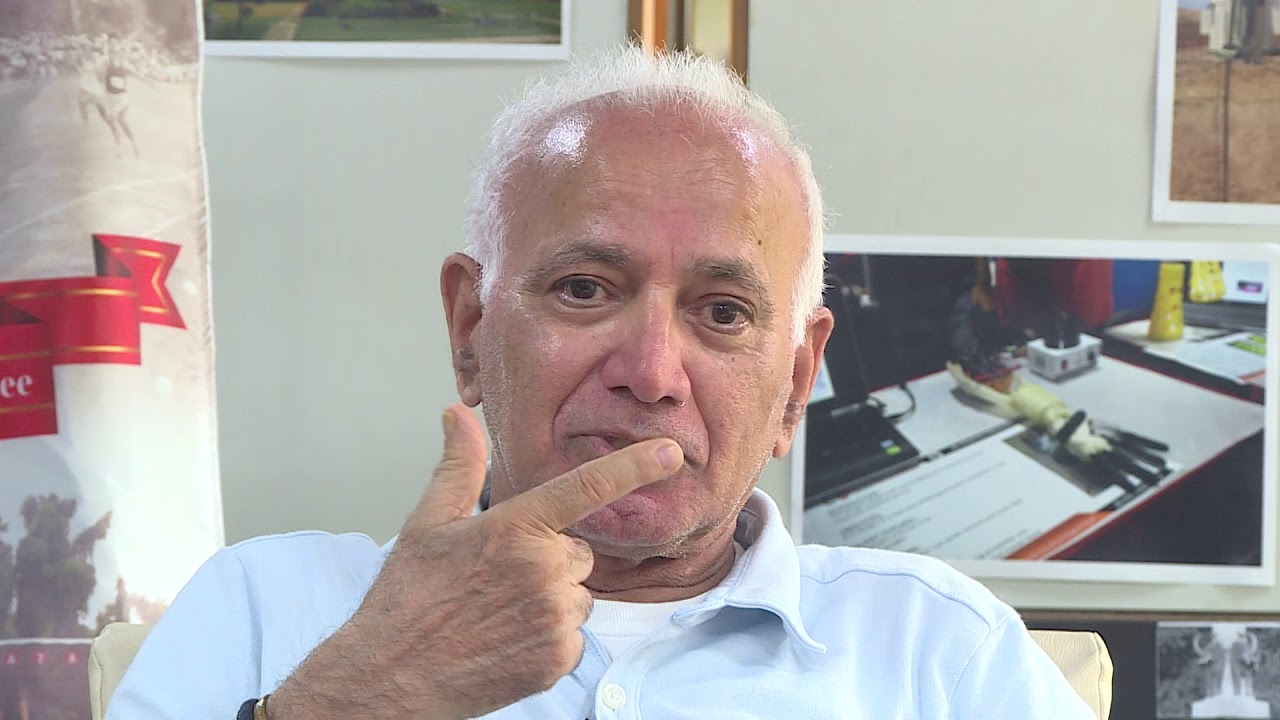
A talk by Mr. Mallik Putcha, first batch alumnus (1964)
And then, my roll number is 1.04/59
and then the way that we have
come to know of IIT Madras was I think
my elder brothers they were in the academic field.
And so, because of that we knew the importance of the IITs
compared to the other state colleges like
Guindy or other PSG College of Technology
or Kakinada and all of that.
So, if I remember right, the advertisements
came in Hindu and Indian Express
and other local papers, sometime in
May-ish kind of a time frame.
So, I applied for the for the admission and I think
we had the interview call sometime around maybe
1st week in June or maybe end of May, end of May or so.
And so, we had the interviews and then the selection process
was based upon our marks in the pre-university and then
we had an extended interview by about 6 to 8 IIT professors
as well as the German professors.
And I think they had two selection committee
interviews were going on simultaneously.
So, I think they have done it in a matter of a day or 2 at best.
And so, I think after the interviews were over,
we were we we got the selection notice saying that
you have been selected.
And our first batch was about 120 people.
The one thing that I wanted to mention about it was
because they are designated as the
Indian Institutes of Technology
based upon Prime Minister Nehru’s desires,
we had representation all the way from Kashmir to Kerala,
Assam to now at that time Bombay.
So, we are 120 of us and then there the students represented
the entire cross section of India
and we had our first day of classes on June 22nd 1959.
At that time they they call they our classes were conducted
at the AC College of Technology in various rooms
as well as in the Chemistry labs and then Physics lab.
And then the workshop used to be in the back back area
and then the Administration Buildings used to be
at CLRI that’s where the registrars and then the
administration buildings used to be.
One thing that I wanted to mention is
when we came to our first day of classes on June 22nd 1950. July.
July. No, no. June, June, it was June 22nd in 1959,
the entire faculty of IIT Madras approximately
about 25; 20 to 25 people including the German professors
were there on the steps of
AC College of Technology to welcome us.
And I don’t think any anyone, any one of the colleges
at that time would have that kind of an honor
by the by the faculty members of the of any institute
and that’s why it was a really a great privilege to have that.
And then we used to have our classes
Monday through Friday and then Saturday used to be a half day.
And then so, we have 4 sections: A, B, C, D
And then we as we call it, we had a of the sandwich sessions,
A and B used to be in the academic and C and D
used to be in in the workshop.
So, that means, for 40 hours a week
we used to be in the work, I mean the
academic area depending upon the designation.
And then the other people used to be in the workshop,
then they reverse it the following week.
So, the one the the emphasis that Germans
did as as all know, the West German Government
is the one that provided the support,
technical support to IIT Madras.
So, their notion was that you are going to be an engineer.
So, what they wanted to make sure is
when you will be provided with an engineering drawing
and if you are provided with an engineering drawing
you should be in a position to manufacture it.
And then you should be able to read the drawing
and then get the the item manufactured.
You have some small pieces of our workshop products.
We had carpentry, we had smithy and then
we had the lathe work, sometime in 61-62ish,
kind of a time frame when the workshops
were built around not too far from this building.
And I think later on I believe they were
demolished and then all of that.
And so the first one was used to be from,
our classes used to be from 7:30 to 11:30 and then 1 to 4.
And the hostels were at Saidapet Hostels and that
used to be at behind the the Teachers College Campus
and it was actually previously, before we occupied
it was previously a girls hostel with Madras University.
And then so, we were about 80 of us in the Saidapet Hostel
for the vegetarian people and then for the non-vegetarian
people about 40, it used to be at Guindy Hostel.
So, from those that hostel we used to come around
I think leave the hostel after the breakfast
and all of that and come over to the classes around
7:30, with a bicycle; most of us used to come by bicycles.
And of course, you know we used to have some
buses used to be there, but I think
because of the vagaries of the Madras bus transportation
we prefer to come by bus.
And then sometimes I think some people used to come,
you can come across from the little Adyar river over there,
from the back side of the our Saidapet Hostel,
you could come across, but that was only in the
evening kind of a time frame, but morning time frame
generally we used to come by bus.
So, it was not too bad, around the traffic
was not too bad compared to what it is right now.
And so, the classes used to be held
in the AC College of Technology and then the
first class used to be in English, Professor Krishnan
used to be teaching us and he used to teach
teach Hamlet at that time.
So, I think he used to be the Principal at the A.M.
Jain College at Meenambakkam at that time,
and so since he he was teaching us the Hamlet.
So, he used to come with a nice [FL] paan and all of that,
so with the red lips and all of that.
So, when he used to enter the thing in the auditorium
the lecture hall kind of an auditorium
we used to say “enter ghost”.
And so and then when he leaves we used to say,
around classes used to be about 1 hour duration.
And when he leaves around 8:30,
we used to call him “exeunt ghost”,
just to get a little bit of kick out of our classes and all of that.
And then of course, we had Mathematics, Physics, Chemistry.
And Maths professor was used to be the Professor Hahn
and so, when Professor Hahn and then they in the
Mathematics and then Professor Koch Koch in Physics,
the entire faculty of the department
used to be in the back row.
And one comment that I wanted to make a mention
if that as you know after 60 years plus,
generally the German Professor used to teach
in the early stages of our instructions.
And then Sir Professor Hahn used to teach us Mathematics
and then he used to teach the Algebra at that time.
And then Schaum series were very form
for I think they just came into vogue at that time.
So, he used to teach the Schaum series and then in the
the the the algebra from the Schaum series.
So, once in a while Professor S. K. Srinivasan the, at that time
he was the Assistant Professor at
in the Maths Department.
And then so, when he had we made a mistake
or something was incorrect, Professor Hahn used to
have a little habit of putting his finger like this.
And then the moment he puts that finger like this
then Srinivasan used to get very nervous
saying that he made a mistake and then
he used to be little bit jumping
little bit on the platform over there.
So, when he used to do that we knew that Professor Hahn
was putting his finger like this.
So, anyway that was a little bit of a
fun fun factor of the various teachers.
And then the of course, the we had the tutorial classes.
And so, when we had tutorial classes
I think particularly on Saturdays I think,
they used to have various tutorial classes to help us out
with the understanding of the concept to make sure
that we understood the principles behind what they were
talking about in Math, Physics, Chemistry and all of that.
And then we had the Chemistry labs as well as
the Physics labs in the AC College of Technology.
Initially Dr. Venkateswarlu he was actually the professor
in the Chemical Engineering, but he used to be the one
and I think his one of the other names that
I remember was Ram Sharma and then I forget the names,
but there are not that many people in each department
we had about less than 4 to 5 people.
And then Rama Sastry used to be in the Physics Department.
And then I think BHV,
I am not getting I am not getting the name
that few of the people were there.
So, we had a wonderful lab experience and
we used to do the the U-tube principles thing.
And one thing that I wanted to mention,
when we were doing the U-tube
experiment in the Physics lab
that is where the we will have to determine the the
the purpose of the experiment was to determine
the frequency of the tuning fork.
If I remember right there is a standard used to be
around 600 or 650 cycles or whatever.
So, you have the U-tube and then so what you do is
you need to get a resonance when you and then strike the thing
with a rubber mallet and then put it on the top of the thing
and then you get the minimum or the maximum and
all of that based upon the the column of water
you could determine the the tuning fork frequency.
And one of the comments that Professor Rama Sastry
used to make is you need to have a musical ear
to figure out when is the maximum volume and
then when is the minimum volume depending upon the
column of water, but anyway we used to have
lot of fun with the experience.
One thing that I also wanted to mention is most of these
faculty members were around 25 to 35 ish kind of a range
compared to the Director who were maybe 40 plus and all of that.
So, for them in the first few years when we were there,
because we were all around 16 plus 17 in the beginning
and then so were essentially by the time we graduated in 64,
we were about 21, 22 ish kind of a thing.
So, they really the affections that they had for us
in the first batch on their subsequently in the second batches
and third batches were, we were they treated us
more like their younger brothers.
And so we were only 120 you know I think in the
first batch and then similarly in the second
batch also only 120 plus.
So, we had such a close knit kind of a relationship
on a one on one kind of a thing.
So, they know all of our names by first name
and even sometimes our pet names
that our all of us had in some fashion or other.
And then of course, my name was where they my nickname
was PMV my initials and all of that.
Similarly, the other people had some different names
and then so, we had that kind of a close relationship
compared to what it is right now because obviously,
now I was told I think today is the first day of class
I think first I think there are about 850 or 900 people
in the first day or the first I mean first year batch.
There is no way you could have the personal relationship
with the each of the individual ones.
The first two years we were in Saidapet Hostel and
then the the third year beginning of third year
that is June of 1961, we came onto the campus.
We we lived in Krishna and Cauvery
are the first hostel that were built.
Actually Krishna was the first one.
So, the second batch of people actually
came onto the campus first time
they occupied the hostels in 1960.
At that time it was called the Taramani Taramani Hostel
then later on they changed into the
Krishna and Cauvery and all of that.
So, the so basically my room number was
Room 107 Cauvery Hostel
and now I think it is now Room 207.
And we had wonderful time at
because all of us used to be in the hostels.
And one thing that Sengupto
our first Director insisted was that
everybody in the in the in the IIT
has to be resident in a hostel.
There are few of few of our classmates
they had their houses
their parents houses in Saidapet and Adyar and
all of that and they wanted to take a get an exemption,
but he said no, he will not allow that.
So, basically he said ok, if you want to do that that’s fine,
you have to pay your room rent irrespective
whether you stay or not, but finally, anyway
they have to stay and all of that.
So, I think the the thing that I really like in that
one is by staying in the hostels
we developed our soft skills.
And so, because as I was mentioning in the first batch
we had representation across the whole
cross section of the country,
we know the idiosyncrasies of the various people
from the various states their cultural
and then food habits and the idiosyncrasies.
And so by the time that we got to final year in 64,
all our idiosyncrasies and then
sharp corners have been rounded off.
So, that really helped us to whenever we go
and get a job in some other locations across
the country or even for that matter across the world,
we know how to conduct ourselves in the various
social situations as well as in professional situations
with people that are different either Indian or the foreigners or
something of that American and Britishers or something.
So, that helped us to have the different soft skills
and that really helped us out.
And then after the our first day classes
in on campus used to be in 1960, the first building
we had was in the Building Sciences Building and
then the classes used to be held in Room 105
and that’s where most of our classes used to be held.
And then of course, then later on we had the
Mechanical Engineering, Electrical and then I am from Electrical.
And then they had they used to have the
light current designation for the Electronics,
and then the heavy current for the
heavy heavy currents for the Power people.
And so we had our classes in Electrical Engineering Building
I think sometime in 1961.
And then of course, we had the Humanities Building
and then the other workshops and all of that.
And then so I think that’s that was the setup.
And then we had we graduated on on July 11th, 1964.
And then the previous day one fun fact was
the faculty gave the graduand class of 92 plus
and then from B.Tech, and then 15 from the M.Tech people
and a dinner with Hema Malini providing the dance number.
At that time Hema Malini was about 15, 16 years old or something.
And so her family requested our first Registrar R. Natarajan.
And then so through through her,
so she had the dance performance and
so that that was a very memorial memorable kind of a event.
And then of course, our first convocation was on July 11th, 1964
and President Radhakrishnan was our guest speaker.
And then of course, the the thing was held
in the Open Air Theater and so I think that was the thing.
And then also the other thing is
I did my M.Tech also over here in 64 to 66.
And so I was here on campus almost for about 7 years
that’s the on the the actual actual campus was 5
because considering the 2 years we were at Saidapet Hostel.
So, the way that I feel is because of the the love of learning
and then the critical thinking skills that our professors
have inculcated in us that stood us in a very strong fashion,
when we are in a professional career anywhere in the world.
So, soon after my my graduation from in from IIT Madras,
I started working at Bharat Electronics in the Special Projects Team
and then I was there for about 5 and half years
and then I went to US to do my Masters.
And then after the Masters and the MBA
and all of that I started working at NASA
Johnson Space Center in the Space Shuttle Program
and then the Space Station Program Constellation
and then the Mission Control Center.
And then I retired in 2012 from the service.
And so I lived I still live in Houston and then
it is really a great honor for us that
we had the honored Director and the other people
have done last night at the at the event
in the Science Activities Building.
One thing that I wanted to make a little appeal
for all the people is number 1 is right now
there are about 48000 of us who graduated from IIT Madras.
First batch they we were 92 B.Tech and then 15 M.Tech.
So, first graduating class on July 11th 1964 was 107 people.
Now we are total of about 48000, from the figures that
I heard from our the Dean of International Alumni and
International and Alumni Relations Mahesh Panchagnula
approximately about 10 percent about 5000 people
have given and I wanted to give give back
to the IIT Madras in some fashion.
Some people have given enormously like Kris and Deshpande
and others, but whereas, others I think
quite a few of the people have not really
contributed to the IIT Madras.
I would really urge all of you to just to consider
a fact of life how IIT Madras contributions
stack up against the world class institutions like
MIT, Stanford not more than other.
Our numbers are around 10 percent less than 10 percent.
The numbers for MIT it is about I now sure MIT
was about 150 years plus they cut the the alumni of MIT,
30 percent of the people give back to MIT.
Dartmouth, the numbers when I checked last
was about 36 percent.
So, right now if you really compare
if you want to be the world class institution
competing against the Stanwood, Stanfords,
MITs and Hogwarts, we really need to increase our
contributions to give back to the institution for the various purpose.
And I think they have multiple purposes that
the office has created in in order to give back to the institution.
So, please contribute whatever you could, 1 dollar or 1 rupee.
Sure you may have various reasons
why you cannot do it because of the
family considerations and other consideration.
But every one of us can give a 1 dollar or 1 rupee,
you are what can do do remember you are
what you are in your life thanks to the
education you got from IIT Madras.
Think about it, contemplate on it.
Please contribute in whatever way you could
over a period of time or whatever you could do or one time or
work with the so the International Alumni Relations
and then as well as with MAA and then
so give something back to the to the institution because
it is for us the 48,000 of us to improve
the world standing of IIT Madras.
Along those lines I wanted to make an appeal
for the Founding Professors Endowment Chairs.
Professor Sampath, he was our first Director,
Deputy Director and then later on he was also
our first our Professor of Electronics and then
because he made a profound impact on me
and so basically the thought came to us sometime in 2011.
And finally, in 2016 we were able to establish
Professor Sampath’s Endowment Chair in December of 2016.
Based upon the success of it, even though
we had some little difficulty to raise the money
and all of that, we made it happen.
What I wanted to emphasize in this appeal is
we wanted to establish the endowment chairs
for all of the founding professors over there from the
beginning of times from 59 through approximately
64 or 65ish kind of a time frame.
It is for us these 64 to 69 graduates
approximately 1200 of us to contribute towards these
48 professors, 36 Indians and 12 Germans.
And we, I got a thing on the website and then
I will be sending out a note out shortly that the
thing was announced yesterday for the Professor Sengupto’s
Chair and then Professor Natarajan’s endowment lecture series
was also announced yesterday.
So, what I would urge you is to the extent that
you could these 1200 of of us the alumni both from
B.Tech, M.Tech and then 3 year, 3 by 3 or a 5 by 5
or a M.Sc or M.Tech or Ph.D,
please do contribute whatever we could to get these
48 professors money raised.
And I am going to be asking the apart
from the alumni, I will be I will be seeking
the help from the our professors family
and their their children non-profit organizations
as well as the corporations plus some of the philanthropists
that are there across like Azim Premji
or with TATAs and all of that.
And yesterday at the meeting I was able to meet
with our Director the previous Director Natarajan,
yeah Natarajan as well as the Kris Gopalakrishnan
and other people and I said ok, hey,
I will come and meet you. So, I am meeting some of them
on 16th to help us out to raise the money.
Total money is what I need is about 500 dollars.
I mean 5 5 million dollars not 500 sorry 5 million dollar
and I think just to get a little kick out of it
you know the people in our generation knew
about the Chalti Ka Naam Gaadi that
was released in about 57, 58 kind of a time frame
and then I think Kishore Kumar and Madhubala
were the the hero and heroines at that time
and so, Kishore Kumar song was
Paanch Rupaiya Baara Aana and all of that.
So, what I need is about 5 million dollars folks.
Let us try to contribute in whatever way
we could to fund all of the 48 Endowment Chairs.
Yesterday I was also talking with the
German Consulate General for the Madras
and then she said she would like to help.
So, what I would really urge you
the purpose of this message is
give back to the to the institutions in whatever
way you could; 1 rupee, 1 dollar.
Please honor your commitment to the institute
Indian Institute of Technology, Madras [FL] Siddhirbhavati Karmaja.
Thank you.


- Contribute
to the Centre -
 Monetary
Support  Digital
Material
