Prof. C.S. Swamy (Retd. faculty, Dept. of Chemistry) in conversation with Dr. Shobha Sharma (Alumna of Dept. of Chemistry)
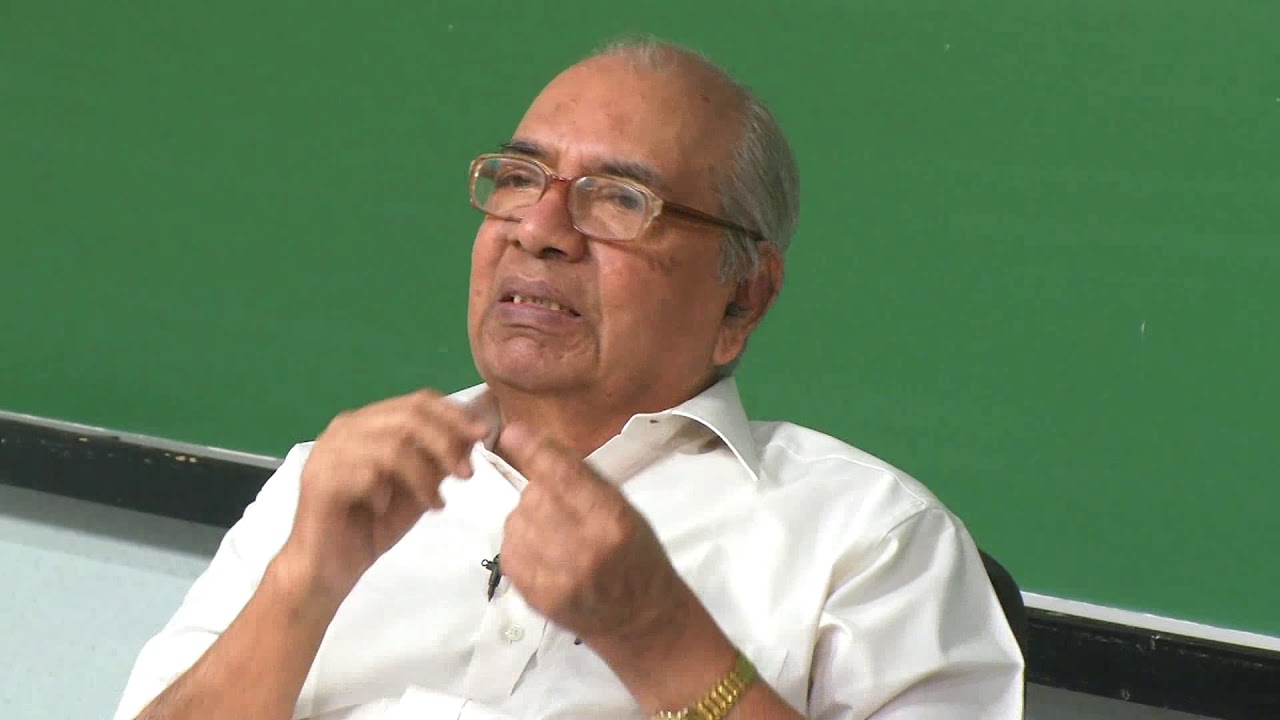
It’s...it’s good to talk to you Professor C. S. Swamy. Yeah.
And I would like to start
by asking you something about
your education,
work experience before you came to IIT.
Yeah. And then why you chose IIT?
See, I...let me start from my birth.
So, I was born in Bhadravathi.
It is in Mysore State,
present day Karnataka.
It’s almost border and near the forests in those days.
And...according to the Bharat Ratna Visvesvaraya
who used to say “industrialize or perish”.
So, he was the person who started
the steel factory and paper factory at Bhadravathi.
Now, I started my education
only in Bangalore when I was almost
6 to 7 years old
because I think I was
sickly child during my young days.
And straightway I entered the
4th class in primary school
and after completing it,
I went into the 5th class in middle school,
middle school is 4 years in those days.
That means I had already learnt
about alphabets
and little bit of reading
the local language Kannada
or Kanarese and a little bit of English.
So I straightaway entered
the middle school 1st year
and where my elder brother was also
studying, 3rd year
and then after about one and a half years or so
It so happened that the school
was divided into two parts.
So, some students who were
beyond a particular area...who were living,
they were transferred to another school.
So, the government said...
So one fine day
I was told after...in the morning
before the lunch
that is afternoon some...
principal of another school is going to come,
these students are going to
study in another school tomorrow.
I didn’t know what it meant,
so, when I came for lunch...
I used to rush for lunch during the interval.
I told my mother,
I am being sent to another school.
My brother thought it was a joke,
but afternoon, suddenly
the...another principal,
another...our principal and another teacher
came and said,
read out my names and some other names
were asked to stand outside, form a line.
They were told we are being...you are
being taken to the new school.
So we were taken to a new school,
we are introduced, we sang the national anthem,
or the state anthem
because we are still...not in independence
and then we were told, can you reach your house?
And I asked which cross is this?
And they said this is
13th cross Malleswaram, Bangalore.
Then I said my house is between 11th and 10th cross
and I asked the teacher,
“Sir, if I go in this direction,
will I reach a banyan tree?"
He said, "Exactly, there is a big banyan tree."
"Then from there I know my house, Sir."
So, others who didn’t know, he said,
“I will take you back to the old school,
from there you know how to reach yours."
But then it was a sudden thing,
but then nothing could be done because
the government had given the order.
So I studied there for about one and half years
and then...and the final, that means...
'47, I was to come to
the lower secondary, which means 8th standard.
We have a public examination.
So my father thought
that I must go back to that other school
which is much better,
so he took sent the application to the DEO
and I was transferred to that school.
So in my school education
it so happened that
from that time onwards,
I was looked...look...I mean,
considered as a very good student.
I was going to bring a State Rank and all that,
but it didn’t happen.
Then, I joined a government high school in 1948
and then, around the time,
we also shifted our residence,
my father bought a house very near the high school.
That building even now exists in Bangalore,
it is a stone building.
And with the clock tower on the top
and very near the Indian Institute of Science.
And I started studying there.
Now, it so happened,
that myself and a brother, elder brother
we were very much
I mean in admiration of Mahatma Gandhi.
So, one day we were walking on a street,
and we saw that somebody is going to teach us Hindi
and then we both of us entered there
and then we asked, "What are you going to teach?"
He said, "We are going to teach oral Hindi"
that means, to talk in Hindi
and then it just costs you 1 Rupee.
To to appear for the examination,
it is a one-month course
and then we both joined.
And then after one month or two months,
the examination was conducted,
we both passed in First Class
that means, "What’s your name?"
"What are you studying?" something like that,
"What is your parents?"
A very simple thing one.
Then the first Prathamic, Madhyamic like this,
but then I never heard that
time, what a public examination is.
This was when I was in middle school,
not even high school.
So I think what I did was,
it is very...it is an anecdote, I can say.
I filled up the marks,
which marks which is obtained,
in that column I filled up the full marks for the question.
Which has put in the question paper,
I put 100 on the total.
And then my parents had told me
"Don’t write your name,"
I didn’t write my name, but I came back.
Naturally my paper was rejected, I failed.
So I said, "Oh, Hindi is not for me," I left off.
And after two years once again started
started Hindi, and to tell you,
in the whole of high school, for three years,
the second language I took Hindi,
I had no tuition.
I didn’t have examination,
except in the final
Secondary School Leaving Certificate, what you call SSLC,
at 11th...11th class,
and then I took the examination on my own.
By then I already come to the fourth examination
in Dakshina Bharat Hindi Prachar Sabha,
what is called as Praveshika.
Then within one year or so, when I was about 16,
I got the first degree Rashtrabhasha Visharad.
So in the college also for about
2 years plus another 2 years, 4 years,
I did self study
and I used to only write the final examination Hindi,
there was no this one.
And then this is my...
so, when I was in intermediate,
naturally the tendency in those days was
to enter Engineering
because that was the one which was paying.
So, you could get jobs easily
and then you could get good salary,
naturally parents encourage.
So what was important was,
you should get very good marks in Mathematics,
Physics and Chemistry.
In fact, I had got very high marks
but then due to certain quota system,
I...in fact, even on the quota system I had
scored very high,
but it...I didn’t get a seat
because I had not met the member...
selection committee member,
who was in charge of
selecting students under that quota.
And, I joined BSc degree,
and I had applied for Chemistry Honours
in Central College that is Mysore University.
And in the second or third list, I was selected.
First I felt that there had been a mistake,
but then I remembered what I had
promised myself, when I was in school.
See, my elder brother
we used to have a grammar book,
I think Wren and Martin, or some authors.
And then the author was
M. A. Oxon D. Litt. London,
it means M. A. in Oxford and
Doctor Literature in London.
So my brother used to write
against his name, M. A. Oxon D. Litt. London.
So...and one of the Chemistry books we got,
and I found the author was
M. Sc. Ph. D. then I said I am going
to be M. Sc. Ph. D. in Chemistry.
Well, why was...I got interested in Chemistry?
Purely because, when my brother used to come and
tell me about, describe about
the experiment that his teacher had shown in the class,
I really got excited about the thing.
If I choose, I am going to choose this subject.
But then I forgot all this,
when I was studying in college because
the question of employment,
the question of my father had retired.
We were six children,
and all those economic conditions
made me think of Engineering.
Once, I didn’t get it and joined Chemistry...
well, my goal was settled.
So, sometime around...around that time,
one of the Professors in Indian Institute of Science,
he was not a Professor then, he was a faculty member,
was a family friend of ours
Vasudeva Murthy, R. Vasudeva Murthy.
And he got his D. Sc. degree.
And one of his nephews, who was my
classmate in school,
he came home to tell me that
my uncle has got his D. Sc. degree
Mysore University.
Then immediately, I just pricked one of my fingers
and then wrote in a diary,
with blood, that "I am going to get
a Ph. D. degree in Chemistry."
So...and it was when I was in Honours,
and then it so happened that once I finished Honours,
again, an opening came for
Engineering, in the sense, IISc Bangalore,
used to admit students who have passed
B. Sc. Honours and M. Sc.,
to Diploma in Metallurgy.
And in Metallurgy, was a very very paying field,
because India was opening up,
steel factories were coming up.
So, the rank students were being taken,
and I was the second rank holder
and therefore I was
advised by Professor Vasudeva Murthy,
I mean my family friend, to take up.
I applied for it,
but then after realizing that I could not pay the fees,
I gave it up and then joined M. Sc.
in Central College itself,
continued for one year,
took my M. Sc. degree, once again in First Class,
but even before I got my result,
I had gone to Indian Institute of Science
and joined research,
because my a senior,
had already...was already working for Ph. D. there.
So, I just went,
but when I went and joined,
I told the concerned professors,
“Well, Sir, I am joining this
hoping that I will get a scholarship,
but you say that there is only one scholarship
a 125 Rupees
for M. Sc. First Class students."
"But, if I get it, I would continue,
otherwise one year my brothers have
agreed to support me,
and then I will look for a job."
And then it so happened that I didn’t get that scholarship,
it was given to somebody else.
But I continued, I was
interviewed by State Bank of India,
interviewed by accountant office.
But then, I picked up
I got interested in experimental work,
I made friends with faculty members,
and then by 1958,
I had already started on research problem
with Professor K. R. Krishnaswamy
who was Head of the Department.
In fact, I was asked to work with somebody else,
but I went and requested
whoever was allotting these,
these students I said “Sir, I would like to work
in the Field of Adsorption and Catalysis”.
And then immediately he went and talked to
the Head of the Department Professor Swamy,
and I was asked to join
and he was my first research supervisor.
So happened that about 7-8 months later,
one day I was trying to do my experiments,
maybe I was...I had not eaten,
or something was wrong, I don’t know,
Professor Krishnaswamy walked into the lab,
and this...my seniors were not there,
and then he straight came to me and
said, "How is your work going on?"
And then I said, "Sir, I am doing..." and then
suddenly he looked at me and said,
patted my back and said,
"The IISc is going to become a University,
and you are going to get a scholarship in August."
So because he had also come to know
that I was going to leave...
so suddenly, you know this was such a shock to me,
I started crying, I didn’t know.
By then he left and the,
my seniors wanted...and said, "What happened?"
Then I said, "This is what happened."
So...he...I just felt when he said that you don’t,
in a way saying "Don’t leave,
your interest in research continue."
Then, the...the...the information spread
in the whole research community
and then somebody came and
suddenly asked me,
"Why don’t you apply for a CSIR scholarship?
I have the form with me."
Then, I took the form.
You know for the first time,
CSIR was giving
junior and senior research fellowships,
it was the first time, and
and the form was got.
Then, I went and met the Head of the Department
and told him, "Sir, can I apply for this?"
He said, "Go ahead,
but then I tell you,
you are anyway going to get the Institute’s Scholarship."
but then he recommended
my this one, and sent.
In June '58, I was called for interview to Delhi,
and then within 10 days, I got information
that I had got a scholarship, 200 Rupees.
Institute was supposed to give
scholarship from August,
that I got it from June
and...the Interview Committee consists of
this senior most professors in Chemistry
from Delhi University and all that.
And it so happened that only
two students of the entire Indian Institute of Science had applied for it,
I was one of those.
And then in within four months,
they increased the scholarship to 250 Rupees,
and there was a contingency grant.
So, although I was a junior most student,
research scholar I was paid the maximum amount.
So...and from next year onwards
people start applying for Junior Research Fellowship.
but I then, having got this scholarship,
now my aim is to finish my Ph. D. early.
So, that encouraged me
to start corresponding
with professors abroad,
doing the research in the proper way,
in the sense indexing,
preparing index cards,
doing extensive survey, research survey and all that.
And then by the time within two...
one and a half years to two years,
I felt I had done sufficient research work for my Ph. D.
So, I have...by then
Professor Krishnaswamy has retired,
Professor M. R. A. Rao had taken over Head of the Department,
and he was my supervisor.
He had agreed to be my supervisor.
Then, he was surprised when I told him that
two years, I have completed my work
and then we started reading,
the checking the data
and checking all the information.
And it was in 1960,
it so happened that I had to go to Kharagpur,
for some personal work, to IIT Kharagpur,
and two times I went
and I knew Professor...
I mean M. V. C. Sastri,
Dr. M. V. C. Sastri that time,
he was an Assistant Professor there.
I met him once in October 1960.
Well that time he invited me to his house,
and then we were talking
something about our work,
and then Professor C. N. R. Rao,
Bharat Ratna C. N. R. Rao,
he was actually his student
for a few months, and so he told me a few things
about him, and he was my...he was my
I mean he was a faculty member already in Indian Institute of Science.
So...I came back, and we exchanged,
and then again I went back
two months later, by then I had already started
discussing my research work
with my professor.
So, I had even taken
some samples to be worked in IIT Kharagpur.
It also happened that
Professor S. K Bhattacharya,
Who was the head of the Department of Chemistry there
had attended the Second International Congress in Catalysis
in Paris.
And he was the only Indian
who had attended the First International Congress also
which was held in USA.
And, it so happened,
that I was interested in going through the proceedings.
So, before meeting Professor S. K Bhattacharya,
I went to Dr. M. V. C. Sastri,
and I had by then decided
that I...since I was going to complete my Ph. D.,
I was thinking why not
I joined to a postdoctoral with a different group.
I had thought of NCL, Poona,
but then there was nobody working in catalysis then.
I wanted to go to Professor M. V. C. Sastri
So working on adsorption
and he has guided
a large number of students.
So I asked him about the possibility of a
Senior Fellowship.
Then he told me,
"There is an IIT coming up in
Madras", I said "I know about it, it is already there", I said.
"No, no they are going to advertise
for Chemistry faculty,
it’s going to come in a big way,
you go there."
I didn’t know that
he was already aiming to move to IIT Madras,
but anyway I came back,
and then, the few months passed away.
And it so happened, my senior
who was not interested in writing up his thesis
suddenly started writing his thesis in my absence,
and then the Professor was
busy with so many things, he said your senior is
started discussing.
So unless he...I finish his work,
I would not like to take back
your work, I would not take your thesis.
Then something which I cannot forget,
I mean in my life,
on my 21st birthday,
the day I completed 20 years,
my Honours result was announced
and I had passed in First Division.
On my 25th birthday,
on in 1961,
I just went to my Professor,
took my blessings in the usual way,
then told him,
"Sir, today I complete 25 years.
I had planned my own by today,
I would be a Ph. D. holder
and I would be settled in some job."
He was simply taken aback,
I said "I have not done it.
So what do you feel, Sir?"
He said, "Yes, you are right."
And then immediately he said,
he asked me, I said "You see there is commitment to my
parents, commitment to my family,
the others who have help me.
So I want to..." Then within
one week or so, the advertisement
came from Indian Institute of Science...
Indian Institute of Technology here, IIT Madras,
and I was called for interview for Associate Lecturer
with the starting salary of 375,
the Lecturer was 400 those days.
And then I came for interview
and then interview was held in CLRI
because the part of the office was there.
And...the reason, why I thought of IIT,
was not only because Professor Sastri told me,
my seniors Professor V. Srinivasan,
I mean now say Professor because
at that time was Dr. V. Srinivasan.
He joined IIT in the very first year, that is 1959,
and then another senior,
Professor Aravamudhan
joined this institute in 1961, as a Lecturer.
When he was offered a lectureship
in Indian Institute of Science,
he felt that this is an Institute which is coming up,
so possibility of building
a department, or building a
sort of a group is much better here,
so he had moved here.
So, I had the backing of these two
and I came, attended the interview
and Professor Sengupto was then its Director.
The Member of the Selection Committee was
Professor D. K. Banerjee,
who was a Professor of Organic Chemistry at IISc Bangalore,
who had possibly seen me in the corridors,
because I had a common corridor
and Professor Yeddanapalli of
Loyola College, he was the Principal at that time,
he was a person working in my field
and I had met him several times,
he used to come to IISc during summer vacation.
He used to come and visit.
And I was also on correspondence with his students,
just like I was in correspondence with the Professor M. V. C. Sastri
and a large number of foreigners also.
And then he knew my work,
possibly this helped me,
and anyway that night, I returned back.
I had already been recommended
for a job in Delhi College of Engineering
from my Professor,
that interview was one week later,
two of us had been recommended.
So, next morning,
as usual I went to this lab around 7:30.
And one of the person who used to
come very early to the department was
Dr. C. N. R. Rao.
And at 7:30, he walked into my room
and congratulated me.
I said "What?"
He said, "You have got the job."
Then I said, "Well."
Now there is no...it is no longer confidential,
so I am sharing this with you,
point is you know he came
and told me like that and I said, "How do you know?"
Then he said, "I learned from Professor Banerjee."
I knew that he was working with Professor D. K. Banerjee,
and he had a student from Organic Chemistry and asked him.
Then, he has gone and told this to my Professor
and then Professor called me to the room and said
"I know it is confidential,
but congratulations anyway.
So postpone the celebration
once you get the order."
Within one month, I got the order.
Let let me ask you.
Yeah, please. So this was
when you were coming into IIT,
right? Yes, yes.
So let me...I...am just framing this,
you got your education
pre and post-independence. Yeah, yeah.
And you came to IIT, when it was just starting.
I am very interested to know,
Yeah. How life was in IIT at that time
and how it compares with later?
Yeah, naturally, the...the...the
in the 50-60 years the whole thing has changed,
but one thing I want to tell you, 1959 to '61,
IIT...this...this campus was not existing.
So these classes were being conducted
in Guindy Engineering College
and part in AC College.
And the boys used to stay in hostels somewhere outside,
and the first hostel to be built
was the Krishna Hostel,
and the second hostel was Cauvery Hostel.
And then the Building Sciences Block,
that is, I don’t know whether it is still called as the Building Sciences Block.
It is late, it was originally called as
Administration Blocks, Civil Engineering Block.
Then, they named it Building Sciences Block.
That was the only block that came up.
Then the workshop came up.
So when I came for medical examination
in September 1961,
so my friend or colleague
Dr. V. Srinivasan who used to stay the Adyar at that time,
3rd Main Road,
he told me "You stay with me,
instead of staying in a hotel."
So I stayed with him,
and then he brought me one day to IIT,
the Building Sciences Block
and Chemistry was somewhere behind
and 3-4 labs were given,
and there were two rooms given.
And then...I came to know only then,
that till, for two years,
Chemistry was a part of Chemical Engineering.
And in the first
agreement that was signed between
Germany and India,
West Germany and India,
the Chemical Engineering was included,
all the equipment had been planned,
whatever was to be obtained,
and since Professor V. Srinivasan was there,
they took care of one or two things which he wanted.
See one advantages of Professor V. Srinivasan was
he had done a Diploma in the
Chemical Engineering at Indian Institute of Science.
So he had a Chemical Engineering background.
So he could teach Chemical Engineering courses also,
as well as Chemistry courses because he done his
Masters and Ph. D. in Chemistry,
Physical Chemistry that too Adsorption and Catalysis.
So, he had advantage in both ways,
and then he started the
Chemistry Laboratory in 1959.
The...there was only a special officer that time,
his name was L. S. Chandrakant,
and he was the brother of L. S. Srinath,
who later became a Director.
And L. S. Chandrakant it seems to have called one day
Dr. V. Srinivasan, one Dr. T. Gopichand
who was in Chemical Engineering,
gave them a lot of money, cash,
and told them engage a bus
engage a taxi, or you go by bus
and then buy whatever you want to
establish undergraduate laboratory,
whatever, glassware, chemicals
put in a taxi and bring it.
So they did like this for two days,
and they got whatever is required for
running a class of 60 students or so, or one,
I think 120 students, or 100 or something like that.
And then that is how they started the chemistry laboratory.
And in 1960 also,
when Aravamudhan joined,
the same thing happened.
Only thing is, 1960,
a few more faculty...staff members were appointed.
Professor Aravamudhan came
because to teach Inorganic Chemistry part of it.
And then Professor Rajappa,
there was a S. Rajappa,
he was selected to teach Organic Chemistry,
Dr. S. Rajappa.
And another two or one or two technical assistants are appointed.
And all these people
moved in '91...sorry '61
to the BSB Block.
And when I joined,
we had only one preparation lab
and part of the preparation lab other side was the balance room.
And two laboratories
and there was a store room
and below this store room,
there was a Petrol Gas Plant,
common to Chemical Engineering and Chemistry
because one side was Chemistry,
another side was Chemical Engineering. Ok.
All the...but Chemical Engineering
also had some facilities built up
because the first batch students all they come to third year.
So in fact, I wanted to join in December,
but then the...
I got a letter from the Registrar,
that the second semester...of the classes
are going to start from October
at some such thing was there.
And then they said you are going to you are appointed to
start the laboratory course
for Physical Chemistry.
So I had no option, so I
took leave from the Indian Institute of Science
and then without a degree,
without completing my work, I moved over to
this place on 13th October 1961.
So well according to
French people 13th maybe
a bad day, but for me it didn’t happen so.
But then I started. By then
I knew that Chemistry was going to be separated
from Chemical Engineering
and then Professor V. Srinivasan,
I mean he was the first
Head of the Section,
although he was a lecturer. Yes.
And then we were all sitting in the preparation lab
and in November, I joined in October, November end
Doc...Professor M. V. C. Sastri joined.
And then he had already...
from the time he got his
offer, till he came here
had already made a very big plan,
and he had sent enquiries and got quotations.
So he came with big this one
plan for the department.
So, from the day he joined,
he was very hardworking,
but only thing is as a human being,
he was a bit difficult to deal with.
He was a very
hard working person himself,
but then I something which goes with certain people
maybe for various reasons.
But I almost thought of leaving this
in December, because of
certain things for which I was accused, which I was not
ready to accept.
But anyway I continued,
and in January,
I was asked to take over the
Assistant Wardenship
of Cauvery Hostel.
So. Cauvery Hostel,
Yes. So this was from '61-'62 year
you were already so... Yeah, yeah yeah.
So, some of your...
so besides being a Professor here,
Yeah. and teaching, being Head of the
Physical Chemistry part with
Dr. M. V. C. Sastri here,
you were also getting involved in
other activities like Wardenship. Yeah.
Yes. Because you know I
tell you why, because at that time
getting accommodation in was quite difficult.
And since Professor...I mean Srinivasan was there
and Aravamudhan was there,
they had talked to
the warden at that time,
Cauvery Hostel,
Dr. V...Dr. Venkateswarlu...D. Venkateswarlu,
Chemical Engineering Department,
he was an Assistant Professor, he was a warden also.
So, he offered to give me
give me a room there
and the room that was given to me was
that of the Physical Training Instructor,
who had married and he had
taken a flat outside.
So, the room was much better
and this was next to an Assistant Warden’s room
and it was very convenient.
And then I started taking interest
in the sort of student’s activities and all that.
Within two months, it so happened that
another Assistant Warden M. A Veluswami,
he was an Applied Mechanic,
he had some problems who resigned.
So, I was asked to take over the wardenship.
I was actually in charge of the mess.
A person who had never who lived in the hostel
and never eaten the mess,
I had to become a Mess Assistant Warden.
I did it with my utmost this one for about six months,
and of course, coming to the personal matter,
say even before I came here,
I had already seen a girl
whom I was supposed to marry because it was all
arranged marriage.
So I had only given...
I put one condition,
that I will marry only after I submit my thesis.
So since I submitted my thesis in May '62
so my marriage took place in August '62
and therefore, I had told the Registrar at that time
I am not going to continue,
I would like to spend my bachelor days in Mylapore.
So, a Luz Corner, and the reason,
there was a reason for it,
because during the early days
when IIT came over here,
the transport buses used to run
both in the morning,
as well as in the evening,
from Saidapet, and as well from Mylapore Tank to IIT.
So the bus from Mylapore Tank used to pass through Adyar,
pick up all the faculty and staff.
Similarly, from Saidapet
it used to come, and the staff,
both faculty and others,
they all used to take the bus,
otherwise they used to make their own arrangements.
And I think by '62 only, the first
two buses of IIT came
and they started running one or two more trips in between.
So, both morning and evening
one has to make use of the transport buses.
So, Mylapore was a convenient place,
so that is why I went and there were many others who was
started staying.
I was staying in a lodge that time called as Murali’s Lodge.
So even after marriage I stayed for 2-3 months,
till the quarters got ready.
The first person to occupy
a sort of some place in the IIT
Was the security officer.
And that was already there
it was not a new building,
it was an old building which was very near the
warden’s quarters,
or very near Taramani House.
So it was a small building,
he had to stay in the campus.
So he was the first person who moved
and then the second person to move was
the Director himself.
So, it so happened that...the
the handing over of quarters got delayed
and then one of the faculty members of Physics Department,
had already given a notice to his
owner in Adyar, that he was going to leave by
October or November 1962.
And then he had to leave and so he came and told
the Director, "You see
I am supposed to leave tomorrow, what do I do?"
So, over night, one quarters was got ready
near Post Office,
opposite Post Office.
They have called D1 Block,
and then he was the first occupant other than the Director.
So this how the whole thing started.
Professor Swamy, so that was in the '60s. Yeah.
So, fast forward to the '70s
and you know your time, I...I...
and you were here till the 90s,
what changes have you
Seen in the department? Yeah I will come to that.
see the...since I told you that
1961, we became independent department.
So, as soon as Professor Sastri came,
we started drafting a syllabus,
if as a Chemistry, as an independent subject.
So, same thing happened in
so I can say that first revision of syllabus took place in 1961.
So, there is one more thing which we did.
So we were didn’t want to waste chemicals and all that.
So, we started semi microanalysis.
You see the Chemistry Undergraduates
First Year B.Tech.,
they used to do only
some quantitative analysis, estimation
and they used to do qualitative analysis.
And qualitative analysis was being
done in big tubes and all that.
So, we converted into semi micro.
So to make semi micro kits,
the drawings were given,
they were made by companies,
the glass tubes were made to that size
and we wrote our own manuals for it,
we tested all the things,
3-4 of us and we started the class.
So, I had already had experience,
of organizing the Physical Chemistry Lab,
for the Third Year Metallurgy students
in 1961. I joined for that only.
So in fact, the some of the experiments I
arranged was being done
was possibly done by
others in M. Sc. later,
experiments on phase rule,
conductivity and other things.
So because all they made a planned
along with the head of the department, we got it.
And...so, the first revision of syllabus took place
and then 1962, the first
recruitment drive also took place.
So we had Professor Kuriacose
as a Pool Officer from January '62
he became an Assistant Professor.
And one more gentleman joined who left within 3-4 months,
and Professor C. N. Pillai, Professor Kalidas,
They came over as lecturers,
and then we had already...
I was an Associate Lecturer,
there was another Dr. Sharma who was an Associate Lecturer.
We had several Technical Assistants
both Senior Technical Assistants...
Well, when we saw the Senior Technical Assistants the idea was,
they will specialize either in inorganic
or physical or organic...
that means, they would have worked in some
places where they have their experience.
The person from Indian Institute of Science
who had already published work in Analytical Chemistry,
of course, he had published along with the Professor,
V. R. Satyanarayana Rao who was selected, V. R. S. Rao.
For Physical Chemistry, one
Ramaswamy, R. Ramaswamy was selected from...Karaikudi.
He had some publication.
And for organic, we selected D. V. Ramana
from Delhi University
who had worked with Professor T. R. Seshadri and Microanalysis.
And Junior Technical Assistants were all
B. Sc...one or two year experiences.
So the department expanded.
The lectures were being taken only by the faculty,
and Professor Sastri
had his first health break down somewhere in '62,
that was the time when I got married.
So, he seems to have told
that I should not hold the...any
any sort of get together
till he returns back.
He returned back only after two months or so.
There is something which I want to share which I...
some reason I possibly forgot.
The Chemistry Department
in 1962 itself, not only do they think of a new syllabus,
we started what is known as a 'Chemistry Colloquium',
where we get somebody to speak, give a lecture.
And we wanted to inaugurate it
and so Dr. Rajappa
who was a student of Professor T. R. Govindachari,
the almost...the foremost chemist
or organic chemist in the city of Madras at time,
he was the Principal of the Presidency College.
We invited him to give the inaugural lecture
and this was held in the BSB.
And the Registrar
who was an IAS Officer,
Mr. Natarajan was so happy about that.
Because of the first
club or whatever association was being started.
And he took the initiative
to send invitations to all the press.
We got invitations printed,
he gave me a car
to use if you wanted, the office car was given
and then since the press were invited,
press covered it,
and almost all the institutions
dealing with Chemistry in
the city of Madras were invited.
Well, there was a comic thing
about that in this one which I would
possibly mention if necessary.
Now, the function was held
in a...fairly grand way,
and then the colloquium had taken root.
The second lecture was given by one
Dr. Muttanna who was the Director of Lac Research Institute,
later he became a Deputy Director
and Director of IIT Kanpur.
Originally from IIT Kharagpur.
So...then you know this became
a regular thing and
when there were no speakers from outside,
one by one we used to give seminars.
In fact, I gave a seminar
along with the party.
So I invited all the faculty, which were there,
Chemical Engineering and other...
we are a small group,
So we used to call everybody
and then it was...
So, we started this in '62,
so I moved into the quarters in '62 end or so.
So, '63, '62 I told you we
we recruited Technical Assistant. Right right right.
'63, we decided to start the M. Sc. course.
So...and the Head of the Department was very particular
that all the Technical Assistants,
they were only Bachelors degree holders,
they should also have a chance to do Masters.
So, he talked to the Director
and both in Physics and Chemistry,
they were permitted to join M. Sc. degree.
Only thing is, instead of two years M. Sc.,
they were supposed to complete in three years.
Because they had their own class work to do and all that
regular administrative work.
So the...all of them joined, and happy to say,
that all the three Senior Technical Assistants,
all of them retired as Professors,
all of them in separate fields of research,
and one of the Junior Research Assistants
who continued,
he retired as a Professor,
and he was a Member of the Board of Governors also.
So...and if necessary
I can mention the names, it is not necessary
now. Please do,
do you remember? Yeah
the Professor V. R. S. Rao.
He worked in Nuclear Chemistry.
Professor Ramaswamy,
he worked on Oscillatory Reactions and then,
what do you call is I...forget the name...
oh yeah, let me tell Oscillate Reactions, Electric Chemistry.
And then Professor Venkatachalam worked on
Electro Organic Chemistry.
And Professor D. V. Ramana worked on
Mass Spectrometry,
Organic Mass Spectrometry.
Each of them were trained abroad,
each of them did their work very well.
So, they got a number of students,
number of publication.
So it was good.
So that is how Professor M. V. C. Sastri
was appreciated by
the Madras University
that he made a very good selection.
So, whether he recruited Lecturers,
whether recruited Assistant Professors or recruited,
so recruited people who could
take the department in a particular direction.
Now, coming to the subjects of
specialization and all that,
now as I told you,
Professor Kuriakose had already worked
in catalysis along with Professor M. V. C. Sastri
for some time in Kharagpur,
and he had independent work in
Belgium and also USA.
So he started his work in Kinetics and Catalysis
and Professor Sastri is started on Catalysis.
Professor Aravamudhan who was actually
the only person in the whole of Asia,
possibly I don’t know about Japan,
who had worked in Phase Rule or Phase Equilibria
in Indian Institute of Science.
He thought that he may not be able to continue that
because he did build up an apparatus for it,
but then he started doing analytical work
and Professor C. N. Pillai
started doing work on Organic Chemistry.
So this is how the four divisions,
Catalysis, Kinetics and Catalysis, the Organic Chemistry
and Inorganic Chemistry came up.
And then this 1965, again '64,
Professor V. Ramakrishnan joined.
He started, he is a person who worked on
Theoretical Chemistry and Spectroscopy.
So he joined as a lecturer, and then in '65
Dr. Ramadas joined,
again he had worked in Organic Chemistry,
but in a different type of area
and steroids and all that with lot of molecular transformations.
He joined. '67
Dr. V. Mahadevan joined to work on
Organic Polymer Chemistry,
and then '68,
Dr. R. Narayan joined
who had worked in Karaikudi,
and abroad, he had worked on
Electrochemical Problems Corrosion.
So we had in a way,
so Electrochemistry,
Kinetics Catalysis, Heterogeneous Catalysis,
Organic Chemistry
and Organic Chemistry both
say...what Professor Pillai was doing,
and Professor Ramadas started.
So this was the situation
as of up to '68 or so.
but then let me tell you,
I said about development of the department.
The first five year programme
or the Indo-German programme,
it didn't include Chemistry.
The second programme also did include Chemistry,
the third programme,
they started somewhere in '66 or '67,
it included Chemistry.
And the group came and '66
there was one Professor Schmeiser
who was an Inorganic Chemist,
Preparatory Inorganic Chemistry,
he was the leader of the delegation.
He visited Indian Institute of Science and then he came here,
and then it so happened that here,
I had become a lecturer only in '65
and I was not very very happy with whatever was happening,
in the sense that I could not do independent research and all that.
So I was thinking of going out,
so I had told Professor Sastri
and '66, I applied for an International Fellowship
to Germany and then '67, I was selected.
But then the condition was,
that Institute should give me deputation,
that may they must pay my family the salary.
The Director had signed,
but then when I went to him with my letter
he said that there is no guarantee
that we should agree to that one.
I was a bit taken aback,
but then it so happened that Professor Schmeiser
who visited the lab,
and Professor Sastri told him that
this is so and so and he has been selected,
but then there is some problem is being relieved.
He said, "I will talk to the Director,
no, no any programme that is
that takes somebody to Germany, he must go."
The reason why this happened was
that along with the programme, Indo-German Programme,
some faculty will be sent
to Germany and D. A. A. D.
DAAD Programme, as you call it,
Deutscher Akademischer Austauschdienst.
So that is how other Engineering Department had gone,
Chemistry got the chance only then.
So they said if you are having that why should we put.
So in that you know, the Director
they have their own choice, they can choose whoever they want,
and anyway I got a chance to go and I went away in
'67, not knowing what are we going to specialize in,
but I went there to work in a Nuclear Research Laboratory.
And that too working on Composites,
which was a new word at that time
synergy, composites all that was new,
I worked on it for a few months 8 months or so,
I almost guided a person who was my Betreuer
what you call is somebody who takes
care of me...regular things,
and he was doing his Ph. D. in Mechanical Engineering,
I helped him with his work,
by building some apparatus and all that.
In fact, I built something
which was actually taken into stock,
something an electro deposition and all that.
Now this introduced me
to some new areas,
not only ceramics, composites,
techniques which are used in
welding, like electron beam welding,
in chemical vapor deposition which was all
words which were not heard of,
sol gel transformation.
So all this, with this knowledge, I came back.
and then the Head of the Department was expecting
that I will come with some knowledge of nuclear instrumentation.
It was not, it was not the
thing for which I was selected.
Because it was International
Workshop in Chemical Engineering and Physical Chemistry.
So they gave me training in
something related to that.
I was working actually in Institute of Material Science
in Nuclear Research Centre.
My Professor was an authority in
Powder Metallurgy and Ceramics.
So I learned something about a technique
which was used at that time only in Germany
and United States,
what is known as 'Isostatic Hot Pressing.'
Even in the place where I was working,
this unit had been set up just at the
time when I joined,
and we are doing the preliminary investigations.
So...I actually worked on the properties of the
samples that the properties I measured was
electrical conductivity and thermal conductivity.
I used to enter the
radiation labs.
In fact, I used to enter the maximum radiation
labs also, where I had to change my
coat, 3-4 times to enter those labs, but not to make
any such measurements,
but only to use some apparatus which was kept there.
So, I returned back
since there was no chance for me
to do work on that area.
So, when I was asked that one...one of the
circulars which I was sent,
what is it that I would like to do?
So, I naturally I wrote say not
knowing why the circular is issued.
If I had been given a chance to build up a laboratory,
I would have worked on these areas
and I would have had by now, a Ph. D. student,
or a Masters student.
This was mistaken
by the Head of the Department.
So, there was a small
what you call...a...what do you call disagreement
or whatever it is.
It led to some
thing which upset my health.
He sent word to me
and he simply said,
"Here is some work for you.
I received...some tenders
and also some details about
some equipment we are going to get from Germany.
These are all in German language
and you have studied German,
I...please translate and
please let me know what is being written here."
Specifications and equipment and all that.
Once again my work started,
so I had to start doing administrative work.
Let me tell you because this has nothing to do with,
she was asking me about...
you were asking me about...
the... Basically, I want to know
you know the fact...I think this is amazing,
you have covered a lot of my questions.
Ok. What I wanted to know is
when you came back, and after all this happened,
what area of specialization
did you work on in the '70s,
when I was there? Yeah.
Yeah, you see. Because all these
names are familiar to me. Sure sure sure, you see,
All the names. What I did was, see,
before I went itself,
for Dr. Vishwanathan’s research work,
I set up an apparatus for him.
I did the calibration and I taught him how to work on it.
Unfortunately, I could not work on it because you know,
he is a Ph. D. student, he had to work on it.
It took a lot of time
because he is involved doing a lot of glass blowing and all that.
So, in the meanwhile,
I started setting up facilities and differentials from analysis
and magneto balance.
So these were facilities which were not there,
I set it up. Set it up.
And then in the department,
the IIT Madras was the first
to get a Liquid Nitrogen Plant in 1964,
from Philips Liquid Nitrogen Plant.
And I was in hold in setting up the Liquid Nitrogen Plant
and running the plant
for a few months, till I trained up a mechanic,
and then he could take care.
And of course, the plant was,
I mean it had worked with
a lot of...least efficiency,
because we didn’t have cold water to cool.
It was 11 HP motor
which used...which were using it
and we didn’t have a cooling system.
So, the whole thing used to break down within one hour, two hours.
And we supplied
liquid nitrogen, even to Cancer Institute,
they used to bring their cell samples
and they used to do experiments here.
Then, I used to tell them ok, I will give you a Dewar flask
filled with liquid nitrogen, you take it with you
and and the...I...I want to tell you about
the research work as such which is started.
You know, even in the
BSB when we were in the
small two labs and a preparation lab,
Professor Aravamudhan started some work with a technical assistant
and he published a paper
in Analytical Chemistry.
And this is a record because research work done
in the Preparation Lab
and then Professor C. N. Pillai,
he set up an apparatus
on the window sill.
See, if you go and see the BSB,
you see usually when you have a window, you have
a block outside,
so that there is no rain coming in and all that.
For the sake of having more space inside the lab,
the first Director Professor Sengupto
pushed the window back.
So that, that space you know,
Is used for cupboards and all that,
but unfortunately it used to...rain water is to come in.
whatever it is on the window sill,
he set up a reactor,
and then a lady
who was the daughter of a Professor of Applied Mechanics
German professor.
A German lady started working on it.
Ms. Alan Hough and even published a note in
'Current Science', a research note on that work.
So this is the way we
said whatever happens, we must do our research works.
So I could not do anything till '69
'68...16...60...sorry
'69, I...one student Maruthamuthu,
Who later became Vice Chancellor of
Madurai University, Kamaraj University.
He were the first student who joined
for Master's project.
He worked in adsorption,
and then Miss. Sitalakshmi. Yes.
She joined, and by that time you know I had
passed through a lot of health problems in '69,
and I was asked to work on a gravimetric unit. Right
And so we did some work on the
measurement of weight changes during adsorption
and we did some thermodynamic calculations,
and then, we published a paper also.
And she continued for her Masters,
Ph. D. for one year.
By then she got married and
she had to leave,
because she had married a Air Force Officer
who was on transfer.
So, again there was a break
and that was the time
that the new block
that is Applied Chemistry Block came up.
And the foundation of the Applied Chemistry Block
was laid in '68 or '69,
I was not very much involved in the
construction or anything,
whereas, I was completely involved
when the BSB, sorry HSB was set up.
And in in the new building...
so only certain labs
were provided space,
but then Professor Kuriacose
and one or two others could not be accommodated
there, because the way it was planned.
So, they stayed back here
and the Director that time Professor A. Ramachandran
gave them some more space
and...well, let may not go into some other aspects,
regarding my own my own promotion and all that.
I decided to move to the
the new block, so I just went and occupied a room
and as they started working there, I asked the
Head of the Department
give me show me a space to build up.
So he came and showed me a place,
so I started building,
I had research students.
So we started doing the nitrous oxide decomposition.
So that was the first one
and then we took systems which are not investigated by others.
And it later took isopropyl
two propanol decomposition.
So, this was the first Ph. D. project
which was completed by...
C. S. Das, so he was the first student.
The nitrous oxide decomposition was done by the second student.
I am happy to say that both these students
even before they...
completed their thesis work,
were selected by the Hindustan Unilever Research Centre
for...as Technical Staff
because getting jobs was difficult,
but anyway they were selected,
but they both submitted and they got their degrees.
And then they...there was gap
and...I must tell you at this time, whether I...
what I did in Germany whether utilize or not.
I said, "I...I don’t want to talk about the promotion aspect of it,"
but then A. Ramachandran, who was the Director
was very much impressed
by the work that was done there.
And in an interview in 1971,
he tried to tell about, or highlight the work
that I had done in Germany,
how it is very important for defence work.
And he told me, that your your
your expertise is required for Defence Metallurgical Laboratory.
I didn’t know at the time,
that he was the...
he was the Chairman of the Research Council of DMRL, at Hyderabad.
And...because of something which happened
during the the selection.
It so happened I had to meet him,
and then certain things he revealed to me
was upsetting to me,
I had to answer back to him,
but he told me "Don't worry about all that,
I am going to set up a
committee of three professors,
and you will be the coordinator."
I was a lecturer he said, "You will be a coordinator.
You are going to start working on composites."
and I must tell you I must...with...with all...
this one...that it one requires certain Directors,
certain type of Directors.
He was the person who could
start the Metal Forming Lab,
Metal Joining Lab,
Metal Casting Lab, that is the three
because he said,
"Mechanical Engineering is not just workshop."
So, Mechanical Engineering is practical.
so he was the person who started it,
and he went and told the Metallurgy Department
all the professors had basic background on physics.
So they were all Physical Metallurgists.
Metallurgy is not just
Physical Metallurgy,
nobody is doing work in Ceramics,
nobody is doing work on Powder Metallurgy,
what sort of work is this?
And...funnily, I was appointed as the Convenor of the Committee
consisting of the Head of the Department Metallurgy,
Head of the Department of Chemical Engineering
and a Professor in Mechanical Engineering
and instead of my going to them,
he has asked them to meet me
and then with Head of the Department of Chemical Engineering,
I drafted a syllabus,
a B. Tech. in Ceramic Engineering.
This was all in '71 - '72
B. Tech. in Ceramic Engineering.
And I said that...we said
that this could be taken in the 5 year,
say at the 3rd year or...
sorry 4th year and 5th year
this specialization.
They could till then they work
Metallurgy or whatever specialization,
they could take it in
courses in Ceramic Engineering.
The reason was
only Banaras Hindu University
was giving a Bachelors Degree in Ceramic Engineering at that time...
it was not very good.
So Ramachandran wanted it
and similarly, Metallurgy,
he went and told them about me,
and then I got one day a phone call saying,
"You are going to take classes
in Guindy Engineering College,
on Advanced Powder Metallurgy
for BE students there."
So I conducted a one semester course
in Guindy Engineering College,
and I was later asked
by the Head of the Department of Metallurgy
to take students for Masters in Metallurgy
and Ph. D. in Metallurgy.
So one student
joined me in Ph. D. Metallurgy,
it was very unfortunate
that he didn’t submit
his Ph. D. thesis.
But the work he did
is something which nobody else has done
in the Che...Metallurgy Department.
I...I have no pictures of its.
It is there, but it was all in slides which I lost,
but then we built Isostatic Pressing Unit...
Hydrostatic Pressing,
this was built in Metal Forming Lab.
We could get probes or whatever the samples.
I could...I don’t think I have a samples now.
With...you see normally when you do with...
certain types of pressing techniques and all that,
you only have the length diameter.
See, when you make a pellet
there is a length which is nothing but the height diameter.
So, you can only have
the length will always be the shorter than the diameter.
When you do a stamping...
see...look at the tablets,
the medical tablets that we have got,
whereas, if you want
to have the length more than the diameter,
it is long ones,
then you have to do it on isostatic conditions.
There was no facility.
So...the principle of isostatic pressing is
very simple, but
to achieve it practically is very difficult.
So, I used a regular
press...hydraulic press which was available
in the Metal Forming Lab...500 tonne.
We thought for a while,
the auto clay was built in the Central Workshop.
The necessary whatever was required was all built,
the O-rings and all that,
the rubber bags
and we did the experiment
and then it was a success.
So it was publicized,
but I didn’t want to do a newspaper publication,
but it was known to
industries outside
and we did work for certain industry.
But then...we in fact, wanted to start
an industry, the student wanted to start an industry,
but then due to
certain problems...political problems,
that was dropped.
Because whoever was to finance this industry,
was...told us, that you will going to burn your fingers.
You know it was something to do with magnets.
But Professor Swamy, so I am very...
I think you had a very interesting career in IIT,
but I also want to know a little bit about your hobbies,
I know, I have a feeling
that you were interested in photography.
Can you tell us a few words about that?
No...the see, it is just like...
see, I purchased a camera in Germany.
during my visit.
So naturally I thought
if you want to do...
say, static photography,
and that too sceneries and all that,
you must have a tripod.
So I purchased a tripod
and then I used to take
sceneries and with tripods and then
even in IIT during that...
the annual festival.
Like, the...the Saarang or something. Institute Day?
I...institute, no no, somewhere when
all lights used to be put
on the entire...from Gajendra Circle,
to...to the...that is I think,
the...some Cultural Festival. Cultural festival.
In fact, I had taken, I don’t have now.
I had mounted the tripod at the
Gajendra Circle in several places and taken
the illumination.
In fact, I had taken even the Administrative block.
And I had gone on the top of the block.
I had taken photographs of the quarters,
hostels and all that.
So, it is only interest,
but then it is a very costly hobby.
It is a very costly hobby,
and initially I think I burnt
quite a lot of money because
I had bought a projector also.
So I used to take positive...
the...what you saw the positive slides,
it is...see negative means you have to
once again print it
and then I mean convert it and
also print it, it costs more money.
Here at least you just
develop it and then you can show picture.
But then, keeping a projector
and again, projector lamps we could not get here.
So all this became a big problem.
And now you know, we have
come to a age where you...everything is in the phone.
So...the...I can say I was interested,
but I couldn’t pursue that hobby,
but then as regards the photographs which I took,
it is not every one of them were not taken by me,
except that as I was just mentioning as a small thing.
You know when the foundation stone for the
Applied Chemistry Block was laid,
so...I don’t know what was the reason.
Professor Sastri simply said that
"There is a camera lying in the department,
and why don’t you buy a negative
and then take a few pictures."
But I was a bit hesitant,
we...this...no photographer came.
So I took some distance shots
of the programme.
So that is what, I think she must have just copied now.
And and I also held
a one...one hour programme
in the department,
where I showed all the slides I had taken,
and I requested some of my colleagues also.
In fact, like that we
spent an evening after a cup of coffee.
I don’t know whether you were there.
It was all before you joined. Ok.
In '68 or '69.
Now, let me tell
something about this chemistry colloquium.
The chemistry colloquium ran for some time
then it stopped.
Professor Dr. K. Narayanan was the person who
took over from me, he was running it,
and then Professor M. V. C. Sastri retired in '74.
By then, you know we had already been
compelled to run a Summer School,
1972 Professor Kuriacose
ran a Summer School, QIP Summer School
in which I also gave lectures and all that.
And based on that notes that we had prepared,
Professor Kuriacose wanted to bring out a book.
Well, there was not much cooperation coming.
As I had written my chapters and given,
but then I decided that we should not hold it up.
So, I told him you carry on.
So, he published along with Professor Rajaram.
And afterwards we had
winter schools and summer schools.
In fact, 1979, I organized the Summer School
along with Professor Kuriacose,
and it was a very bad year
because we had very big floods,
bridge fell down in Andhra Pradesh...cyclone.
So all the participants in North India could not come,
so both from the Eastern Side and this upper side.
So where we had expected 40 participants,
we got only 20 participants.
So, it was in '70...it was a one-month programme.
I had planned
lectures from the students, projects work.
So I was running a overhead transparency,
I used to give them roles to write,
then with all that we arrange.
These were divided nicely.
And one thing which we started during
Professor Kuriacose time was to have the annual symposium.
I don’t know whether you attended...
yeah, you must have attended. I have attended.
We started it because
the University of Madras started these
projects for M. Sc. students.
So they themselves came and requested,
"You are people who are
doing M. Sc. projects,
we don’t know how to do this.
So, we would like to have some combined."
So that is how for their sake we started holding.
But, they were supposed to collaborate
every time, but it so happened that we were
spending all the time arranging for it,
and they used to come only
to present a few papers and eat and go.
So, to arrange a symposium was not easy,
because we had to arranged for lunch and everything also.
So it happened for about 10...
10-12 years and I think it also...
and later we used to have some sort of the special
lectures by faculty.
So this sort of thing started in the late '80s.
We...we also did something in the '70s, where we
collaborated with Indian Institute of Science.
No, not Indian Institute of Science. Professors used to come.
We collaborated with Kalpakkam.
Kalpakkam, Kalpakkam. Kalpakkam. Correct.
So...and let me tell you that by '80s,
well '80s itself things started changing.
And Chemistry Department,
has not only the...sort of
reputation for starting
research work even a Preparation Laboratory,
and producing quite a number of doctorates in the initial years.
And by about 1975 onward,
we started having association
with industries.
You may ask me how. Yeah.
It was again in the field of catalysis.
In 1973, a meeting was held in Banaras Hindu University
where Professor S. K. Bhattacharya was the
visiting Professor as...
or Retired Emeritus Professor
and Professor Kuriacose had gone there.
I didn’t know about the meeting,
and then they desired to form
an Catalysis Society of India
with the headquarters
in Department of Chemistry, IIT Madras.
Because Professor Kuriacose was elected as the secretary.
Till today, that office is in the Department of Chemistry.
And...the first National Symposium of Catalysis
was held in 1974,
December, the year in which
Professor Kuriacose took charge as a Head of the Department.
And second symposium was held in IIT Kharagpur.
I don’t know
how many symposium have taken place today.
Then I can just tell
that somewhere in 1997,
the Indian Institute of Petroleum, Dehradun
said that they were arranging the
Silver Jubilee Symposium.
So the Silver Jubilee Meeting you can say.
So that is to honour
I think...I don’t know how many people
who had contributed to the area of heterogeneous catalysis.
And in this way,
this particular plate
was sent to me.
I didn’t attend this, I was invited.
This is for..."In Recognition
of Lifetime Contributions
to the Field of Catalysis,
Science and Technology."
So, we introduced,
I was a Treasurer of this
society for 10 years, 1980 to 1990.
During this period,
I was also a Member of the International Congress
Catalysis, a period of 4 years
with which time, the Congress was held in Berlin.
For some reason, I could not attend
because you know at 1984
I was sent to England.
I went to UK to...
we had purchased the
surface...Surface Electron Microscopy.
Photo Electron Microscopy.
Or XPS as you call it, XPS
X-Ray Photoelectron Spectrometer
from VG Industries.
And so as a part of the contract,
they were supposed to give training for two people.
And so I went on the faculty member.
I took an Operating Assistant also with me
And...and as a part of it,
I was allowed to go
visit any universities in UK or elsewhere.
So I visited Germany
because I had spent 3 months in Germany in 1981.
If not working at least,
following the work in
this Photo Electron Spectroscopy.
So, somehow I felt
that when I came back
after '84, I became an Adjunct Faculty of RSIC,
Regional Sophisticated Instrumentation Centre.
Now, I don’t want to talk...
go into origins of that,
maybe there is a different programme you might have seen.
RSIC was a offshoot
of the Third Indo-German Programme
where Chemistry was included.
All the instruments we got,
spectrometers all that,
we put it in a separate wing
and we called it a Special Instruments Laboratory.
But for reasons of his own,
Professor A. Ramachandran
called it as a different sort of a thing
and Spectroscopists were appointed.
Professor P. T. Manoharan became
the Head of the Centre.
And that was the nucleus
of the Regional Sophisticated Instrumentation Centre
which was started by A. Ramachandran,
when he was the First Secretary of DST,
Department of Science and Technology.
In fact, chemist...the South India
was the first one where it started,
that is in IIT Madras,
service organization.
Now, can I just... Please.
So then, 1983, we arranged a workshop
in...at a catalysis first time,
for fertilizer and petrochemical industries,
and united the Madras Petroleum.
They...what you call?
It was Madras Petroleum you know earlier
MRL, Madras Refineries Limited. Madras Refinery.
Madras Refineries Limited.
The Chairman Manager Director, one
Mr. Deenadayalu, he not only inaugurated the function,
and he also made a...mentioned that
they were prepared to
give a grant to 25 Lakhs
to the catalysis group,
Chemistry Department,
to work on developing a new catalyst
for what is known as Fluid Catalytic Cracking.
So, at that time this was very much necessary.
Already a group was working in Indian Institute of Petroleum
and National Chemical Laboratory
and all those groups,
but we did it independently.
I am glad to say,
although, we worked for 9...8 or 9 years,
Even after retirement of
Professor Kuriacose and Professor Srinivasan,
we completed
and we could show even at
the semi pilot plant scale,
that the catalyst, we had developed was...
could be used.
Only thing was the company which did these test
at Haldia or in Calcutta,
they wanted MRL
to write out a contract for 1 Crore, that is
whether they would work on it. Yeah.
Reason meaning, reason being,
that they wanted to invest money on
buying the chemicals.
It is amazing Sir, I think we have heard so much from you.
Thank you so much for this.
Yeah thank...yeah You gave us a very wonderful idea of
what’s going on in IIT.
Ok, thank you so much. Thank you so much.
Thanks, thanks.


- Contribute
to the Centre -
 Monetary
Support  Digital
Material
