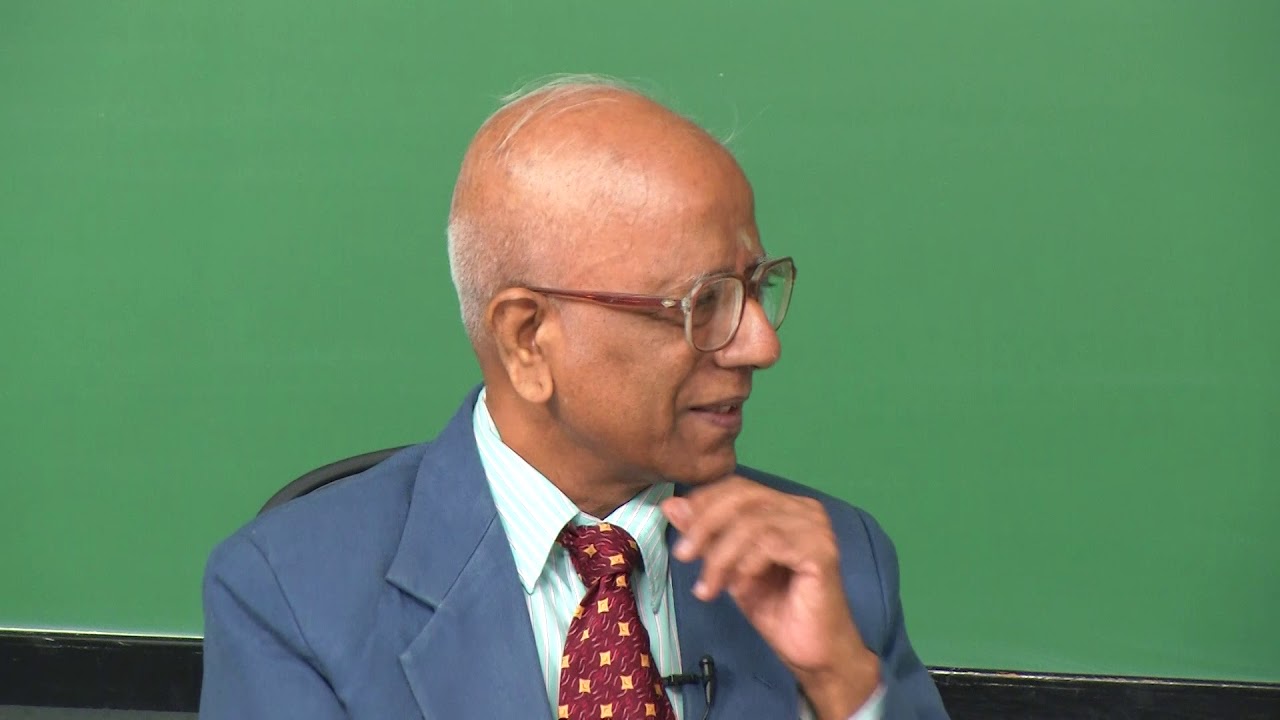
Prof. E.G. Thulapurkar (Retd. faculty, Aerospace Engineering) in conversation with Parvathi (student)
Good morning sir.
Good morning. I am Parvathi.
So, I guess we will just start off with the questions. Yeah.
So, to...from the beginning, could you just
tell us a bit about your career, where you studied,
and the...your reason for joining
the Aeronautics Department so early on.
I did my B. E. Mechanical from
Vikram University Ujjain,
of course I studied in Indore. Ok.
and...in 1964.
Then I joined IISc Bangalore.
For M. E. in Aeronautical Engineering. Ok.
And that I completed in 1966.
And then I was looking for some industrial experience in HAL,
for...before taking academics,
but that year there was an inci...that
there was a heavy devaluation of the rupee
in June 1966
and therefore, there was sort of job freeze.
And so, I could not get into HAL, but then
NAL had offered some...this fellowship.
Research...Senior Research Fellowship,
so I was there for about four months
and then IIT Madras was hiring but...for...
because the department was coming up.
So, I received a...senior Professor G. Subramaniam joined in
July, I think July 2000, July 1966.
Then some other Professor R. M. S. Gowda
and T. K. Varadan joined later,
and then I joined in January 1967. Ok.
Yeah, and of course that was the...
but then I have continued here.
Ok, and what was the reason for choosing the aeronautics branch?
No, that was after B. E. we were just
thinking aeronautics, one of the
advanced topics and so on. Ok.
So that glamour
Yes, sure. ...glamour yeah.
Ok and so, when you joined,
the department was in its nascent state then. Yeah.
And so, who were the faculty members,
the Head of the Dep...could you just give us a feel of the department yeah
at that point of time see
I would just like to mention at this stage, that
Professor S. R. Valluri,
Sitaram Rao Valluri,
he...he joined IIT in 1964,
he had done actually M. E. from IISc,
and then he did some work at CalTech.
California Institute of Technology,
and then, in many American institutes they have
Department of Aeronautics and Applied Mechanics.
So, he started that department,
but it so happened that 1965, the Founder-Director of NAL,
Neelakantan, he passed away
and Dr. Valluri was requested to start
become the Director there.
So, at that time, he is 65 I think, he joined there.
Professor Balaraman, K. Balaraman
was there, and then D. V. Reddy,
they were there. But then an Aero they started
first batch in...'63 batch was taken
to enter, to take and so,
they were there, then 19...7...then after...by '66-'67,
they started having aero courses,
and so they were recruiting.
So, Professor G...as I mentioned G. Subramaniam and Varadan...
and '67 January I joined,
but there were other faculty members in Applied Mechanics,
like Professor B. H. L. Gowda, Ashwathanarayana,
and others were there. Ok.
Yeah. Ok, and Professor Santhakumar had mentioned that
in the beginning there was more focus on teaching than on research.
So, how did that affect the branch?
Yeah what happened was that...
six...yeah yeah...there is...it was Aeronautics and Applied Mechanics.
And, but because of that, it could get some German aid.
And so, Professor Armin Klein,
he joined I think in '68 or so. Ok.
And he got some facilities for this. Ok.
And then research could be done,
and at that time of course, there were not many
senior people here.
So, research was slightly...
there is also many of us who joined,
who had M. Tech. degrees and all that,
so we were doing teaching,
but soon after, that is why...what I felt was
that Professor Sengupto’s contribution was
to set up the infrastructure and all that. Yeah.
And the German professors who were here,
they were setting up laboratories,
which were later...
later became research laboratories and all that. Ok.
So Professor Sengupto did play a major part
in the development of the department.
Like, could you tell us any memories of him?
No I...I was rather a junior.
Ok, I mean I was a Lecturer, but still,
not so high to be in contact,
I did not have much with...we use to know he is Director
and he used to address sometimes, and all that.
But not...but this is what I say,
his role was to develop rather...
develop the infrastructure and all that,
and the German professors,
and as I mentioned Professor Armin Klein..
he had worked in Göttingen under famous Professor Schlichting.
He had worked, and so he came and then he
he got one good very good tunnel,
thats a return circuit tunnel
which is called Göttingen type tunnel Ok
and it was started...and on mid...I think early '70s it was
set up and many people used it for research purposes.
I had also used it, yeah. Ok.
Research and Consultancy Project. Ok.
And to talk about the building itself,
when was the department building built,
and, like was it extended at any point of time?
What...in that also, I would just like to give a little background. Ok sir.
See earlier, this Department of Aeronautics and Applied Mechanics,
but then in late '60s,
there was a committee, national committee, Ok.
which recommended that there should be
Aerospace Departments in many IITs. Ok.
And so, that IIT Madras also decided,
and then, in order to give more emphasis to Aeronautics,
it...it was decided to separate.
So, and also Professor Pandalai. K. A. V. Pandalai,
he was...he had worked in structures
and in Brooklyn Polytechnic.
So he also came and...
then a separate department was formed in...in 1969.
4th of April I think.
1969, the building was inaugurated
by the then Chairman Board of Governors
Dr. H. V....Mister H. V. R Iengar. Ok.
Yeah, so department was started, and then of course
we had...we had laboratories, space and all that.
And later Gas Dynamics Laboratory was...
because now we did not have much...
I mean we did not have German aid.
So, we were developing our own laboratory,
so Gas Dynamics Laboratory was developed, just nearby. Ok.
And then Rarefied Gas Dynamics, that was the...that area,
I will perhaps talk about that later. Sure.
Rarefied Gas Dynamics facility was erected,
and it was...it has been used very well.
So, that also a separate. Ok.
And something that catches the eye about
the Aerospace Department is the
aircraft that you have outside it.
So, how did the department come to get it?
No, see early...as you have also mentioned there,
that there was an old airplane.
So, old airplane was given by the Air Force
and...that, but that was rather dilapidated,
and so, we were looking for different airplane.
So Navy gave this, this is...airplane Navy has given.
So the one that is lying discarded
at the back is the one you got earlier. Yeah.
Ok fine, fine.
Then, could you tell us a bit about
Professor Ramchandran, the second Director.
Yeah, he joined in the late, I mean, towards the end of 1967,
and he did give,
I mean he gave emphasis to the research. Ok.
And actually...may...he was...he...
I had heard somewhere, that when he
joined, there were only 40 professors in IIT,
but when he left, there were about 100 or so. Ok.
100 professor...may...that number may not be correct,
but 100-120 professors were there,
and Aero also Aero Department also benefited,
senior people were inducted, professor level and all that.
Professor N. R. Rajappa. He did his Ph. D....
of course, he was here earlier in Maths Department,
he did Ph. D. in Stanford, and then he joined Aero Department,
then then of course, Professor Pandalai
as I mentioned he was there, Professor Damodaran
and A. Krishnan they joined.
But in '70...and then Professor T. K. Bose,
Ph. D. from Stuttgart, he joined
in high...gas dynamics and all that.
And then Professor A. K. Sreekanth from...what is that
it is called University of Toronto Institute of Aerospace Study. Ok.
It is a famous institute.
So he had worked there, and he came.
And then Professor N. R. Subramaniam.
He was a well-known scientist in NAL Bangalore.
So he...he came for four years - '71 to '75.
So this period, we had many people.
Inducted and so the department...
then the research activity started,
you know as you had asked for research,
Professor Klein was there,
then Professor Pandalai,
then this Professor Sreekanth, Professor Rajappa, Professor Bose.
Then they were guiding Research Scholars,
ofcourse, I did work with Professor Rajappa and all. Ok.
And to talk about your other activities on the campus,
like were you involved in any other activities?
Like were you a warden of any hostel or something like that?
No, I was the Assistant Warden in Narmada Hostel Ok.
From '67 to '70. Ok.
But afterwards, I was mainly concentrating on academics. Ok, fine, fine.
Then how was...like
could you tell us a bit about how it was to teach students
so early on in the department, like
how was the...how was their attitude towards the subject,
and a bit about your teaching experience?
Ofcourse, there I have some attitude like that,
if there...I mean my feeling is only about
10 to 20 percent of the students
are interested in a particular topic and pursuing it.
And so, I was happy if that was happening,
see we used to have only about twenty students,
about five-six students are interested,
so they would come and meet me outside the class,
and we would interact with them. Ok.
And and ofcourse, I gave,
ofcourse later I will come to my topic of
research and all, turbulent flows. Yeah.
I used to give courses on
introduction turbulence flows and their prediction.
There the students from various departments used to...
used to...I mean that is...they used to attend my classes,
and actually I used to give them notes,
and those notes were circulated even abroad.
So people even there, they used to study me,
when I went to University of Maryland,
they said we are studying your notes and all. Ok.
So, that way it was one happy experience. Ok.
But there were some students who may not be interested,
so that is how...and because
everybody is not interested in every subject.
Do you have any other
memorable incidents that you still remember
from your teaching career,
anything specific sort of? Yeah.
No, not...means...I was rated as one of the good teachers and
that some students would come, and there was
some good students, one is one S. P. Vishwanathan.
He did it in '60...no '70, 1970 batch
he was, and then he was in Boeing,
he was in Boeing and all that,
and he used to do,
but even as B. Tech. student, he did some work
which was later used, you know the winglets.
Winglets on the airplanes,
he had thought about it here.
And then he went there,
he went...he was in Lockheed no...
he was in Lockheed, I think
he was in Lockheed Martin,
and then he was nice.
I had his notes,
see he had...he used to write nice answer...he...
his assignments used to be good,
so I had kept them.
And then in 2004, he came here
as a Visiting Professor. Ok.
So I showed him, and he was very happy,
very happy to see his notes, yeah. Ok
And, one more thing sir, Yeah.
we understand that there was a brief collaboration with
France with...for the department.
So, how did this affect the department?
Yeah, that...no, it was useful. Ok.
And that is...it started in mid-1970s
and Professor Pandalai was Director from '73
to...he was the HOD...first HOD of Aerospace,
then '73 he became the Director.
'73 to '77 he was the Director,
and since Aero did not have any aid,
he...although he had inspired us to
develop the laboratories on our own,
but he also procured this...
or rather he was instrumental in getting this collaboration.
So...we of five people visited, under that,
so Professor Gowda, S. Santhakumar,
then S. Krishnan, P. Venkateswarlu and myself,
we went there for a varying period. nine to... Ok.
nine months to 15 months or so,
we used to...we went to some of the very important laboratories
and did, and then they gave a shock tube.
I forget which institute they gave,
right, they gave a shock tube in that
Professor...for that Professor Sreekanth and Dr. Kurian,
Job Kurian, they went to France
then they brought it, and set it up.
So it was only a small collaboration,
ofcourse there was a very interesting...
then once we asked one of the French Professors
that "Why not extend it?"
They said, "You bought some French airplanes,
so we gave a collaboration.
You buy more aeroplanes, we will give you more."
So, it was... Ok.
So, now we could, we would like to move a bit
on to your fields of research.
Yeah. So, could you tell us a bit about your major areas of interest?
Yeah, I have been working in the area of
Turbulent Measurement and Computation of Turbulent Flows. Ok.
And so, I have given,
actually invited lecture on...on this topic,
or on turbulent flows for one week
short term courses, for major aerospace industry
that is NAL in 1987, ISRO in 1991,
and then DRDA in...I think 1996, HAL in 1990,
and also I...abroad I have given lectures on this subject,
turbulent flows and their prediction.
And then I gave advice to ADE
Aeronautical Development Establishment
when they...who were developed this LCA airplane,
that is what model should be used for
computation of low pass airplanes.
And that has also been published as a review article
in 1997, in Progress in Aerospace Sciences. Yeah. Ok.
So, like, could you tell us about your first research project
and how was it to get funding and other support for the project?
I would just like to give a background. Sure.
That...you see in mid-'70s,
The Government of...the not...Ministry of Defence,
they established this...there is one board,
Aeronautical Research and Development...
Development Board, AR & DB.
So, this, and on this was rather
they would fund open ended projects, research projects
and all, not exactly application oriented.
And so...and they were also visual,
they had people, eminent people from IITs and IISc, NAL,
and various people, and they would give projects.
So, Professor Sreekanth got a project for...
I...this rarefied gas dynamics facility. Ok.
Because that was not there in the country and actually...
and when it was built in early '80s, I think.
So, it was one of the best facilities in the South-East Asia.
South-East Asia and then ofcourse,
the shock tube was also there,
that was also updated under this ARDB projects.
And I had a project in '80...
'84, I had first project from ARDB, wave boundary layer interaction.
So, we did studies on that,
and under that, we lot equipment.
See, the main...as I mentioned, ARDB
was very generous in funding,
and also, they didn't ask for...you know applications immediately.
So, because I had also gone to France and that...
I had also done something work on turbulence and all that,
and so that was very helpful to continue,
then it was a four year project,
we did some work, published many papers,
and yeah, after of...subsequently
I had a project from Volkswagen Foundation.
For flow study inside cars...inside,
because outside people have studied inside,
so for that, we got a equipment...laser Doppler anemometer. Ok.
Laser Dop...so we were able to get this
latest equipment with the help of these projects. Ok.
So, when you look back on your research career,
what is it that you find the most memorable,
or most successful sort of?
That is, I was also...I was trying to involve many...
I was also involved in Computational Fluid Dynamics,
of course Professor T. K. Bose and
some other peoples...people will also be there,
Professor Ramakrishna, M. Ramakrishna
had joined our department in 1990,
and so CFD, that is Computational Fluid Dynamics
was becoming a very important area.
And so, we brought...we...and this was being,
the research was being done in various departments.
Aero...Applied Mechanics, Civil, Mechanical, Chemical, Mathematics,
and so...Metallurgy also.
So we brought toge...people together,
and then proposed a big project to DST,
and they gave us a three crore project.
So, to set up a CFD centre ok.
That was project was given in 1998,
and then centre was...centre started working and all that.
And ofcourse, at that time there had been this,
India was not being high speed computers and all that,
high, so we took help of DR...
there is a DRDL Lab called ANURAG. Ok.
Advanced Numerical Research Analysis,
so they built a supercomputer. Ok.
Supercomputer for our purpose,
of course that it was super...at that time,
but now it is, of course, ALDR this C-DAC
Centre for Advanced Computing in Pune, they also had.
So we got that, and then we worked, about 25
staff members from various departments,
were working together,
and we did computations for various industries
and all that...GTRE Gas Turbine Research Es...
so we had some six-seven projects from them.
Then DRDL, DRDL Hyderabad.
We...and many other...you know, in some industries also
we developed some codes and all that.
It is still there, centre is there.
But then...I will come to that, later also.
Some things...what happened.
And one other thing I would like to know is like
how was the collaboration with other departments then?
So...like the interaction, teaching or research,
could you tell us a bit about that? Yeah
As I mentioned here, that, I mean see
Aero we had four-five people who were working,
the...actually the...the CFD centre,
coordinators also, there were five coordinators. Ok.
Five or six, six coordinators,
and they were from different department.
Aero of course, we...because I was the Principal Coordinator,
Aero there were one more Ramakrishna, Yeah.
And then Professor Sreenivas Jayanthi from Chemical Engineering,
then Professor T. Sundararajan from Mechanical Engineering.
And somebody else...
but ofcourse, one more person was there,
so five-six coordinators...and then, we had good relationship. Ok.
People from Mathematics and all that,
so one Professor Usha in Mathematics, Yeah yeah.
she...we have worked with her
and we have published, I mean several papers together.
So otherwise people they think that
Maths people you cannot...work with them...with them easily,
but now we...we, but with, understanding it was possible,
Metallurgy people were there. Ok.
So it was...there about 25-30 people were,
you know, using the facilities, students would use,
and, we were doing problems of industry by solving... Ok.
And one other thing, like the FRP Centre was
set up around this time,
so were you involved with it in...in any form?
No, that was a slightly different area,
but the history as I...as I see about it is,
that in 1972, I think it was 19...
this CSIR, you know Scientis... Yeah,
Council of Scientific Industrialists.
I...I think that it was having Silver Jubilee Ok.
in '72 or '73, somewhere around that.
And then Professor Pandalai,
he was given a project by CSIR.
Silver Jubilee fund, that to start a Centre for Composites...
Composites...FRP, FRP means Ok
Fibre Reinforced Plastic, Ok
this research centre was started in 1972.
So...and then he...he...it was attached to the Aero Department
and some two-three people were...
one Professor Kunukkuseril...Xavier Kunukkuseri he was... Ok
he...he was there and some others were there,
and he mentioned about Professor Nair or somebody,
so Nair and others were there.
And then in the active...they did very good work,
industry and others were...they were developing manpower,
they were they develop...
and also did lot of work for others,
they acquired equipment
which could be used by industry and others. Ok.
And so, in order to further encourage ARDB I think,
ARDB gave funds to have more equipment, more faculty,
and also three-four people from from other department also. Ok.
So, people from Aero were there,
then people from Metallurgy, people from Civil,
So three-fo...they used to work,
it became interdisciplinary centre, Comptech,
it...then it become Comptech in 1997. Ok.
And it was doing, it was doing good work. Ok.
Ofcourse, I will come to it later, what happened to... Sure, sure.
what...some problems came up, yeah.
And sir, moving on a bit to your life on campus,
did you stay in campus during those days? Yes, yes
ofcourse, as Assistant Warden I was here and then,
afterwards I had...I was in Taramani Guest House
for some time, and then we moved after marriage,
and we moved to quarter, that was in D-Type,
then C1-Type and B-Type.
It was a nice...ofcourse,
my wife was also working in KV-IIT. Ok.
And son was study...son was studying in Vanavani.
So, we had...it was very lovely, Yeah yeah
ofcourse deer would come into our camp...compound and all that.
So, like anything else, like how was the...
was the OAT...did you go for the movies at OAT? Yeah,
we used to go, we used to go every week and all,
even after retirement I used to go for some time,
I used to go. Ok.
And looking back, could you identify any
exceptional research scholars and
any experiences with them?
People you still remember from your career?
Yeah, now...I would mention about Dr. Gangan Prathap.
Gangan Prathap you might have heard of his name,
he...he...he...he was first in JEE in 1969. Ok.
And then he joined Aero Department,
and then he was first in B. Tech., Ok.
I think President's Medal, yeah President's Medal he got,
and...Gangan Prathap...and then he
joined our Department for Ph. D.,
then of course he did Aero B. Tech. Aero,
so first time anybody from Aero had stood first. First
Stood first in IIT, and then he
joined for Ph. D. under Professor Varadan. Yeah.
Varadan in Structural Mechanics and all that,
and he finished Ph. D. in four years.
In the '78 he had finished his Ph. D., then he joined NAL. ok
National Aerospace Laboratories, Bangalore,
and he did work in Structural Mechanics and all that,
he...he got Bhatnagar Award and many things,
and he is...he is one of the I...I think he is the only from Aero
to get the Distinguished Alumnus Award
and so, he has made... Ok.
so he was...of course, I had very good students,
they have published some papers and
some of them, they remember and all that.
And, I have...I mean, I had also a good
experience with M. S. scholars. Ok.
See, what happened, M. S. scholars most...
many of them are from other colleges,
not from IIT, because our own students used to go abroad mostly.
So, the M. S. scholars I found them
very, I mean and that...are hardworking and also
willing to listen and all that, learn,
and then I used to publish papers with them
and so, it was nice.
So we have published several
papers in international journals,
and done some good work,
industrial work and all that. Ok.
So, Ph. D. scholars also have been good,
I had one person from Iran. Ok.
So, he... From Iran.
Yeah Iran, he was a student of Iran.
So, I had good relationship, and yeah. Ok.
And now looking back at the department as a,
could I...could you identify like two or three
major implications that the work
has had on the aerospace industry,
like department has had on that industry?
That as you see, this CFD Centre
which was there, Yes
it was...it...it did...I mean projects
for DTRE or DRDL and many other research.
even some private...these on metallurgy,
the...the Institute of Metallurgy Company,
they m...they mould and all that.
So, they ha...they were having an imported code.
But then, they wanted to make changes
and they...and it was becoming costly,
so IIT people wrote.
IIT people wrote a code for that, Ok
that is you know, it is a very complicated,
the...in the mould, the molten metal is coming,
it is freezing, and so, phase change and all that.
And so it was completed already...Professor T. Sundararajan of
Mechanical, and Professor what is his name, Prasanna Kumar. Ok
Of Metallurgy. You know Professor Prasanna Kumar, Yes yes
he is still there I think, he is still the faculty yeah. Yes.
So, Prasanna Kumar, and Sundararajan and others,
they did project for industry
and so, that was one thing.
Then, yeah and department, yeah
this...I...what is that...yeah rarefied gas dynamics I think,
that was the unique in the
neighbourhood country and neighbourhood.
So, a lot of research,
interesting research for ISRO was done. Ok.
And then shock tube also, yeah the...
because we...we have at high...high...high speeds
and all that, you have the shocks
so the, when we had updated facility.
Just to give you an example in that
rarefied gas dynamics facility...you have a jet of air,
it expands at a certain rate,
in this ordinary atmosphere. Yes.
But in the rarefied atmosphere,
it expands much...much...
much faster...wider, it becomes wider,
and then in a...in a...in a satellite,
there are small jets to correct its rotation and all that.
There are small jets.
Now, these jets are...when they are fired,
the...that jet will come,
and that jet should not hit the solar panels.
So, that kind of studies people have done, and so on
and then another thing was,
our Professor, I didn't mention our Professor S. Krishnan
Professor S. Krishnan joined IIT say '68-'69 or so,
and he did lot of work in propulsion. Ok
So, he developed his Rockets and Missiles Laboratory.
There, they did lot of propellant tests for propellants, for DRDL.
And DRDL was given propellants,
which were more efficient,
you know...you know the specific thrust,
there is a term called specific thrust,
so they had more specific thrust.
So, he did lot of work along
with Satyanarayana and others.
And then the gas dynamics and other laboratories,
the Professor Sujith, R. I. Sujith
he did lot of work for...consultancy work for ISRO. Ok.
ISRO, so department made
Parvathi: Quite a lot of...[Indistinct Dialogue] Yeah yeah.
Parvathi: Ok, and Because you know, and one thing was most of the
aerospace organizations they had this embargo.
So DRDL was not getting technology from outside,
ISRO was not getting technology from outside.
So, our peop...and even nuclear research
you know that is Kalpakkam and others. Yes.
So they...they were denied in this thing,
our people were helping them.
See people from...and the
the flow inside the reactors are complicated.
They have different material sodium, liquid
sodium, and with a different type of fluid and all, so
flow inside that and complicated flow.
so people have been solving those things...problem Ok
Sir, and one other thing, like with all your experience
in the field, like could you tell us
like two or three qualities that you think
an aerospace engineer should have,
just looking back on your experience?
I see, you know aerospace what we try to do is,
it is...it is something at the cutting edge level.
So, we give them general background. Yeah.
That is because...but at the same time,
they are given more fundamentals and computational skills. Yeah.
Experimental skills, all the fundamentals, Yeah
computational and experimental skills, we...
so they have good mathematical background,
because this, you know computational fluid dynamics
or aero dynamics, or structural mechanics,
they involve advance techniques, Yeah.
finite element methods and so on.
So our students have given background in
computational techniques and also mathematics.
So, they are able to solve problems in different areas,
and also they go to different areas. Yes.
Our students have been going to different areas
and doing very well, even one of them,
there is one...Sumantran. Sumantran, he was
he...he was in General Motors.
He was...he was you know...and then he came and he was in...
he was in Tata Motors. ok.
And this I think Nano and all that
were...he was...he was one of the
persons who...he lives here only I think,
he...he...in Besant Nagar, but he was been...
So he was...so like that, there were our,
they have general background.
So, they are able to fit into various areas.
And, looking at the situation of the industry right now,
how do you think 'Make in India' and the increased
external investment will help the department, and the industry?
Now, as I have mentioned earlier, that
our people have been helping the aeros...
I mean that aerospace laboratories and R and D,
because most of the aerospace is actually is like
they do R and D, and then they produce,
it is not much of a mass production,
but you know, the satellites are made,
but there are problems, our people have been solving them,
and even this...some time back, they have...they...
they have flown that reusable vehicle. Yeah.
So, some of our people have helped in that, Ok
they have done some problem, here...here and also
DRDL the...the some of the missiles,
they enter the atmosphere.
So how that...what should be the
type of material for the heat shield and all that,
so many of these...and even as
I mentioned, nuclear power also.
So people have been helping,
so, there is a potential available.
So if now, other people also, they have some problems,
they can come, and our people can tackle them. Ok.
So that may...that Make in India,
where it is not Make in India, just producing,
but if there...there will be technological inputs,
so I do not know, this maybe this, our Research Park, Yes.
they must be helping them.
So, and if some of them,
ofcourse, I am not sure whether aero people
are involved with them, but they can be involved
and they...there should be...that should be,
and they should...I mean...that is, they should design and make. Yes
Ok, you are saying it should not be just Make in India. Just making.
Ok Ofcourse, in making also if there are any difficulties,
our Production Engineering and other...
a Manufacturing Eengineering you know, MES. Yes
People are there to sort out those problems.
So, to just close off, could you just like...
what would you like to say it to the young aerospace engineers
in campus, and like everywhere around?
What...see when I become a HOD in 1995,
I was finding that some of the younger people
were drifting in...away from research,
so, then what...what...I tried to do something,
and so Professor Sujith,
in '95, he joined and then Professor...
now they are Professors, Satyanarayana Chakravarthy.
They joined during that period.
So, I used to, when they came
and met me after joining,
I told him that, "You concentrate on research,"
because what I told them is that IIT teaching
is different from other colleges,
Because here people do research.
People are doing research
and the research findings they percolate into teaching.
So that is how the teaching is much...at a higher level.
And, how to keep on doing research, I told them
that there are simple...I mean two simple ways,
but practical, that is you try to publish
at least two papers in journals in a year.
And second thing is, you have two projects at a time.
Because some people are not taking project,
even now IIT not...I think the...only about...
not even half these faculty are having projects.
So, with the projects, I told them
"You will have...you can buy equipment,
computing experimental equipment
or computing resources
and then you can also have students."
See IIT has limited number of students,
but if you have project, you can have a student
on the project and he can do M. S. and Ph. D.
So...and there were some other freedoms also,
you can travel, and all that.
So, have two projects at a time
and...so this advice was...
was followed by Sujith and Satyanarayana,
Sujith has done very well, he...he two years ago
he got that Mid-Career Research Award.
Ok IIT has the awards you know.
That...the initial award and then,
Mid-Career and then senior people get
some Lifetime Award and all that.
So he got that award, and he has even published
more than 100 papers by now,
I had just told him,
that "Try to publish hundred by...try that
target of 100 before you become 50."
So, he...he came and told me
the other day that he he had achieved that.
And Satyanarayana also has done very well in...
he is very well known...abroad,
and in the country also.
And he is now the...almost he is the leading...Principal Coordinator
for the 50 crore centre on combustion research.
There is a big...it...it will be inaugurated I think soon. Ok.
You might have heard by the side of Aero Department, Yes.
There is the Centre for Combustion Studies,
so, he has been given that project,
and so, they are doing...they have done,
then they have been editor of journals,
and so they have...both of them have done very well.
So that's what I tell you know, our younger people also
when I met them that, because some people say,
"No we will not do project," and all that.
But I tell them, "Projects have their own..."
even projects help the Institute, and we solve problems
which are needed for the country and all that. Ok.
So I have been telling that,
and that was...they followed and it is
having a seen this way.
Now, Sujith is...has...recently you might have see in
last Sunday’s Indian Express that,
Sujith and his students, they have...
they have been studying this combustion instability.
And now, they have developed a scheme,
or a method...that how to...because
sometimes, this instability sets in, and engine stops.
To prevent that, they do all sorts of...
they...I mean, they do use it under efficient yeah...
under capacity and all that.
But now they are, they have given a...yeah, they are coming up
with a scheme that it can be...warning can be given.
Warning can be given, it came in last Sunday
Indian Express and all that,
and so, of course, they are going to have patent and all that.
So those things, they are coming,
that is we should develop new things
and then make patents and all that. Ok.
So before we end, anything else that, you would like to say
to the people who are watching this?
So, about your having had such a long career
in the department, and looking back,
anything that you would like to say to us?
Yeah that is what...
yeah I think you had asked something,
now, the working together...
yeah [Reads From Paper] see...yeah working...that was...the anything
[Reads From Paper] I would like to have accomplish
[Reads From Paper] accomplishments of department. What happened was,
that yeah since 1990s and so on, the funds are available.
That is...when you propose projects and all that,
so you can get big funds for equipment,
for computing resources and so on,
but to make a mark, what was...
what is needed is, to have a group. Yes sir.
And the interdisciplinary group.
So, CFD centre we started,
and so, as I have mentioned 25-30 staff members
from various departments would come together,
discuss together, and see, somebody working
in metallurgy, he may have some problem,
but same thing can be...same...
that method can be used in some other.
So, that was that...what they call
cross fertilisation of ideas and all that.
So that was going on,
and it went on for some some years.
Similarly there is the there is this...this Comptech
Comptech there are people from Civil, Metallurgy and others.
Then, the CFEAD there was a centre called
Centre for Finite Element Analysis and Design. Ok.
CFEAD. It was in civil line,
but there were people from aero
and other people were there,
even Tata Consultancy had given them...
some students used to come.
That is, they used to depute their staff
to do M. Tech., and all that here.
And there was one MSRC, Material Science Research Centre. Yeah.
So these we are bringing together
from Metallurgy, Chemistry and other places.
But somehow in 2004, something happened
and the IIT was trying to say...
yeah of course, I was I think I was mentioning in something
which you...you felt you could not do before retirement,
I think that is the point I was...
that question is what I had written down this.
So, 2004 this idea somehow it came,
that the centre should be attached to the departments. Ok.
2004, and I have...
I thought that was not a good idea,
but after I retired in 2005 first time,
of course, second, then re-employed
and first time at the age of 62.
So, 2005, I could not prevent that.
And then these centres were attached.
CFD centre were attached,
Mechanical Engineering Department
Comptech was attached to Aero,
MSRC was attached to Chemistry,
and CFEAD was...they...they didn't like this idea,
so they closed, I think they...they said...
they...they...they they sort of...people said you know ok,
we...we will do our own.
But what happened with this attachment,
the interdiscipline nature stopped. Yes.
So now, CFD Centre in Mechanical Engineering,
the people from Chemical and all the
other departments are not coming,
he said, "It is department of Mechanical,"
and Mchanical Department says
"Let us have...it is a part of the department."
So, it is like one laboratory.
So, funding was also gone,
Comptech also these people from Civil, Metallurgy
they went away, they...they same MSRC,
which is all other people,
Metallurgy and other people
they had lot of costly equipment,
they...they have gone away.
So, this was not, this is...this I felt was
not a good thing, I felt, I...even now I feel sad about it,
but now of course some new centres are coming up.
This Combustion Centre is coming up,
and then I think Biotechnology also they have some...
so, I only wish that these centres
and interdisciplinary work blossoms in IIT. Sure, thank you.
Ok, and that's all sir, so
Yeah. we come to the end of our interview.
Kumaran Sathasivam: You had mentioned something about the FRP Centre, sir.
FRP had become Comptech, FRP in 1997,
because to give it more importance,
it was made Composite Technology Centre, Comptech.
that also see, Comptech had people from Aero,
people from Civil, people from Metallurgy,
I know they were there,
but now once the centre was attached to Aero Department,
it became...the funding was small
and also other people said "It is Aero."
So, it was. So the interdisciplinary nature was not there.
That interdisciplinary nature was...
so this was...now anyway some...it's coming,
new centres are coming, this Combustion Centre
they are Mechanical Engineering people, Aero people,
and maybe Chemical Engineering, they...they will be there...there.
so that is needed...interdisciplinary studies,
our way of working is important,
because people come together
and they can do bigger projects.
See what happens is IIT Kanpur,
they had some Professor Biswas,
of course he has now left
and he has become Director of IIT Guwahati.
But Professor Biswas, Professor Muraleedhar,
Professor Muraleedhar, Professor Eshwar,
but of course, he has also gone to IIT Hyderabad,
The Head of Mechanic...
But there some of them, they came together
at IIT Kanpur, and then they developed course.
See to develop a course,
you need a team,
and you need also some ideas,
because different people have different ideas,
so what they have...what they had achieved was,
that BARC, BARC had developed some code. Ok.
Now, these people develop a parallel code,
and then they would compare.
See the...so that is called...I mean
in computational fluid dynamics, that also is needed.
You give it to two teams,
and they develop course,
and then they...inter-code comparisons,
and there will be some other things.
See, how they are tackling some of the computational difficulties,
so that was, of course they are also...
these people have now...they have gone
to different places, Muraleedhar is there,
but Eshwaran has gone to Hyderabad,
Biswas has gone to... Ok.
But that is needed.
So people coming over together,
then only they can do good codes.
See, abroad some of the professors
and others are developing codes,
they are forming companies,
that is because they...they have
they...they work together and yeah,
so that is what is...interdisciplinary...working is needed. Ok.
Yeah. Ok, that's all sir.
So, thank you so much for spending your time,
No, it is ok. Ok, thank you.


- Contribute
to the Centre -
 Monetary
Support  Digital
Material
