Prof. J. Sobhanadri in conversation with Prof. Vijayan and Ms M. Mayarani
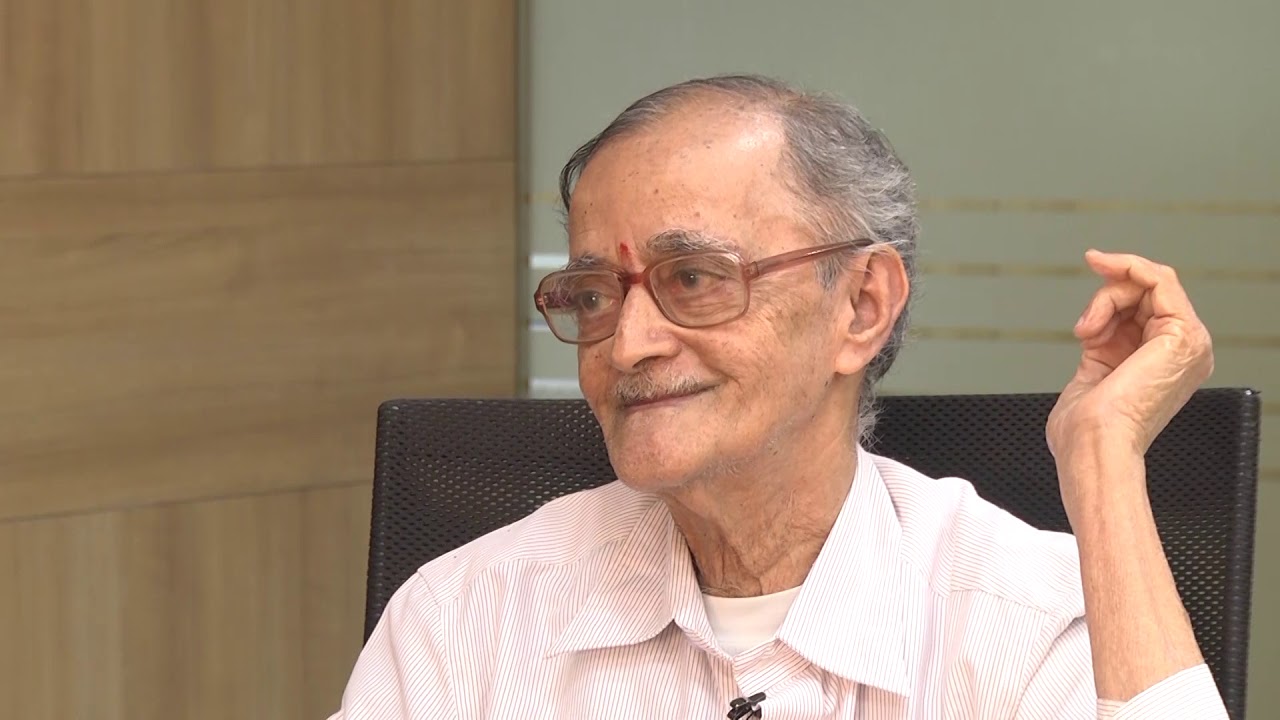
Today, we have Professor J. Sobhanadri with us,
who has been a very active faculty member
in the Department of Physics, IIT Madras
for a long duration - 1962 to 1995.
During this time, he has taught several courses,
developed several laboratories; in particular,
the microwave laboratory,
and he has published several papers and guided
many students who have come…
who have later become academicians,
Professors and scientists all over the world.
Professor Sobhanadri was also the Head of the Department
for 4 years in our department.
So, we are very happy
that Professor Sobhanadri could visit us and talk to us…
he will…and he is willing to talk to us about
his experiences and the
important aspects of the history of the Department of Physics.
Sir, we are very happy to have you here,
we have…I am Professor Vijayan from the Department of Physics,
your old student.
Prof. Sobhanadri: Yeah. Prof. Vijayan: He was also my Ph.D….M.Sc.
project supervisor for the M.Sc. dissertation.
I had done M.Sc. and Ph.D. in our depart…in the Physics Department.
We also have Mayarani,
who is a student,
who did…who was an M.Sc. student here and later she continued
as a research scholar, she is continuing as a research scholar here,
probably because she liked the department very much
and she would like to know how the department has
become so likeable and what
is the contribution of Professor Sobhanadri in that.
So we will be having an informal conversation with Professor Sobhanadri.
Yeah, I am very happy to be here, being interviewed by old student.
And also, another M.Sc. student to the old students.
We have in the audience also some of my friends here.
I am glad that I have been associated with IIT for so many years.
In those days,
we didn’t have the mental set up to move to
another place after joining IIT
so with that thing I joined IIT,
I wanted to develop IIT
and I continued like that till I retired in 1995.
I am here to tell you anything
starting from my childhood, which I can share with you also.
We are curious how you came to know about IIT
and what was your educational background
before that, and how you came here.
Before knowing about IITs,
I had a school education that…at that point,
I didn’t know that there are IITs.
At that time, we were only thinking that
I should complete my schooling and college education,
and go to a university for higher studies
and Andhra University was my…in my mind.
After I completed Andhra University,
I also joined there as a lecturer.
And when I was working in Andhra University,
this advertisement about IITs has come.
Earlier some IITs were started, probably
Kharagpur, Kanpur were there,
but Madras IIT advertisement came at that time.
And we were happy to choose that.
Luckily, I got the selection in the first trial,
that is how I have come here.
Ms. Mayarani: Sir, you were…you were a faculty member here in 1962. Prof. Sobhanadri: ‘62.
Yeah, So that time,
when you look back and when you see the new infrastructure
and the new instruments that we have bought
to the department and things like that,
what is the…the change that you see actually,
I have been here for…now for five and half years
and in this five and half year time itself,
I can see lot of differences
that happened in terms of infrastructure
and so…and the number of faculties and so on.
So what is the difference that you see, and how happy
you are to see this differences in this campus?
During last 5 years, we have a lot of money in the country,
and so, we are buying a lot of instruments also
and some of the instruments we don’t even know how to operate also.
In the earlier days when I was a student,
there were not so much money,
so many instruments also there,
so we have to grow the instruments,
we have to make the instruments ourselves.
So that way, we have interest in assembling instruments,
knowing what they are, how they work, the background is different.
Ms. Mayarani: Yes, yes, yes. Prof. Sobhanadri: You are now in a
Prof. Sobhanadri: a affluent society. Ms. Mayarani: Yes,
Prof. Sobhanadri: You are a…thing is different Ms. Mayarani: Yeah.
We are curious to know what kind of
major equipment was there when you joined here?
When I joined here, maybe if you go to the beginning,
there was only one building;
the Civil Engineering Department that we have even now,
that was the building which was available when I joined.
The Director was sitting there,
all the faculty…few departments were working there,
Physics Department also worked there.
So when I joined there, that was the thing.
Next couple of years,
the other buildings were constructed, and after that,
instruments started coming.
In the Physics Department,
what were the major instruments at that time?
Prof. Vijayan: In ‘60s. Prof. Sobhanadri: All the instruments were unpacked only after I joined.
Instruments started coming because the German aid has come,
as part of the German aid,
they started sending the equipment,
and one by one faculty members
have to open it and make it function.
So, faculty were also recruited around that time.
’59 IIT Madras was started, 1962 I joined.
And along with me, several of other faculty members also joined.
Professor Sivaramakrishnan joined at that time,
Professor R. Srinivasan joined at that time,
only Professor Ramasastry was there…before at that time.
So we all joined in…around 1961-62 time; that is when
we started the construction of the department.
What is the...like, these days we know the working style is
different from earlier style…that like…we saw that
you have been able to publish lot of research papers
and conduct very good research work even that time,
when we didn’t have many instrumental facilities and all that.
So what was the working style back then?
Working style was, for example,
I think sometime later I will go to my Andhra University life also.
At that time, for example, when I joined,
I was interested in electron spin resonance.
We didn’t have any equipment here.
Kanpur IIT got an equipment,
they got it also from America.
But they opened it, we have not done it here.
So what I did was, Hariharan was our first student.
Hariharan was also an old M.Sc. student,
the first batch M.Sc. student who joined for Ph.D..
So, we used to go to IIT Kanpur, conduct the experiments,
couple of times I went, later on,
Hariharan stayed there for a couple of months.
After coming back,
we analysed the experimental result
and started publishing the papers and the thesis.
So to start with, the equipment was not there,
we started a research by going to IIT Kanpur in the ESR [indistinct]
that is the first experiment we have done.
And do you remember sir,
when was the first publication that happened?
First publication…M.Sc. students used to do some projects at at that time,
after I joined in ’62,
first batch came in ‘64 I think, ‘64 yes.
Then…the M.Sc. students used to do some project with me.
One…one lady by the name Meera, she has become a Distinguished Alumni of
our department also and I [indistinct] she is in Missouri,
the public…first publication was with her, along with Hariharan.
Prof. Sobhanadri: Hariharan, myself and Meera Ms. Mayarani: Okay.
published the first paper in Current Science, sometime in ‘66. I think.
You were mentioning about the publication in ’67,
with several colleagues,
is it this publication?
That is Professor Ramasastry when he joined the department,
he was interested in developing magnetic resonance;
Electron spin resonance particularly.
So around that time only,
some of my friends in Andhra University also joined here as faculty.
Not faculty, demonstrators in those days it is called.
Professor S. B. S. Sastry joined,
Professor Y. V. G. S. Murthi joined.
So, myself, Professor Sastry and Professor Murthi;
We three…we three of us
got some data, Professor Ramasastry collected somewhere,
And [indistinct] though we three together analysed the data
and published the paper. That was the first paper
published by all the four of us.
1966, I think.
And so also, the way faculty and students interact;
Do you think there are much changes in the interaction between
a faculty and student from the time when you were working and then
the time…like the present time…
Very much, very much, very very much.
See those days, we were all interacting as a one family,
the whole department was a family,
we were not thinking whose laboratory you belong to.
Also, my tuning is…when I go back to Andhra University,
I will tell you those stories also.
My tuning also was to see that it is as a whole, a family.
So Professor Ramasastry was a leader at that time.
Myself, Professor S. B. S. Sastry, Y. V. G. S. Murthi,
we were all working together.
All the three of us working as research scholars only,
trying to do what…at a whatever data we have used to analyse,
then, we also think about how to teach the students,
because we also started getting the classes;
Laboratory and other things.
So we were working as a team.
So there is no thing.
Apart from our people,
Professor B. V. Ramanamurthi was there, another senior member.
He was looking after the X-ray Laboratory.
So he was also interacting with us.
So…which was like a family only,
Prof. Sobhanadri: because it is a smaller number also. Ms. Mayarani: Yes.
Now, we have several laboratories which are doing very well,
do you remember the early laboratories
which were started in those days?
Yeah, those days there was only two laboratories:
one is organized by Professor Ramasastry,
that is, he wanted to do defect solid state.
The other one is X-ray Laboratory,
which Professor Ramanamurthi wanted
to initiate, though they are the two senior people,
and also some equipment was there in the X-ray Laboratory at that time.
But the initial stages the growth was very slow,
until it was 1962-63.
When did Professor Srinivasan, R. Srinivasan join?
Myself, Professor Srinivasan, we all joined about the same time: 1962.
Prof. Sobhanadri: He joined as Assistant Professor, I joined as a Lecturer. Prof. Vijayan: Okay.
So, he joined the…there and he started thinking of…
he was joining originally as a theoretical physicist,
because at the IISc, he was doing some theoretical work.
Then later on, of course, Low Temperature Lab came after several years.
Part of German aid.
Sir also, could you talk about your other role in the department,
other than teaching or a researcher,
you were also the Head of the Department for 4 years;
during 1980 to ‘84.
Before he answers,
Ms. Mayarani: Yes. Prof. Vijayan: I would like to say that
he was a very good active participant and supporter for all…all activities.
It so happened that there is an award given to him
which was signed by me,
because we were…we had a Research Scholars Association,
and even in that faculty members participated,
including senior people like
Professor Sobhanadri.
Sir, you can elaborate on…
Yeah, we used to have some quiz programmes,
and sometimes, lectures by students or research scholars also.
Even if it is half an hour,
they used to come and say
what they want to do and things like that.
So, one year, we had a competition,
in that competition,
even B.Tech. students from the other departments came and participated.
Professor R. Srinivasan was very active as a quizmaster.
Many of the research scholars including Vijayan,
was there at that time. It was interesting.
But it did not continue for several years you know.
As Head of the Department, I had some interest in such things,
so I allowed it, I encouraged it rather, not then,
Prof. Sobhanadri: everybody will allow, only thing is if you encourage, there may... Ms. Mayarani: Yes.
Prof. Sobhanadri: people like Vijayan who will come forward to do such things. Ms. Mayarani: Yes.
So it is sustained for only few years
I think. After that now,
they…you don’t have any vibrations or any such things.
Prof. Vijayan: Other activities and there…yeah, Ms. Mayarani: There were…
this is the one of those…that old certificate.
Prof. Vijayan: That is Prof. Sobhanadri: That was in ‘84.
Senior Professor in Head of the Department
Prof. Vijayan: getting a certificate from a research scholar…that is the situation. Prof. Sobhanadri: That is what I am [indistinct]
That shows how the senior faculty members also participated
Prof. Sobhanadri: Participated. Prof. Vijayan: in these activities, interesting activities,
extracurricular activities in the department, with the enthusiasm.
No, I…I think the…that trend continued until the ‘90s also.
Only after the ‘90s, some change has
started coming in…like competition and things like that,
and once the 2000 year has come, it even more difficult.
Before 2000, it was different, before ‘95 it was different,
before 1960, it was even different.
Also, could you please tell your other experiences in the campus,
like we have a very nice campus and
what are the…like, other than teaching and research,
Ms. Mayarani: can you tell some good memories Prof. Sobhanadri: Yeah,
or good experiences that you have had in the
Ms. Mayarani: department. Prof. Sobhanadri: See and…those interests vary
Prof. Sobhanadri: from person to person; Ms. Mayarani: Yes.
Prof. Sobhanadri: There were some people who are interested to be wardens, Ms. Mayarani: Yes.
Prof. Sobhanadri: some people who are interested in games and sports. Ms. Mayarani: Yes.
Like that it varies you know,
I was not associated with wardenship
or any of those activities.
I used to take interest in sports;
outdoor games or indoor games, like that.
Prof. Vijayan: You have stayed… Prof. Sobhanadri: We…we used to have a staff club also,
even now it is there.
Prof. Vijayan: You had stayed in the campus with family for a number of years. Prof. Sobhanadri: Yeah.
I think probably your children were born and brought up here?
Right, right, all the children were educated in IIT only.
We had two schools at that time: Vanvani School was there,
even now, Vanvani School there, Central School is there, CBSE
even now it is there.
So all my daughters got educated in campus only.
Then for colleges, they went to city.
We had good colleges also.
And then, two of them studied in IIT also.
All…all of them worked in IIT, two of them studied M.Sc..
Prof. Vijayan: Oh, I see. Prof. Sobhanadri: One M.Sc. Chemistry,
and one M.Sc. Mathematics.
My eldest daughter Nirmala studied M.Sc. Mathematics.
Prof. Vijayan: Oh, I see.
She did M…actually, she worked in the Computer Centre also.
The Computer Centre I think 19…
What time? ‘80s.
Around that time, they got…
Prof. Sobhanadri: they got the IBM mainframe system. Prof. Vijayan: Yes, yes.
She just completed her M.Sc. and joined the Computer Centre.
She worked with the IBM mainframe, at that time.
Prof. Sobhanadri: The eldest daughter. Prof. Vijayan: Nice.
So…nowadays you may not be using the mainframe,
Prof. Sobhanadri: you may not know Prof. Vijayan: Yeah yeah.
also, what a mainframe is also.
That was the time when mainframe was there in the Computer Centre.
How was social life at that time with your family and other members?
Social life was much better because,
number was much less,
so, we know each other personally,
Ms. Mayarani: Yes. Prof. Sobhanadri: Even families,
they used to meet quite often also.
So, life is not very fast at that time.
So we had time to spare in the evening, sometimes meeting.
In their house, or in clubhouse, like that.
The buses, campus buses used to take people up to Adyar those days.
Prof. Sobhanadri: Correct. Prof. Vijayan: Some people used to go for shopping.
That is true.
Actually, in the beginning, I didn’t get the quarters.
We used to…we have a house in Adyar,
We used to stay there.
And once the quarters got ready, then I moved there.
That was ‘70s I think, ‘70s.
The first quarters I stayed was…now
you call it as a ‘doctor’s quarters’ I think, opposite Central School.
Prof. Sobhanadri: They have some quarters. Prof. Vijayan: Yes, yes.
In that, I stayed C1-10-20 I think that’s the number.
Sir, could you remember different projects that you were involved
with during your career…like different research projects.
We have a…I…there is a
Prof. Vijayan: Yeah, there is a list. Prof. Sobhanadri: There is a project,
Professor Subramaniam gave a project projection.
Prof. Sobhanadri: The…the project. Prof. Vijayan: The general outline of
Prof. Vijayan: major work. Ms. Mayarani: Outline… Prof. Sobhanadri: Yeah, yeah, the major project.
The…the project culture was not there in the beginning in IIT,
because it was newly started.
But somehow, I got this idea of
applying for projects and getting it.
I was the first person for the entire IIT to get projects.
Prof. Vijayan: Oh, I see. Prof. Sobhanadri: To think of projects.
Then the Director was also thinking, what to do with this project?
Who will organize them? Who will manage them?
So, they…they identified a Deputy Director,
there was no ICSR at that time.
So Professor Sampath was the Deputy Director.
He took part in,
and he also interested in…both of us have some common interests
also; microwaves, electronics and things like that.
So he was in charge of the project.
The first project was a CSIR project,
to develop the nuclear quadrupole resonance:
NQR. And that was a big success.
Then, I got another defence project,
that was for microwave…development of the microwave range.
That started the Microwave Laboratory actually.
So these two projects
were the first projects which were organized by the
department, and they were good.
The people have done very well,
they are doing very well.
You had colleagues like Professor Murthi and Professor Rama Rao,
Prof. Vijayan: you might have interacted with them at that time... Prof. Sobhanadri: Yeah, yeah.
Professor Rama Rao has joined when
Prof. Sobhanadri: the department has grown sufficiently well. Prof. Vijayan: Oh okay.
So he joined as a Assistant Professor
and he got…with some experience in US also,
Before coming here.
And I was working NQR till then, but his field was NQR,
so I didn’t take any other students after that on NQR.
NQR was completely developed by
Professor Rama Rao.
You can say that in those days,
myself, Professor S. B. S. Sastry,
Professor Y. V. G. S. Murthi,
Rama Rao…K. V. S. Rama Rao;
they were the young and active people in the department,
trying to take it forward.
Prof. Vijayan: What were your main hobbies apart from… Prof. Sobhanadri: Main hobbies
Prof. Sobhanadri: is playing indoor games like carroms and chess, Prof. Vijayan: Oh, oh I see.
Outdoor games like badminton, cricket, mainly.
Ms. Mayarani: Could you share some
Prof. Vijayan: Anecdotes, Ms. Mayarani: Yeah.
Prof. Vijayan: incidents. Ms. Mayarani: Yes, yes, incidents.
Yeah, yeah, I…I want to start from my childhood,
Prof. Sobhanadri: probably that is better. Ms. Mayarani: Yes, yeah,
See I was born and brought up in a small place
called Vijayawada. Now it is a big place.
It was Bezawada on those days.
I was born and brought up in Vijayawada.
I studied in the school…in those days,
we don’t have elementary school.
I went to the school first time in…for the 5th class.
So 5th to 10th class, we were in the school.
Then, that was a municipal high school.
Not any convent like what you have these days.
Telugu medium…Telugu medium.
But then, afterwards, I went to a college.
Private college; intermediate that is called…plus 2 is intermediate those days.
SRR and CVR College in Vijayawada.
So, that was the first 15 years of my life
staying in Vijayawada only,
studying in the school and the college and after that 1952,
I moved to Andhra University.
Andhra University ‘52 to ’62: 10 years.
At that time, it was a leading university…even now,
Prof. Vijayan: it is a…it has its name. Prof. Sobhanadri: Yeah, yeah,
it is…even now it is university.
About the main problem over the years is
IITs have developed as a cosmopolitan institute.
There you don’t think whether you belong to
Prof. Sobhanadri: Andhra or whether you belong to Prof. Vijayan: Yes, yes.
Tamil Nadu or…like that.
Whereas in the university, that culture has not gone fully.
Then there was one more thing that I noticed in the university,
the…there is a competition between people,
which was somehow very strong in those days.
I didn’t like it,
and that is why I have grown differently
when I joined IIT, see,
I never encouraged that in IIT.
See, for example, in those days,
Professor C. V. Raman was a big scientist.
If there is a student of Professor C. V. Raman,
he will control the whole country.
Professor Bhagavantam was his student.
My teacher was Professor Rangadhama Rao.
I have a photo also here.
I think I have given it to you.
Professor K. Rangadhama Rao.
He is the…he was a Principal,
Head of the Physics Department,
he is a well-known spectroscopist,
And he…he worked there until 1972.
So, Professor Bhagavantam,
Professor…I want to tell you olden time politics,
so that you also try to avoid those things these days.
When I come to the present day, I want to ins…
I want to suggest at least, that competition…
we are competing with the world around.
Prof. Sobhanadri: Not between the Vijayan and Subramanian. Prof. Vijayan: Yeah.
So, we must have that type of a [indistinct] whereas, in those days,
he is Professor C. V. Raman’s student
so all the students were taken by him.
So then he doesn’t have students to
even work with him.
So slowly the trend started…stopped.
Then, when he became Professor,
the trend also continued,
but we joined about that time…research scholar.
Then, I noticed and we also heard about this,
So we all made a decision that we should not behave like this.
There was no talking between two research scholars.
If you are working with [indistinct] Vijayan
and he is working with me, you don’t talk at all.
So that used to be the culture in the earlier days,
Prof. Sobhanadri: and that should be avoided even now. Prof. Vijayan: Yes.
Prof. Sobhanadri: See if it is there, Prof. Vijayan: Yeah.
you must take care of that.
It is not a bad…good thing…it is not a good thing.
So that is how he has been a good Professor, we liked him.
He continued only in spectroscopy
and then he started the Microwave Laboratory himself
in Andhra University, Microwave Laboratory was first started
in the country in Andhra University.
About that time, there was a…in North India, M. N. Saha and others
were there…these age group only.
They also thought of doing…Krishnaji, there are other Professors
also, but Microwave Lab idea came in Andhra University,
as a development of the spectroscopy.
Sir, it might have been very difficult as you earlier pointed out,
that, if you had to do a simple measurement,
you had to take your sample and go to another place
and do the measurement and come back.
So, what was the driving force which kept you
going with all the difficulties; whenever these kind of difficulties came?
That was only in the first 2 years, okay.
Prof. Sobhanadri: That is not…not the rest of the 30 years. Ms. Mayarani: Yes.
Only first 2 years,
when we were developing in IIT Madras,
Prof. Sobhanadri: buildings were not ready, what to do? Ms. Mayarani: Yes.
See, as he was telling,
M.Sc. Physics was started in 1964. ‘64 only,
Because ’62, the buildings have started construction,
the HSB block came only around ’63 -‘64.
Then, Electro…M.Sc. was started,
that is how I get the credit for doing the M.Sc. Electronics part.
First 2-3 years, I didn’t learn myself M.Sc. Electronics, as a student.
But, when the first batch came,
Prof. Sobhanadri: I was ready to take M.Sc. Electronics course. Prof. Vijayan: Okay.
It was started like that,
then in the HSB block 2nd floor, I think even now,
you have the Electronics Lab there probably.
I don’t know with the changes now,
we have the M.Sc. Electronics…M.Sc. Physics
course started at that time.
And so we were all the faculty members: myself,
S. B. S, Y. V. G. S., Professor Ramasastry was there,
Professor Ramaseshan also joined,
he was also taking the courses.
So it went on well,
so, since the equipment was not ready,
I got some data collected earlier.
That we used with the M.Sc. students also.
And for Ph.D., Hariharan who belongs to the first batch has to go to Kanpur.
Subsequently we have done in Madras itself.
We have an ESR Lab even now, you know,
Prof. Sobhanadri: with the AEG instruments is there, in Physics Department. Prof Vijayan: Physics.
Before that, the Special Instrument Lab was started.
That is by…RSIC. Now it has a different name
Prof. Sobhanadri: I think, Sophisticated Instrumental Lab. Prof. Vijayan: Yes.
There we got [indistinct] equipment.
Prof. Sobhanadri: Lot of equipment has come. Prof. Vijayan: Yes.
And we were the first people
Prof. Sobhanadri: to use that also, because of my experience in ESR, Prof. Vijayan: Yeah.
Prof. Sobhanadri: I was the person who used that instrument. Prof. Vijayan: Yeah.
In RSIC, in the Chemistry Department.
And Suryanarayana, Kumaraswamy,
they were the people who did ESR work.
When I was a student, we used to have lot of conferences here,
this is…this photo is from one of those conferences.
Both at national level and international level.
Prof. Vijayan: You may be remembering the first few conferences Prof. Sobhanadri: Yeah.
which were held.
See. in the first, we wanted to do a solid state physics conference,
by inviting people in the southern region
who are interested in develop solid-state physics.
So that was a small conference,
Professor Ramasastry took lot of interest in that.
People from Andhra University area came,
IISc also some people came,
Madras University people also came.
It was a good success,
because the number was less,
the people are really interested to learn
Prof. Vijayan: Yes yes. Prof. Sobhanadri: something and develop their own departments.
So it was a success,
and that is how it…the activities slowly improved.
The research scholars also would be inspired by hearing
Prof. Sobhanadri: Yeah, yeah that is right. Prof. Vijayan: these presentations and all.
Even M.Sc. students; we were volunteers in those
Prof. Sobhanadri: Correct, correct, correct. Prof. Vijayan: conferences.
We also were benefited by
being exposed to lectures by many participants,
junior scientists and senior professors and all that.
That is true.
Many of the M.Sc. students who were interested in these projects,
they were willing to develop the equipment also
Prof. Vijayan: Yeah, yeah. Prof. Sobhanadri: in those days, and so some
electronic computer is another…
the computer programming
has also developed very fast in the department.
I can say in ‘70s itself it started.
When Kumaraswamy was one of the research scholars,
He…he did in ESR,
Peof. Sobhanadri: he did M.Sc. also here. Prof. Vijayan: Oh.
He is senior to you.
Then, he developed a good a control of the computer software,
when the IBM instrument was there at the time.
That was the time when people from other department used to come here
Prof. Vijayan: Oh. Prof. Sobhanadri: and ask him,
Prof. Vijayan: Oh. Prof. Sobhanadri: Not the faculty.
Research scholar Kumaraswamy.
He used to tell them lot of things about how to do that.
In fact, he only helped in our Microwave Laboratory,
to construct, to convert the instrumentation
automatically to electronics.
Earlier, we were taking readings and doing it,
he developed some instrument.
He didn’t work on the microwave bench as such,
Prof. Sobhanadri: but the computer part he has developed. Prof. Vijayan: Okay.
So that is why, in the other laboratories also, these things have developed,
and some chemistry people use to come and interact also.
Chemistry has become a bigger department now,
but those days, they were also interacting with [indistinct].
Talking of the incidents and anecdotes,
you may be remembering the open house was which was
conducted when I was a student.
Yeah, yeah.
Prof. Vijayan: We also had put up something in the lab. Prof. Sobhanadri: Yeah, correct.
Thomas Thundat, who is a
renowned scientist now, Thomas Thundat and myself,
we were your students, project students.
Prof. Vijayan: And we had set up some antenna system, Prof. Sobhanadri: Correct.
Prof. Vijayan: where we sent the… Prof. Sobhanadri: That is correct, yes.
Prof. Vijayan: use microwaves as a modulating wave. Prof. Sobhanadri: Yes, yeah, yeah.
Yes, the…I think that it was close to the silver jubilee year
I think. You were here
Prof. Vijayan: Yes, yes, yes. Prof. Sobhanadri: at the time of silver jubilee,
Prof. Sobhanadri: you know. Prof. Vijayan: Yeah yeah
Close to the silver jubilee year, we wanted to have an open house,
in which developments in the department
were shown there.
Prof. Sobhanadri: One of the things is the parabolic antenna. Prof. Vijayan: Yeah, yeah, yeah.
Prof. Sobhanadri: See, now you see Prof. Vijayan: We were assistants
Prof. Sobhanadri: everywhere parabolas, but those days it was a new thing. Prof. Vijayan: Yeah, yeah.
So we somewhere got a parabolic
Prof. Sobhanadri: antenna, put a microwave in, Prof. Vijayan: Yeah, yeah.
somebody who is speaking here,
somebody who is able to hear elsewhere.
Prof. Sobhanadri: There is no connection in the air also. Prof. Vijayan: Yes, yes, yes, yes.
Prof. Sobhanadri: I mean the direct connection is not there. Prof. Vijayan: Yeah, yeah.
So that was an exciting experiment.
Prof. Vijayan: Microwave propagation through atmosphere. Prof. Sobhanadri: Propagation through atmosphere, yes.
Prof. Vijayan: And we used to block it and show
Prof. Sobhanadri: Yeah, yeah. Prof. Vijayan: that…we used to play a song and the music stops when we
Prof. Sobhanadri: right, right that is correct. Prof. Vijayan: stop the
Prof. Vijayan: that was…that attracted lot of people in the open house. Prof. Sobhanadri: Yes, yes, yes.
That was the time when this parabolic antenna
concept was introduced. Of course it was a…extended.
Prof. Vijayan: Some of the people in this photo are here. Prof. Sobhanadri: Yeah
that is Kumaraswamy on the left side there.
He is Kumaraswamy, next is Jeyaraj,
next is Khanna…
That is our Hariharan, the first student,
next is myself.
The others are participants.
This lady was very helpful in the technical development of the…
Oh, oh, oh.
Mrs. Bharthi, she must be somewhere here, she is retired now.
Yes, yes, she was there, she work in the department for several years.
Jayashree was there, our T. S. Natarajan is there, you can see there.
Oh, this…this last.
Next to him…T. S. Natarajan, yes.
Prof. Vijayan: He is now Registrar of IIT Tirupathi after retirement from here. Prof. Sobhanadri: Yeah, yeah, correct.
This is another photo.
Prof. Sobhanadri: You can recognise. Prof. Vijayan: Professor Subramanian I can see, Professor Subramanian.
Prof. Sobhanadri: Professor V. R. K. Murthy, Professor Subramanyam, Prof. Vijayan: Yeah.
Professor Murugavel, Sivasubramaniam.
Prof. Sobhanadri: K. M. Prof. Vijayan: There is Professor V. R. K. Murthy at the middle,
Prof. Sobhanadri: Yeah, next to him is James. Prof. Vijayan: next is Professor Sivasubramaniam.
James is a Professor in the Central University Hyderabad now.
And he is in the Hyderabad University right.
Hyderabad University.
He is in Hyderabad University.
The two ladies are in TCS,
Prof. Sobhanadri: Madhurima is also here, he is the daughter of our V. S. Murthy. Prof. Vijayan: V. S. Murthy.
V. S. Murthy.
And Madhurima is now an Assistant Professor
in the…the Central University of Tamil Nadu.
Central University of Tamil Nadu, yes.
Next to Professor Sobhanadri.
So that was a good photo.
Long, long back.
Yeah, yeah this has got many people.
Sir, what do you think about the vision for future?
What kind of courses we should have for M.Sc.s,
should we change the classical style of teaching physics…
M.Sc. physics course, or the some electives should be there,
how…what is your view?
Now, first thing is, basics must be there,
so M.Sc. physics course by itself should be there.
And second year only the project part can be started.
Now you have so many areas.
Even vacation time, students are willing to
Prof. Vijayan: Yeah that is, Prof. Sobhanadri: work and learn it,
so they must use an extra time to learn that.
Not at the expense of the coursework.
Yes of course.
Coursework…unless you have a solid base,
you cannot, it takes a lot of readings,
Prof. Sobhanadri: you don’t know what is the meaning of the readings. Ms. Mayarani: Yes
That is how things are going.
So it is important
to give basic stuff.
For example, the five-year integrated course:
B.Tech. Engineering in Physics, has come.
It is an important course.
The many students are taking interest in that.
There are many students who are coming up very well also
in that, because they are learning
the subject first one or two years,
then, going into the physics and applications side.
So…academics should be always there you know,
that is important.
Do you have any other remembrances,
anecdotes or incidents which you would like to share?
So, we…we use to have a departmental seminar where
Prof. Sobhanadri: research scholars in…for the laboratory used to come and talk. Prof. Vijayan: Oh, yes yes yes.
All the others also used to
hear those lectures. That way, you will have advantage
for improving and interacting.
Nowadays, it is…you have to
Prof. Sobhanadri: have a good expression of what you have done. Prof. Vijayan: Yes.
If you just do silently, it is not advantage,
you must also express it clearly to others,
so that they will appreciate what you are doing it.
So a seminar is a very important thing that
should be encouraged.
What are the things the new students or
the newcomer here and new students here,
new generation won’t under…
we won’t remember is that we had lot of
collaboration and support from Germany.
For example, we have a visitor from Germany,
Prof. Vijayan: I am sure during your time also Prof. Sobhanadri: Yes, yes.
Prof. Vijayan: here a lot of people would have visited from Germany. Prof. Sobhanadri: We also used to have a lot of visitors from Germany,
And the…that also,
see, I think if I go back into the old thing,
there are two types of visits.
Some people who used to join IIT,
they look for a trip to Germany.
Because those days,
Prof. Sobhanadri: they used to give a DAAD Fellowship, Ms. Mayarani: Yes.
Prof. Sobhanadri: and they send you, one 3 months trip they used to send, Prof. Vijayan: Still some students...
so that you can learn something and do it here.
People used to go there…
3 months are over.
Not many have spent
Prof. Sobhanadri: usefully here. Prof. Vijayan: Successfully, yeah.
I…I have a small theory, whether this is correct or not…
whatever investment you do,
the benefit you see is out of 20 percent.
The rest of it…we have lot of population in the country.
Are you getting the benefit of all the people in the country? No.
If 20 percent of the people are good,
we are happy.
We can improve.
So the same thing continues with this also;
with the faculty also.
I mean I…I am not saying I am a very good faculty member,
there are many people much better than me also,
but you must always have a motivation
to do something that you can do to
grow the department, rather than spend the time here,
morning 10 to 4, and then go back.
That type of attitude if this 20 percent
can be made at 30 percent,
Prof. Sobhanadri: we may be better at least in the Asian part. South Asia is a... Prof. Vijayan: Yeah.
We are now competing with
Prof. Vijayan: Now we are… Prof. Sobhanadri: China, Japan
Korea. Korea is what…smaller than even Tamil Nadu.
But still, we use Korean cars.
We don’t use our own cars.
So this has to come out.
I have written an article long long back. See,
I think I gave it. It was pub...
‘Education in Universities.’
1984 or ’85; 30 years have gone.
Is there any improvement?
We have to see whether that improvement is there or not. Otherwise,
we have not progressed, you see.
‘Education environment in the universities.’
Universities is the place where you have more number of students.
IITs 5 are there, now 15 or 20
maybe there, but many of these students come out
from the universities. unless you have a good base in the
universities. Your population will not be good enough.
We hear about…
elections are over, people fight,
that type of a thing should be there only for improving the
country as a whole, not for “I should get it,
you should get it.” It is not for a personal interest.
That type of a culture should grow in the mind.
Then only, the country as a whole can improve.
Maybe…you have experience, like you have been to outside India and then,
you have seen different work culture and
Ms. Mayarani: you have worked outside India also. Prof. Sobhanadri: Yeah.
So, sir, what kind of difference did you feel from
working in IIT like…a system like IIT and outside India and
Prof. Sobhanadri: No, all said and done, Ms. Mayarani:Yeah.
Madras IIT has a cultural background which is still maintained.
Ms. Mayarani: Yes. Prof. Sobhanadri: If you go to other places,
some of the negative things that I am pointing out,
you see more prominently there.
So, we must be able to see that those things will not infiltrate into our
cultural atmosphere.
So, I don’t say that there is another place which is
very, very good and ours is very very bad.
The people inside must have the strong feeling
to improve upon that. See, in the earlier days,
We used to have some visitors from Germany.
They used to come, spend 3 months or 4 months,
after that they go away. Subsequently,
development is to be done by ourselves only,
Prof. Sobhanadri: we have to do that. Ms. Mayarani: (softly) Yes, yes.
For example, if I go back to my old association,
when I was in the department,
I used to interact with Chemistry Department,
very much.
I used to interact with the Electrical Engineering Department very much.
Because, we need chemicals for doing
Prof. Sobhanadri: the experiments. Ms. Mayarani: Yes.
They are the better people than us.
Electrical Engineering, they have some equipment, better than…
for example, this microwave bench,
when I joined, it was already existing
in Electrical Engineering Department.
They didn’t know how to open it.
Professor Sampath asked me to come there
and initiate the work. That is how we both have become
good interactions. He is [indistinct]
and he used to encourage me a lot.
So the first microwave experiment
I have done in Electrical Engineering Department.
Similarly, a few years later,
they used to have a set up called molecular beam epitaxy.
That was obtained by Professor Kakati.
And for some reason, he would not manage it,
and he left.
He came to me and requested me to take care of that project.
It was all in the boxes only at that stage.
Professor Indiresan was the Director of that time.
He somehow had a good impression about me,
and we have not met before
that, but the way our department was going on
and people are also interacting with me without quarrels,
he thought I may be able to do that.
So he advised me to take up that project.
So I was associated with the molecular beam epitaxy;
which is growing a thin film,
single crystal.
Prof. Vijayan: Okay. Prof. Sobhanadri: Single crystal thin films.
MBA, you must be all familiar
Prof. Vijayan: Yeah, yeah yes. Prof. Sobhanadri: now, you are all experts in this area.
At those time, we didn’t know what is MBA also.
I…I took the credit…not that I know MBA,
I went there, I learnt it, I took the help of
research scholars like you, [Indistinct]
was there.
Then, Suresh Babu was there.
I…we took the help of the research scholars,
myself, and worked hard.
and made the system work.
That was the credit
because that was the first time MBA was growing in the country.
Country as a whole.
Then, the person who worked in that,
he is now working in SSPL: Srinivasan.
Yes, yes, yes.
So, many of your students later become a good scientist all over.
The NPL administration…
Are you in touch with them still, now?
Oh, yes.
I am in touch with everybody.
Yeah, they had a get together last time,
Prof. Vijayan: a few years back with you remember that? Prof. Sobhanadri: Correct correct.
Yeah…Professor Subramanian and…yes…
Prof. Vijayan: Sir, this is the same Prof. Sobhanadri: What we have seen there,
Prof. Sobhanadri: Subramanian setting up the laboratory there, Prof. Vijayan: Yeah, yeah.
I…and I didn’t tell me…tell you that I have been abroad also, you know.
I have not told you.
I…I Doctor A. Ramachandran,
who built this Heritage building…
who advised, not that he…
Prof. Sobhanadri: he was behind this idea, you know. Prof. Vijayan: I see, yeah
He was the Director of IIT.
He called me one day,
everybody is going to Germany, DAAD Fellowship
and like that, “Why are you not going?”
Then I told him
“I want to develop my base here first,
then I want to go as a Humboldt fellow,
rather than a DAAD fellow.”
Prof. Sobhanadri: Humboldt is a prestigious. Prof. Vijayan: Yeah, it is more prestigious.
And then, after this first 3 years the laboratory has developed,
I applied for the Humboldt Fellowship, I got it.
I was the first to get in the science departments.
Engineering departments,
again, I am always critical about the engineering department,
not many engineers
are here. They used to go to DAAD Fellowship,
make a friend with the local German fellow,
Then after 1 year or so,
also ask for the Humboldt Fellowship.
Go there, they come back,
then they think oh
there are some dean vacancies or
something…Head of the Department vacancies,
let us go there.
So, there was no development in the laboratory,
there are many people like that.
I used to tell them directly, not that I am telling here today.
I used to tell them, “You must develop this here
rather than going there and coming back.”
So, coming back,
when Doctor Ramachandran was the Director,
I told him that I will not go
unless…I will develop these two labs,
I will go by Humboldt Fellowship.
I went to Humboldt Fellowship to Germany.
That Professor is not shown here, Professor [indistinct]
is the name. I worked there in NQR,
because I just finished Ramamohan’s work here,
I went there, worked on NQR...that was bromine.
Here we did chlorine, there we did bromine, NQR.
So it was the next step.
Chlorine is a 30 megahertz; this is 100 - 150 megahertz.
Prof. Sobhanadri: Electronics is very difficult. Ms. Mayarani: Yes yes.
Prof. Sobhanadri: It is…in those days. Prof. Vijayan: Yes, yes.
So, I worked there and came back, but then,
by the time, Rama Rao, K. V. S. Rama Rao has joined here.
So I thought NQR let him do, and I concentrated on…this…
Prof. Vijayan: Magnetic resonance. Prof. Sobhanadri: Magnetic resonance and Microwave Laboratory,
mostly Microwave Laboratory.
Subsequently also, I went there.
That was when I developed this molecular dynamics
Prof. Sobhanadri: involving polymers. Prof. Vijayan: Yes.
In the subsequent visit to Germany, I went there
Prof. Sobhanadri: and molecular dynamics part was developed, Prof. Vijayan: Yeah.
both, there were some students who worked on that.
Many others in the department also got interested; K. Srinivasan,
he also got interested in that.
So it was developed in a very big way in the department.
Prof. Vijayan: It became a very important branch of study. Prof. Sobhanadri: Branches yeah.
Whatever we see there,
we should also keep…think of developing here,
Prof. Sobhanadri: and then, when our areas increase, Prof. Vijayan: Yes, yes.
now, today you can think of many people…nanoparticles you have come.
Prof. Vijayan: Yeah, yeah, yeah.
Nanoparticles was not there at that time,
but slowly one molecule,
small particle, nanoparticle, we have gone in steps.
Like that we have gone.
Similarly, when I went to Germ…US,
Prof. Sobhanadri: that was after I completed my headship…‘85 I think. Prof. Vijayan: Yes.
I went…sabbatical was there in those times.
One year I can go, with salary being paid here.
I went to Notre Dame, University of Notre Dame.
That is where we developed this idea of semiconductors and microwaves
combining together.
That idea was there earlier even in India,
And DSA has given me a project for that.
Vaidynathan, was the person who started that work.
Then, when I got this opportunity, you go to Notre Dame,
I went there, you see an equipment there.
Prof. Sobhanadri: Subramanian was starting…standing there. Prof. Vijayan: Yeah, yeah, yeah.
Yeah. That was the equipment that we have developed.
I think I have given a photograph also
where I actually worked in USA.
Yeah, yeah, yeah, yeah.
Prof. Sobhanadri: This is the one. Prof. Vijayan: Yeah.
Prof. Sobhanadri: This is the one, Prof. Vijayan: Yeah
Prof. Vijayan: Yeah, yeah. Prof. Sobhanadri: this is not in India, that was in US.
Prof. Sobhanadri: Notre Dame Laboratory. Prof. Vijayan: Oh, oh.
That is where the microwave wing…they use to develop a cavity,
and the cavity…they are chemistry people.
They worked on organic liquids:
The excited state of the organic liquids.
Since I was already thinking of the semiconductor and exciting it,
Prof. Sobhanadri: we have developed the cavity technique also in… Prof. Vijayan: Yes.
Madras also. I say…I told them, “Let me try with semiconductors.”
Those people were thinking what semiconductors and this,
they don’t go together.
But somehow, they had some confidence in me,
and allowed me to work on that.
This same technique I used by semiconductors.
Zn3P2 zinc phosphide, that is what Suresh Babu developed here,
while working in CSD.
The molecular beam epitaxy and hot wall epitaxy,
two techniques were used for developing thin films.
Zn3P2 was developed here.
Some of the films I took there, and with that,
we did work and of course,
we check on silicon other things, it worked.
Then I wanted to do with the one we have developed here,
it worked very well.
And that was the thing which Subramanian developed in subsequent 5 years.
Oh oh.
There was only 5 years left
before I retire, and he developed that year.
The other thing is,
these liquid part also we have done here.
Before retirement,
I got an excimer laser to the department.
I don’t know whether it is there or not.
Prof. Vijayan: Ah, it’s there.
Excimer laser; that is meant for organic liquids, excited state.
Arathi Rani was working on that.
So we excited the chemical fluorenone was a liquid that we used.
Excited it, we studied both microwave part and also the optical part.
Optical part is also another area that we have developed
by that Notre Dame,
that is copied here also.
He was able to do it here also.
Optical absorption…
for…you…you must be also understanding it very well, say.
Optical absorption as you do from one end to the other end,
Prof. Sobhanadri: you also do the excitement. Prof. Vijayan: Okay.
Laser pulse, you use.
Prof. Sobhanadri: And then, you find out how the time decay is. Prof. Vijayan: Okay okay.
So that part we have done here also.
So that was another thing which is going anywhere,
now coming to what is going on
Prof. Sobhanadri: at the moment here is, this lasers has come very fast Prof. Vijayan: Yes.
In IIT, after my first use of that one.
Chemistry people have overtaken us today.
The reason is chemicals are in their hands.
Prof. Vijayan: Yeah, yeah, yeah.
All the new chemicals, they…they can make it,
do the experiment.
Earlier days, when I was a student,
chemistry people used to come to us.
For taking a spectrum, they don’t know how to take the spectrum,
they used to bring a molecule and do this one,
now, they know both.
If you take our Subramaniam or Manoharan,
Prof. Sobhanadri: They know chemistry as well as instrumentations, Prof. Vijayan: Yes, yes.
Prof. Sobhanadri: They don’t have to depend on the physics people. Prof. Vijayan: Right, right.
Whereas physics people don’t know the chemistry part much.
So as the years passed,
In IIT also, chemistry has become a better department
than physics as far as spectroscopy is concerned.
Spectroscopy, I will say.
Now, situation is changing slowly,
Prof. Vijayan: we have an ultra-fast spectroscopy setup now, Prof. Sobhanadri: Right.
Prof. Vijayan: with an ultra-fast femtosecond laser and all. Prof. Sobhanadri: Right.
Prof. Vijayan: So chemists are coming here to do their samples and all Prof. Sobhanadri: Chemists are coming to help.
Yeah, in other words,
it goes to the first thing that I am saying;
Prof. Sobhanadri: it has to be interdisciplinary only. Prof. Vijayan: Yeah
Prof. Vijayan: that is what I was coming to, yeah, yeah. Prof. Sobhanadri: You are strong in one point,
they are strong in another point, if you all combine together,
something great will come out.
Prof. Vijayan: You will be happy to hear that Prof. Sobhanadri: I will.
Prof. Vijayan: now, we have our interdisciplinary research there. Prof. Sobhanadri: Yes, yes.
The institute has introduced…
they…they take students to interdisciplinary research directly,
not through the department
Prof. Sobhanadri: Very good, very good. Prof. Vijayan: and then…anything like that.
Prof. Vijayan: So two guides from different departments can come together, offer a project Prof. Sobhanadri: Department yeah, yes yes.
Prof. Sobhanadri: Very good, very good, very good.. Prof. Vijayan: and the students is directly admitted to that.
So there is a strong interdisciplinary research component nowadays.
That’s very good, that’s very good.
Is there any other general advice you would like to give to researchers,
research scholars, teachers?
No…that is what I have been telling you every time
you know, that don’t quarrel among yourselves, that is the first thing.
Research scholars also by talking with other group of the research scholars,
they will learn what they are doing. The subject is a very broad,
you can’t read yourself and learn; time is short.
Nowadays, you are not having enough time to sleep also.
That is the next problem you see,
you must have good sleep also but
people are sleeping at 12 O’clock,
getting up at 6 O’clock. That type of thing is too much,
Prof. Sobhanadri: the…there must be a balanced way of doing it. Prof. Vijayan: Yes yes.
Prof. Vijayan: Balanced mind could be. Prof. Sobhanadri: Balance is very very important.
We…I…you are asking me whether I used to play games?
I used to think of going to the club and play after 5 or 6.
Nowadays, you don’t have time for that,
you say you want to be always before the computer,
you do something or other. So…
I will just make a note on the thing which you had
just mentioned, that you will be
very happy to know that now in our department,
we have a research scholars open seminar series
where only the research scholars
come together and every once in a month,
Ms. Mayarani: we discuss what to first do. Prof. Sobhanadri: Good good.
If it is going on, I am happy.
Ms. Mayarani: Yes, yes, yes, yeah, so it is like…yeah Prof. Sobhanadri: See I didn’t know that it is, should be active.
last…this semester we have started this.
Very good that is very good, very good.
Now, we…he…Professor Sobhanadri continues
his association with the department even now,
and the latest very happy incident is that he would like to give
an award to one of the students,
Prof. Vijayan: can you please tell us about the thought behind it and yes start. Prof. Sobhanadri: Yeah.
See at the…at the time of the golden jubilee,
that was when some money was collected,
Prof. Sobhanadri: they have instituted a prize. Prof. Vijayan: Yes.
Prof. Sobhanadri: That is for the integrated course you know, integrated course. Prof. Vijayan: Yeah, yeah.
Which is 5-year…
Prof. Vijayan: Yeah. Prof. Sobhanadri: they are JEE students; the 3 students have come out of it already,
I am in touch with those 3 students also.
They are all doing Ph.D.,
they are academically coming up very well.
All of them from IIT Madras,
they are doing…IISc one is there, one is in USA,
another is also in IIT Hyderabad, I think.
They are coming up very nicely.
Prof. Vijayan: That is the recent one.
The recent one is…you see…I…I…say well…
if I have come up like this,
it is only because of my parents.
When I was studying in…my father studied B.Sc. with B. Ed.
That means you are good to be a teacher.
Then, he joined a Municipal High School in Vijayawada.
He became a teacher.
While studying, he was a…Professor Bhagavantam
and himself, were doing together.
They studied B.Sc. and B. Ed. together, they worked in a to…school,
then he wanted to do MA also.
After marriage, they came to Madras,
Prof. Sobhanadri: Studied in Madras Christian College, finished MA, Prof. Vijayan: Oh.
Again came back to Vijayawada,
and continued as a teacher only.
Those days, the family wanted to be together, there were 4 brothers,
all the 4 brothers were in Vijayawada, they continued there.
But when it came to us,
he wanted that I should do beyond that.
So, when I finish my…intermediate,
he encouraged me to go to Andhra University,
complete up to doctorate.
I didn’t get the fellowship like what you people get in the…
I took some 6 months before I got my…they call it “demonstrator.”
I became a demonstrator after 6 months,
but until then, my father only supported me.
That’s how I could do my doctorate.
Later on I got government of…some scholarships I got and it continued.
So, initial stages, the parents’ support is very very important.
And that has motivated me to see that even other students,
there may be different types of people,
So we should try to encourage, support, motivate others also.
So I never had any quarrel with whoever is working with me.
If I…when I…when I was doing my doctorate,
I completed my work in first 2 years itself.
My friend has to still complete another 6 months.
But I was acting I…I was doing something else or other,
Prof. Sobhanadri: both of us completed and submitted together. Prof. Vijayan: I see.
So that is how I developed the interaction of a good relationship.
Human relationship, you see. He joined Defence Laboratories.
I joined IITs. He has become Deputy Director,
I have become equally good here, so…
Prof. Vijayan: Sir, this award is in…in remembrance of your father. Prof. Sobhanadri: This award is in remembrance of my father and mother
who encouraged me to study well,
and continue up to doctorate.
Then I…when I told my father I was working as a lecturer in Andhra University…
the basic was 210 at the time.
I got a UGC fellowship that was 500.
So, they relieved me from the lectureship,
and I joined as UGC fellow…500.
When I came to interview for IIT, IIT also is 210 only for Lecturer.
210 was the basic at that time.
Then I told them I am getting 500 already,
so they said…they didn’t argue anything at all,
they said we will pick your basic higher.
That is what they put the basic higher.
That is a different thing you see, you feel happy to say that.
So my father felt very happy that I got in IIT Madras
because, he also studied in Madras Oh.
Christian College. When we were in Madras, parents came here,
he took me to Christian College area,
and then…Triplicane; where they stayed there,
showed me the place, so that was something exciting is there.
It is old experiences.
Prof. Vijayan: [indistinct]…students. Prof. Sobhanadri: That is the reason why
Prof. Sobhanadri: I wanted to institute a prize. Prof. Vijayan: Yes.
See I…I will tell you one more thing; I am a pensioner,
many people even in Adyar asking me if I go to IIT they ask me,
“What sir are you getting still some pension?”
Because they…those people know that
I am getting some money…otherwise,
I do…how do I go in an auto or something like that?
That type of thing they used to…they…they…they realization now.
Maybe hereafter pensions may not be there,
by the time, rules may change.
So, because of…I am getting a lot of money from the pension,
I always feel like contributing. That is why I ask all of these
people, “What are you doing?” Not because I want to know it,
I feel that I…then I can say that, “Oh, I am doing something in IIT.”
I ask you, “What are you doing in your lab?” That is the idea of that.
So, with that idea, this fellowship was…
Prof. Vijayan: It is actually a very nice gesture,
I am sure it will encourage a lot of students.
Prof. Sobhanadri: I hope this year it will come…2018 competition… Prof. Vijayan: Yeah.
I hope it will come. I have written both the names of my parents.
Prof. Vijayan: Yes, yes, yes, yes.
Prof. Vijayan: There is a committee which looks after that,
Prof. Sobhanadri: Yeah. Prof. Vijayan: they will do the needful to do that.
Thank you all very much for listening to me, you see,
Prof. Vijayan: It is a [indistinct] Prof. Sobhanadri: you have given me some idea to go back to history.
I can talk like this for some more time probably,
but we have to say enough for now.
Prof. Vijayan: So overall you are happy to see the progress. Prof. Sobhanadri: [Indistinct]…also you are there to take care.
Yes, yes, yes.
Prof. Vijayan: So overall I…I hope that you are very happy to see the developments Prof. Sobhanadri: [coughs]
in your lab and the department
Prof. Vijayan: and institute also. Prof. Sobhanadri: In the department…department here.
Prof. Sobhanadri: If the department grows only IIT also grows, Prof. Vijayan: Yes.
this is not just one lab.
Right, right, right, right, okay.
Now, theoretical people also are there.
There is a big group,
Professor Balakrishnan joined when I was Head of the Department,
then, Professor Balakrishna took charge of the
development of the theoretical group.
Prof. Sobhanadri: There is a big theoretical group also. Prof. Vijayan: Yes, yes.
I only wish there is a good interaction between the
Prof. Sobhanadri: theoretical group and the experimental group also. Prof. Vijayan: It is there now, it is there now,
Prof. Sobhanadri: It should be there, I am happy about it. Prof. Vijayan: people are interacting together.
That was the thing, when Professor Balakrishnan joined,
it was continued there.
See this is an interesting thing,
the…I was telling you about my American visit, in ‘94-‘95.
I have…microwaves we have started several things:
dielectrics, polymers…
Prof. Vijayan: Yes, semiconductors. Prof. Sobhanadri: Only microwave spectroscopy would not succeed.
So, one of the Indo-American projects is on microwave spectroscopy.
I did…I went there, did some experiments, collected data.
But I told the person there that I am retiring so, keep the data with you.
He kept all the data with him,
and published a paper recently, where is that?
Prof. Vijayan: Oh. Prof. Sobhanadri: First page:
that is the work that I have done in ‘95
Prof. Vijayan: Microwave rotational spectroscopy. Prof. Sobhanadri: before retirement, published in 2011.
Prof. Vijayan: Lovas and Sobhanadri, hmm.
That is…see, some people will say you have gone,
I will publish myself, he didn’t do that.
Prof. Vijayan: Yeah, he has given you credit for your work. Ms. Mayarani: Given yeah.
He…he asked for Subramaniam, I think.
Where is this gentleman who retired from your IIT?
Then he got my ID,
he took it, then we were corresponding for 1 year.
Prof. Vijayan: Oh, this is 2015. Prof. Sobhanadri: ‘15.
Prof. Vijayan: Oh, you have published a paper in 2015, Prof. Sobhanadri: ‘15, yes.
oh, that is nice to see that.
Of the work done before retirement.
And in this context,
you maybe be remembering my small project with you
Prof. Vijayan: on microwave spectroscopy. Prof. Sobhanadri: Yes, yes, yes, yes, yes, yes.
Prof. Vijayan: Tried to build a microwave spectrometer. Prof. Sobhanadri: That is right. It was published…
it was there in…I have seen it in…
Prof. Vijayan: Yeah, it is here, inside the journal:
Prof. Vijayan: Journal of Molecular Spectroscopy, 2015.
Yeah, yeah.
Prof. Vijayan: F. J. Lovas and J. Sobhanadri.
Right, right.
What you require is also…I also gave you something
Prof. Sobhanadri: about vibrations in the…in that I have noted down. Prof. Vijayan: Yes, yes, yes…yeah, yeah, yeah, okay okay.
Prof. Sobhanadri: Your…your thing. Prof. Vijayan: Yeah.
Okay. thank you,
many old memories are coming now.
If you keep talking like this, some more memories also will come.
One of the students, he is now the Chief Secretary of Tamil Nadu,
Prof. Vijayan: Yes, yes M.Sc. student…no. Prof. Sobhanadri: Girija, Girija, she did M.Sc. here.
Prof. Vijayan: Chief Secretary…chief secretary. Prof. Sobhanadri: She did M.Sc. here.
When I was the Head of the Department,
I used to have every year interaction with the M.Sc. students,
at the end of the year, at the time of the convocation.
3…3-4 years.
So there all the students also remember me.
I…I used to have this weakness even the earlier days,
even if they don’t belong to my laboratory,
like Vijayan was telling, I used to interact with them.
So those…they have gone…
IAS…she has selected to IAS,
Prof. Sobhanadri: then, she is the Chief Secretary of Tamil Nadu. Prof. Vijayan: Yes,
Prof. Vijayan: now she is. Prof. Sobhanadri: She could not come of course, this…there.
Okay, so there are many people who went to police also.
One of the Police Secretary…retired as Secretary of Andhra Pradesh.
He did M.Sc. here, M.Sc. Physics.
Anyway, it has been a very encouraging session for all of us.
So as a student and researcher,
Prof. Vijayan: I hope you have been inspired by this session. Ms. Mayarani: Yeah, yeah, yes, yes.
But do you have anything more to add?
So, no I…in fact, I was much inspired by the fact that
he was very much keen on interacting with other people in the department,
Yeah, yeah.
and, in fact, yeah, like I pointed out, we are still following it sir, like
Prof. Sobhanadri: Yeah. Ms. Mayarani: We still have interaction groups
Ms. Mayarani: where research scholars interact. Prof. Sobhanadri: Yes yes,
that is easiest way of learning also.
Ms. Mayarani: Yes, yes. Prof. Vijayan: Yeah, yeah.
And that was like…that actually
give us insight into the fact that it is not just your work or your
Ms. Mayarani: research, it is…it’s about all… Prof. Sobhanadri: Right right.
Ms. Mayarani: everybody’s work and research and growing as a team, Prof. Sobhanadri: All yes, yes, yes, yes.
Ms. Mayarani: or as a department, or as an institute Prof. Sobhanadri: Right.
Ms. Mayarani: is the take home message which…yeah. Prof. Sobhanadri: Very important thing. Yeah.
Yeah, that is self…that is actually a very good
take home message from Professor Sobhanadri’s interaction with us.


- Contribute
to the Centre -
 Monetary
Support  Digital
Material
