
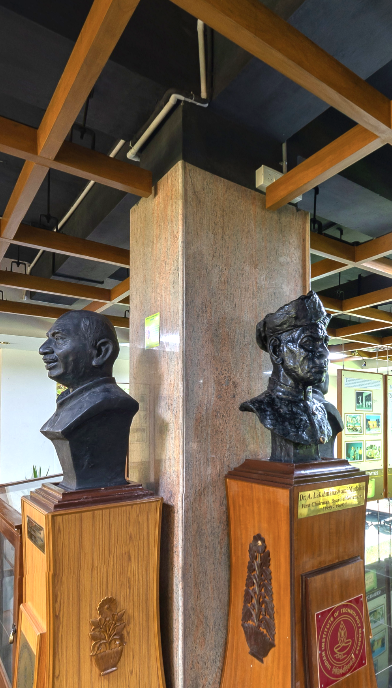
Prof. J.B. Majhi in conversation with Prof. Subrahmanyam
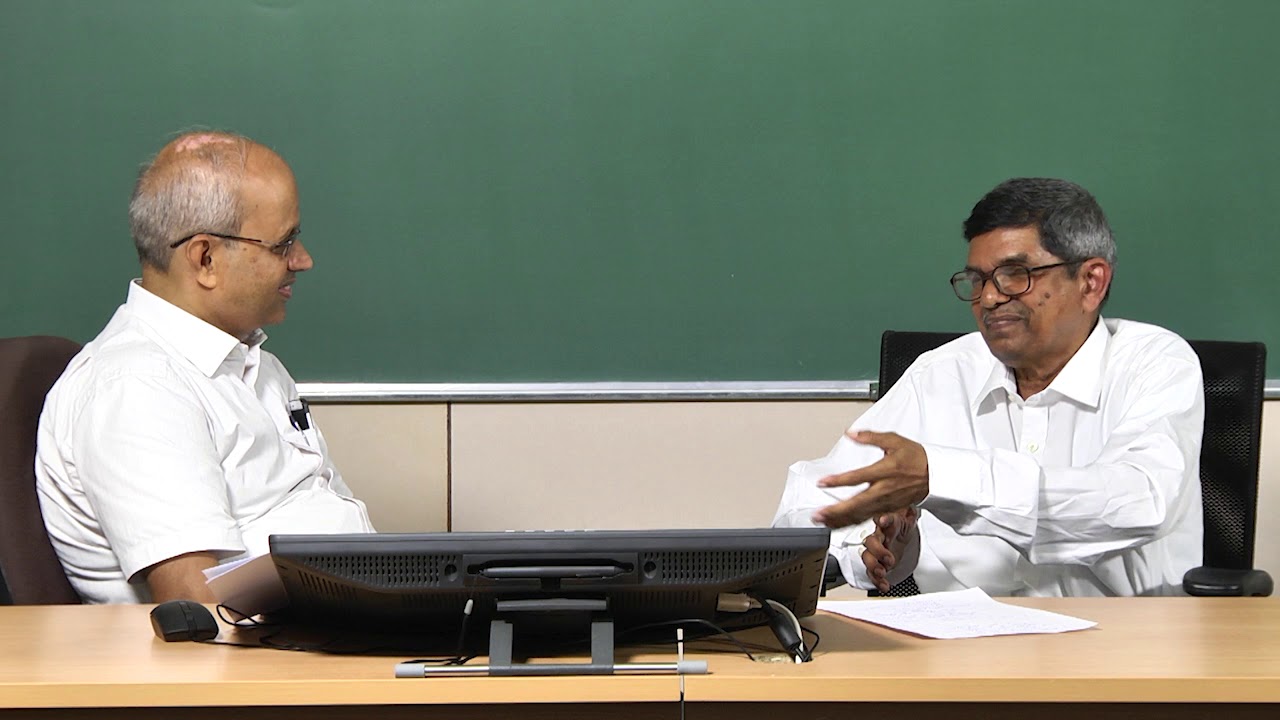
Yes, Dr. Majhi, welcome to this programme organized by the
Heritage Centre of IIT Madras.
The main purpose of...is to show, to learn from you
the history of the Department of Physics,
after you joined in 1967.
So if you can, kindly brief us. Yeah.
When you joined how the department was, with reference to its
programmes like Ph. D., M. Sc.
and the type of research,
and the people you have been interacting with.
Yeah, ok, good evening everybody.
So, as suggested by the Heritage Centre, I will briefly outline
my talk in three groups, before joining IIT,
then in the IIT, activities
and after leaving IIT, means after retirement, ok.
So, I was born in Berhampur, a small town in Orissa,
I think you also know that. Yes.
My primary education, middle class, up to B. Sc., I was in Berhampur.
So, I came to IIT straight from Berhampur to this place,
it was really difficult for me, because when
a person comes from a small place to a bigger city,
you get a shock first,
Yeah. so I heard that...
Is it a shock of the language?
Is it a shock of the culture, is it a shock of the food? Everything.
I didn’t know Tamil. Ok.
And also, the culture was little different,
Ok. even the food habits are different.
So...but I could adjust, in the short time, that’s ok. That’s good.
Its ok...anyway, Berhampur I will tell a little bit ok.
My childhood...see my father was a teacher,
I come from a teacher family, my brother is a teacher,
father is a teacher, I am a teacher, ok.
So, my father used...he was the district teacher means,
so what is that called I don’t know,
he used to move from one place to another,
wherever the district people ask him to go there, like that.
So, my education, primary education was a problem,
because every one year, two years, he used to go to a different place.
So my uncle took the responsibility to educate me. Good.
So my mother...mother’s brother,
she nicely left with my uncle and
went to...went my father wherever they goes to.
So my education started with my uncle’s house,
from primary school.
The primary school was very close to our street only,
I used to just walk down, ok,
we are only four, five students at that time.
It was a municipal school.
So they were just starting.
So I studied up to 3rd class,
then I have to go to another middle
school or something, where I have 4th, 5th, 6th, 7th.
So that was a little away, maybe one kilometre away.
That was a training school.
So its a government school. Ok.
So, I studied there up to 7th.
Somehow I was studying well,
so I got some fellowship also, after 7th there used to be a
scholarship examination. Great.
So. I got it, and of course, it was a meagre amount only,
some...I don’t know, 15 or 20 rupees, but it was encouraging.
In those days. In those days. Ok.
And also I needed money at that time
because my uncle also was a school teacher, and
so that helped me to I think...motivated me to
go to higher and higher classes. Good.
Then after 7th I have to go to high school,
high school is a missionary schoonl, is called Queen
Queen Mission School.
So there I studied from 8th to 11th, at that time
11th was there, not 12th. Yeah. Ok.
Somehow I got a first class in 11th, at that time
first class means everybody used to come and...it was great.
Here nowadays I see the marks people children get, above 90 only.
Yeah. And, there if you get 60, it is a great thing.
Those So that helped me to get another scholarship
in the college education.
So, because my uncle also was telling, "After high school
I cannot teach you, I don’t have funds also."
So I said, "I got scholarship,"
"But anyway you...scholarship, you go to your place."
So I went to my parents' place, that is another street only,
its very...all in Berhampur only. Ok.
So, somehow I managed to join the college.
At that time, it was I. Sc. and B. Sc. Yes.
2 years I. Sc. and 2 years B. Sc.
I managed up to B. Sc. Very good.
With a little struggling and all,
and then after B. Sc., what to do?
There was no M. Sc. in that Khallikote College, ok,
it is a Khallikote college...is a big college,
but at that time, there were no M. Sc. in Khallikote College.
I have to go to...outside, either go to Utkal University, Ravenshaw College,
or I have to come to IIT,
I applied both the places,
no at that time, I was having short of funds.
So I said, "I will work for some time."
I...same college, I joined as a demonstrator. Ok.
For one year, collected some money.
At that time the salary was I think 250 or something...anyway.
250 rupees in those days is a big money. Its a good...good amount Yeah.
So I collected some money to go for higher studies.
So my uncle also agreed and my
brother...elder brother who was also teacher. Ok.
He said, "Ok, we will get some fund,
I will also save give you some funds you can join M. Sc."
So one year I was...the demonstrator
to the Khallikote college, then...then I started thinking where to go. Ok.
B. Sc...after B. Sc., I tried for a JEE IIT ok,
but I failed, I couldn’t get it.
At that time the question paper also was very tough.
And there were. Even now it is tough.
Very tough and there was drawing in that.
Yes. So I didn’t know anything about drawing and all.
So you have to write drawing, as well as the questions but
anyway I am not very sorry, its ok,
I tried once, I didn’t pass, then the other choice was also tried,
a Engineering College in Rourkela, that is REC,
it was just starting.
Ok, just went as far as my grades are concerned, it was ok.
But they...at that time they have to have physical fitness also.
Ok. I was lean and I was more lean.
So I was disqualified on the physical...
then I was So to say, you have been maintaining this physique,
right from the beginning. I think you have seen me from...
So, that was a little shock for me.
So I could not be an engineer ok,
then the other choice was to go for science, ok.
So, to go for science, I have to do M. Sc.
So either go to Ravenshaw, which is near Cuttack.
Yeah, it is near to Cuttack, yes. it is Cuttack.
Or you have to go to...[Indistinct Dialogue] or somewhere ok.
So I think at that time only Ravenshaw College was there,
Khallikote College, then there was another Parlakhemundi College,
these three colleges were there.
But Khallikote...as I said, there was no M. Sc.,
so I applied to...at that time I see this advertisement from IIT.
IIT Madras. They are starting M. Sc., my...I was in the second batch, M. Sc.
B. Tech. was there '59,
but M. Sc. started only in...I joined '63, '62 they started.
Very good. So already one batch was studying.
So I applied...I got the admission in both the places,
but then I had to decide where to go.
So my friend said IIT is the bigger institute,
anyway you are going out of your native...
native place, you have to spend
wherever you go, you have to stay in a hostel,
almost it may come in the...financially, it may be same
whether you stay in Madras or in...
So, I was...hesitant, where to go, finally
I decided, ok let me go to IIT Madras
and But, one question,
at that time IIT Kharagpur also...is much nearer to you.
Kharagpur. Did you try?
I...I didn’t know whether there is a M. Sc. there or something. Ok.
I don’t know, at that time. So.
so IIT Madras... But, this I...this I saw in the newspaper and just applied.
Ok. My friends also asked...advised me to apply just like that.
So it is 1963. '63 that was.
You came from. So at that time there was no entrance test for M. Sc.
Ok, just walking. Luckily maybe...maybe this marks,
B. Sc. marks they called me, for a simple interview like that,
Ok. before admission they
they want to chit chat and say you are fit or not.
Ok.
So I somehow...I managed. Who was the chairman of the department at that time?
At that time, Professor Ramasastry was the HOD. Ramasastry. Ramasastry was there. Ok.
He was the HOD, he joined from beginning, '50...'59. He was coming from IIT Kharagpur at that time.
He came from IIT Kharagpur. Yes.
And then Ramaseshan also, he had joined. Ramaseshan who...
Professor who came from Institute of Science. Later on went back to
He came from Institute of Science Bangalore.
But, he stayed for only one or two years and went off as it... and went back to National Aeronautical Laboratories.
So from beginning, Ramasastry was there,
and he became my guide also, afterwards Ph. D. guide. Ph. D. guide. Exactly, yes.
So, they were there, somehow I could manage.
So how was your days in M. Sc. in IIT Madras?
So, a little bit I want to say about my journey from Berhampur to Chennai. That’s good.
Ok. Because, I was new and I didn’t know anybody in Chennai, no language,
so luckily there was one friend who was studying AMIE.
So there, at that time, lot of Oria people used to come from...studying AMIE,
there were no engineering colleges,
now plenty of engineering colleges are there
In Orissa, some seats are even vacant.
But at that time, only very few engineering...Rourkela, Burla,
and maybe one more like that.
So, many people used to come to...Oria people come to study AMIE
that’s a...you know, that is a...
engineering college, now its not very popular.
So, one fellow was there, his name was
again Aditya Kumar Pattnaik,
your son’s name. Ok.
So I knew only him, he also used to encourage me.
He said, "You come to Madras, I will take care of you."
Because I can’t come straight to IIT, I don’t know where the IIT is,
from station how to come,
and the language problem, he said, "You come,
I will pick you up from station, I will take to my room."
He was already established there. Ok.
And I will bring next day to IIT and put you... Wonderful.
and that was a very good gesture for me,
and there was another friend, who was doing...what is that, Chromepet,
there was...he was doing after B. Sc. you know,
I stayed in Berhampur for one more year.
He joined the Chromepet...that what is that
There is one Madras Institute of Technology, MIT. MIT
He joined as a...he also told me
you..."When you come to Chennai, you come to my..."
But Chromepet is quite far from that,
so I preferred to meet this man, Aditya,
he...luckily what happened, at that time there was only two trains,
one is that Madras Mail Yes.
The famous Madras Mail. Another is a...I think Coromandel was there and I don’t know
No, Coromandel was not there. Not there, and there was...one the Express was there.
So, I took the Mail.
That was a very popular Mail and is a good...
I don’t know how I came, maybe second class somewhere
ordinary compartment or something like that.
Those days we never had reservation.
So, I could manage to come.
But when I got down in station,
he was missing, I was looking for him.
That was very difficult for me.
But, he gave me instruction, "Suppose I can’t come,"
you...he has given me address,
its very near, he was in Vepery somewhere.
Vepery Two-three kilometre.
"You take a rikshaw, come there,
and I will, in case I can’t come to station."
So, it happened
so, because this is the Mail, reaches Chennai in...early mornings.
Around 4 o’ clock. 4 o’ clock.
So I don’t expect him to come also, it happens sometimes.
So, I stayed in the... I would like to say one thing,
Mail is the only one which has not changed
even after the Second World War, Yeah.
till today. Very reliable.
The time of its arrival in Chennai. Yeah.
The time of its departure. Yes, very very reliable.
Great. Even now also I prefer to go by Mail.
Yes. Because Mail reaches Berhampur in a proper time.
In the evening, but Coromandel...midnight both way, Yes.
this way and that way, it is in midnight,
I prefer to go So you reached Central, and then?
Central...and I was looking for him, then I said, "It is still dark, what to do."
So I stayed for some time in the station, Till it is getting.
then I took...I become a little brave,
let me start my journey, at that time, you know these rikshaw walas...
even that auto was not available that time, ordinary rikshaw. Only rikshaw.
Rikshaw, and even hand pulling...people pulling,
So, I took I think cycle rikshaw something, yeah,
I...I didn’t know how to communicate with that rikshaw fellow.
I showed that address, that is written in... He speaks only Telugu and Tamil
That was written in English,
so he couldn’t understand.
But I said...Vepery means...he said, "Ok, I will take you, don’t worry,"
the house number was there. I reached there,
he was anxiously waiting for me.
Very good. So, he took a referral and then,
he brought to...to IIT and then joined.
So that was something interesting, I...
so that gave me some braveness that...
So two years passed after your M. Sc.? Yeah.
You passed out, Then I... and who were the teachers
who were teaching you at that time, 1963?
So I...they put me in Godavari Hostel. Godavari.
Godavari, because at that time only Krishna, Cauvery
was there, and Godavari was just
newly coming Godavari and... Ok, so it was a new hostel for you.
New hostel. I still remember the room number 109 something. 109.
And it happens that later I became Assistant Warden of the same hostel.
Its a very nice thing to do.
So, M. Sc. I...two years, ok.
Yeah, but who were the teachers with you? Yeah.
So, let me see. Ramasastry was there.
Ramasastry was teaching us
solid state physics and semiconductor physics.
And Professor Srinivasan also might be there.
R. Srinivsan. R. Srinivasan. Is the quantum mechanics...
were very good teachers, great teachers.
Swaminathan also might be there.
Swaminathan was teaching some...mathematical physics. Yes.
And . Ramanamurthi was there teaching Ramanamurthi X-rays
X-ray and solid state physics. And who were the other old teachers?
Ramaji Rao, classical mechanics. Yes.
And, then pagdi man what is his name?
Ramabhadran. Ramabhadran.
Electromagnetic theory and relativity, it was nice,
all the teachers were very devoted, and I really like the teaching. Ok.
One thing I want to say was...Professor R. Srinivasan,
he will just come with a chalk,
he will start exactly in time, suppose 10 to 11, exactly he will come,
start immediately, and when he finishes the class,
he finishes the topic, he finishes the chalk and goes.
I was wondering how he adjusting all this thing, wonderful teacher
He was one of the great teachers. and great teacher.
Ok that...so that...and Ramasastry is different type, he will come last class only.
That is 11 to 12, ok, and we don’t know when he will end,
that is another interesting thing.
He will come, slowly he will come, slowly he will start,
but he sometimes, he comes without preparation with things and teaches,
but whatever he teaches you remember,
is a from his practice I mean
These are all the great teachers. Practical things he is more of a practical nature.
So, I really learnt how to do practical experiment from him,
that I have to be understand. Ok.
And, we don’t know, we can’t say,
"Sir time is up" and because it was a difficult things,
so sometimes so it goes up to 1 o’ clock, we miss our lunch.
So again you have to come for the lab,
so it was...that is a peculiar thing.
And, Ramaji Rao, you know, he used to talk philosophy,
someone immediately he will stop,
he will talk something philosophy, and again
come down and do something.
So that is another peculiar, you know
and Ramabhadran is typical you know...
Yeah, Ramabhadran. He was there when you came?
I was there...he was there, all these people were there
when I was there...except He is a very traditional teaching.
He is very principled and disciplined, like that
So, the yeah then X-ray is a our Ram...what is that? Ramanamurthi.
Ramanamurthi "Arre baba," he will say very nicely,
he says he always tell about his village and all you see
"I came from very hard work, you should work hard." Yeah, he is one example.
He used to teach us X-ray as well as experimental techniques.
Experimental techniques. Techniques ok.
Ok. So like that, I had a very good teacher in M. Sc. ok,
any other thing I forgot to you ok. You you you you I think you have you completed M. Sc.
by '65. '65, '63 to '65. '65
Ok, in the hostel life, you know it was... You were there in Godavari
and... Godavari,
it used to have its own mess. So I told no,
initially I had a little problem about the food habits.
Because, here everything is sour no, they give
what is that...curd and all, everything they.
So, I...I slowly I had to adjust...
You also might have had a problem with your timing
because, in Berhampur and Orissa,
you ate lunch around...I mean you eat dinner around
That’s another interesting thing. 11’ o clock in the evening.
Here you have to eat at 6 o’ clock to 7 o’ clock. At 7.
Which is not even your evening tea time. So I am not hungry at all.
So I have to wait at least 8 o’ clock,
by the time, things will be over.
So they say "If you come late, you have to ask for late dinner."
Late meals. ok late meals. Yeah, yeah.
So sometimes I have to say force..."Ok put me for late meals, ok."
And they will put in the plate and cover with another plate
they will write your Room number. Name.
oh Room number right.
Room number because this room number
is more important than name I think. Ok.
So I sometimes...I miss that also,
when I open the top, you have...nothing will be there.
Somebody else might have come later and taken that food also,
and sometimes maybe your rice and sambar will be there.
No... Let me ask you one question,
How much used to be the mess bill per month in those days?
Those days it was very cheap maybe.
Maybe. Maybe about 20, 25, 30 rupees?
May be 30, 40 rupees like that. 30, 40 rupees.
But that also was too much for us.
Yeah, but so to say, the rupee value. But still get food was good,
Yeah. slowly I liked it, because it was nice.
So, another...there used to be a mess committee also.
Student. So 1965, you completed your Masters. Yes.
Then what did you do?
Because you had all the summer vacation. Yes
You went home. so went home.
Then I wanted to apply for research.
In between I got lot of three, four months' gap, ok.
So, I finished in June or July no.
1965, it should be July.
July.
then August, September, October,
the research scholar too was in October something,
so what will I do these three months?
I thought if suppose I don’t get Ph. D.,
I mean research fellowship, what will I do?
So let me join some local college here.
I joined again Khallikote College as a Lecturer.
Khallikote College, the place where you have been doing your... Yeah.
They were happy to take me.
Because I was student there. Ok.
So...but I told them, "Suppose I get fellowship, I may go."
So you have been truthful right through your career,
right through your life. Yeah yeah.
You did not hide any information.
No no. Very nice, ok.
So, so after 3 months, no, I had to leave that college.
Then I got this fellowship, ok.
Then the... How much was the fellowship in 1965?
250 or something 250 rupees, huge money.
And during my M. Sc. also, I got that small fellowship. Fellowship.
They used to be merit come means Yes.
so I was I was really lucky, to get some small fellowship everywhere,
so that I could continue my education. Very nice.
Ok that’s one good thing, ok.
So somehow I got the scholarship here,
so I had to leave that...
so I got a little problem with the administrators,
they say, "You can’t leave like this,
without giving what is prior
information," what is that...of notice that you will be leaving.
So but luckily, the...the Chairman of that,
he was a very kind man...my...they are known to my family.
So my brother, and my...my father’s brother,
they went to the Chairman...[Inaudible Dialogue]
So, you could come out and... I could come out.
Joined in 1965 October in IIT Madras as a Research Scholar. As a Research Scholar.
So With whom did you get registered?
I registered with Professor Ramasastry. Ramasastry.
So I was there at '65 to '67 as the Research Scholar, As the Research Scholar
at that time the other small...what is that...
what is that...available for joining as STA. Yeah,
some scheme was there, because, There was a opening scheme. the department is still
wanted some technical people, Ok.
and Ramasastry said, "Why don’t you join as a senior. As a senior technical assistant.
And do your...continue your Ph. D., ok.
So that way, I joined 1967. '67, I joined.
You joined as a Senior Technical Assistant. A Research Scholar...as a Research Scholar.
No, '65 as a Research Scholar. No no '65 as a Research Scholar
'65 to '67 as a Ph. D. Research Scholar,
'67. After '67, I joined the staff.
Senior Technical Assistant.
So my Ph. D. work became delayed now
because I have to do other work also, ok.
What was the assignment given to you as a STA? Assignment at that time,
see, suddenly Professor Ramasastry gave me a class
to teach M. Sc. Chemistry people ok,
some Physics they have, ok. Ok.
That’s a...maybe that’s a...just like we had, when I studied M. Sc.,
we had a course in Mathematics,
Professor Achuthan used to take. Ok.
Like that there used to be
Interdisciplinary subjects. Interdisciplinary subjects,
that’s a good thing actually.
So I enjoyed that teaching, without much experience Teaching Physics to the Chemistry people.
Chemistry people. Masters.
Some of my students still, I see, they are
teachers in Central School. Ok.
So we still...whenever I see... Great.
So that’s a good thing, ok.
So like that I finished my M. Sc., then two years of research,
and then...then started STA, then after that
You became Lecturer in 1977. I got...'77
because at that time, unless you have Ph. D., you don’t get a
Lecturer post. Ok.
So I had to wait, and because I had to do this teaching and
lab work, my work also got delayed.
And you know Ram sir is the task master,
he won’t...unless you do a perfect job,
he won’t accept it. Yes.
So its ok. How many faculty were there in those days?
When you joined as a...as a...as a staff.
Staff, I told already my teachers Yeah.
they are there, and then, later on who came...
Y. S. Rao might have joined.
Professor Y. V. G. S. Murthi was there. Y. V. G. S. Murthi.
Professor Gopalam was there. Gopalam.
They joined very early, Professor... And S. B. S. Sastry.
Professor S. B. S. Sastry. Maha Seshsayee Maha Seshsayee also...that yes
Around that time. He joined little later.
Yeah. Yes K. V. Reddy.
K. V. Reddy was there from the beginning
And '77 means it should be K. V. S. Rama Rao.
K. V. S. Rama Rao, yeah joined little later, Must be very fresh.
Yeah yeah, then our Y. Syamasundara Rao.
Y. S. Rao, Syamasundara Rao. Y. S. Rao, they are...Acharyulu
B. S. V. S. R. Acharyulu B. S. V. Acharyulu...
There were... How about B. Subrahmanyam?
B. Subrahmanyam also came bit late,
but he was also there for very long time. So, to say...
Yeah By 1977, the department is more or less
formed with these people, to run the department as well as the...
Really, I should say, they have sacrificed their thing
for the department. Ok.
I don’t say the younger generation are not doing,
they are also, but in the beginning, when there are no infrastructure...
Yeah, when you say no infrastructure
what is...what was available at that time?
For example, let me tell about our group,
Yes. Yes. small group, Semiconductor.
Yes. So when I started with Ramasastry,
we didn’t have any material at all,
he got some few samples, from abroad
when he visited what is that University of... Illinois. Illinois.
Where Professor Bardin was working.
Bardin...that is another interesting thing, He had been there for about a couple of months. yeah couple of months.
and, so he, when he...he when he visited his lab,
they were in Bell Labs no, Bardin was working in Bell Lab,
but he was also teaching in the Illinois. Illinois.
So he met him and had discussion. By that time Bardin already was a Nobel laureate.
Nobel laureate. 1977.
Yeah yeah he...he came no, he came to... He is already.
When did he '73 he visit '73 he visited our
visit our department, because Ramasastry
was known to him, and they arranged a Special Convocation.
And also, we had a small conference like thing...
He was awarded the Honoris...Doc...Causa Honoris...
Yeah, in '73. By IIT Madras.
IIT Madras, that’s a great thing to meet a Nobel laureate.
He is a double Nobel laureate, if I remember Yeah, yeah he
He got two Nobel prizes. One for the semi conductor,
One for the invention of transistor, the other for the super conductors. I think
Super conductor, yes so that’s
So you had a chance to meet a wonderful man in semiconductors.
Bardin. Yes that’s really great to see him and discuss with him.
Dr. Bardin. Yeah he was very nice gentleman
and we had a good time.
So that is one...
By the time you finished your Doctorate, 1977 Don’t know
I finished only '76, Ok.
but I was in almost in the verge of...
he visited the department. Visited, yeah.
So, that was How much time did he spend in the department?
I mean with us, in IIT.
Maybe a week or something, I don’t About a week.
exactly...Ramasastry forced him
to visit our department meet all the faculty
and I think he gave a talk also.
This...his experience and all,
how they invented the transistor. Yes.
It is very interesting.
So here, he also told, see
you will not have a very high, I mean what is that
always...for infrastructure and
very good instruments to discover something,
but he say no no we did in a very humble way,
you might have seen the picture no, of the Yes.
transistor invention, how crude it looks. Yes.
So so could do, if...if you have will, you can do something.
So...that so, that’s a good thing actually.
Very good. That’s not necessary always you should have a
big infrastructure to do something.
What do you find? You...you have supernnuated in 2002.
1973 to 2002 is almost about 20, say 30 years.
Yeah, I spent nearly...yeah 30...30. Yeah 30 years.
more than 30 years, yeah. In the 30 years, the...the...the
the whole science has changed,
now infrastructure is more important than the ideas. Yeah yeah
now of course, without infrastructure you can’t do anything, yeah.
And, so what you have to do is, when you are doing research,
there was not much infrastructure.
We have to build our own equipment, ok
small-scale, for example What was available in the department at that time?
An X-ray diffractometer?
X-ray was there and, Because with Ramanamurthy.
Ramasastry bought some good oscilloscopes,
HP oscilloscope, which was...I used for my field of experiment.
Therefore one thing. There used to be one...Czochralski Crystal Puller.
If I remember correctly the silicon That was silicon,
but it didn’t work really actually You didn't use it, ok.
It was the...I don’t know,
they didn’t send a good equipment,
because its useful for research, that is a fabrication for... Its actually a pilot plant.
It is for industry that is used.
Yes. See we can’t use the industrial unit,
we don’t have so much of material to put that. Exactly.
So that was a waste actually,
planning I would say it was not good. Ok.
They should have got a smaller one.
But there used to be Professor Koch,
who...who has come all the way from Germany
with all this equipment. Yeah yeah yeah.
How was your interaction with him?
So, he taught us also semiconductor in the class.
We can...see in M. Sc. we had three specialization,
one is X-ray, semiconductor physics and microwave
So I took Microwave used to be taken care by Professor
Shobhanadri. Shobhanadri, yeah I forgot to mention,
he's also from beginning, Shobhanadri. I think he and Professor
Ramasastry, R. Srinivasan joined almost at the same time.
Same time I think Its around the same time.
Yeah, same time.
So, he used to take also electronics lab.
Our Shobhanadri. Wonderful.
And, it was good. What was your research topic?
My research topic is actually mine thing was
field effector and semiconductor.
Ok.
Mostly whatever samples are
available were brought by Professor Ramasastry.
Few silicon wafers, few germanium wafers
I used to cut and...with the diamond curve,
I used to take the help of glass flowing section.
Glass flowing. They used to cut glass.
So the silicon crystals also can be cut by glass.
So that also technique I learn, how to cut this...
putting a scale and putting that...
it was a nice experience, to...in earlier days.
So I used to cut this,
then I have to do simple oxidation.
You might have seen some of our, what is that?
Oxidation furnaces.
furnace built by us,
that is quartz tube, of about two, three inches.
We had a good glass...glass flowing section. In those days.
Who is that person, who is a foreman? Venugopal.
Venugopal, before that. Before that is
Kumaraswamy. Kumaraswamy.
Kumaraswamy, they really helped us.
So, I still feel such facilities are required.
See now when I visited some time back,
it was almost in a...nothing is going on there in
that glass building section. Yeah, but people are going to advance.
Since its No no see it was
It was catering to Chemical Engineering,
Yeah. Chemistry and Physics.
So now, I don’t know how people do... Yeah, coming back to your Ph. D. thesis
you have attended the convocation for receiving your degree.
Yeah yeah. You remember the great man who awarded the degree to you?
Tell us a few words about. Yeah yeah yeah, M. Sc., M. Sc. at that time,
who came, yeah great that Raman, Not M. Sc.
C. V. Raman came for my M. Sc. degree M. Sc., C. V. Raman.
I...I actually I finished in '65,
but, the convocation was in '66.
Ok.
So I got my paper, why it happened is, that '65 batch,
they preponed the...their degree.
Ok. I don’t know at the time some war was there no.
Ok yeah, there was a war So they wanted the engineers to come
fast and help the army and all.
So that was the thing.
So, all those who finished in '65,
M. Sc., they were...the degree was available in '66. Awarded in '66
that was a And you are lucky to have Professor...
Dr. Sir C. V. Raman C. V. Raman, C. V. Raman.
And for my M. Sc., M. S. Swaminathan...
and Ph. D., the chief guest was M. S. Swaminathan
Who is the Director...what is that.
Agricultural scientist. Agricultural scientist.
M. S. Swaminathan. He has come.
Later on he became our Chairman, Board of the Governors as well So like that
And, my...our Director was this...what is Sengupto.
Sengupto. So I have seen Sengupto.
Then second was...what is that Ramachandran.
Arcot Ramachandran. Arcot Ramachandran.
He was a great man. So they were there.
So you had excellent time in those days.
Yeah, very good.
So when I got my M. Sc. degree, Professor Sengupto was there,
when I got Ph. D., Pandalai was there.
So, So, we have seen your research career.
Yeah. How about your teaching career.
Teaching, I taught some courses to B. Tech.,
and some to M. Sc.
So...since my voice was low,
they preferred...I preferred to take a M. Sc.
class because the number is less, than I can talk
You are always calm and quiet. Yes yes.
So...so because if I take B. Tech., I have to have
mic and all those things.
But B. Tech. in those days used to be about 300 students.
So that was very big, that...our Physics, what is that...theatre.
Physics Lecture Theatre Theatre! That was too big for me.
Ok. So, so then I preferred to have M. Sc. and M. Tech.,
some students and some Ph. D. course also I took.
At that time we used to have some course for Ph. D. students you know.
Yeah. Just to...like that
and semiconductor part I used to take, Now,
we have seen your teaching career,
now tell us something about your research in guiding Ph. Ds.,
handling projects. Yeah yeah.
So, I guided of course, I didn’t have many students.
My first student who joined, he...what is his name?
C. P. Sridhar you might have seen,
he joined somewhere in
Sridhar is working with IBM for sometime.
Not that Sridhar
This is the senior Sridhar, yeah. Earlier who joined in the...
Senior Sridhar was working for a company who is now distributing
some of the equipments. Equipments.
Semiconductor equipments. I know that. Lasers and all the Yes, yes optical instruments.
So, I was very unfortunate, after two years he got a job.
Then he asked me politely, "Sir, I am
financially little difficult, whether I will go for the job
or I will continue for my Ph. D.?"
I said, "Ph. D. we don’t know when it will end,
So, if you are getting a job with a good salary, go."
But my colleagues, they said, "Don’t leave him, your first student."
I said, "No no, he is requesting,
he he is not...he needs immediately some financial things," I left him.
So right from the beginning you are an excellent teacher and research. So, he...he did only 2 years research.
And so he only took...took some course work and...
but whenever he comes to Chennai, he meets me. Good.
He remembers, "I did a mistake,
I didn’t do my Ph. D."
So, its alright,
but he's financially ok, he, I think in a good post
in the...that was the first student.
Second was our, Krishna Rao.
Krishna Rao who is working as a Lecturer.
By this time he must have been Professor in
somewhere in Andhra Pradesh. Andhra Pradesh.
he also, after Ph. D., he went as post-doctoral to Belgium.
I thought he will do a good job somewhere,
he will settle there, or go to America.
But poor fellow, he was homesick, I think.
He came back to his Andhra,
he joined some college there, and I think he there continued. Once
he came I think Your third student is again Sridhar.
He is another Sridhar, he did on amorphous semiconductor.
It is...it was a new for me also, I had a project
DSD with the another Ramachandran, no...
Ramachandran of CSD, that is...
So we had a project. Yeah.
So. A part of Electrical Engineering.
So, we built some equipment and he did some work in that,
he...he that was the third.
He is presently working in United States, for I think Global Foundries.
Good, good, and here students are well off, I think. Yeah,
after that Because, you also help them.
See something interesting is my students and his students,
it is...we take care of each other.
Whenever he is...out of station, I will take care of...including
that Ph. D. viva, and you took care of I think somebody, my student.
Yes. Maybe Binny or somebody.
It was in 1983, we joined together. So we had a very good...in...
semiconductor...although is a small lab, we had a very good
cooperation with our colleagues, as well as our students.
They were very faithful and doing whatever you say.
Your fourth student is Paul Binny.
Paul Binny yeah. Paul Binny is now with Bangalore,
running his own He also did the silicon, he did the interface,
silicon...silicon dias interface. Yes, he is the man of oxidation,
high pressure oxidation. Oxidation,
we developed that equipment... I know, I remember that.
So that was the...some of the equipment
we used to develop, whatever possible
for example, we wanted to study CV characteristic,
at different frequencies,
I didn’t get a ready-made equipment for that CV meter.
CV meter they will say only 1 frequency or 1 and 10, like that.
Yes. Because, that is used for just testing some capacitor.
But we went into the continuous variation. Yes.
So we have to build our own capacitor...they did it nicely.
It worked, but I don’t know what happened after that, nobody was there.
So, that was the one. Your sixth student is...is Suresh.
Suresh, fifth...fifth.
I did some with...collaboration with Chemistry,
and the material science yeah what is that.
CSD. CSD.
With Dr. Y. R. Dr. Y. R., I did something.
That is another thing, another good friend,
he because, I am...most of my work was electronics nature.
So some of the devices, I made in the CSD.
Dr. Y. R. helped me.
So we had a mutually You also had a good interaction with Professor Raina.
Raina also was there.
And, you also had a good interaction with
Who were the Chairman? Achuthan of Electric.
And Bhat. K. N. Bhat. K. N. Bhat. K. N. Bhat of Electrical.
Yeah, so, it was good to make some simple devices,
in the like...we...they had a clean room and all those things,
we didn’t have.
So maybe you can develop a clean room here,
so that people can do some device work, ok. Yes.
So that was then.
So these five student then some two, three collabrate
with the what is the material science who was incharge earlier? Subba Rao.
Subba Rao was there first.
First? He started collaboration,
he was doing some electrochemical something.
Electrochemical He asked me whether you could help in Physics part of it,
I said, "Ok, I can help."
So they you...students used to come and discuss me and all,
he was doing at that time, high temperature superconductors. High temperature superconductivity.
Then I used to ask him what is the temperature today?
We used to have fun.
So then he left for Karaikudi.
As a Director.
Afterwards, I don’t know what happened to that. Yeah,
he went to Singapore, then he came back,
now he is presently in Chennai in his own house.
Then after that who came, as an in charge?
Any student...who is it still there no.
I forgot...name.
Material Science Centre.
who was in charge? After Subba Rao,
I think it was the Chemistry people who took over.
This name I am not sure. Who is still there now
No, that that. You told me his name.
That is Subramaniam, S. Subramaniam of R. S. I. C.
No, that is different, that is R. S. I. C., your material were,
you were telling one person no,
This is a Ramachandran Rao and... Ramachandran before that Ramachandran Rao?
Before Ramachandran Rao, I don’t remember
because Subba Rao we had a very good interaction,
After that, I don’t know.
No, he...you were a good friend only.
Who? I don’t know.
Recollect, he was now he is shifted to Chemistry.
Varadaraju, Dr. Varadaraju. Varadaraju, he has some students,
Ok. interacted with me,
Dr. Varadaraju ok. Some one or two people,
they used to do by chemical methods. Ok.
I didn’t know any Chemistry
so I have to learn from them, and I only Physics part I helped them.
Yeah. ok, how to take some measurements,
how to study.
At the...around 1999,
preparatory course was introduced in IIT,
or maybe a little before that.
Have you taken any preparatory courses?
Preparatory means. Preparatory means these people will be appearing,
coming from the special category. Oh...this SC ST. SC ST.
I took some...I had tough time actually...
What was your experience in that?
I had a tough time because, we used to take the class
before they joined the Institute.
The actual program starts... And you have to take extra classes,
Yeah extra classes. still they are not able to get good marks,
then we were asked to explain why he is not getting...
why he is not getting pass and all that’s a real...
I don’t know how to solve that problem.
So we can only pity them, but how to give them marks
unless they don’t write.
So that is a problem also, I had a difficult You you you have handled some of the preparatory courses.
Preparatory course and I handled some tutorial classes Ok.
with our...what is that? He was our good teacher.
Tutorials for our colleagues.
V. Ramachandran? V. Ram...no no, Balakrishnan...
he was...I used to attend his class,
he is also very nice teacher wonderful. Wonderful teacher.
And then I used to help only the tutorial class, Ok.
to solve the problems and all.
And, coming to the...this this COSTED,
COSTED used to be their Committee of
Science and Technology in Developing Countries.
It was...the Chairman happened to be our Professor Radhakrishnan.
Radhakrishnan yeah, yeah. They used to organize quite a number of
Yeah, yeah. Yes, yes. conferences,
they used to support for faculty to go for conferences. Yes.
What was your participation in this COSTED you had? I had a good interaction with him,
he used to help me and
he also tried to send me some places, but I didn’t work, ok,
but I helped in some of the short term courses,
he used to conduct some courses. Yeah, he used to conduct a lot of short term courses.
asked me to give some lectures like that, I said ok.
I also arranged some short term course for teachers you know.
Science teachers and Engineering school, college teachers Exactly.
I...two, three courses I did.
FIP they called at that time. FIP.
QIP. Faculty Improvement Program, exactly.
QIP I conducted two, three courses like that,
and the another thing overall thing. Overall, you have spent how many years in the department?
1963, no. No, '67, '67 to
2002. 2002, how much?
35 years. 35 years I was there.
A full term. So I don’t have any grievances,
the another advantage I got is this beautiful campus.
No first let us see,
what is your impressions of your...of your career in the department,
you have spent 35 years? Yeah,
I have no regret although there are some
sometimes you feel little upset.
For example, I stayed the STA for 10 years.
So that...little, I wanted to go to Berhampur University, I also applied.
Then I didn’t go afterwards but,
but then I You became Professor in '95 or '96?
I...professor in '96, '96. Around that time, around that time.
I became Professor.
So because of the delay, I was a little unhappy,
but for my family and for children
since they get very nice atmosphere here for schools and all.
So all my children studied in K. V. IIT.
So coming to the campus life. Campus life
You must have really enjoyed the campus life. I enjoyed the campus.
Tell us something about your No no regret about this.
wonderful time One is...best thing I got is the good education for my children,
and good friends like you and all.
We are the...we are not only colleagues, but we are also family friends so. Yes.
So like that I got Y. S. family, your family, K. V. Reddy.
Yes. They were neighbours,
Yes. a beautiful thing, they were just neighbours.
No, you are nice to all of us,
so therefore we are all...[Indistinct Conversation]
Then they...like that many.
Is there any anecdote?
Any good incident, which you remember both in the department,
as well as in your family life staying in IIT Madras?
Some interesting incidents right? Yeah.
So when I got married you know,
So I married this...7th of December 1970.
You remember it very well. Yeah.
7th December 1970.
So, then I was in Berhampur for some time for marriage event,
I came to...again back to
Chennai. Department, on first of '71.
So, my wife also didn’t know any language in...
and at that time, the allotment of quarters were difficult. Quarters.
So first day we stayed in...I was at that time Assistant Warden.
So I said, "I can...we will adjust in that Assistant Warden room."
Godavari. She...she was a little scared, so many students all were there.
It looks odd, anyway the students were nice also.
Anyway, so we stayed one...one day only.
afterwards I shifted to what is Taramani Guest House. Taramani
Guest House. At that time they used to give
Taramani Guest House for first month, two months like that. Ok
now. So we stayed nearly two months there,
by the time I was looking for the quarters,
so, what happened is, at that time we did...a lot of time used to take
to get a quarter, even a small quarter. Ok.
So, somebody left for Germany,
So, D-type.
So, he is left for 6 months or so,
then we got hold of, our Prasad Rao helped...
told me that they will... T. A. Prasad Rao.
T. A. Prasad Rao, he...I forgot his name
he was a very nice gentleman. T. A. Prasad Rao.
But he joined in...oh he was working at that time
and rejoined the department in 19... yeah. He joined as a what, as a
pool officer or something.
It was after his Ph. D. from IIT Kanpur, he joined as a pool...
as a Research Associate or a pool officer. Yeah yeah.
So at that time, there was a quarter vacant, D-type.
He asked me, "Why don’t you
That’s good. take that things."
So we stayed for a few months there.
and then later I got the allotment.
After very small...that E1 type you know, the smallest.
Yeah smallest single room apartment.
That's not single bedroom single room apartment. Just a kitchen and a
Yeah. hall like...a small hall, and a bedroom like that,
its a single bedroom, yeah. Yes.
Somehow we managed
in that room also there are a lot of guests,
That too come from Berhampur and...
somehow my wife managed, it was a...
So, overall So when we join...came to that...Taramani Guest House,
so I used to come to the department, she was alone in the room.
So I was feeling, "Suppose somebody comes, what will I say?"
She don’t know language...language Yeah, language was a problem.
I told you say (In Tamil) "I don't know Tamil."
What is that called? Tamil...?
(In Tamil) I don't know Tamil.
So you tell that, he will go away.
So like that, we managed.
So some funny incident, then slowly,
but she learnt the language so fast. Fast.
My wife she talks very fluently. I know.
Whereas I have spent so many years,
still I don’t know proper Tamil!
This is one thing I share with you,
I...I...I spent 32 years, I can’t speak Tamil like you,
you and I are just the same. I don’t know how it happens.
It happened because we started speaking in Hindi and English.
yes. In the...in the...in the...in the department.
Yeah. So, that is the. Yes.
So, so. Coming back, what are your hobbies?
Hobby...in the schools I used to play cricket. This is a good question for me,
because I...I never asked you this question.
Yeah, yeah. I never noticed it.
Because, I think, they asked me to write hobby also
I...I felt what I will write?
In schools I used to play cricket Ok.
and then college also I played. Yeah, but in IIT.
No...in Berhampur, in Berhampur. Your hobby is to work...your hobby is to work
I suppose in the laboratory. Yes.
So in Khallikote college, I was in the college team,
we used to go to inter-college tournament like that,
but after I...coming to IIT, I left everything,
only research and teaching that’s all,
so called...ok No but you were instrumental
in making a few people, trained in giving good lectures.
I am one among them. Is it?
Yes. I don’t know.
Because you and Y. R.,
Dr. Y. R. used to ask me to give the lectures almost once a week,
we used to have a good program Yeah.
You were going for tea very
Yeah, tea. I should say I should say, religiously.
Religiously...yeah we, go for...morning. In the morning.
Yeah. Once we used to discuss, we can go...go to tea.
Yeah. Sometimes, I would meet you on the way, you never took tea I think.
I was not taking tea in those days. But we used to force you, "Come!"
Yeah you are forcing me. You discuss on the road, we will discuss something.
Yes, yes. Because we all are the same...semiconductor.
Yes. So we used to have a nice discussion.
So, like that. So, are you still continuing that habit of tea
in the morning, or stopped it?
Nowadays not much, so once in a while I take Not much.
take tea but, only morning I think take some tea. So.
Yeah. Not going out...canteen and all.
What do you want to tell the department
or the institute, about your 35 years of wonderful journey,
both in academics, as well as in your family life, in the campus?
What would you like to give a message to
the people? Message means...its...I think we are lucky to have
such a great Institute
we have social life, academic life both are...
Particularly, for the...our children no, it was a very good
place for their education and,
when my boy, my elder boy was studying,
his higher class. Jayanth Jayanth,
five of his friends got into JEE.
Yeah, Jayanth is one among the And he got a very good rank,
yeah in the top rankers my son got 6...16th rank he got.
Yeah, without any coach.
Without any coach, that is the That is the most important part.
that happened because of the environment in those days. Yeah yeah.
So, I don’t know, that’s good.
And, second boy also got into
Prashanth also got into JEE, Prashanth.
but he got Metallurgy, this fellow got Computer Science.
His rank was very low, he told me in that
don’t expect...like Jayanth.
He used to study so hard and all Jayanth is a real giant
So, he did a good job, and he also doing well in the abroad also Fantastic.
So he is there. So, how often do you visit your children in U. S. and in Europe?.
So, so my daughter is in Europe.
She’s in Europe. So we find convenient to go to Europe,
then America. Yeah hop in Europe and then hop in U. S.
So, sometimes we go to Europe, then stay for two weeks,
then go there, like that we will do, four-five times we have gone like that,
but now we are old no.
No, you are not old. So we find very difficult to
travel, particularly America...that from Dubai to that
place takes 15-16 hours.
Yes. Its really hard for me and
my wife says, "No no I will never go,
let them come, let the children come... Right
and see us," like that.
So that is another thing.
Ok. So you would like to say something more,
you have? Something I
We...did we cover the point?
[Indistinct Dialogue]
Ok, activities after retirement... After retirement, yeah yeah its interesting.
Because this you can always find out what I am doing.
Yeah, 2002 afterwards. After retirement
first, yeah towards the end of my thing no, I retired in 2002
June. When Professor V. R. K. Murthy was the Head of the Department.
I remember. June, so at that time,
I got letter from EGC you know,
To go as a expert committee,
to visit some universities to Ok.
what’s...what are the progress, what they want...know,
what are the drawbacks,
Ok. what are the merits...like that,
we go in a group. I was for the Physics,
there was somebody from Electronics
like that different...Chemistry, like that we visited Allahabad University,
as a team. At that time Professor Murli Manohar Joshi must be there.
2002. Maybe.
Yeah, he is working in the Allahabad University as a Professor in
Nuclear Physics Department. I could see,
interesting to see that Meghnad Saha was there, his equipment.
They were doing...were very excited,
see at that time they used to do lot of work.
Yes. It is a good university, good work is going on.
Allahabad is there top in the list.
Only thing...like any other university,
they also feel that funding is not
good like IITs you know.
So, they don’t...able to do
I mean, some work, the lack of funds. Ok.
So that was an interesting exp...
I mean experience for me to go like this.
2002 onwards. Onwards and
then the UPSC fellow they used to call,
they called several times to set questions for
IAS, IFS and all,
and then sometimes they say...they will send the
paper, that I didn’t like, because
500-600 papers, and they will give it you one week to
finish and give it back.
I said, "I can’t do now, I can set some questions
and come back," like, that.
So we used to go...also a team work.
Ok.
We go there, sit there, finish it in one week,
and come back, like that. Two-three times So, you were active even after that,
very good. I went for some time,
and then this Berhampur University they knew I retired,
they called me to come as a Visiting Professor.
Because, I was there...another thing, when I was here
I went on lien '93 to '95 at Berhampur University.
Yeah, I know that, yes. They started the Electronic Science Department.
They called me.
So, "Whether you can help us."
So I went there, because to go to your native place is interesting thing.
Yes.
You don’t...you don’t bother about the money and all. Nostalgic, ok.
You want to do something for the...your home town. Yes.
That spirit I went, but my wife was not happy,
because she used to be alone, and my...by the time
Jayanth and Prasanth they had already left. Left.
yes. So, she was finding it difficult, but somehow I
forced her, "You manage, I will go,
I will do something and come."
Ok. So that was an interesting period for me,
because you know the atmosphere, IIT and University
how much different it is. Yeah.
That too Berhampur University.
First thing I wanted to change the timing.
See they used to go at 11 o’ clock,
and come back at 3 o’ clock.
I said, "This kind of thing you cannot teach,
you cannot to improve your..."
I said, "You have to start like IIT 8 o’ clock,
and stay up to 4 o’ clock
at least," but they didn’t agree.
Why? Because most of the teachers
and student they used to stay in town. Ok.
They used to go to the camp...university campus. Yeah.
And, that is...buses are arranged.
That timing is fixed, nobody can change that driver,
that fellow will come like a maharaja, I will say.
"I will take come only 11 o’ clock and take
and bring you 3 o’ clock," like that. Its ok.
that was the constant...
I had to fight with the Vice Chancellor,
say if you want to study Electronics,
you should have a more timing and all.
Finally he agreed with lot of hesitation.
But some of the colleagues they didn’t like
because they have to come early now.
They were all staying in Berhampur.
So they said, "We we arranged a special bus for that."
The bus will go at 7 o’ clock...
So you tried to change the Berhampur University system. Change the...
system, but only that department,
I can’t do this whole...little bit I do,
then I changed the syllabus also.
I saw the old syllabus...that old
triode valve, all those things were there.
Now... I said "You change...
you change this."
So they cooperated all the colleagues, they came
and we changed all the subjects. Good.
So that was one good thing, I was happy
and, but some equipment like high vacuum unit, like that.
To do some work, experimental work you say.
And some instruments. Good.
Basic instruments in the limited facility,
that was one contribution.
Similarly, when I went to NIST the Engineering College,
still they are calling me,
I went as a Emeritus Person because after Berhampur University,
Berhampur University gave me as the Waiting
Professor, because that age limit is there.
Yes. Once you cross 70, you are not eligible.
Yeah, it is very difficult to get.
I said ok, I will stop now.
Then these people caught me, this NIST
National Institute of Science and Technology,
this is a Engineering College is a good Engineering College in Berhampur.
In Berhampur. Berhampur.
Being a private college, they can...they can ask you It is a private college.
Ok. And the Director was from USA.
So he has trained that, he knows the culture, how to deal
Ok ok. with the students and all.
He was very liberal.
So, he used to give freedom to students, as well as staff. Ok.
You do whatever useful for the students.
So that way I found...I gave some lectures,
but I said, "I can’t prepare at this age,
and give lecture, I can do as a consultant." So to lab...
some of the research lab we want to...because now,
even MHRD, are insisting that even in Engineering Colleges,
you have to develop some research also.
Yeah, it is mandate...its a mandate. Not only teaching and all.
If you want to get some funding a lot. Yes.
So they asked me "Whether you can help us?"
I said, "I whatever I know I can do." Fantastic.
Buy this thing...high vacuum we need,
buy one good furnace,
I took from here on...I took your help
everybody, where its available. Yes.
yes. And the furnace some readymade...not that
finding and all, we got a good furnace,
with a digital control and all.
Which can go up to 1400...
So right now you are still working with NIST? You don’t need...
They call me sometimes. Oh yeah.
Because that also is limited,
see the Emeritus Professor, you get only up to three years or something. Yes.
Two years, so they extend another year. Yes.
After that over, "I said ok goodbye,
whenever you need some help I will come." Great.
So still they are calling sometimes, when they have some
difficulty, or to...when I go there...go to my native place,
I’ll just visit them,
they ask some, "Give a seminar or something, I do like..."
So, finding a peaceful life in Pallikaranai in your own home?
Yeah, its ok.
And. That...luckily that’s called IIT colony.
IIT colony. So still some retired people are there.
So I don’t...I feel comfortable. Very nice.
Because our street, all the three Majhis are there.
Yeah yeah, there are three Majhis.
One Majhi is Electrical Electrical
Another Majhi is Mathematics You please catch hold of other Mahji, P. C. Majhee
who was a...first student of B. Tech.
He joined '59, ok.
So he will tell you the story how they...they...they were
they were staying Saidapet it...they used to come Yeah, yeah.
That I don’t know how it was.
Marvellous. But when I joined everything was ok,
BSB was there, department was full fledged.
So it was good.
So, I think I covered most of the things Yeah, I think we covered most of the things and
we should say thank... and then
other things of course, these things...I...what is that
I did some work for the...what is that
Pensioner’s Association, the Treasurer like that, Yeah.
is the different thing.
So you keep yourself active.
So sometimes they ask me to help...and ok.
So that’s all I think
and then another thing is...some social life was there,
we used to...mostly...students,
when I joined, very few students were there,
we used to have some picnic like that
because a beautiful campus.
Near that Durga temple you know,
Yeah. we used to cook, and the families they will come, get together,
they will cook and eat and go like that,
it was an another interesting thing.
So, at that time, students were also faithful. Yeah,
Very nice Majhi,
thank you very much for your time. Thank you very much, for your patience.
Yeah, thank you very much. Ok.
And also I thank the...your Heritage
for giving me this opportunity to talk to them, ok.


- Contribute
to the Centre -
 Monetary
Support  Digital
Material
