
Prof. M. Ravindran in conversation with Prof. V.G. Idichandy
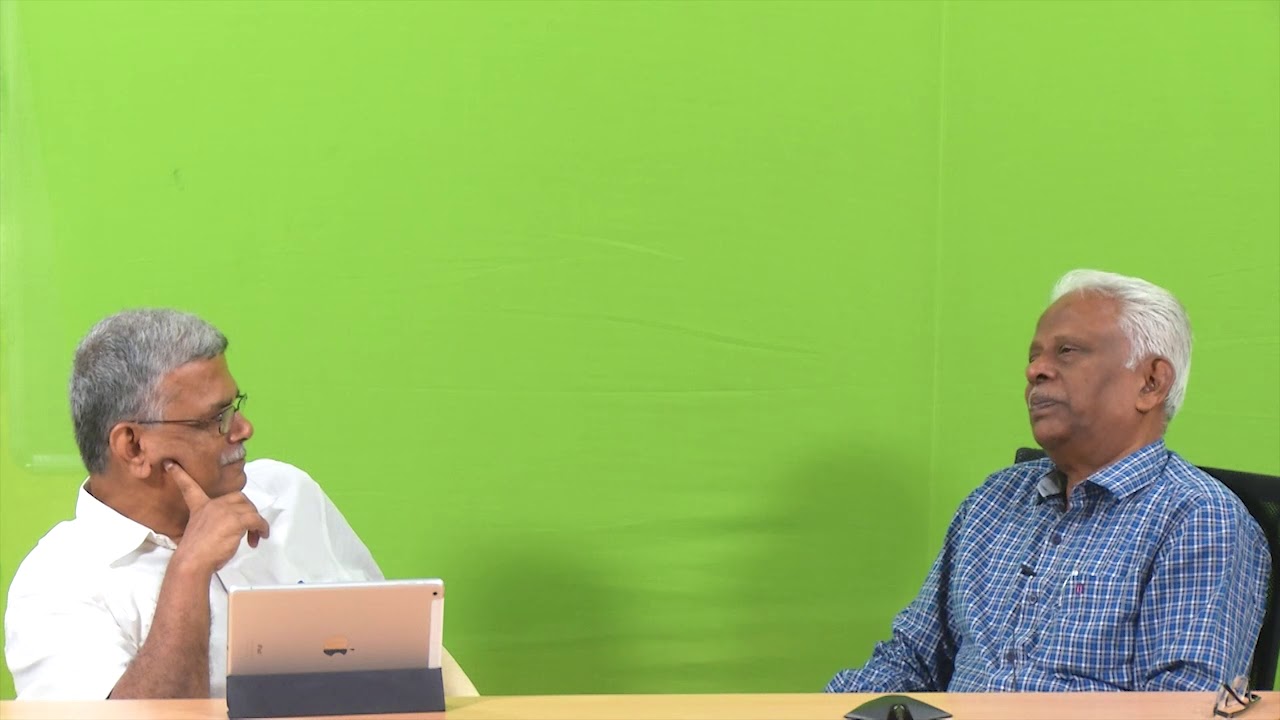
Professor Ravindran, I was trying to do some research
on your work that has been done during your career.
I have seen ... 4 different stages.
[Prof. Ravindran] Mm. [Prof. Idichandy] Probably, we will restrict the interview to these 4 stages
and it is probably for everybody who has done as much work as you
we have much more stages
but that we will see later on whether it can be added.
First one is of course, your childhood, schooling
and you studied in PSG College.
[Prof. Ravindran] Yes. [Prof. Idichandy] So, the first stage is up to completion of undergraduate
[Prof. Ravindran] Yes, yes. [Prof. Idichandy] in Mechanical Engineering in PSG.
Second stage though there is some employment in between,
but you came to IIT as a Technical Teacher Trainee.
[Prof. Ravindran] Yes. [Prof. Idichandy] And then you joined the faculty,
worked in Turbomachines Laboratory.
And ... I know fully well that
you're - your heart is more in the Turbo Machine Laboratory
wherein you know you have developed a lot of
experimental set up. So, that is the second stage.
Of course, in between you went to Germany
there also you had...you know,
made use of whatever is possible in Germany to ...
[Prof. Ravindran] Yes. [Prof. Idichandy] you know, get your Ph.D. done, back here in India.
So, that will be the second stage.
The third stage is, you know, Ocean Engineering,
because the Director has identified you as, you know,
faculty for Ocean Engineering to - to cut a lot of work ...
in establishing the department experimental facilities.
[Prof. Ravindran] Yes. [Prof. Idichandy] I know a little more in detail because I was also working
[Prof. Ravindran] Yes, yes. [Prof. Idichandy] with you at that time. So, therefore, that is the next stage.
Then there is a fourth stage probably
that is the biggest contribution that you have done
for the country in developing ocean technology.
That is the - as the Founder-Director of NIOT
which is an offshoot from IIT to start with,
but it has grown much beyond IIT
before you stepped down at the age of superannuation.
[Prof. Ravindran] Yes. [Prof. Idichandy] Later, if you add one more stage
it will be the stage wherein you are giving back to the society
and that is something which many people don’t do.
Those who are doing they may like to
pay some money and then forget about it.
But in your case, it is doing things
to make life in a very rural setting much more comfortable.
And your association with the - the tribal health initiative;
I mean these are something
which many of our friends should learn,
so that they give back to the society
what they have derived from it
and that is probably the fourth stage of your work, career.
Out of this, all different segments,
where do you - which one do you think is the most important?
[Prof. Ravindran] Why? [Prof. Idichandy] See, there are the [inaudible] the importance
it means to me personally and to the -
to the nations around - around the country.
I will [inaudible] that the contribution to the country
as a new development of an Institute of Ocean Technology
first time in our country is a contribution to the nation
because that has really started on a good way and if IIT and
we have not worked together,
that institute would not have come at all.
[Prof. Idichandy] Yes. [Prof. Ravindran] So, that was a very great effort and contribution to the nation
in the field of Ocean Technology.
The other one ... the social
society-related activity is giving me a great pleasure.
[Prof. Idichandy] Yeah. [Prof. Ravindran] Because there you see that...there are people who need of help
and we are able to give them some help
and they are extremely happy.
And you can see that it is useful to them, immediately.
So, that way I found that - that
these two are two different aspects, you know.
[Prof. Idichandy] Yeah. [Prof. Ravindran] This is a pride coming from our contribution
to the nation on high technology, new technology,
whereas, that is coming from contribution to humans.
From what is your capability, you are helping people and
and you are happy that it is useful to them.
So, these are two different things, at two different levels,
but both of things I - I give really good-
[Prof. Idichandy] Equal importance, ok. [Prof. Ravindran] - equal weightage to both of them.
[Prof. Idichandy] Yeah. I always look upon you as an institution builder.
It is not only in IIT,
wherein in Ocean Engineering Department
from practically nothing it has come to a stage
wherein it is one of the best laboratories in the country
and perhaps in South-East Asia
and NIOT - of course, there is no question.
I mean, I - I - I know that - that is, your heart was in that
almost nearly 10 years as Founder-Director
I think from practically nothing - a piece of paper
[Prof. Ravindran] Yes. [Prof. Idichandy] wherein MoU is written between IIT and DoD
to what you see in Pallikaranai right now is because of your planning,
and that way I think you can be
very very proud of as an institution builder.
[Prof. Ravindran] Yeah. [Prof. Idichandy] And of course, to the society what you are
[Prof. Ravindran] Yes. [Prof. Idichandy] giving back is something that is
[Prof. Idichandy] probably - [Prof. Ravindran] That came - that - by accidently - I didn’t plan for it
[Prof. Idichandy] Ok. [Prof. Ravindran] I didn’t want it.
Actually it came out of the interest of the IIT
[Prof. Idichandy] Ok. [Prof. Ravindran] to help the government to build this institution.
So, I mean the government
made a request to the then Director, IIT Madras,
[Prof. Idichandy] Yes. [Prof. Ravindran] and through the Dean, Professor Raju.
So, they said yes.
If at all somebody could develop this institute
only IIT Madras could initiate this;
we will provide the initial infrastructure, administrative support.
[Prof. Idichandy] Ok. [Prof. Ravindran] And they said, we need somebody to lead it.
We will also give you a person to lead it,
without even telling me they proposed my name.
[Prof. Idichandy] Now, that is the type of confidence the IIT system had in [Prof. Ravindran] So.
[Prof. Idichandy] Professor Ravindran's time. [Prof. Ravindran] I wore this tag only to the institute, IIT.
[Prof. Idichandy] And - and you have also proven the confidence that has been, you kow
put on you, ok.
[Prof. Idichandy] Let us go back to the stage one: [Prof. Ravindran] Yes.
[Prof. Idichandy] the childhood, your schooling [Prof. Ravindran] Yes.
[Prof. Idichandy] and upto BE, Mechanical Engineering [Prof. Ravindran] Yes.
[Prof. Idichandy] in PSG. [Prof. Ravindran] Yes.
[Prof. Idichandy] Briefly you can touch upon -
[Prof. Idichandy] it is more a biographical thing. [Prof. Ravindran] Yes.
[Prof. Idichandy] Yeah. [Prof. Ravindran] I came from a very small family
and my father was an accountant.
I studied in a school which was totally free in Virudhunagar
and I studied the pre-university also in a college
which is, you know, this thing.
And I had good academic record.
But ... my father was [inaudible] and he was sick that time,
and then he said "Okay, if you want to study Engineering
you put only one application,
[Prof. V. G. Idichandy laughs] if you get one admission at that time, you know,
go, otherwise we'll do some work here".
So, I applied and I got admission to B.Tech.
That's how I started my career.
Then, there also I involved myself
in learning the subject much better
and did lot of hands-on work
even for the final year B.Tech., BE I mean,
we did - some of our friends together,
we designed a working windmill
at that time, developing 300 watts
and put in the top of our Administrative Building
B.Tech which was working actually.
So, that was first happiness -
we said "We could design a machine".
[Prof. Idichandy] This is sometime in 1966. [Prof. Ravindran]'66.
[Prof. Idichandy] '66. [Prof. Ravindran] So,
[Prof. Idichandy] Yeah. [Prof. Ravindran] that was 66.
[Prof. Ravindran] So, that was long time ago- [Prof. Idichandy] So, before
[Prof. Ravindran] we fabricated. [Prof. Idichandy] windmills were not even
[Prof. Ravindran] known, yeah. [Prof. Idichandy] known at that time.
[Prof. Ravindran] Yeah. [Prof. Idichandy] Yeah, ok.
[Prof. Ravindran] Actually - [Prof. Idichandy] What was the motivation to do..
Actually, it was a funded project by CSIR,
one of the faculty has taken it and he left.
So, the institute was under constraint to complete the project
and the professor requested me
whether we could take it up and complete.
And that was one of the thing;
and it went as a report to CSIR for completion -
we were very proud of that.
[Prof. Idichandy] And ... for example, the blade. [Prof. Ravindran] Yes.
[Prof. Idichandy] You know, probably there were no design,
[inaudible] at that time. [Prof. Ravindran] Yes, yes, yes.
[Prof. Idichandy] How did you - how did you - [Prof. Ravindran] Actually.
[Prof. Idichandy] designed? [Prof. Ravindran] That's why, you know, I was basically - somehow ...
I had an inbuilt interest on turbomachinery.
So, when this request came ... there was a Russian book
and I requested one of the professors, Prof. Kandaswamy.
I said, "Please translate that
because there were no other books to
[Prof. Idichandy] Oh my god. [Prof. Ravindran] design the windmill. So, Russians had a book.
I forgot the name of it, but he translated and then
and there was one more book Putna, I remember that.
So, we designed, and I told, we incorporate a new device
because the - there was a previous model
made by that faculty who left.
[Prof. Ravindran] The base flew off when there were strong winds. [Prof. Idichandy] Oh my god.
[Prof. Ravindran] So, I was thinking you know
somehow we should have a speed limiting device.
[Prof. Ravindran] Something which is automatic. [Prof. Idichandy] Ok.
We thought about that and what we did was you know
we arranged the blades with the, yeah, bearing,
a sleeve bearing at the root, in the hub.
[Prof. Ravindran] So, due to the centrifugal force the blades will be moving
[Prof. Idichandy] Yes. [Prof. Ravindran] at a particular offset radially outwards.
At that time, the blades will have a pin in their axis
and the pin will be guided by a helical screw guide.
So that, as it moves out it will turn the pitch.
[Prof. Idichandy] Oh. [Prof. Ravindran] So, the automatically the angle of attack comes down.
So, the torque at high speeds automatically became less.
So, it was a self-regulating speed control.
[Prof. Idichandy] Technology is even today it is the same probably. [Prof. Ravindran] Similar, similar, yes.
[Prof. Ravindran] It is almost may be. [Prof. Idichandy] Yeah, now they have complicated the
[Prof. Ravindran] vane adjusting mechanisms, it's very expensive.
But on a small blade - machine like 300 watts.
We could afford it
nobody could provide such a complicated mechanism
of vane adjusting mechanism
which is similar to our turbine blades, no?
[Prof. Idichandy] Ok. [Prof. Ravindran] So, with this one itself, you know, it was spring-loaded.
See, it only works when the - the centrifugal force is too high
then they get back to the normals mode,
when the speeds are normal. So, that's what it is.
[Prof. Idichandy] So, it is really automatic. [Prof. Ravindran] Automatic, self-regulating.
[Prof. Idichandy] Ok. What about the generator?
[Prof. Ravindran] Generator we just bought... [Prof. Idichandy] Conversion and -
[Prof. Ravindran] locally - a car dynamometer, DC dynamometer: 300 watts. [Prof. Idichandy] Ok.
[Prof. Ravindran] So, it was a DC,
and it was a simply a
just a demonstration project that we could design
for a given wind speed.
[Prof. Ravindran] So there were some. [Prof. Idichandy] So, it like in similar projects you know
[Prof. Idichandy] you must have connected it to -
[Prof. Ravindran] Lamp load, yes. [Prof. Idichandy] Lamp load, and ...
[Prof. Ravindran] Lamp load. [Prof. Idichandy] And what was your feeling when the - the - the -
[Prof. Ravindran] It was very nice
and all the more happiness we got was our batch,
our group - 3 of us were given the Best Project Award
[Prof. Idichandy] Award. [Prof. Ravindran] by the faculty and we were taken
It was very nice. Professor
and Professor Subramanian, who was later Vice Chancellor of Bharathiar University.
He was my guide.
So, it was a nice feeling that something we have made works.
[Prof. Idichandy] Ok and - [Prof. Ravindran] Works for a long time. It is not that it will run for 2 days and stops.
So, that was a good feeling.
So, that's why when I came to IIT
when the Head of the Department
asked me which lab you want to go,
I said I want to go to Turbomachines Lab.
[Prof. Idichandy] Ok. We will come to that. [Prof. Ravindran] Yeah.
[Prof. Idichandy] But do you still continue your contacts with PSG, I mean some...
[Prof. Ravindran] Yeah, very little, but we have contact
but we have the Alumni Association,
but I am not continuing the technical contact.
So, I was continuing till about 5 years ago
because I was also the Naval Research
Board Chairman [inaudible]
and I was part of the RUTAG of IIT Madras.
So, in these connections, we were going for discussions
with them to do projects for us.
[Prof. Idichandy] Ok. [Prof. Ravindran] And, but they were a bit slow on that.
[Prof. Ravindran] So, they were not coming forward [Prof. Idichandy] Ok.
because they were always busy.
So, we lost interest in them basically, because the PhD people...
[Prof. Idichandy] I think, probably they have their own priorities. [Prof. Ravindran] Priorities, yes.
Because they were mainly concentrating on Undergraduate B.Tech.
[Prof. Idichandy] Yeah. [Prof. Ravindran] And the Mechanical Department was very good,
but they were not very keen on
[Prof. Ravindran] doing sponsored research funding. [Prof. Idichandy] Research funding.
Probably, they wanted to come out
[Prof. Idichandy] with larger number of graduates than... [Prof. Ravindran] Yes.
They are expanding that they have built one more institution,
they are on a - this thing,
expansion mode at the B.Tech. level, maybe little bit of M.Tech.,
but we have this alumni meetings for the last 51 years.
[Prof. Idichandy] Yes, yes. Every year. [Prof. Ravindran] It's still going on - every year.
[Prof. Idichandy] there we have and it is held only in the college itself. [Prof. Ravindran] No, not college.
[Prof. Idichandy] Oh, I see, different places. [Prof. Ravindran] We meet outside; except the 50th anniversary.
And the Silver Jubilee 25th anniversary,
all the other meetings are ... it's a family get-together
[Prof. Idichandy] Ok. [Prof. Ravindran] of classmates, it is nothing technical.
[Prof. Idichandy] Ok. [Prof. Ravindran] We meet, spend 2-3 days together,
and we are planning for a foreign trip this year,
next year - early next year - to Thailand.
[Prof. Idichandy] Oh, I see, ok. [Prof. Ravindran] 70 people are with me, 60 to 62 people, yes.
[Prof. Idichandy] Ok. Do you remember some of your very close friends
who have reached, you know, some stage
wherein you know, who have done very well - in - in - in - in -
[Prof. Ravindran] My BE? [Prof. Idichandy] contributing back ... your - your own batch.
Yes, yeah. There are many of them.
Some of the people were in BHEL Trichy,
they came out and started firms - consultancy firms,
engineering firms like Fishner and the - N. Chandrasekaran.
I think he became a big industrialist.
And in Coimbatore itself there is one Balasundaram,
who was in Electrical branch
and he is with that KG group and then
he is in charge of this Trigger Jeans company.
And he himself runs a stock broking.
[Prof. Ravindran] He has become a financial management man. [Prof. Idichandy] Ok.
And my own namesake, my roommate [inaudible]
they put people as per the alphabetical order.
So, I have another classmate named Ravindran
from a - that too, Mettupalayam - he is a industrialist.
He is making this, you know, paper - newspaper
actually he got in Madras, Andhra,
he a very successful man.
We have some people
employed in industries also: one Ranganathan,
who was given a President's Award,
he was a BAL Chief Executive, my own classmate in Bangalore.
[Prof. Idichandy] Ok, so - [Prof. Ravindran] Like that.
[Prof. Idichandy] That was perhaps, you know, after the graduation
probably you are always inclined to go for higher studies.
[Prof. Ravindran] Yes, that was my interest, actually. [Prof. Idichandy] Yeah.
because somehow you know when I started applying for...
when I started - about Engineering education
I came to know about -
I heard that IIT Madras has started, so I wanted to apply.
Sometime in February, March I was thinking,
then they said oh you fellow, you're
[Prof. Ravindran] too late. I never knew that we have to write an entrance exam. [Prof. Idichandy] Oh, time was over.
So, at that time itself I was thinking,
so IIT is something different, we should go.
But ... middle of my graduation
there was some compulsion from my family
that I should go for work.
So, when I saw this advertisement
for Technical Teacher Training Programme which was
Central Government's Programme, Ministry of Education,
to select candidates for, yeah, teaching career,
at that time itself, when there were
so few engineering colleges, they thought of
developing good faculty for engineering colleges.
So, they started this programme for providing Master’s degree
[Prof. Ravindran] as well as giving them training in teaching [Prof. Idichandy] Teaching.
in standard institution like IIT Madras and Anna University.
So, I applied for it. I was very really lucky to get selected.
So, we got almost double the scholarship compared to our M.Tech.
[Prof. Idichandy] Ok. [Prof. Ravindran] And we were also given an opportunity
to work in institution like IIT, work with German professors.
I think that was the greatest opportunity in my life, I thought.
My interest -so, I am just doing M.Tech., but this opportunity
to work with German professor - even short period,
I think that was a very great experience I could have.
[Prof. Idichandy] What was the year when you came to IIT Madras? [Prof. Ravindran] 1966.
[Prof. Idichandy] '66. [Prof. Ravindran] Immediately after graduation, I worked for 1 month
in a local Karaikudi Engineering College,
I left that, and I joined here - and that professor - that time he was
Professor Vijay Ram, who was later Guindy
[Prof. Idichandy] Oh, ok. [Prof. Ravindran] Principal, he said, "You should go to IIT".
He said, "You don't have to work in Karaikudi,
you please go to IIT.
So, he relieved me and then he said you go, so...
At that time, IIT was a great ambition in life
[Prof. Ravindran] you know 'we should get into IIT'. [Prof. Idichandy] Yes.
And then get M.Tech.
So, that was, so immediately came and joined here, '66.
[Prof. Idichandy] Ok. [Prof. Ravindran] August exactly.
[Prof. Idichandy] And ... probably, you know, you thought -
I - I - don't know whether you were always having an inclination
to work in the faculty of IIT
because after this 3 years of technical teacher-training
[Prof. Idichandy] you will be allotted some college by the [Prof. Ravindran] Yes.
[Prof. Idichandy] Government and- [Prof. Ravindran] Yes, yes.
But ... still you had interest in continuing in IIT in the faculty.
[Prof. Ravindran] It was like this. You see, the ... one of the conditions of the
selection for the Teacher Training Programme was that
we should serve at least 3 years in any engineering college
[Prof. Idichandy] Anywhere. [Prof. Ravindran] decided by the Ministry anywhere in India.
So, we had accepted that.
So, I had accepted the condition.
But I had a very lucky break, I should tell you now itself
because I don't know how many people had this opportunity.
During these 3 years, you know,
I was given ... very very tough task of
erecting certain test rig, very complicated test rigs;
fabrication, erection, testing by the German professor.
[Prof. Idichandy] This is in addition to your [Prof. Ravindran] To the
[Prof. Idichandy] course work. [Prof. Ravindran] yes yes, course work.
He said, "Your course work is your own personal benefit"
because that was - he was a very tough -
that's why not many people
[Prof. Ravindran] wanted to work under this Professor Scheer. [Prof. Idichandy] And [inaudible]
[Prof. Ravindran] I have great respect for him. [Prof. Idichandy] ... has a German attitude.
German. And he said, you know,
at that time there were many German professors
in IIT Madras - in Mechanical and Civil there were.
But what they did was
they brought equipments and erected them.
So, they could develop the laboratories fast.
Well, this Professor Scheer said "No, I want you guys
to design, fabricate, and erect and operate."
So, this was a very slow, painful process.
And it was very tough;
not many people wanted to do this - faculty.
So, the initial faculty ran away from him.
So, let’s say when I told you other day that
when Head of the Department
asked me where do you want to go,
I say I want to do Turbomachinery.
He said "Don't come and cry to me
that I ruined your career."
I said, "What is wrong with Turbomachines Lab?"
Later only, I knew that because of his very tough attitude
that doing work is only thing,
he will never give leave,
you have to do all the drawings yourself,
you go to the central workshop, get them fabricated,
erect, everything we had to do
like a very factory-level
which many of the initial faculty didn’t want.
[Prof. Idichandy] And most of it were done by you, alone? [Prof. Ravindran] No, there was a -
[Prof. Idichandy] Probably technical help. [Prof. Ravindran] That - that was the advantage, you know
the German design was that each laboratory -
we had at that time 10 laboratories in Mechanical Engineering -
had its own full quota of technical staff and equipment
[Prof. Ravindran] like lathe, milling machine, shaping machine. [Prof. Idichandy] Yeah yeah.
Small milling machine for tool making, this one;
drill - huge drilling, radar drilling machines.
So, we were well-equipped
to do the fabrication within ourself.
Whatever could not be done could be done in central workshop.
[Prof. Idichandy] Yeah. [Prof. Ravindran] So, most of the equipment like all the welding equipment
gas welding, arc welding, everything was provided to us
and this professor will come and supervise that
we are doing it correctly.
So, that is the best training period I ever had.
Then he will say, "I am going to teach Turbomachines.
All you guys come and attend."
So, me, along with Professor Venkatrayulu
who was at that time my batchmate,
we used to carry all the equipment
of turbomachinery models, you know,
to the class and he will explain,
I one of the best teacher in practical things.
So, compared to what I learnt in undergraduate,
I learnt more attending his lecture in IIT
by Professor Scheer on Turbomachines: on theory,
design, fabrication, and performance test.
Complete, it was a total course.
[Prof. Idichandy] Which - which university in Germany he was associated?
He was associated with Braunschweig.
[Prof. Idichandy] Braunschweig. [Prof. Ravindran] Technical University of Braunschweig.
And he was - he was - he was a war veteran,
then he has completed his Ph.D.
and when he came here none of [inaudible] were available,
so he was teaching Drawing.
He was also designated as Professor of Drawing.
So, he used to be a very meticulous instructor for drawing.
So, he will say: everything should have a drawing,
even if you make a chalk piece holder,
there should be a drawing.
So, he designed a system of designation of drawings,
numbering of drawings, storing them and assembling them - he got,
get - got his equipment to keep drawings properly.
All those things are still available after almost 50 years.
[Prof. Idichandy] Ok. [Prof. Ravindran] You can even [inaudible].
So, that this way, he taught us meticulously.
I was in charge some of the keys, you know,
every key in the laboratory,
every table key, every door key, every cupboard key
will have a duplicate, it will be in a central key board.
I was a key manager in that - key-in-charge,
like that, you know.
About everything, there was perfect discipline,
he taught us, yes.
[Prof. Idichandy] No wonder that you transfered many of these things, you know.
[Prof. Ravindran] So, that is the best part of my learning
in my life, was that 3 years
I went to Professor Scheer.
[Prof. Idichandy] Now, with Turbomachines Laboratory which you have completed
[Prof. Idichandy] your Master's in 3 years. [Prof. Ravindran] Yes. Yes.
Before I come to a very pertinent question which is
about the situation of laboratories
in - in - in IIT Madras in the present.
Was there any offer from the Government of India
for to you to go to some college after completion of it?
[Prof. Ravindran] That is - I was just -
I was about to say that, you know,
after I submitted my Ph.D. thesis with the
fabrication of test rig for the axial flow welding machine,
then I took an extra project title
of studying the inlet flow region of axial pumps.
So, that was also experimental, theoretical.
So, when I put all this work together -
in the 3 years of work, together -
it became so thick
and I presented the entire result to the committee,
Professor Thirunarayanan was the examiner,
[Prof. Ravindran] Head of the Department of IAC. [Prof. Idichandy] Ok.
In Mechanical Engineering - was the exam,
that - that - that was the level
[Prof. Ravindran] at which M.Tech. exams were held at that time. [Prof. Idichandy] Ok.
[Prof. Ravindran] Even though I - I don’t think we get those people in for [Prof. Idichandy] No, no.
[Prof. Ravindran] Ph.D.s now. He came and asked
"What, Ravindran, after all you are going to be -
after all you are going to be a teacher,
why have you done so much of work -
design, fabrication, experiments, making probes, calibrating them."
Then, I told - at that time, I had the offer from Calicut University
[Prof. Ravindran] to go, I had the offer. [Prof. Idichandy] Ok.
[Prof. Ravindran] I told him, "Sir,
any teacher should have the capability and confidence
to design machines, fabricate them, erect them,
and make them work successfully
for the design specification as made.
I have done this. I have this confidence
so wherever I go, I will be a good teacher
because I can teach the students how to
design, fabricate, commission, with all practical knowledge.
So, wherever I will go I will be a good teacher," I told him.
Then, the Head of the Department was present:
Narayan, he was Head of the YOC.
[Prof. Idichandy] Oh, board. [Prof. Ravindran] Board.
He said "He need not go anywhere,
myself and Venkatrayulu, my batchmate,
they can join us as faculty tomorrow."
Just like that. On the viva examination day,
he said they can join on ad hoc basis
[Prof. Ravindran] and which was at the time - Dr. Ramachandra was the director. [Prof. Idichandy] Ok.
He got us [inaudible] as a faculty few months later.
That's how I entered as a faculty, my transition from
teacher trainee to faculty happened in
'69 August - September - on the viva day.
I don’t think many people would have had this lucky chance
[Prof. Ravindran] to become a - [Prof. Idichandy] No, I do not think there will be any comparison account anywhere anytime, later also.
Because to get into this, you know,
[Prof. Ravindran] you have to go through so much of process. [Prof. Idichandy] Yeah.
[Prof. Ravindran] Whereas, just like that we got into IIT. [Prof. Idichandy] Ok.
[Prof. Idichandy] Now, you are a person who has been down to earth. [Prof. Ravindran] Yes.
So, you know working in the laboratory,
designing your own stuff,
getting it fabricated, I mean, totally hands-on.
What do you think about the present engineers?
I am not asking about IITs at all.
If you go to a typical engineering college
wherein, you know, graduates are produced,
do you think they get - they are lucky to get into
[Prof. Idichandy] you know, such type of an education? [Prof. Ravindran] No, not, except in few institution.
[Prof. Ravindran] Bulk of the present engineering students
do not get this opportunity.
One of the reason being, in the last decade has been that
the IT companies came and selected them,
and gave them some jobs
totally unconnected with what they study.
So, slowly the students lost interest in hands-on work.
The faculty also thought it was unnecessary to train them
[Prof. Ravindran] because anyway they get a job. [Prof. Idichandy] Correct.
[Prof. Idichandy] And that has nothing to do with what they learn. [Prof. Ravindran] Yes.
[Prof. Ravindran] So, sometime the offers came in the 3rd year itself,
so 4th year they never learned anything.
So, now, that's why some of the ...
the government rule has come that
you should come for campus only in the 4th year.
I think this is a very negative aspect
because, what for we train engineers,
they should have a problem-solving capability
for their own interest is around them,
[Prof. Ravindran] you can also do R and D. [Prof. Idichandy] Yes.
Excellence, then you publish, take patents,
that's one way of going up in your career.
But otherwise you are supposed to transfer your capability
to problem-solving practical industries,
[Prof. Ravindran] develop something what society needs. [Prof. Idichandy] Yeah.
[Prof. Idichandy] Can somebody design a machine?
So, that capability is totally missing.
So, many people ask me to come and teach,
I say I don’t want.
But one of the college now I am going I am stressing this,
I making them do hands-on work,
you know, all the few institution
where I am just mentoring. I am stressing,
but 85 percent of the students
who are getting undergraduate degrees,
they don't get this hands-on experience at all.
[Prof. Idichandy] Unfortunately, teachers are also not
very - very much inclined to take that type of offer.
[Prof. Ravindran] Because they have never seen an industry. [Prof. Idichandy] Yes.
[Prof. Ravindran] I can give you one disastrous situation.
I will not tell the institution.
I was talking to a faculty
who was a student of the same college.
It seem one student asked: "Sir" - Electrical student -
"Sir, I have not seen a induction motor".
This faculty, he said, I myself has not seen one".
[Prof. Ravindran] You - this is the status of the faculty. [Prof. Idichandy] Yeah.
[Prof. Ravindran] What good is the degree of the
undergraduate student studying under him?
So, I think it's very very important that
we should come back to this hands-on experience
by making it compulsory for the institutions
to work with industries
[Prof. Ravindran] and for students to work with industrial problems. [Prof. Idichandy] Yeah.
[Prof. Ravindran] That is my - that is the sad part of the Engineering education today.
[Prof. Idichandy] Don't you think that to some extent that has also
come into the IIT system, you know wherein probably
[Prof. Idichandy] they are little better off than the normal in various - [Prof. Ravindran] Yeah.
[Prof. Ravindran] My own experience - see, because
that was very clearly expressed by the ...
some of the visiting professor who came for the
50th anniversary of the Indo-German collaboration.
Some of - Professor Scheer himself was there,
his assistants were all there,
but some of the remarks were very very painful to hear.
Saying that the facility which they have created in the
late '60s, early '70s, were all
coming down in its quality and effectiveness,
and IIT Madras never took an initiative to upgrade them.
[Prof. Idichandy] Ok. [Prof. Ravindran] Especially, Professor Lutz was
almost crying. You see, his boilers and steam turbines
[Prof. Ravindran] have disappeared. [Prof. Idichandy] Yes.
And our own lab, even though some physicists are working
the original he brought, some turbines product,
they were all corroded and - this thing - they were not replaced.
So, and the - the - the - workshop manpower not there.
So, the students were very reluctant to take up
Master's and Ph.D. programmes in such labs.
[Prof. Idichandy] Yeah. [Prof. Ravindran] I think that has killed the initiative on
hands-on experience for the people
plus we did so much of work: we used to work in the lathe,
and the milling machine ourselves to manufacture, weld ourselves,
we had training in welding because number of pipelines were,
14 is pipeline, we used to weld for the test rigs.
So, that type of experience our students are not being given
by default, you know, because we don't have the manpower.
So, people are staying away, okay, if we go for equipment work,
I have to get all the things in -
fabricated outside, it is time consuming, it is expensive,
easy way to sit before the computer to do some modeling.
Easily you can publish papers, you can get your M.Tech. or Ph.D.,
that seems to be the trend nowadays.
[Prof. Idichandy] Yeah. [Prof. Ravindran] Even in IITs.
I am not very happy with that because that may be good for
getting our admissions abroad and
going thing but that is not expected
for engineer to contribute to the local industries.
I am very - very very particular about that
that IIT is not contributing enough
to the hands-on experience of students.
Even the number of those days we used to have
[Prof. Ravindran] workshop week completely. [Prof. Idichandy] Yeah.
Whole week they used to work in all the lab,
Workshops at Central Workshop,
Carpentry, Smithy, Machine Tools lab, Welding lab.
[Prof. Ravindran] Nowadays, that workshop also is reduced. [Prof. Idichandy] Yeah.
And one of the contributing factors is
that the 5-year programme came - became 4-year programme.
They expect lot of work to go into the plus 2.
[Prof. Idichandy] Yes. [Prof. Ravindran] But that didn’t happen.
We lost something in this process.
Engineering education lost some
very precious time in educating them and
this is because we lost 1 year of the instruction period.
[Prof. Idichandy] Ok. But coming to the students' point of view
because once, one of my
friend's son who joined Computer Science here,
he asked me: "Why should I do Workshop because in my lifetime
I will never even look at any of these machines
because it is not necessary."
And slowly from Computer Science the same question
is being asked even by Mechanical Engineers
you know: "Why should I do Workshop,
why should I dirty my hand
when I can get, you know, complete my courses
and also complete my project without -
[Prof. Ravindran] Yes. [Prof. Idichandy] -dirtying my hands and all."
That is looking ... very narrow approach to life.
You see, you can be a Computer Science Engineer
be a Computer Science man all the time,
look at servicing of computers
or develop computer language, hardware, software all that;
that means, your part of life is restricted
to a very small group of experts.
But in a field like Mechanical Engineering,
you can do computer simulations, test analysis,
software pactice all that you can - be -
do with only with computer knowledge.
[Prof. Ravindran] But finally, who will make - hardware?
[Prof. Idichandy] Yeah. [Prof. Ravindran] Somebody has to produce things,
things around us - who is manufacturing them,
who designs the machines to manufacture them,
who - machines the - who manufactures the tools
dyes, tool bits, to machine this,
material development, machining process,
finishing process - who does that?
He has to be a practical engineer.
Who developed that - interface is - totally, that's why
we are not making any new machines in our country.
[Prof. Idichandy] Yeah. [Prof. Ravindran] We buy and use them.
[Prof. Idichandy] Yes. [Prof. Ravindran] Are we making new machines?
Are we designing new machines?
Are we developing new technologies?
Are we taking new patents which are possible to be made
for our own industry? That is our weakness,
unless we improve upon this
physical hands-on experience for our own engineers,
we are going to be always a
second generation of machine users.
So, to make our Make in India
successful you think that the entire
engineering education has to be revamped.
Definitely. See, nowadays Make in India is import technology,
[Prof. Idichandy] Yeah. [Prof. Ravindran] use the factory - you are using our
cheap labour - that is not Make in India.
Make in India is really that you design,
make our R and D laboratories,
technology laboratories - you - to make mistakes and design,
give them time, and a chance to make mistakes and learn
hands-on experience, develop their own machines,
support them. Where do we support them -to make?
[Prof. Idichandy] Yeah, unfortunately that is the situation.
[Prof. Ravindran] Unfortunately, in Defence also,
the same thing is happened.
I have seen in Defence Laboratory,
you have seen in Defence Laboratories.
Lot of work is done, but they will never buy the final product.
There are some Western interest, difficulties,
maybe some of them are not reliable,
materials are not the best, but
we should give them a chance to improve.
In many case like space,
we have proven that we can do wonders.
[Prof. Idichandy] Yeah. [Prof. Ravindran] Why the same chance is not being
given to other industries?
The support that ISRO enjoys today
or Atomic Energy enjoys today,
Science and Technology Bombay is not enjoying.
Human Resource Department is not enjoying
that is why our education system is suffering.
Science and technology is suffering.
Technology development is suffering.
Because our education systems also fall into that trap
that we make people more computer-based,
not hardware-based at all, thanks for the [inaudible].
[Prof. Idichandy] See, unfortunately the - the - ultimately what happens is
even the faculty who are joining,
many of them do not have - any - any hands-on experience at all.
Yes. Similar thing will happen, I told you
one faculty said in one of the - "I have not seen induction machine".
Same thing will happen to some of these people.
High-tech Computer Science engineers or high-tech
Chemical engineer, he may - he may not see a
lathe or this thing, he may not be able to do any work.
So - that should not - we should not allow this
degradation of the practical knowledge to happen
in our hands-on experience
Yeah, let us hope that I mean your -
this voice will reach some stage wherein, you know, there will be some -
[Prof. Ravindran] That is my sadness here, that - [Prof. Idichandy] Like many [inaudible]...
[Prof. Ravindran] Because I started my career
with so much of this thing and all
I see before my eyes, yeah, change of trend.
Many people thinking that we don’t have to do this.
The younger generation thinks that
hands-on experience is not required,
that is my saddest feeling as a engineer,
as a Mechanical Engineer, or Ocean Engineer.
[Prof. Idichandy] Shall we stop for some time or -
[Mr. Kumaran Sathasivam] We - we cannot, sir. [Ms. Mamata Dash] 10 minutes,
[Ms. Mamata Dash] another 10 minutes. [Mr. Kumaran Sathasivam] We have another 10 minutes
[Mr. Kumaran Sathasivam] which we can use. [Prof. Idichandy] 10 minutes.
[Mr. Kumaran Sathasivam] Yes. Ok
[Mr. Kumaran Sathasivam] before we need to stop.
[Prof. Idichandy] Now, I can understand your, you know, hard feeling
because you have done so much to the laboratory,
it has been brought to a certain stage,
have you visited the laboratory again -
not before - or after that 50th Golden Jubilee here?
I have been visiting especially, Ocean Centre I have visited,
but Turbomachines Laboratory
I think once or twice I have gone.
But things are not very
very well because the number of faculty.
[Prof. Idichandy] Yeah. [Prof. Ravindran] See, for example,
I am attached to the Turbomachines Laboratory
because no institution or country
is teaching the turbomachines similar to what
the German system has introduced here.
Pumps, turbines, steam turbines or gas turbines,
they all are taught in a unified theory
and special fluid related properties are solved separately.
So, we have two groups of turbomachines.
And the knowledge those days
we used to have Turbo Machine lectures for 2 years
in the 5 year stream. So, a person could
without any knowledge of pumps or turbines earlier
could design the turbine, fabricate.
So, all of M.Tech. students those days
do a fabrication of a pump or a turbine and do the testing,
that was our standard at that time.
[Prof. Idichandy] Ok. [Prof. Ravindran] That - that means, when they could
[inaudible] what does industry need
the R and D department, we
develop engineers for R and D department.
So, we want him to be capable of designing a new system
or modify the existing impeller to a new application,
modify the materials to a new fluid being handled,
a slurry pump or a turbine.
So, even the faculty: Professor Prithviraj or
everybody was able to design hands-on things.
I think that - what is - is - helping
the development of new machines, new ideas
can be transformed into new hardware;
if you have that practical knowledge of doing that,
but if you are sitting before a computer
only, that becomes very difficult.
Because I - I - I forgot to tell you also that turbine
the research, obviously, I did it on a reversible pump turbine,
actual turbine - developing about 50 kilowatts of power
the entire rotors were machined by me right from scratch
from a bronze metal. I cast the material [inaudible]
Deckel Milling machine because they didn’t have labour
I worked in the [inaudible] I brought in my personal suitcase all these
machine components and assembled here and tested it.
I tested for 9 months, day and night.
My thesis will be ... external work is so much;
all the associated message systems calibrating them.
Nowadays, these people do not know what is an error analysis,
what is fabrication of a probe, 3-dimensional probe or
how do you measure the flow field in a
impeller - nobody knows. They can do maybe a
computer simulation, but how do you validate your -
[Prof. Idichandy] Yeah. [Prof. Ravindran] Computational Fluid Mechanics.
[Prof. Idichandy] That is something missing in our [Prof. Ravindran] That is something...is very
[Prof. Ravindran] much missing in our present training programme. [Prof. Idichandy] Ok.
Immediately, after you know, the initial stages I think
you had an opportunity to go - go to Germany
[Prof. Idichandy] on a - under a DAAD scholarship. [Prof. Ravindran] Yes.
Yeah, that was immediately after joining in 1971
after I finished my M.Tech.
there was an opportunity: I applied for a scholarship
to the Government of India, at that time there was a
all India quota and IIT Madras enjoyed a -
[Prof. Idichandy] Special [Prof. Ravindran] private quota, but I was too junior.
So, I could not get that.
So, I applied - I was lucky to get that lucky break I had.
So, I went along with senior people of my faculty
who were my teachers,
I went with them to Germany for training
and worked in a laboratory. There also, I had an opportunity
where the professor said we should teach - learn -
speak to me only in German language,
learn the language very nicely and do the work here.
You start an all these lectures in German language.
So, that also and they gave me total freedom
to develop the - even though I didn’t know
how computer program at that time.
Those days IBM 370 was the only computer
in IIT Madras and the telephone equivalent was there.
We used to have 2000 cards for the code.
So, all that was learned by me, newly in Germany
they supported me and when I wanted
to fabricate the turbine, they said, ok, I approached a private
company called Deckel Mill, actually we have lot of
copy milling machines from them.
When it was - I'm from IIT Madras, I would like to go, he said
we don’t have people, but you are welcome to
[Prof. Ravindran] come and use our machines. [Prof. Idichandy] I see.
I worked there, machined myself, 4 months, like maybe about
26-27 different types of blades, assembled them.
[Prof. Idichandy] It is not a copying - [Prof. Ravindran] Copying only, means
[Prof. Ravindran] but different types you know. [Prof. Idichandy] Ok.
13 blades of guide blades, axial for guide blades
and then 3 different rotors with 3 different profiles.
Each rotor having 6 blades.
I have to make them. So, cast them,
then copy mill them, finish them, check their profile,
if necessary, modify it.
I brought them, ok, assembled them;
[Prof. Ravindran] random at 2000 rpm which is not that you know. [Prof. Idichandy] Yeah.
[Prof. Ravindran] It is a real pump, real turbine what kind of pump
and turbine it was a machine for tidal performance.
So, associated planning of the
performance: how is the flow
distribution, 3-dimensional flow,
3-dimensional components of velocity
static pressure, dynamic pressures,
flow rates, completely measured,
then mechanical power, speed, torque, accurately.
So, that was the work - that was the...
[Prof. Idichandy] How long you were there in Germany?
[Prof. Ravindran] Nearly 2 and half years I was there.
[Prof. Idichandy] That was [Prof. Ravindran] Apart from language course;
[Prof. Ravindran] no, including language course. [Prof. Idichandy] Including language,
[Prof. Idichandy] Yeah. It was completely in a Technische University
[Prof. Idichandy] that [Prof. Ravindran] Munich, Munich, it was in the Munich.
And it was totally, it was a very nice experience
because there I could really see
the total advancement of
technology, experimental technology;
to measure things in a rotating machine,
that is measure the flow velocities static pressures.
On the rotor blade, transfer them through the slip rings
physically and then take the signal out and
it's ready for our interface, those days.
And even the 3-dimensional velocity probes
where you have the radial common velocity
[Prof. Ravindran] in water had minute as you know the cool it once. [Prof. Idichandy] Yeah.
6 of them in a 5 millimetre base
such was the quality of manufacture.
So, that was - that was real learning.
And since I could speak German language fluently,
I could talk to them and learn lot of this
very nicely because there I had my family with me - wife,
[Prof. Ravindran] son, so, we enjoyed ourselves. [Prof. Idichandy] I am surprised you know, how can -
[Prof. Idichandy] you said you got in Deckel, no.
[Prof. Ravindran] Deckel Milling Machine, yes.
How is that, you know, the...totally, you know, a strange
person from a very strange country
they just leave the equipment to you to
[Prof. Idichandy] you know fabricate whatever you want. [Prof. Ravindran] Yes.
That - that - that is what you know, the
universities had such a big respect from industries
[Prof. Ravindran] so, when somebody from a [Prof. Idichandy] Sure.
institute wants to come and work for their research,
they offer the facilities.
They like to involve with work.
[Prof. Idichandy] Ok. [Prof. Ravindran] With industries, you know.
I had a person from
who make automatic gears - car,
he is a CEO of the company.
So, when the university requested him to
come and take lectures on Hydraulic Systems
because it was the Hydraulic Torque Converters no,
he left half the job and then he said
1 hour per week only he will be take class,
but he said, I should be called only professor.
So, they have such a major
[Prof. Idichandy] Yeah. [Prof. Ravindran] respect for university systems.
And he used to take all the students to his company,
take them around give them good gifts
of tool kits, I still have those [inaudible] which is
[Prof. Ravindran] 55 years old. [Prof. Idichandy] Ok.
So, that was the respect of the
university by the industrial people.
So, you were in Munich two and half years
and you know Munich is most famous for its beer.
[Prof. Ravindran] Yes. [Prof. Idichandy] And the Oktoberfest.
[Prof. Ravindran] Yes. [Prof. Idichandy] I still wonder
how you have not even tasted beer.
[Prof. Ravindran] Yeah. At that time,
yeah, the problem was that, you know, that German beer
is the purest beer in the world. [Prof. Idichandy] Yeah
[Prof. Ravindran] By law they have prevented any
[Prof. Ravindran] flavors being added. [Prof. Idichandy] Added.
[Prof. Ravindran] So, so the German beer is very bitter.
I never loved the taste for German beer. [Prof. Idichandy] Ok.
to Oktoberfest where they drink from
11 o’clock in the morning to 11 o’clock in the night,
it is fun. People drink, eat, drink and then play music.
[Prof. Idichandy] Yeah. [Prof. Ravindran] It’s called the Oktoberfest music.
[Prof. Idichandy] Yeah. [Prof. Ravindran] All trumpets only.
So, in a tent there are about 30,000 people
sitting and eating and drinking and dancing.
[Prof. Idichandy] Yeah. [Prof. Ravindran] Great fun
but beer itself we never had a taste,
[Prof. Ravindran] but that beer is really bitter. German beer is [Prof. Idichandy] Ok.
[Prof. Ravindran] really bitter. [Prof. Idichandy] And they always consume
[Prof. Idichandy] the beer in 1 litre. [Prof. Ravindran] 1 litre.
[Prof. Ravindran] They don't sell anything less than 1 litre these - Oktoberfest time.
[Prof. Idichandy] Ok. Yeah. After your
very successful teaching, research, as well as
doing your - completing your Ph.D., everything,
after completing in the Turbomachines Laboratory, you joined
or shall I say you were forced to join Ocean Engineering Department.
No, not that way, but something
really happened, you know, at that time
the Director was Professor P. V. Indiresan. Indiresan.
And the Head of the Laboratory was Professor Raju.
So, Professor Indiresan is one person who wanted
the different faculty from different departments to work
together and take up major projects for
industries as interdisciplinary projects.
So, you will give me a thrust.
In this process, he formed a number of interdisciplinary
[Prof. Idichandy] Research groups. [Prof. Ravindran] research groups from [inaudible] faculty from
Electrical, Mechanical, Civil, Computer Science etcetera;
when they were taking up lot of projects, industrial projects
like the micro project in Shivaganga and all that.
So, they were doing that and at that time
there was a special interest on
renewable energy from the oceans
and Professor Indiresan felt that if at all anybody
could do the work on ocean energy,
it could be only IIT Madras Ocean Engineering Centre
and we should take initiative.
So, he took the interest to call for a
formation of a group of industry - faculty
to work on renewable energy sources from the ocean.
So, from the turbomachinery side, myself and Venkatrayulu were...
we volunteered to work
on the design of pumps and turbines, aspects of both
Ocean Thermal Energy and Wave Energy.
And there were people from
Ocean Engineering Centre like Professor Vendhan,
an instrumentation group like yourself and
Professor Bhattacharya, and Civil Engineering group
people maybe Professor Aravindan was
very - this thing - Electrical group,
Professor Laxmi Narayana. And Jagadeesh Kumar.
[Prof. Idichandy] Okay. [Prof. Ravindran] They were all ... involved.
So, we started working on very very preliminary
designs of Ocean Thermal Energies [inaudible] to start with.
And at that time, the Government of India started the
[Prof. Ravindran] new department of ocean development [Prof. Idichandy] Development.
[Prof. Ravindran] under the Ministry of Science and Technology.
Dr. Qasim, who went to Antarctica for the first
time taking the group from us, was made the secretary
and Professor Indiresan was always in touch with him.
And then Professor Indiresan
said that we are going to start this initiative
and Dr. Qasim said he will support that.
So, at that time the ministry of - or the department of
non-conventional energy source also was there
who had interest on Ocean Energy.
So, from these two departments of
Ocean - Ocean Development and
Ministry of Non-Conventional Energy Sources,
Professor Indiresan arranged some funding to be given
and formulated...created a cell called Ocean Energy Cell
[Prof. Ravindran] as a part of the Ocean Engineering [Prof. Idichandy] Centre.
[Prof. Ravindran] Centre of IIT Madras with industrial faculty.
So, at that time because we were
taking active part from Mechanical Engineering group on
pumps and turbines, aspects of both the
wave energy and this thing.
And he was also requesting us to develop the - or to
complete the wavemaker insulation,
[Prof. Ravindran] at that time which was bought from Germany and the installation was delayed. [Prof. Idichandy] Ok.
[Prof. Ravindran] As a person interested in turbomachinery,
especially there was a special
bi-directional airflow uni-directional turbine
called Wells turbine, which was of tremendous interest
for the Wave Energy Programme.
I wanted to work further on that.
So, we volunteered to commission that
wave energy, wavemaker in Ocean Engineering Centre.
So, first our job was - my job was to
commission as a faculty of Mechanical Engineering.
I offered support to commission that wavemaker
which was commissioned in about 6 months; we worked
day and night. Then, Professor Indiresan said, "Ravindran
now we know because there were no Mechanical Engineers
part of the faculty of Ocean Engineering at that time,
they were all only Civil Engineers,
structural engineers and instrumentation group headed by you.
So, there was no Mechanical Engineer there."
So, he said "We need you."
I was bit hesitating, saying that I had research students working in
Turbomachines Laboratory, then they said you could be a
adjunct faculty and all.
Then, when this funding came, specifically from both the ministries
to create a cell, he wanted somebody to head that
and he wanted me, I was bit reluctant, but he forced me to
apply - appear for it even though I didn’t apply.
So, I was given the opportunity to start this activity on
renewable energy from the oceans
and he could recruit more younger faculty, research staff
from other IITs also, from IIT Kharagpur, example
and then we started major activity
to study the different aspects of wave energy conversion,
the system which is practically useful for India,
for the type of wave climate we have in India.
The components of the system
where we select this system called Oscillating Water Column System,
there was work for optimizing the
hydrodynamic shape of that wave absorbing.
This converts the energy from the wave from the
waves to the air trapped in a chamber under [inaudible].
Then from the air to a mechanical shaft
through a turbine which is this bi-directional airflow turbine,
then a generator for it which will convert this mechanical energy
into air flow energy and pump power to the grid.
So, we had to design the total loop.
So, even though Professor Indiresan was a bit
in a hurry to do that we recommended that we have
3 research groups, independently,
to work on the hydrodynamic gas turbine energy
conversion of wave to water, air, hydrodynamic part of it.
Then, the mechanical turbomachine aspect of the
design of a special turbine
for pneumatic to mechanical conversion
and advice from electrical engineers to
select the right type of
machinery to convert cheap machinery to convert
mechanical to electrical engineering.
So, we had 3 different research topics given to Ph.D.
[Prof. Idichandy] Students. [Prof. Ravindran] students and we did a very good work
and based on that confidence,
then, we told Professor Indiresan we can go for a
field plant and we selected a site
at Vizhinjam, Kerala. We built one,
one of the first of its kind in the world, you know,
to generate 150 kilowatts. That was also a very big
learning crosses for us because it consisted of a caisson
3000 tons in weight. We built it on the - on the
harbour, Vizhinjam harbour, towed it to the site
and seated it 10 metre. Our first attempt failed
because of many reasons: we didn't have right tug,
we use some prefabricated
technology for slabs connecting them,
it started leaking, so...
[Prof. Idichandy] Probably, you could not also get contractors who can do
[Prof. Ravindran] Yes so [Prof. Idichandy] this type of -
Professor Raju used his contact with Larsen Toubro.
He said it is a national programme,
so they have to help us. So, like that
the Vice President of Larsen Toubro,
[Prof. Ravindran] Dr. Ramakrishnan. [Prof. Idichandy] Ramakrishnan.
Ramakrishnan was there and he agreed, even though
it was not a profitable business for them - it was
a technology demonstration capability of Larsen Toubro
for this project. First of its kind there caisson; fabricated
and floated out and then rest of the equipments
assembled on it, built a bridge to the shore which has
seated 50 metres away from the near breakwater.
So, that was also a tremendous
learning process and demonstration of capability of IIT Madras
on all the aspects and we commissioned that,
that's how I got involved then.
When we did that Professor Indiresan said
we want you to permanent -
I was a deputation of Mechanical to
this thing; then he said, "No, we want you to
permanently be in Ocean Engineering Centre."
So, I became a permanent faculty
of Ocean Engineering Centre.
And at that time only, also,
we have commissioned the second stage of German
support to us. We expand our facility to include
multi-element wavemaker. We formed a group of
multidisciplinary faculty from IIT, Ocean Engineering Centre,
your group and Sundaravadivelu's group doing the structural connections
and we did the mechanical part of that
[inaudible] running the sophisticated wave-making facility,
3-dimensional wavemaking
facility which was full of hydraulics.
Very complicated system of first of its kind installed.
And that way that time it was a
first thing which happened that
2 million German marks were used
[Prof. Ravindran] to buy an equipment not from Germany. [Prof. Idichandy] Yes.
[Prof. Ravindran] We bought that from Denmark. [Prof. Idichandy] Denmark.
So, that was also another thing we could,
because I was Head of the Department
we could convince the German representative
who was staying with us, one Dr. ?? We want the
best equipment which is affordable.
The German equipment was very very expensive.
An extension of a 4 metre flume would have been very expensive
which is hydraulic-based, this was servo motor base one.
So, that's how we got that equipment.
And it was a cooperation. We gave - IIT gave
20 million rupees, for the associated
structure facilities and infrastructure
[Prof. Ravindran] they gave us 2 million German marks [Prof. Idichandy] German marks.
for the especially imported equipment.
That's how we could commission this
[Prof. Ravindran] special facility which is unique in this part of the world. [Prof. Idichandy] Yeah.
[Prof. Idichandy] In fact, Ocean Engineering Centre at that
[Prof. Idichandy] time was probably the only one of its kind in South-East Asia [Prof. Ravindran] Yes true.
[Prof. Idichandy] which had most of the facilities under one roof.
[Prof. Ravindran] That too, even Germany did not have, you know.
[Prof. Idichandy] Yes. [Prof. Ravindran] And see there were facilities
under commercial or private this thing like
[Prof. Ravindran] National Hydronus Laboratory in Trondheim. [Prof. Idichandy] Yeah.
They were all privately owned laboratories.
Under a university system,
I think this was the first of its kind of the unique
facilities, so many facilities under one group.
I think that showed the success of our initiative in IIT Madras.
And Germans supported us very much.
I think that was a brainchild of
Professor Indiresan to develop this and
he had special interest in oceans.
[Prof. Idichandy] Yeah. [Prof. Ravindran] Because before he came to IIT Madras, he was in
Centre for Applied Research in Electronics.
There he has worked a lot of things on underwater
[Prof. Ravindran] acoustics, electronics, etcetera. [Prof. Idichandy] I think...
[Prof. Ravindran] So, he had a special interest in Ocean Engineering Centre. [Prof. Idichandy] Yes.
Even after his retirement he came and stayed with us
[Prof. Ravindran] as a faculty of Ocean Engineering Centre. [Prof. Idichandy] Just like us.
I think a lot of great support for him we developed this
in disciplinary group. I - now I think we have
lot of Mechanical Engineers and there are other
people in Ocean Engineering Centre. [Prof. Idichandy] Yes, correct.
[Prof. Ravindran] I think that was a vision of Professor Indiresan we should review. [Prof. Idichandy] Yeah.
[Prof. Idichandy] And he is totally a multidisciplinary. [Prof. Ravindran] Yes, yes.
[Prof. Idichandy] Coming back again to the - I think, no wonder the
[Prof. Idichandy] President of Germany himself came and [Prof. Ravindran] Came, yes.
[Prof. Idichandy] inaugurated it. [Prof. Ravindran] Yes. That was one of our
best achievement because till that time Ocean Engineering Centre
[Prof. Ravindran] never had any recognition even within India. [Prof. Idichandy] Yeah.
Even though we had done 1 or 2 projects for ONGC and all that.
The whole facility, the uniqueness
of Ocean Engineering Centre was not known to anybody
outside our Ocean Engineering Centre.
So, we sent, we requested the German department of GTZ
[Prof. Ravindran] German agency for technical cooperation. [Prof. Idichandy] Technical cooperation, yes.
To support us and they were also thrilled that
you know, they could bring the President
to inaugurate such a very important
example of that cooperation to us.
Even though Ocean Engineering Centre came very late into the
German aid program, and we have become a - such a
big advertisement for them
or, this thing we've achieved a very major result within a short time.
That was the happiness of German agency also.
They will like to also support us
[Prof. Ravindran] and that was a very good thing yes. [Prof. Idichandy] In fact, it was
[Prof. Idichandy] also a big news for the German media. [Prof. Ravindran] Yes.
[Prof. Idichandy] For the President came. And one of the aspects
which they projected was such a facility is not available in Germany.
[Prof. Ravindran] Yes. [Prof. Idichandy] Whereas, the government has supported,
[Prof. Idichandy] want to be created in the... [Prof. Ravindran] You know and
that was the greatness of German,
[Prof. Ravindran] they agreed to that otherwise. [Prof. Idichandy] Correct, correct.
normally a donor agency
never allows such a major equipment,
money to be spent outside Germany.
[Prof. Ravindran] They will like to use it for their own industrial support. [Prof. Idichandy] Correct.
[Prof. Ravindran] But this was - I mean, when we convinced them
they accepted that. I think that was a very magnanimous
[Prof. Ravindran] way in which they accepted. [Prof. Idichandy] Ok.
[Prof. Idichandy] I think the caisson - again it was rebuilt [Prof. Ravindran] Yes.
[Prof. Idichandy] second time. [Prof. Ravindran] Yes. After the first failure
when we could not place it
at the right place at the right tide.
We... it got damaged also during the big monsoon time.
We designed a stronger caisson little bit
[Prof. Ravindran] more of more surplus [Prof. Idichandy] Ok.
strength - that is factor of safety was slightly more.
And this was slightly constructed in a slightly different
procedure that the - only the basic raft was
[Prof. Ravindran] built on the shore. [Prof. Idichandy] Shore.
On the beach. Then we pulled the raft into the sea
and then built the super structure
of nearly 20 metres in the floating water.
[Prof. Ravindran] The whole raft was floating. [Prof. Idichandy] Yeah.
And that was a big challenge because
when we put concrete on one side
because of the floating mode it used to tilt.
So, keeping the right angle and the
strength and uniformity was a
big challenge to Larsen Turbo.
But still it was a very good demonstration of the
new capability of building this huge caisson
which was ballasted with 3000 tonnes of sand
to make it sit on the floor.
It became a gravity structure.
No foundations were added
and all - it was just sitting on a
prepared rubble bed which was prepared by divers.
And we built the turbine and
the generator afterwards, after building a connecting bridge
where there was no crane. It was purely, it was another
learning experience how to build a
50 metres long bridge from the breakwater to the
[Prof. Ravindran] caisson sitting in 10 metres water depth. [Prof. Idichandy] Ok.
So, without big crane, without a Harley crane of 2 tonnes capacity,
so, slowly like they build this a road, railway bridges now,
[Prof. Ravindran] we built extension; extension we built over the oceans. [Prof. Idichandy] Yeah yeah yeah.
[Prof. Ravindran] Yes, that was - [Prof. Idichandy] I think the second caisson worked
[Prof. Idichandy] probably about 15 years later. [Prof. Ravindran] Yes,
that is one of the longest
[Prof. Ravindran] working wave enery plant in a whole world. [Prof. Idichandy] World.
The Belfast people started one,
but that fell into the sea within about 2-3 years.
So, that way ours was the longest surviving.
We commissioned in 1989 that was the last eve,
[Prof. Ravindran] New Year Eve success, December 31st. [Prof. Idichandy] Oh, yes.
It was ... a happiness. After initial
failure it was a very great joy for all of us
when we seated it properly and then
slowly we added the turbine and generator,
we pumped power to the grid. Then, after the initial
system was commissioned with induction generator
that is induction motor, very conventional rendered machine,
Kirloskar machine, run at a speed higher than the
synchronous speed to work as a generator,
cheapest possible generator. But that was
very stiff, you know, torque slip characteristics
3 percent when speed is the
power went from 0 to 100 percent.
The wave characteristics didn’t match that very much.
We looked out for a very simple and rugged machine.
So, slowly we involved the faculty from
[Prof. Ravindran] Electrical Engineering like this fellow, Professor Jagadish Kumar. [Prof. Idichandy] Yeah.
He started a variable speed induction motor,
then control of the speed in line with the
power availability from the waves. We did lot of
research on the electrical machine also
plus which slowly change the type of
turbine from adjustable guide blades,
we have put adjustable guide blades,
then we fixed guide blades.
Then, we said that during monsoon
the power availability is so high
we designed for average power.
The peak power was nearly
[Prof. Ravindran] 10 times that of the average power. [Prof. Idichandy] Oh.
So, we said, "Why we should lose that peak power?"
So, we changed the type of design of the turbine from
reaction turbine, low pressure reaction to
high pressure impulse turbine,
similar to the work done by Japanese,
we have cooperation with Germany.
Then, we involved the faculty from Aeronautics Department
[Prof. Ravindran] the Professor Santhakumar. [Prof. Idichandy] Santhakumar.
[Prof. Ravindran] I think you are right.
He came and he developed a test rig also, done for the
Bio Nuclear Lab. So, it was a really
a wholehearted cooperation from faculty, we developed
new machines. We developed and we attained a very high
overall efficiency compared to anybody else in the world.
Only: our sadness is that we could not
put that in the harbour that was being built in the
[Prof. Ravindran] Valiyathura harbour. [Prof. Idichandy] Ok.
Near Kollam, there was a harbour project coming
not Valiyathura, near Kollam.
But...they said we are having stones which are very
cheaply available in the nearby hills.
So, our caisson was little more expensive.
So, we had planned all this, that this
path will be part of the breakwater,
as a multipurpose breakwater -
that we could not achieve because they could get -
because there's still; hills are available in Kerala to break.
So, you know environmentally it was not nice, but they said
this is the cheapest way we have the money only for this.
So, even though it was the best wave energy device we could develop,
we could not put it in a commercial ...
[Prof. Idichandy] Yeah. [Prof. Ravindran] production mode.
[Prof. Idichandy] Speaking about the economics of, you know, wave energy,
I think it is definitely not
comparable with the conventional energy
[Prof. Idichandy] that is probably the case with the - any - any - you know, [Prof. Ravindran] Yes.
[Prof. Ravindran] Yes, that is true. [Prof. Idichandy] non-conventional energy.
Because the two main reason is that, that the
wave energy varies; wave energy potential
of the wave varies continuously from
very low, almost 0 during calm period,
during the non- in between months like December and all.
It was very lull, you can see that it, like a lake,
compared to the monsoon it is June, July in Kerala,
it is peak we have 6 metre waves and 7 metre waves.
So, it's quite high. The ratio,
peak to average power is more than 10 to 15.
We have to design the structure to withstand the peak waves
[Prof. Ravindran] which is there for few days in a year [Prof. Idichandy] Correct, correct.
[Prof. Ravindran] whereas, you have to design the equipment for the average
for which is - so, that is the most difficult thing
[Prof. Ravindran] in a wave energy device in an country like India. [Prof. Idichandy] Ok.
That’s why we designed our system
as a multipurpose device where this caisson
when you put number of them in a row,
[Prof. Ravindran] it becomes a breakwater. [Prof. Idichandy] Yeah.
Instead of a stone breakwater with tetrapods
which dissipates the energy of the waves
to create a calm water behind in a harbour,
we said this will absorb and convert into electricity.
[Prof. Idichandy] In ... the same purpose. [Prof. Ravindran] So, this way it will be a
multi-purpose we can offset the extra cost
from the cost of breakwater.
[Prof. Ravindran] That's what we wanted to put in the Neendakara port. [Prof. Idichandy] Ok.
And somehow they said, still it is not
cheaper for them compared to stone breakwater.
So, in spite our best effort to convince the
Fisheries Ministry which was building,
[Prof. Ravindran] it was a fishing harbour, [Prof. Idichandy] Ok.
we could not do that.
But we are very confident that it is the best
device anywhere in the world [inaudible] see with our generators.
And Dr. Jayashankar who came in later,
unfortunately I should pay our respect to him, he is no more,
he was working on so many simulations of optimizing into
various components, electrical, mechanical, turbine,
hydrodynamics, etcetera, he was working much longer period
as a faculty he came from NIOT to IIT faculty.
And then, he has come with a very solid modelling proof
that the government system could be cheaper.
[Prof. Idichandy] Right. [Prof. Ravindran] any time.
So, he was negotiating with some people abroad for the project
and somebody was even willing to take his advice for certain funding.
They asked him: not to public?
He said, no, this technology is available,
is to be used by everybody
who is interested in renewal energy.
[Prof. Ravindran] So, he was not willing to sell this or restrict this technology [Prof. Idichandy] Right.
[Prof. Ravindran] to a particular agency. So, he didn’t do that.
He didn’t give the technology to them
and unfortunately, he passed away because of certain illness
[Prof. Ravindran] due to cancer. [Prof. Idichandy] Yeah.
So, I think that initiative has come down to this.
So, we are waiting still for a oil price to increase or
this place to come down.
[Prof. Idichandy] Yeah. I think later on the
power produce sort of so been used for desalination work.
[Prof. Ravindran] Yes, in order to demonstrate the multipurpose capability,
the Vizhinjam harbour has lot of fishermen who use lot of ice.
And also they need drinking water,
because during the previous monsoon, the
daily [inaudible], they have severe drought in these fishing harbours.
So, we had put desalination plant run by purely wave energy.
And demonstrated that we could give them everyday
at least 5000 litres of water from this small plant
[Prof. Idichandy] Ok. [Prof. Ravindran] purely run by wave energy and it was running for quite some time.
Well, I guess the - the - the total expenditure on this
like security because that is on the harbour.
Then, maintenance and because this is in the
corrosive one, environment, so that was bit high,
even though it could have been done.
So, we wanted the Kerala Government to take over
somehow they didn’t want to take over
because of the expense, they said we don't have budget.
So, after we were very confident that we have enough technology,
demonstration capability, demonstration done,
and then any day we can design a
commercial system, we said: ok, we will stop
and then we said we will dismantle the system.
So, after nearly 25 years, we have dismantled the system.
[Prof. Idichandy] Yeah. See, it's - it’s unfortunate, you know
you've put in so much of effort because lot of technology,
lot of, you know, knowledge has been generated from it,
but ultimately you know it could not be
used on a - on a commercial scale.
[Prof. Ravindran] Yeah. [Prof. Idichandy] Even if it is little expensive.
[Prof. Ravindran] Yeah, that is a tragedy in India I will say, this is my personal opinion.
You see, tidal power plant, the first ever plant was commissioned in
France, Rance, in 1966. 50 years it is working, still working.
Initially, it was known it is expensively - barrier,
the civil engineering construction cost of the barrier is expensive,
but now, having seen how much energy it has produced.
[Prof. Idichandy] Yeah, it's - [Prof. Ravindran] and now people want to build,
but India which has got a tremendous potential in Gulf of Cambay,
Gulf of Kutch, and feasibility
studies have been done for the last 20 years repeatedly.
Government have never took a decision
[Prof. Ravindran] to go for a tidal power plant [Prof. Idichandy] Tidal power.
which would have helped the Saurashtra region,
Marashtra region very much.
They were very clear designs done for a
[Prof. Ravindran] 800 megawatt plant in Gulf of Kutch. [Prof. Idichandy] Oh.
[Prof. Ravindran] 25 years ago. [Prof. Idichandy] Oh my god.
In the Ministry of Water Resources
there was a dedicated Chief Engineer, one Mr. H. R. Sharma
who got frustrated, he went to Mauritius,
really, after having done so much of work.
Similarly, we did a feasibility study after NIOT was started, oceans engineering centre.
We, ourselves, Professor Raju
was the coordinator, we did a feasibility [study] for Sundarbans.
We said we'll put a small plant, entire technology will be ours.
3 megawatt plant at the cost of about 3 crores or 4 crores
with a standby diesel power plant for the hospitals to be started.
Government, they worked on it for years, they didn’t take a decision.
So, somehow I feel that there is a reluctance
to go for a renewable energy plant in our country,
always quoting that it is expensive, expensive;
expensive from what sense? In a place like Sundarbans
[Prof. Ravindran] when there is no other power available. [Prof. Idichandy] Correct.
Like ... the first the Chairman, Atomic Power Commission
said, you know, no energy is costly than the position of no-energy,
[Prof. Ravindran] that our people have never understood. [Prof. Idichandy] Ok.
And we have been also highlighting the water plant
which was later - there also similar thing happened.
They were always asking where is the -
first plant they want to be commercially viable.
[Prof. Idichandy] Yeah. [Prof. Ravindran] See, same yardstick is not used for all ministry.
For example, ISRO they have put so many rockets
which was not commercially viable
or it was not technologically successful.
[Prof. Idichandy] Yeah. [Prof. Ravindran] Slowly, they have taken 30-40 years to
[Prof. Ravindran] come to a commercially viable stage. [Prof. Idichandy] Yeah.
That lead time was not coming to ocean technology or ocean energy,
that is my personal disappointment from the - our ministries.
[Prof. Idichandy] Yeah. And it’s - it's very strange you know
sometimes when it comes to political will,
it lacks because of I don't know
whether they have no confidence,
always in a 'I can blame, that it is not commercially viable,
so therefore, we are not going to - not going to support.'
[Prof. Idichandy] I think it is [Prof. Ravindran] Yes.
[Prof. Idichandy] very unfortunate. [Prof. Ravindran] We always trust first we have to prove
[Prof. Ravindran] technical viability first. [Prof. Idichandy] Yeah.
It takes few years of lead time -
till that is technically feasible, don’t ask about commercial viability.
[Prof. Idichandy] Yeah, exactly. [Prof. Ravindran] Because by that time maybe the commercial, like deep sea mining.
Even yesterday’s paper there was a report on deep sea mining.
We have been working on 20 years, and I was working on;
slowly we see that in this 20 years time it has became a viable.
[Prof. Idichandy] Yeah. [Prof. Ravindran] The cost of the cobalt, nickel, and this thing has gone up,
but if we start with technology we'll not be there, we'll be
[Prof. Ravindran] demonstrating next year. [Prof. Idichandy] That's correct.
Because if start with technology today
would have been another 20 years to mine this.
See, this is what our government is not accepting or understanding.
Always there is a lead to prove the technology
till it is proven commercially viable.
[Prof. Idichandy] Ok. Let us hope that there will be some change in the mindset of [Prof. Ravindran] Yes.
[Prof. Idichandy] the government. [Prof. Ravindran] Yes.
[Prof. Idichandy] Ok. Let us probably start with NIOT, next phase. [Prof. Ravindran] Yes.
I think the talk for starting a National Institute of Technology
or Ocean Technology for quite some time.
[Prof. Ravindran] Yes. [Prof. Idichandy] Because National Institute of Oceanography is there
[Prof. Ravindran] '66 onwards. [Prof. Idichandy] Yeah.
It was started long back, but then there is nothing on technology.
Every time there is, something is talked about, the - the - the -
I mean, the - the government or the department has to come to IIT
and probably the navy to some extent.
So, then this National Institute of Ocean Technology was thought of.
Probably, again Indiresan was behind it
and East Coast was taken was one of the places where it is
likely to come up. And then considering
all aspects especially the proximity of
IIT Ocean Engineering Department,
it has been decided to establish the centre
in - in Chennai to start with an IIT itself.
[Prof. Idichandy] That's a very wise decision, of course. [Prof. Ravindran] Yes.
[Prof. Idichandy] Both NIOT as well as IIT got benefitted
[Prof. Ravindran] Yes. [Prof. Idichandy] because of it.
[Prof. Idichandy] I think you were in the thick of -
[Prof. Ravindran] Yes. [Prof. Idichandy] you know, the entire establishment of the institute.
I think you should elaborate a little on that.
Yeah. Ever since the Ministry of Ocean Development was was started in 1982,
there was talk about ocean ... Dr. Qasim,
who felt the need for this.
Till that time, you know, from '66 when
people started talking about oceanography,
ocean technology need was not appreciated
till the offshore platform started coming.
[Prof. Idichandy] Yeah. [Prof. Ravindran] The entire technology for offshore oil
exploration was higher technology.
There was nothing indigenously available.
For every small thing, we have to pay through our nose
and ONGC slowly started developing
its own core strength from its [inaudible] team engineers.
And another thing is that the people, who knew oceans, the naval people,
they never understood the deepwater technology.
There was no need for them to understand deepwater technology.
For them the submarine operation depth was
[Prof. Ravindran] less than 300 metres. [Prof. Idichandy] That's correct.
So, they were happy.
So, the authorities or the advisors for the government authorities
never felt the importance of developing a capability
in deep sea technologies or offshore engineering proper.
[Prof. Idichandy] Yeah. [Prof. Ravindran] Till they realize, ok, offshore oil is one
but there are so many other thing
which are more - also equally important in offshore engineering
other than offshore oil platforms.
I think that came known to them
only after Ocean Engineering Centre was started.
[Prof. Idichandy] Yes. [Prof. Ravindran] When even before the [inaudible] could be commissioned,
I think you are the first to do demonstrate the launching capability of
offshore platform indigenously from our own platform.
So, people started understanding here;
capability is being built in Ocean Engineering Centre
and there is a need to go to
other unknown areas of deepwater technology.
So, that way, again, Professor Indiresan’s
idea was there. He had a very close
personal equation with Dr. Qasim
[Prof. Ravindran] because I think Indiresan daughter went to Antarctica. [Prof. Idichandy] Yeah.
And at day - at that time when Dr. Qasim proposed
in the first instance I think the end of 6th 5-year plan or something,
they'd prepared a totally green field, the institute budget with multiple,
I think about 80 or 100 crores.
Government had said no, no,
we don’t have money to start a green field institution.
So, they just closed it.
Then, it was lying low, then Professor Rama Rao came,
N. P. Rama Rao who was the
Secretary of Science and Technology, who was also in charge of
Ocean Development, Department, Ocean Development.
So, our Professor Raju and Professor Swamy
who was the then Director
when they went for discussion sometime with
DST said, we should take over.
I think Professor Raju was the main trust
that we should have a Institute of Ocean Technology
and we should do that.
And they say we don’t have much money.
So, then the Director offered that,
we offer the administrative support;
it could be started within the IIT campus,
they can use all the facilities of IIT in the R and D because
it is the interdisciplinary technology development institution.
They can use all our existing facilities.
So, we don’t have to create immediately a
huge infrastructure and other administrative support
we can give; security administration and other things.
So, you give us minimum money, we will start.
Then they said, where is the director?
we said: we also give one of our faculty
with that only it came in to be
[inaudible] was promoted - submitted by Dr. Rama Rao.
And for the first year, the budget was hardly 40 lakhs.
IIT accepted that, ok, give us 40 lakhs
maybe give us something more for the other 2 years the - initially
remaining parts of that 5-year plan
I think 7.5-year plan was hardly 2 crores
or so, for the entire 2 and half years or so.
IIT accepted that. They said we will provide our facilities to start.
So, give us project to individual departments
and then we will start working.
That’s how the NIOT came into being,
[Prof. Ravindran] otherwise NIOT would not have been started at all. [Prof. Idichandy] Started.
So, that real - this thing - thanks to go to IIT Madras,
the then Directo,r and Professor Raju.
And then, it so happened that they recommended my name
that we we will depute; even without my - they didn’t discuss
with me the idea. So, and at that time only the...
I just completed my term of Head of the Department.
And I was had more time. He said: ok, we will give Ravindran.
Even though it was a surprise to me,
it was not discussed with me,
I accepted because I just committed.
So, I was thankful for the confidence they had in me.
So, I said: it is a big challenge starting on Ocean Technology.
So, we have to right from
beginning, we need to look for land onwards, you know,
right from scratch we have to start
that was a big challenge, we accepted that,
and with all the cooperation from the Ocean Engineering Centre
and this thing, we started. And then within two years
the secretary of Ocean Development changed,
we got Dr. Muthunayagam who was the
senior person from ISRO. He came into the Oceans
and he is a man of the hardware type
because they are used to having projects
[Prof. Ravindran] with that time-bound delivery. [Prof. Idichandy] Yeah.
With no restraint on expenses, time frame,
they are all always project - time-based project.
So, when he took over in '95,
[Prof. Ravindran] we started in '93, November, [Prof. Idichandy] Yeah.
He said, he told me: Ravindran, why not we expand?
As long as we are restricted to this one
floor in ICSR building which built with that 40 lakhs first year,
he said you will still remain only as a pure R and D.
You cannot explain your activity.
There are so many different activities
to be taken up and this place is not sufficient.
So, we should look for a place at least 50 acres,
look for a place. So, we took a policy decision, ok.
Look for a place and build it.
As he said: no, we should build it within 2 years,
we don't have even a land you know at that time,
we didn’t have the money, but we took this challenge.
And then we asked the Government of Tamil Nadu
to give us some land. They wanted to give us some
land very far away or give us only
few grounds you know less than a acre for the institute.
We said no, give us the land which nobody else wants.
So, we got this garbage dump area
in Pallikaranai which was a marshy land with 7 feet of water.
We said: ok, give us, we will develop it.
So, that time the Commissioner of Land Administration
one Mr. Narayan IAS, very nice gentleman,
who later became Chief Secretary.
Within a very short time, he allotted 50 acres of land within
Madras city which was a very big gesture on the
part of the Tamil Nadu government.
And now, we could build this campus in
18 months as required by our secretary.
And that was the first time we committed
in writing to Planning Commission:
there will be no cost escalation
and time escalation and we did that.
So, there was a tremendous appreciation from
everybody concerning the Planning Commission
everybody, and that was one of the
nicest campus ... we have developed
from a garbage dump area with so much of facilities.
Even before the official commissioning we started work there like deep sea
mining technology, all works were started,
many projects were started in the ocean
apart from OTEC: data buoy programme, deep sea mining technology,
marine instrumentation, you know, to the activities there.
Then, later we added the data buoy programme
and they we built ships for ourself.
Go into the sea, because
without going into the sea, what do they learn?
So, we said we should survey and take sample from deep sea,
see, we built two small ships, later we built two big ships
which became really the best ships
[Prof. Ravindran] in our part of the country as a technology demonstration vessel. [Prof. Idichandy] Ok.
Which goes almost our - to southern oceans.
[Prof. Idichandy] Yeah. [Prof. Ravindran] To about 60 degrees South
and all that, it has gone.
So, such capability we have developed
[Prof. Ravindran] within a short time. [Prof. Idichandy] Yeah.
Yes. That is how the ocean technology...
and I took retirement in 2004.
It is 10 years, we did all these
the budget increase from 40 lakhs per year
first year - to more than 100 crores per year
when I retired and we had about 300 people
working for the institute. Nice campus, nice campus,
beautiful, with excellent facilities
technology-wise, capability-wise during the time.
[Prof. Idichandy] Ok. NIOT, to tell something about the
the these technology demonstrators
[Prof. Idichandy] done by the NIOT. [Prof. Ravindran] Yes.
Because they only even starting with water
[Prof. Ravindran] desalination. [Prof. Idichandy] Yes.
The first project which we came into
actual service to the humanity
in - in - in India is the data buoys programme
in which we have deployed data buoys floating around
in the Arabian Sea and the Bay of Bengal,
number of them, 12 of them.
They have all the ocean parameters and the
air parameters above the ocean.
One of the important requirements for
predicting our rainfall, cyclones, and storms was that the
[Prof. Ravindran] air-sea interaction, the weather or the [Prof. Idichandy] Yes.
air parameters just above the sea.
We didn’t have any offshore stations earlier.
So, we have to depend only from islands
like Andaman or Lakshadweep, in between we didn’t have
any measurement station. So, IMD was handicapped,
MET department was handicapped.
So, this data buoys give very very well information on the
energy coming from the oceans which are being
transferred to the air or the atmosphere
and change into rain or hurricanes or monsoon.
So, that became a very important contribution,
within I think '97, we commissioned that.
Our whole institute was started in '93,
that was one of the first solid contribution
to our society to understand the oceans - understand -
safeguard the coastal population from
hazards like hurricanes and storms.
That was the first one.
Then we started the Ocean Thermal Energy
conversion against the opposition
by Ministry of Non-Conventional Energy Resources
because that you are supposed to do, it
is not economical, they were opposing, opposing, opposing.
Actually, our Ministry Dr. Muthunayagam fought and took up this project.
With so much of opposition from many people
I - I don't want to name the people or the organization
who were opposing, when whole thing -
it was again a 2-year project, you know that we draw water
from 1000 metre water depth through a
[Prof. Ravindran] vertical pipeline hanging from the barge. [Prof. Idichandy] Yes.
Where all the equipment, power plant equipments are there,
all the plants, all the equipments about the barge, specially built
barge Sagar Shakti, which was built in Goa shipyard
within 18 months was tested.
Only the coded well could not be tested because
we have to go to the ocean to ... testing it.
It is tragedy that our country doesn't have
any offshore crane, even today.
We have to handle 200 tonnes of the anchor for the cold water pipe.
So, because like ONGC and all they hire this
crane from offshore for that season between December to April.
Then they go back to Dubai or Singapore.
So, when I went to Singapore and asked
for these people to come and place it,
yes, we erect with warranty, but the Defence Department
totally refused to give security clearance for this.
And he said: I want advance payment of
1 million dollars for the entire contract
because the payment delays are unacceptable to me.
I have seen from other experience. So, I want it.
These two conditions were
[Prof. Ravindran] refused by the Ministry. [Prof. Idichandy] Ministry.
They said use some other equipment which is available.
We have to hire a A frame without a - even a
crane possibility using a winch which failed,
which was supposed to have been tested by -
supposed to have been tested by Lloyd's.
So, we lost the cold water pipe.
So, everybody was objecting to the project said, we know
this is what will happen. It was a very very
unsympathetic remark by the officials,
and the other ministries, we felt very sad.
And out of, I don't know whether I should say that
total project about 30 crores, this damage was only 5 crores. We could have
[Prof. Idichandy] Ok. [Prof. Ravindran] renewed because the entire platform,
everything was tested and ready.
They said we will not give any more money.
So, we have to close the project.
That was one of the saddest part of my career in NIOT
[Prof. Ravindran] but we didn’t stop there, [Prof. Idichandy] Yes.
[Prof. Ravindran] Yes. [Prof. Idichandy] You know, it’s very sad, you know.
[Prof. Ravindran] Yes. [Prof. Idichandy] Some - I do not know whether it is bureaucrats or technocrats,
it take decisions without looking every aspect and then...
So, when other ministries were given
[Prof. Ravindran] so much time and money to prove the capability. [Prof. Idichandy] Yes.
They expect our first plan to be commercially successful,
commercially, say 1 megawatt
which have been the first commercial plan in the whole world
[Prof. Ravindran] they didn’t give us a chance to prove. [Prof. Idichandy] Ok.
Except one common fail, as it wind up the project.
The then Finance Minister wrote: good money for a bad project,
it was very very sickening to read.
[Prof. Idichandy] From the Finance Minister.
[Prof. Ravindran] What does he understand?
[Prof. Idichandy] Yeah, that's what. [Prof. Ravindran] Very unsympathetic remark
and this thing and based on that we were not given any money.
So, the entire 30 crores was left unutilized, scrapped.
[Prof. Idichandy] So, in fact, the real loss is only about 5 crores. [Prof. Ravindran] Yes.
Not - not even you know.
If we were allowed that crane to have been hired,
the right equipment to be hired at the right time,
we could have done that for same.
[Prof. Idichandy] Yeah. [Prof. Ravindran] We were not allowed.
So, we were asked to fight with our folded hands.
You have to work with whatever is available. And we failed.
[Prof. Idichandy] Okay. [Prof. Ravindran] So, but we didn’t
keep quiet. We...took up the other projects of
deep sea mining to mine polymetallic nodules
which are lying on the surface of the seabed at 5000 metre depth.
[Prof. Idichandy] Yeah. [Prof. Ravindran] And they are 2 kilo - 1000 kilometres away
from the Kanyakumari - South - Central Indian Ocean Basin.
So, we said we'd programme in steps.
First, you know, we develop a crawler,
and because we have never worked
more than 300; nobody has touched bottom and work.
So, as we should demonstrate capability
to work about 150-200 metres,
develop a crawler machine which will move on the seabed,
do some work and pump that
[Prof. Idichandy] Yeah, slurry, whatever it is. [Prof. Ravindran] soil up.
So, our technology was that we would pick up the nodules
crush it and send it through a hose, flexible risers.
So, we wanted to prove in stages. So, that was proven first.
We developed a crawler, first in - in this part of the world,
demonstrated off Tuticorin. Then re-demonstrated 500,
first 150 metres then 500 metres on West Coast
then we deployed because the nodules
are available only in 5000 metres.
[Prof. Idichandy] Ok. [Prof. Ravindran] So, to prove that availability, we
made artificial nodules and picked up these nodules.
Capability of picking up these nodules,
crushing, pumping, we demonstrated.
So, all those sub stages gone. So, now, we have to design - the NIOT -
designing the final version for 6000 metres
which is capable of pumping something like
[Prof. Ravindran] 8 kg of nodules [8 tonnes*] per hour [Prof. Idichandy] Ok.
with the slurry of about 10 percent by volume and which is
[Prof. Ravindran] pumping through a host 6000-metres long, [Prof. Idichandy] Yeah.
getting power supply also through a cable 6000-metres long.
So, how to install it, how to recover it, it is a big technology.
[Prof. Idichandy] Yeah. [Prof. Ravindran] So, slowly our engine start working. And we are hopeful that
the first the crawler we demonstrated in 2018,
and the full integrated test will be in 2020, that is our project.
So, we start work something like 10 years ago.
15 years ago, preliminary work was started, but
this we are done, it's a very tough technology because
[Prof. Ravindran] components are all not available [Prof. Idichandy] Yeah.
internationally, so, we have to develop most of the thing ourselves.
To prove the success of these things in deep sea water
because environment is very difficult
[Prof. Ravindran] 600-times atmospheric pressure, you know. [Prof. Idichandy] Yeah.
[Prof. Ravindran] 1000 times denser than the air. [Prof. Idichandy] Yes.
So, the forces are high, depths are unreachable.
So, the - no components is proven in
6000 metres, so far industrially.
So, we buy equipments and
[Prof. Ravindran] provide special casings [Prof. Idichandy] Casing.
to withstand and test about 900 bar.
50 percent more pressure.
So, that facility has been created, infrastructure.
So, these are the new type of the - such a facility doesn’t
[Prof. Ravindran] exist anywhere in this part of the world. [Prof. Idichandy] Exist.
[Prof. Ravindran] Even defence, you know, they have only 600 metres depth testing. [Prof. Idichandy] Yes.
Then fuel has, you know, like that.
So, building and creating facility itself is
a technology by itself.
Then, to go and survey this,
we have developed a remotely-operated vehicle.
Now, people know Titanic and people have gone in a -
people do not know: in India we have developed a
much better version to go to deeper waters.
We have published but now,
people are not really appreciating.
[Prof. Idichandy] Yeah. [Prof. Ravindran] See, your capability and we have done
underwater, ROV to work in Antarctica,
we went under the ice and bored at the bottom.
So, these capabilities we have developed, very unique facilities
which was never existing in our country.
So, we are - NIOT is very proud of this
capability and now after the tsunami...
[Prof. Idichandy] Yeah, 2004. [Prof. Ravindran] It was said that
yes, 2004, there was a strong need felt,
understandably, that we should have a warning system
even though it was very difficult to
have a very long advanced system.
Even 2 hours warning will be good enough.
So, we have put tsunami warning system
that is the special sensors, you are aware,
pressure sensors which sense the
surface variations of that. Once we recognize that,
nature immediately gives a warning.
[Prof. Idichandy] Yeah. [Prof. Ravindran] Through our data buoy system
acoustically from the bottom 4000 metres to the surface buoy
[Prof. Ravindran] from there through satellite communication to our [Prof. Idichandy] Satellite.
standard data buoy system, we are able to. So, we have made
4 such system and installed on the Arabian Sea
because that is the direction in which the most of our tsunami
[Prof. Ravindran] waves are coming periodically. [Prof. Idichandy] Tsunami is likely to have.
So, apart from US, we are
the only country manufacturing these devices.
I think you have tested some of them also the
[Prof. Idichandy] Yeah. [Prof. Ravindran] pressure sensors.
So, I had - NIOT has proven capability to prove this
special equipment in deeper waters
[Prof. Ravindran] which was never there in our country. [Prof. Idichandy] Yeah.
We - they were all imported.
So, we are slowly indigenizing this capability.
[Prof. Idichandy] In fact, you know, it's a totally unexplored area
with not much information, not much technology,
but I think anybody has, can be proud that
especially you can be so proud that
you could achieve, you know;
most of these things in a very very short time.
It is not that - and with very limited resources.
[Prof. Ravindran] Yeah. That too, that's right. Yes. [Prof. Idichandy] I think that is the - you know.
That is true; also in addition to this
in deep sea technologies, we are also we are providing
special benefits like you know,
we also have biotechnology-related activities.
For fishermen we gave technology of lobster
[Prof. Idichandy] Yes. [Prof. Ravindran] being grown in cages in 2 metre water depth.
[Prof. Idichandy] Yes. [Prof. Ravindran] So, they don't have to go into deeper waters and
be demonstrated in - we gave technology to
fisherman in near Thoothukudi, Tharuvaikulam, Erwadi, and all that.
We give them baskets which will survive the waves and currents.
So, it is in 2 metre; people can walk or they can
go and pick up this. It is like a bank you know where
these lobsters are there. Whenever you need money,
go and be - sells per kilo 800 rupees, 1000 rupees
those days, before 10 years.
So, people have - can save diesel, but only thing is
they come in - grow easily in shallow - clean waters.
[Prof. Idichandy] Yes. [Prof. Ravindran] So, unless people maintain clean
beaches we cannot grow lobsters or mud crabs.
[Prof. Idichandy] Ok. [Prof. Ravindran] So, this technology also we have developed.
Now, we are working on medicine
from the sea that is biodiesel also.
These are many activities. Now, new technology, now,
we have ventured into is that
the aquaculture farm land is polluting the land you know,
[Prof. Ravindran] they are losing the coastal aquifers. [Prof. Idichandy] Yeah, yeah.
So, now, like Norway has done,
we go into the deeper sea, put huge cages.
[Prof. Idichandy] Yeah. [Prof. Ravindran] 10 metres, 20 metre diameter cages and
50 metres high and grow fishes there,
big fishes which go up to 30 kg, 50 kg.
[Prof. Ravindran] We have already done this in Mandapam and Andaman area. [Prof. Idichandy] I see, Ok.
And we have demonstrated about 12 kgs.
So, now, this is going to be a major blue water economy
for our country, that, you know, we like to develop
this offshore fish farming technology which was never existent.
[Prof. Idichandy] Yeah. [Prof. Idichandy] So, that for that you know we need lot of
mechanical design like, you know, offshore designs
[Prof. Ravindran] of these cages which would survive [Prof. Idichandy] Survive.
in our monsoon weather conditions.
So, moorings, feeding devices,
so, really, even though its a fishes related,
[Prof. Ravindran] it is a interdisciplinary technology. [Prof. Idichandy] Yeah.
So, that actually also has come up and
[Prof. Ravindran] we have put a office in Andamans [Prof. Idichandy] Yeah.
to study the island environment and give them support,
survey into lot of other engineering work which, of course,
Ocean Engineering Centre also is doing - so, like that -
but most of the projects are
engineering-oriented, not stop with R and D. Provide a -
[Prof. Idichandy] Yeah. [Prof. Ravindran] solution to a problem in which we can harvest the
resources from the sea: either it is energy or food
or save the people from natural hazards.
[Prof. Ravindran] Hazards. [Prof. Idichandy] Like hurricanes, tsunami.
And then keep a complete warning system for monsoon protections.
[Prof. Idichandy] Yeah. [Prof. Ravindran] So, these are all the services being
[Prof. Ravindran] offered. [Prof. Idichandy] No, there is something very unique about
NIOT that... it is not just the R and D alone but
[Prof. Ravindran] Yes. [Prof. Idichandy] you always demonstrated in the industry.
[Prof. Ravindran] Yes, that is the thing, no? [Prof. Idichandy] Yeah.
[Prof. Ravindran] Unlike NIO, you know, people have studying for research's sake. [Prof. Idichandy] Yeah.
They study about the oceans, understand oceans,
but we do engineering projects for the benefit of the people.
So, that is the difference.
So, we need lot more people but we need support.
[Prof. Idichandy] In fact, there is something which [Prof. Ravindran] That support is not yet coming.
[Prof. Idichandy] Yeah that. [Prof. Ravindran] Large numbers.
[Prof. Idichandy] Ocean, if the - if the - it is something which is totally neglected.
[Prof. Ravindran] Yes. [Prof. Idichandy] In fact, we don't even have sufficient data.
[Prof. Ravindran] Yes. [Prof. Idichandy] Only after, you know,
[Prof. Ravindran] Yes, yes, yes. [Prof. Idichandy] the data buoy is
[Prof. Ravindran] Yes, yes. [Prof. Idichandy] collecting data only we have something like
you know, some data is available at this - so, right from that...
[Prof. Ravindran] Yes, yes. Even fisheries not fully exploited. [Prof. Idichandy] Yeah.
There is a joke saying that you know: one -
Indian waters' fish die of old age because they are never caught.
Yes, because we don’t have deep sea fishing trawlers.
[Prof. Ravindran] We don’t have deep sea fishing harbours. [Prof. Idichandy] Yes.
That - that is a policy lacking, lacuna there.
[Prof. Idichandy] Yes. [Prof. Ravindran] for deep sea fishing.
[Prof. Idichandy] It's a - it's a big tragedy, I mean.
[Prof. Idichandy] And - [Prof. Ravindran] Recently there was a conference of one forum
called Forum for Integrated National Security
for the country organised by- supported by
Ministry of HR Affairs and Norway,
and there we are talking about ocean security.
See, we are working now all over the place
[Prof. Ravindran] our ship goes all over the place. [Prof. Idichandy] Yes.
Now, Chinese are watching;
wherever we go Chinese are behind us.
We have to provide security.
[Prof. Ravindran] How are these offshore activities safe [Prof. Idichandy] Yeah.
from these people? People have totally
[inaudible] the threat coming from deep sea.
See, when you go on deep sea mining,
[Prof. Ravindran] you're 2000 kilometre away from coast. [Prof. Idichandy] Coast, yes.
Any health emergency, we don’t have support.
Any threat, security threat, we don’t, so.
So, in some of the ships, we carry gunmen,
hired from abroad, paying through our nose.
So, that's aspect also is not been taken seriously,
so far by Government of India. Now only they are talking about it.
So, we have 7000 kilometres of coast, how are we protecting them?
[Prof. Idichandy] And the huge area. [Prof. Ravindran] Like the 26-11 disaster
[Prof. Ravindran] can take place anytime. [Prof. Idichandy] Yes, correct.
How are we protecting?
So, we should understand oceans,
how do we protect our coast?
Not only look for resources,
how do you protect this science and technology activities?
[Prof. Idichandy] Yeah. [Prof. Ravindran] Resource harvesting activities.
[Prof. Idichandy] Great wealth - wealth is, you know,
[Prof. Idichandy] Lying below. [Prof. Ravindran] Lying below, yeah.
First, we don’t know we don’t know how to protect them.
[Prof. Idichandy] Yeah, that's correct. [Prof. Ravindran] Others are harvesting.
[Prof. Idichandy]I think it should be a complete policy change is required...
[Prof. Ravindran] Yes, the ocean technology needs much more investment
[Prof. Idichandy] Yeah. [Prof. Ravindran] and in terms of finance and manpower.
[Prof. Ravindran] I think - till the Ocean Engineering Centre was, nobody knew what was oceans.
[Prof. Idichandy] Correct, yeah. [Prof. Ravindran] Nobody knew what was offshore structure even.
[Prof. Idichandy] Yes. [Prof. Ravindran] So, Ocean Centre was the beginning
but a small group - we are doing within the
institutions and doing consultancies but
this set of activity, 2000 kilometres away: we need institutions,
we need infrastructure like big ships, standby ships, helicopters.
See, we go to Antarctica, we take 2 helicopters with us.
But when you go to CIOB which is also far away
it is 20 days journey, we don't take helicopters.
We take all of the risk.
So, we need investment, we need more ships,
more supporting systems, more manpower.
Another more important is: the policy making.
[Prof. Idichandy] Yeah. [Prof. Ravindran] Officials.
[Prof. Idichandy] That is - [Prof. Ravindran] They don’t understand oceans.
[Prof. Idichandy] Yes. [Prof. Ravindran] More important, we do not teach anything to our school boys.
[Prof. Idichandy] Exactly. [Prof. Ravindran] In one of the colleges, we asked: how are the
waves made - we are creating awareness about ocean,
we just asked, how do you get waves?
Ships are moving, so we get waves.
This is the knowledge of people about waves.
Nobody knows, even the teacher,
school teachers do not know about oceans.
[Prof. Idichandy] So, it's a - [Prof. Ravindran] So, we have to have a awareness
[Prof. Ravindran] even at the school level [Prof. Idichandy] School level.
about the oceans, then only
[Prof. Ravindran] our officials will know what oceans are. [Prof. Idichandy] Yeah.
So, that's why I said
way forward is to educate our policy-making bodies:
[Prof. Ravindran] officials and ministers. [Prof. Idichandy] Yeah, I think it should start in the school itself because
now there is absolutely nothing.
You know, when a student, 12th standard, when he passes, you know,
I do not think he knows anything about ocean.
I was telling you, this engineering college student said
waves are made by ships, so, like...
[Prof. Idichandy] Ok. I think, I know you can go for hours
[Prof. Ravindran] Yeah. [Prof. Idichandy] talking about NIOT and its programme.
Why did you suddenly decide to say...
[Prof. Ravindran] Yeah. [Prof. Idichandy] That is a.
I was 60, even though there was a request both
by Dir - you know, Professor Ananth came and
requested me to come back as a Professor Emeritus,
you made a request formally, Government of India
also said that. I said the last 12 years of
NIOT, it was a tremendous work, even my wife
was complaining that I don't have time even to talk to her.
[Prof. Idichandy] Ok. [Prof. Ravindran] Really, I used to travel so much,
day night spending the time.
So, she said, let us do something other than technology.
[Prof. Ravindran] So, no more coming to a permanent institution. [Prof. Idichandy] Ok.
So, at that time, we were starting a
parallel activity of social service to a
[Prof. Ravindran] tribal community in Dharmapuri district in the reserve forest. [Prof. Idichandy] Ok.
So, with our doctor friends, we were trying to establish a hospital.
They needed manpower, not only money,
but they needed people to work with them.
Even though they were willing to stay,
but they need lot of support to collect money,
get some approvals, construct the hospital,
bring equipments and bring people administratively.
So, we said we'll go and help them.
And I was also working with Gandhigram,
[Prof. Ravindran] designing small small machines for them [Prof. Idichandy] Yeah.
[Prof. Ravindran] for minimizing the manual effort of rural ladies
who are working in some of our
[Prof. Idichandy] Ok. [Prof. Ravindran] spinning, weaving, and ayurvedic medicine preparations,
soap-making, etcetera. So, I thought I would spend more time,
something different and then spend more time with
the family because I - which I never was able to spend
right from the day 1 - heavy work you know,
in the Turbomachines Laboratory, see
[Prof. Ravindran] I was in charge of major fabrication erection. [Prof. Idichandy] Yes.
And my PhD also was very [inaudible] and then
Ocean Engineering Centre was also a tough [inaudible]
erection, lot of facilities, when we came, in NIOT,
totally different work. So, I started to spend more time.
Went home, and then spend time with these people
where you see immediate benefit, where ocean technology
has got lot - time-relevant for
success. Lead time is there;
[Prof. Ravindran] Yeah. [Prof. Idichandy] Even after 2 years we don't see this.
[Prof. Idichandy] Correct. [Prof. Ravindran] Somebody whereas, here instantly within few weeks,
few months, teaching the small kids who are school drop-outs
doing something with their own hands:
repairing a motor, repairing a pipeline, water pipeline, welding,
[Prof. Idichandy] Yeah. [Prof. Ravindran] constructing, we have trained small kids to build -
[Prof. Idichandy] Masonry work. [Prof. Ravindran] masonry work with compressed bricks without any cement.
[Prof. Idichandy] Yeah. [Prof. Ravindran] You should see the hospital
and the guesthouse building which they have built.
The kids whom we have seen with 15-16
we have taught them and - and they have built -
they have become masons.
So, that really, it's a real
[Prof. Ravindran] happiness which we - [Prof. Idichandy] That is a different type of satisfaction you know.
[Prof. Ravindran] Yes, [inaudible]. [Prof. Idichandy] Nothing like -
And then we gave our small machine to decorticate groundnut,
at sometimes they used to, they used to sell cheaply
[Prof. Ravindran] because they cannot process them. [Prof. Idichandy] Yes, yes.
So, post-harvesting using machine. So, when we gave the one
we can see the happiness in the whole village
that now they are able to use
that groundnut because they are able to decorticate,
they can make chutney, they can make sweets,
they can go and get it crushed, and make oil,
they don't have to sell as a raw material
to somebody who sells the -
brought it back to them at a 3 times cost.
That you know is something - capability building.
Now, the people whom - fellow who did not know
how to speak English or anything is the electrician for the EV.
For the entire village.
We have taught them how to rewind motors, how to repair pumps,
how to lay pipeline, now all hospital: our wiring,
everything is done by these kids whom we have trained.
And in fact, the skill development, you know, it's a
mission of the Central Government; it should happen like this,
I mean, at the - at the grassroot level,
you go there and stay with them and then teach them.
So that, you know, they are independent and they
don't have to depend on anybody else.
So, I would like to tell you something very - my bad experience
with so-called skill development of tribals.
I applied for the project with Ministry of Science,
they have special money and lot of money.
We said: this is what we want to do,
this school dropout kids, we want to train and
we want welding machine, a lathe, and these things,
and a small dormitory because they walk down from hills,
they cannot go back, they will be with us at least for 3 months.
[Prof. Idichandy] Ok. [Prof. Ravindran] So, we want to give them some food and shelter.
Yeah, dormitory accommodation: you know, the committee
of Science and Technology came: Sir, you are a professor from IIT,
why are you asking for such low-grade equipment
like lathes and welding machine?
You ask for project with [inaudible] we will give you
because we know you - you are not going to stay there.
You will go - something will -
I said, I have a house, I have a commitment to live with them.
You come and see my house there. People said no.
I told the then secretary: no,
I said something is wrong with your approach to the tribal.
They have a training fund; skill-development fund.
I was asked to submit a project.
After that the expert committee ask these questions.
I said: I don't want your money.
I want only if you give me. I am not
something, any another project - that was my personal experience.
So, we don't get anyway;
all this effort is done by private money.
There is no government and their money or
Government of Tamil Nadu money, you know.
[inaudible] worked with tribals, even the lot of
[Prof. Ravindran] projects. [Prof. Idichandy] Is there any appreciation from either the government or?
[Prof. Ravindran] Government? No. Government, there is no appreciation,
but lot of other agency which recognize us,
they are give us some awards here and there.
Now, we because we also do organic farming
[Prof. Idichandy] Ok. [Prof. Ravindran] with certification.
So, that's a, even in hills where there is no rainwater
we have to keep them to grow millets and
you know post-harvesting machines; that is
what we want - they stopped worrying because
they could not do like millets, they cannot dehusk them.
They are very hard.
So, we have a small small machines to dehusk them.
And we mark it down further.
So, that way you see the - in the last 20 years,
the tremendous development has taken place in that village,
among women we taught them embroidery.
You do at home and then earn
[Prof. Ravindran] 100 rupees more from embroidery. [Prof. Idichandy] Oh.
Women at home; empowering women
[Prof. Ravindran] it's really the empowering women. [Prof. Idichandy] Yeah.
Then we have these people, we give them free
as - because we collect many 100 rupees from each individual,
[Prof. Ravindran] give them 1 year of free medical help, both [Prof. Idichandy] Ok.
inpatient, outpatient, all medicines free, 100.
[Prof. Ravindran] Just to make them to come to hospital. We have nearly
40 bed hospital with extremely good facilities,
with all facility, ECG, this thing, monitoring, everything.
It is much better than a district hospital in the middle of the village.
And we run a school now for the staff children.
[Prof. Ravindran] They said [Prof. Idichandy] Ok.
our children must speak English like you.
They were kids when we started the hospitals,
when we trained them, the girls, you know
all our nurses are only local girls, tribal girls.
[Prof. Ravindran] Our doctors have trained them. [Prof. Idichandy] Ok.
And now the children are grown up
and [inaudible], built a school for them, teach them English.
[Prof. Ravindran] We are doing that. That is happiness. [Prof. Idichandy] Okay.
[Prof. Idichandy] Great, with Professor Ravindran, we have been on a
very long journey in small 1 hour;
I don’t know how many minutes we have taken about 100 minutes.
[off-camera] Yes. [Prof. Idichandy] Or little above that.
[off-camera] Yes yes. [Prof. Idichandy] I am sure that this message will go to many many
people once it comes out as a project of the
Heritage Centre of IIT Madras.
I hope some of the remarks that you have made
reaches the people to whom it is meant and
with that note let me take -
Thank you very much.
I think, thanks for your time and I think I'll thank the Heritage Centre,
Mr. Kumaran and Mrs. Mamata for the
effort they are taking to talk to the alumni and faculty together.
[Prof. Idichandy] Senior people. [Prof. Ravindran] Senior people who have spent a lot of time
[Prof. Ravindran] to get a feedback of their experience. [Prof. Idichandy] Yeah.
Now and then. Make it public, I think,
[Prof. Ravindran] if people I think they have been, yes. [Prof. Idichandy] Yeah, I am sure it will go.
I think, I have said lot of things, they are purely my opinion.
[Prof. Idichandy] Yeah. [Prof. Ravindran] Not meant to hurt to people, but my personal feeling
because we have worked so much: 50 years in this business
of education and technology.
So, certain times, you know, I used to really get frustrated
because of somebody not supporting, not understanding.
So, whatever I said is because of that frustration,
but it is not meant to hurt anybody,
[Prof. Ravindran] but really, I - what. [Prof. Idichandy] No, I think whatever you have said will be
taken in - in the - true spirit of it.
But I am really thankful to, really, my career growth
opportunities, especially the final great opportunity of NIOT came
[Prof. Ravindran] because of my association with IIT Madras [Prof. Idichandy] Yeah.
Ocean Engineering Centre because I never expected
that I become a Ocean Engineer,
and especially my association with Professor Scheer
in Turbomachines Laboratory,
the support, given on the training [inaudible] so.
And that has helped me in other parts of life, you know,
you became a better overall well-rounded person.
And then, we are able to help people.
So, the hands-on experience, everywhere helpful,
[Prof. Ravindran] either in our rural technology or hospital [Prof. Idichandy] Ok.
or Ocean Technology, we able to see through a
wide spectrum of activities because of that
great experience from IIT Madras.
[Prof. Idichandy] I thank - [Prof. Idichandy] Ok, I think one thing I forgot is
[Prof. Idichandy] asking something about the family, yeah.


- Contribute
to the Centre -
 Monetary
Support  Digital
Material
