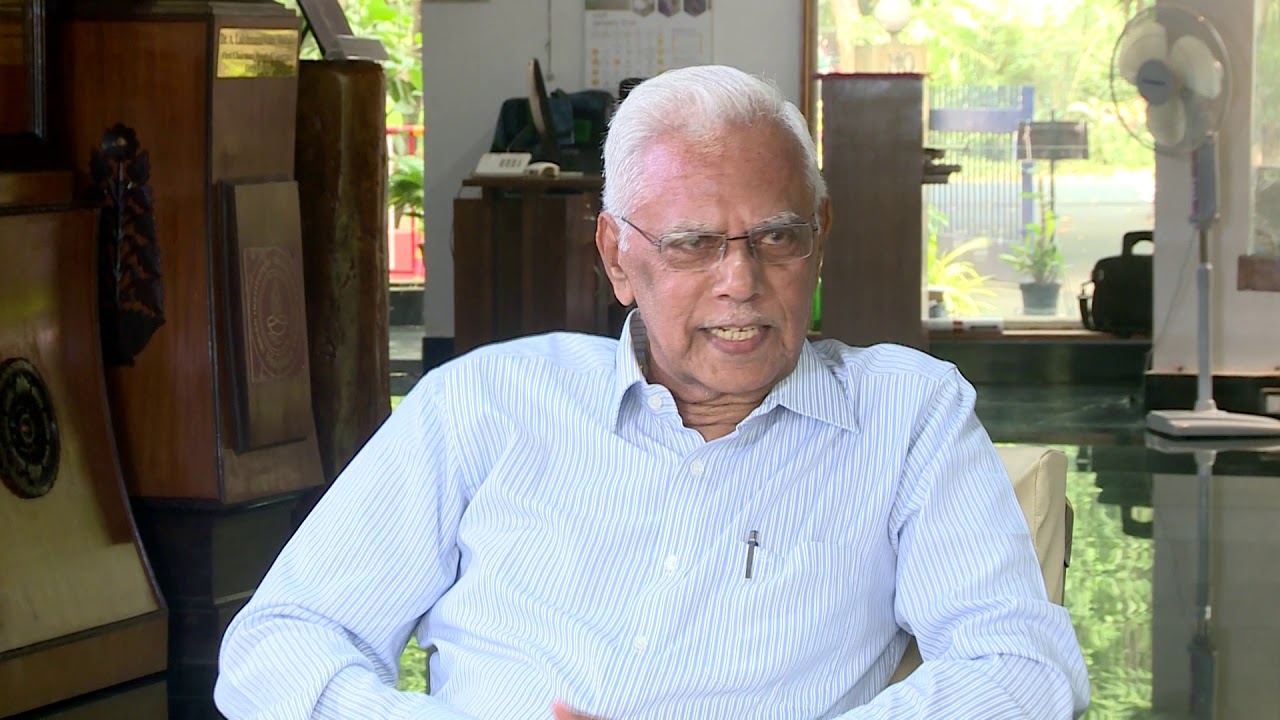
Prof. V.M.K. Sastry in conversation with Prof. Ajit Kolar and Mr. Kumaran Sathasivam
Prof. Ajit Kumar Kolar: Greetings from IIT Madras Heritage Centre.
Today at the Centre we are in conversation
with Professor Vedantam Murali Krishna Sastry
known as Professor V. M. K. Sastry
who was here in IIT Madras
as a faculty member from 1970 to 1998.
I will give you a brief introduction, and then
we will have a conversation about the
history of IIT Madras as Professor
Sastry looks at it during his tenure in this institute.
Professor V. M. K. Sastry graduated from the first
IIT which is at Kharagpur,
then he did his Master's in Indian Institute of Science
Bangalore, then his Ph.D. from
University of Illinois at Chicago Circle Campus, Chicago
in the area of Heat Transfer
he worked with Professor James Hartnett:
highly reputed Heat Transfer researchers of those times.
He worked in IIT Kanpur for some time,
he joined IIT Madras in 1970
in the Department of Mechanical Engineering.
Particularly, he was associated with the Heat
Transfer and Thermal Power Laboratory.
He went on to become the Head of the Department
of Mechanical Engineering from 1986 to 1990.
Later, he was the Dean of Academic Research
and he was the member of Board of Governors
when he retired in 1998.
He also is the Founder Professor
of ETC that is a Educational Technology Centre
which is now a very big part of the IIT Madras outreach,
especially through the NPTEL Programme.
He was Chairman of the Vanavani Committee,
and also he was Warden of Cauvery Hostel.
So, Professor Sastry has tremendous...
A long and vast experience in the IIT system,
first as a student, undergraduate student in IIT Kharagpur,
and then ending up as the member of
the Board of Governors at IIT Madras.
So he has seen the IITM...IIT system grow
from its initial...almost the beginning of the 1950s
up to '98, but then even now, although he is
officially outside the IIT system for the last 20 years,
he has been a very keen observer,
external observer of the growth of the IIT system,
IIT Madras. So, it is our pleasure to have Professor Sastry today,
to get his perspective of the IIT Madras
and IIT system in general. Welcome, Professor Sastry.
Thank You. We are very happy that you are here...
Prof. V. M. K. Sastry: Thank you, Professor Kolar. Prof. Kolar: today.
I would like to start by
asking you what were the circumstances under which you
came to IIT Madras from United States,
especially you joined the
Heat Transfer and Thermal Power Lab,
the academic and research environment,
especially also with respect to Heat Transfer subject,
kindly say few words about it.
Prof. Sastry: First of all, after graduating from IISc Bangalore
that is my Master's,
I was quite...deeply influenced by Dr. Ramachandran,
because though I was doing my
Master's Degree in Foundry Engineering,
he was actually handling the subject of Heat Transfer to us.
So I did his project work under him
and then I worked in an industry for a year,
but then I wanted to shift it to teaching line.
So I thought teaching line if I want to
really contribute, I must have a Ph.D.
So I was in search of a guide for Ph.D.,
and in that process I went first of all to
IIT Kharagpur as a lecturer.
So I was not very successful in finding a Ph.D. guide.
So I shifted to IIT Kanpur.
So there, one Professor Richard Zimmerman from Ohio...
Ohio State University, he actually accepted me to work under him.
But because of some policy issues involving
both Indian side as well as American side,
you know unlike Germany,
the assistance from United States was basically a private
affair; not from the government,
it is what is called an IIT...the...the...the University Consortium
of about 9 universities joining together,
and because of that, there was policy differences,
and the American side objected
that until the entire B.Tech. programme is in place,
you cannot have even faculty members working part-time for Ph.D.
Prof. Kolar: This was in the early 1960s. Prof. Sastry: This was in 1962.
So after a year, the American Professor said,
"Sastry, if you want to really get a Ph.D.,
go abroad." That is how I ended up in the United States.
So after my Ph.D., I joined the faculty of the University of Illinois also,
and when I was there working, 1969,
I got a letter from Professor Ramachandran
who was already by that time, the Director of IIT Madras.
So he said, "Why don't you come and join the
Mechanical Engineering Department?" So I said "Yes, I can do,
but I am now working on a NASA project,
so one more year I need,
so can I have a joining time of one year?"
With his, you know, very broad minded outlook.
He said, "Why not?"
So that is how I...
Basically, in those days you know, the people who went abroad,
they were not willing to settle down there,
they just wanted to increa...improve their qualifications and then get back.
That means basically Bharat Mata calling back.
So that is how the situation was, and I returned.
So I...was supposed to come
and join this '70 academic session, July,
but then my professor and guide,
Dr. Hartnett, he said that
"Now you are going to India,
and we don't really see..."
He was actually the...the very prominent...
International Journal of Heat and Mass Transfer, that is
the international journal, he was the editor.
So he said, "We are not really receiving many
articles...research articles in the
area of Heat Transfer from India.
So, for you to really work in this area,
it may be a good idea, if you meet several of the
international experts in Heat Transfer."
So they said...that's why in
August of 1970, the...there was the Paris
Fourth International Heat Transfer Conference.
So he said, "I will introduce you to a lot of
people there, why don't you come and..."
Because our paper also was there.
So, present it and then go.
So I requested Dr. Ramachandran,
"Is it ok if I join instead of the
beginning of the academic year,
in the middle of the year if I join, is it ok?"
He jumped at the opportunity and he really,
you know that shows actually the vision of Dr. Ramachandran.
Prof. Kolar: And he himself was a Heat Transfer person, basically. Prof. Sastry: He was himself a Heat Transfer person.
So he said, “That's a very good idea,
you come and join, after attending those things.”
So I came here, and because it was in the middle of the
academic session, I had not much teaching work to do.
So, in fact, it was a tremendous experience
for me to interact with him because,
on the first day when I met him in his office,
he said, “Sastry, this lab used to be called a Steam Lab.”
So after I came here, I changed the name
to ‘Heat Transfer and Thermal Power.’
This is very important from the history of the Heat
Transfer research in the country and in IIT Madras,
it was called a ‘Steam Power Lab,’
Prof. Sastry: Steam Power Lab. Prof. Kolar: Under Professor Narjes
But Professor Ramachandran, because
he was a Heat Transfer person,
he said, “We should have a Heat Transfer specialization.”
So he changed the name,
Professor Narjes was the head
and then ’70, Professor Sastry came in.
Prof. Sastry: So, I… Mr. Kumaran Sathasivam: But when had the lab been set up, sir?
Mr. Sathasivam: How many years had it been running? Prof. Sastry: It was set up in the beginning itself.
In fact, there was one
Professor from University of Stuttgart, Professor [indistinct].
He was also a member of the
German Committee which established IIT.
So, he actually was working in…the…in…in
Stuttgart, it was basically a Steam Lab, you know.
Mr. Sathasivam: It was a replica of… Prof. Sastry: Replica of that one
Mr. Sathasivam: The Stuttgart lab. Yes.
So, I…I came and then Dr. Ramachandran said,
“Though I changed the name,
whatever facilities you want, we will try to provide.
Can you, at least after 4 or 5 years,
make this Heat Transfer Lab
a real good Heat Transfer Lab
which is really doing reasonably good work in…in the area.”
Sir, excuse me, was Heat Transfer
being taught as a subject in any IIT or
other institutions in the country at that time?
To my knowledge there was…Heat
Transfer was not being taught at all
in any institution. Maybe,
I may be wrong, maybe Professor Sukhatme in IIT Bombay,
might have started, but I doubt it because as
undergraduate curriculum, it was not part of that.
So in fact, that is the one of the reasons why
Dr. Ramachandran particularly said,
“First of all let us develop a
Master's degree programme in Heat Transfer.”
So, now, that you don't have any teaching load,
why don't you design a 2 year
programme…M.Tech. programme,
in the area…in the subject of Heat Transfer.”
So, I worked on it for a couple of months.
So I made a detailed programme,
the curriculum was completely finalized,
then Dr. Ramachandran looked at it,
he approved, and he said that…until that time,
the Master’s Degree programme in Mechanical Engineering,
was…was only involving I think two or three areas:
One is Advanced Thermal Power,
Machine Design and probably Manufacturing.
I am not very sure.
So he said, “Let us have a regular programme.”
And then when he was quite certain that
there should be a 2 year programme
Master’s degree programme in several areas,
he asked the Department of Mechanical Engineering staff
there are almost about 10 labs
in the Mechanical Engineering.
So he said, “Each lab, each special area,
you should have a similar programme.”
So that's why by 1971, Prof. Kolar: Yes.
You know all the labs of Mechanical Engineering Department,
each department for example,
the M.Tech. programme in Combustion
M.Tech. programme in Refrigeration and Air-Conditioning…like that
all these 10 programmes actually were developed
and that's how it started in 1971.
But more importantly, what
Dr. Ramachandran suggested is that Heat…
Heat Transfer is an engineering science,
it was neither engineering nor science.
That…it used to be taught in Mechanic…Chemical Engineering also
as a more of…as a practical thing rather than
providing theoretical basis for it.
So, Dr. Ramachandran suggested
that we should also see that institutions like
Guindy Engineering College and other
engineering colleges in the country,
they also adopt this particular thing.
So he…I called actually, I arranged a
summer programme for 4 weeks
for teachers in the particular Thermal area.
So, 50 institutions actually participated for this 4…
So for that, what we did was, we actually
had this 4-week summer programme for these teachers,
along with that, we also tried to help them
by developing a lab manual.
For example, ‘How many experiments you can
conduct in Heat Transfer Lab.’
And that was quite a success because,
for the next 4-5 years, because in most of these
colleges you know, they have to go through a…
long drawn out procedure
to have any syllabus changes occurring,
because there should be a university level and all that.
So that is the reason why it took some time,
but eventually, a large number of institutions in the country
started teaching Heat Transfer as a
subject in the undergraduate programme.
I remember this very well sir because I
joined in ‘71 with you
and I was part of that first M.Tech. course specialization.
So, the point here is that
the…Heat Transfer for teaching undergraduate students
and bringing that into the Master’s programme,
actually was done by IIT Madras,
with the encouragement of Professor Ramachandran, and
Professor Sastry was there and Professor M. V. Krishnamurthy Prof. Sastry: Yes.
Prof. Kolar: was in the Refrigeration Lab. Prof. Sastry: Refrigeration Lab.
That's how Heat Transfer took routes
probably Professor Sukhatme who was a
Prof. Kolar: student of Professor [indistinct]. Prof. Sastry: [Indistinct] of.
And then…he is a Heat Transfer man, he had…
also was…sir, how about Professor A. K. Mohanty,
did he participate in this…from IIT Kharagpur?
Prof. Sastry: At that time he did not, but Prof. Kolar: Okay
basically what Mohanty was doing was,
he was in the…of course, Mechanical Engineering Department
in IIT Kharagpur, but when we…to actually
go ahead with this…1971 when we had this,
Dr. Ramachandran…you know, he is a…
in fact, I greatly respect him because he had Prof. Kolar: Yeah.
tremendous vision of so many things. Prof. Kolar: Yes.
One thing is this ‘Introduction of Heat Transfer’ as a
basic core course in the undergraduate programme
all across the country that is number 1.
Number 2, he said, that…“How about research?”
And I am really quite
surprised that he called me and he said,
“Now we will take admission for Ph.D. students,
so, take some.” Then
Dr. Kolar was one of the first ones.
So there are 3 students.
In 1972, again there was a batch of students and I took
3 students already…under me
and I was thinking that. you know, it is
too much for me because,
he said…he comes and says, “Take two more.
Take two more.” He said, “That is because…”
You know, my problem was, I worked actually
for my Ph.D. programme in a Space Research, Space Heat Transfer.
In India we were very much on…on the ground. Mr. Sathasivam: Yeah.
Prof. Sastry: Nowhere near space. Mr. Sathasivam: That’s right.
So therefore, what happened was that,
I myself was not really experienced in
several areas of applications of the Theory of Heat Transfer.
So he said, “Take two more.”
His idea was, if I take five students
in five different aspects of Heat Transfer,
some initiation of research can take place.
That…later on I found out the wisdom in that
because I think we have tried to develop
a Heat Transfer Lab very nicely because of his guidance.
Mr. Sathasivam: Sir, did Professor Ramachandran also initiate
these outreach programmes that you mentioned,
the Teacher Training Programmes that you conducted in summer,
in other branches in other labs and so on?
Actually this summer programme that I conducted
was not initiated by him
it was the so called Ministry of…you know
HRD the…the other… Prof. Kolar: Ministry of Education.
Prof. Sastry: So called Quality Improvement Programme. Prof. Kolar: Quality.
Quality Improvement Programme. They wanted to
actually have this for the…because this is for the teachers,
for the quality improvement.
So that is how it actually started.
But then, his vision was,
how to make this particular subject
very important and prominent one in the country,
because it actually…Heat Transfer is the subject
that cuts across several disciplines.
Aerospace it is there, in Chemical Engineering it is there, in…
of course, Mechanical Engineering obviously.
so because of that he wanted…
but…that it should develop actually quite well
all across, and so, he wanted to…say,
“Why don't we have a…
because you have now international contacts,”
Prof. Kolar: Yeah. Prof. Sastry: “Why don't you invite these
people from abroad, and then
we will have an international conference?”
But then finally, we decided, first of all let us
find out what is the extent of research that is
being done in the country,
before we take this international step.
So we wanted to have the First
National Heat Transfer Conference Prof. Kolar: Yes.
in 1972. And he wanted us to organize this one and
Dr. Krishnamurthy and myself, we were the organizing secretaries. Prof. Kolar: Yes sir.
Prof. Sastry: And we start a Mr. Sathasivam: Dr. M. V. Krishnamurthy.
Prof. Kolar: M. V. Krishnamurthy Mr. Sathasivam: Right.
Prof. Kolar: So it was in…during the Bangladesh War.
Prof. Kolar: 1971 December 1st to 3rd in CLT. Mr. Sathasivam: Ah, yes.
And big names, Professor Hartnett
Prof. Kolar: Professor [indistinct]. Prof. Sastry: Spalding
Professor Spalding from U.K.,
Professor Kadambi from IIT Kanpur,
Prof. Kolar: [Indistinct] from Uni…Russia. Prof. Sastry: Russia.
For us…we had just then joined for research, it was a
big thing that…we had not heard of Heat Transfer as a topic.
I am dwelling a little bit on this because
we started Heat Transfer research,
not only teaching, but research. This conference brought together
all the research community.
Sir and I am very happy to tell you, it is running
very successfully, the next one is being held
in the December of…every 2 years it changes.
So, Professor Ramachandran's vision. Prof. Sastry: Vision.
And the hard work that you and others…Professor
M. V. Krishnamurthy and others put in, has…really [Inaudible]
In fact, 1972 when we had…’71 we had this conference,
and ’73, we had the second conference in IIT Kanpur. Prof. Kolar: Kanpur.
Kanpur. And then, Dr. Ramachandran said,
“Now look…it looks like
we have a reasonably good work that is being done
both in the research laboratories,
education institutions and as well as industry to some extent.
So, why don't we have a society?” Prof. Kolar: Yes.
So, he said that, “We will have a…
we will…we will form an Indian Heat Transfer Society.”
So he gave me the task of
memorandum of association… Prof. Kolar: Following the constitution for the…
Constitution, and all that.
So we worked on it, and then 1974 we
established the Indian Society for Heat and Mass Transfer. Prof. Kolar: Yes.
Prof. Sastry: Heat and Mass Transfer. Prof. Kolar: With our Heat Transfer Lab as the headquarters.
Prof. Sastry: As the headquarters. Prof. Kolar: Even…even today it is so, sir.
Yeah, actually, 1974 onwards, until 1991, I had the
responsibility of being the secretary.
So for 17 years…
because there is nobody else that is willing to take.
Prof. Kolar: Yeah. Mr. Sathasivam: You would have been the Founder Secretary.
Prof. Sastry: Founder Secretary that's right. Prof. Kolar: Yeah yeah.
So, how about that Regional Centre?
This also connected with Heat Transfer and Energy, actually. Prof. Sastry: Yes.
See by that time, Dr. Ramachandran left actually in
1973, to take over as
Secretary, Department of Science and Technology.
In fact, that's what
I…another thing that I…aspect of Dr. Ramachandran:
he is a an institution builder.
He went and established the DST:
Department of Science and Technology. Prof. Kolar: Yes.
And afterwards of course, he…from
there he shifted to United Nations, and he
established the United Nations Centre for Human Settlements.
Prof. Kolar: In…in Nairobi. Mr. Sathasivam: Yes, yes.
Prof. Sastry: In Nairobi. Mr. Sathasivam: Yes.
So, in that sense he is actually a creator of institutions,
because of his visionary outlook.
So, after he went to DST,
there was actually an International Centre for
Heat and Mass Transfer in Yugoslavia
that was established with the assistance of UNESCO.
So, several of my international colleagues in the area,
they were associated with that Centre,
they said, “Now that…” because these people
have attended the conferences in 1971, ‘73 and
‘75 in IIT Bombay, they saw
the kind of work that is being done.
So what they said is, “Why don't we have…
not only India, but in the entire Asian Region, we will do it.”
So the…UNESCO actually sent a delegation
to tour various countries, of which actually Dr. Ramachandran was
a part of…that delegation.
And then the Yugoslavian Centre's Secretary
General was another member,
and of course, my former advisor
in Chicago, he was also another member.
They toured these countries and then they said,
“Yeah, it is time for us to have actually a
Centre for Asian countries, Asia and Pacific countries.
Prof. Kolar: Yeah Pacific. Prof. Sastry: Again, Dr. Ramachandran had the responsibility,
and by that time he was already in the DST, very busy and all that.
So he asked me to create that Centre.
So, I again drafted the constitution, and also
had several representatives from
Bangladesh and Indonesia and other places.
So we formed the Executive Committee and the
Board of Directors from Japan, for example.
So we created that Centre,
and then Dr. Ramachandran said, “Why don't we
start actually publishing a journal, Prof. Kolar: Journal.
taking into consideration the articles from these things.”
So, I also became the first editor of the
journal, he is the editor, and of course, the Prof. Kolar: Yeah.
Scientific Secretary of that (clears throat) that Centre.
He said, “Once we start this one, we have to do it
immediately.” He is…he is quite
impatient about getting things done.
So, first journal, should come out by December of 1978.
So we started this Regional Centre
in 1977, [indistinct] approved.
So the first journal should come actually in ’79…‘78 December.
We got it, but in those days as you know very well,
the printing and all that is…the words should be arranged in the
Mr. Sathasivam: Manual typesetting. Prof. Kolar: Yeah yeah yeah.
Mr. Sathasivam: That’s right. Prof. Kolar: Oh
Prof. Kolar: The First Heat Transfer Conference, we were all research scholars,
every day used to go to the printing press for proofreading,
we looked at the equations and said, “What
are all these equations? We don't understand whatever.”
All the research scholars, we had a fantastic
experience of those times. Prof. Sastry: And the printing
press was actually in the old Shopping Centre. Prof. Kolar: Shopping Centre.
Mr. Sathasivam: Yes. Prof. Sastry: In our
Mr. Sathasivam: Yeah. Prof. Sastry: Campus
Prof. Kolar: So this is very nice to hear
from you directly the… Prof. C. S. Swamy: I have one…
Prof. Kolar: Yeah please go ahead, go ahead, yeah.
Prof. Swamy: Now you said that Professor Ramachandran
Prof. Swamy: was interested in starting Heat Transfer,
Prof. Swamy: [Inaudible] to do with his being
Chairman of the Research Council of Defence Laboratory
You know he was Chairman of the Research Council DMR.
In fact, again I want to ask you, ‘72 I think
the Director of [indistinct] Narayanan
came with the delegation, and they wanted the IIT to
sub…submit projects. Prof. Sastry: Yes.
In fact, most of the projects submitted [Inaudible]
Maybe, I had also submitted a project.
Now why I am telling this, there was something about
he was thinking of rocket cones,
and then it was getting…could not be used again, because oblation.
So he said that we can [Inaudible]
So I had proposed something.
So about a coating of ceramic,
and a ceramic metal and a metal.
I said, “The most important thing is, you have to make the [Inaudible]
and we shall have a plasma torch to do this.”
In fact, my project was submitted,
but was not funded, but I
came to know much later that the plasma
torch was purchased by the Council. Prof. Sastry: Okay.
Prof. Swamy: But what I am telling you is, did Ramachandran get
interested in Heat Transfer because of its application in…
Prof. Sastry: First of all, Dr. Ramachandran himself
was actually…he had his Ph.D. from Purdue University. Prof. Swamy: I know.
Prof. Sastry: So in the…in the subject of Heat Transfer. Prof. Kolar: Heat Transfer.
Prof. Sastry: That is number 1. And of course, he was,
you know, Head of the Department in IISc Bangalore,
but more importantly, he wanted,
in fact, now that you mentioned about the
Sponsored Research and Industrial
Collaboration. In 1972-73…
Again Dr. Ramachandran said, “Somehow you know, when we do
something, we should also interact with the industry.” Prof. Kolar: Industry.
Prof. Sastry: “Industry-Institute interaction must be there.”
There used to be what is called RDOEI. Prof. Kolar: Yes.
Research and Development Organisation for Electrical Industry
In the Ministry of Heavy Industry in Centre, at the Centre.
So, he…the…a request came from there,
saying that, “You know, our…our motors and all these
things are becoming actually very large in size,
electrically we can do all these things, but because of the
cooling problem we are not able to
reduce this size for the same capacity.
So, can you please do something.” Because
because they know that Dr. Ramachandran was…say
expert in heat transfer, and he was Director here.
So they contacted him. Then he asked me and
Dr. Krishnamurthy, V. Krishnamurthy to look into this.
So Dr. Krishnamurthy by that time he changed his interests into. Prof. Kolar: Refrigeration.
Prof. Sastry: Refrigeration and air conditioning. So, we went to Bhopal, and as usual
you know the…the they were all buying the
drawings and equipment and everything
from associate electrical industries
which was supplying the equipment to them, and
they were not really interested in collaborating,
but luckily because of Dr. Ramachandran's
personal connection, Dr. V. Krishnamurthy, at that time. Prof. Kolar: Oh yes.
Prof. Sastry: Yeah. Prof. Kolar: BHEL
Prof. Kolar: top man. Prof. Sastry: BHEL…this thing, top man.
He said, “Let them go…come and look at it.”
But even though the faculty, the staff there were not very
cooperative, there was one Mr. Walker,
a 75-year-old man coming from AEI,
he himself said it’s a good idea if the…
because we don't understand what is happening there,
so theory must be also
matching with the…our experimental work.
So, let them do this. And because of Dr. Krishnamurthy’s
help, they supplied to us
all the drawings and other things like that, then we started.
In fact, that RDOEI industry project in 1972,
that they gave us about one and half lakhs or so.
Prof. Kolar: That is large amount at that time.
Prof. Sastry: That was the probably the first major
sponsored research project that came to us.
To IIT. Prof. Swamy: I see.
Earlier, there might be…you know some…
as far as my knowledge goes, that is the first major…this thing.
That is because of the fact that
there were administrative difficulties later on,
regarding…you know, how to distribute the
money and all that kind of thing, and that is the reason why
they said, we have to make some
policy and there are certain rules.
That is the reason why I am assuming, that that is the first
sponsored research project that came from outside.
So, for 3 years that I was associated with
Dr. Ramachandran 1970 to ‘73,
he started with several different friends,
for example, he also started some interdisciplinary Prof. Kolar: Yes.
programmes, but because he was…
he is way ahead of his times,
they didn't really take off.
Prof. Kolar: It took 45 years for them to materialize.
Yeah, interdisciplinary the reason why he was saying
was, because of his intense interest…should be promoted.
Departments should not be…you know,
the walls should not be built around the departments.
There should be constant interaction and exchange of ideas
and collaborative work among the
departments. That's what his intention was.
But it started and he was actually…along with
me, you know Dr. Natarajan and T. K. Bose and Prof. Kolar: Yes.
Some others of…the people, he
actually invited them from abroad.
Prof. Kolar: Sir, Professor Natarajan also joined just a year or two after you?
Prof. Sastry: No, in fact, around the same time. Prof. Kolar: Same.
Prof. Kolar: And Professor Bose also. Prof. Sastry: Few months.
Mr. Sathasivam: Actually, who were your colleagues?
Mr. Sathasivam: So, you mentioned Professor Krishnamurthy
Mr. Sathasivam: and Professor Ramachandran himself. Prof. Sastry: Heat Transfer,
Mr. Sathasivam: Yes. Prof. Sastry: Professor…Heat Transfer actually
these are the people, and of course, in
Chemical Engineering, then Professor Gopichand,
Prof. Kolar: Professor T. Gopichand. Prof. Sastry: Gopichand was working,
Yeah, Professor Gopichand was working.
Prof. Kolar: Professor K. Subbaraj. Prof. Sastry: K. Subbaraju.
Prof. Kolar: Of Prof. Sastry: Subbaraju, Subbaraju was working
Prof. Kolar: Dr. Sathyanarayana’s father. Prof. Swamy: Yeah, yeah.
He was the Heat Transfer professor.
So…so there was basically a good group of
people working here, in various departments. Prof. Kolar: Yes.
But the question is that the interaction
he wanted to develop, and that is the reason why he was
trying his best and he did a very good job as far as I am concerned.
Prof. Kolar: Sir, now that we are in this topic of research,
Heat Transfer of course, now we have information.
When we were research scholars, we saw the…a
Solar Thermal Power Plant in BSB;
this was in the mid ‘70s.
Professor Ramachandran went to
start the department of non…no no, DST as Secretary.
I think he started the Department of Non-conventional Energy Sources. Prof. Sastry: Yeah, right.
Prof. Kolar: So, what was his role in initiating the solar energy research, here?
Prof. Sastry: He actually…as I said, Prof. Kolar: Yeah.
Prof. Sastry: even the DST when he was Secretary,
with regard to this Regional Centre for Asia and Pacific,
regarding that matter, I visited Delhi, and
I met him in his office. He was so much interested in solar energy. Prof. Kolar: Yes.
In fact, he said casually, “Sastry, do you think
that, like Atomic Energy Commission,
in this country, should we have a Solar Energy Commission?”
Mr. Sathasivam: Right. Prof. Kolar: These were in ’73
Mr. Sathasivam: Right. Prof. Kolar: ‘74.
Prof. Sastry: This was in 1974-75 time frame. Mr. Sathasivam: Yes.
He was thinking, then…I just casually of course,
because I had this freedom with him to… Prof. Kolar: Yes.
Prof. Sastry: have talk, I just…I said, “Unfortunately we should
not…we should first of all develop
a total overall plan for the energy in the entire country.”
For example, energy comes from you know, solar and of course,
from fossil fuels and hydro
and all…what are our resources available in each
one of these areas, and what is our projected
growth rate and what is the amount of
our needs, so far as energy is concerned.
I said, “Already right now, we have…”, actually
at that time, Ministry of Power, Ministry of Water is different.
Prof. Kolar: Ministry of Coal. Prof. Sastry: Coal is different, coal is different.
So, each person actually is…atomic energy of
course, anyway is different.
So, each person actually is having…
and each area is having its own empire, so to speak.
So to say solar energy, wind energy
will become another…Wind Energy Commission.
So, can we avoid that?
He said, “No no, I was just intellectually I was discussing.”
So, what I am trying to say is, Prof. Kolar: He had.
Prof. Sastry: He had that. Prof. Kolar: Absolutely.
You know he was looking into the future, and in that
context only, we also had actually solar
Prof. Kolar: Yes 10 kilo watt thermal power plant. Prof. Sastry: 10 kilo watt station
actually developed here, probably that is the first one
Prof. Kolar: I think so, it is the first one. Prof. Sastry: First one.
Prof. Kolar: Solar energy research, again, to the best of
my knowledge, started in IIT Madras.
Mr. Sathasivam: The first in the country, sir? Prof. Kolar: Yes.
Prof. Sastry: Yeah, first in the country. Mr. Sathasivam: Right.
Prof. Kolar: Definitely in the IIT system and the educational institutions,
and there was no…he started the Non-Conventional Energy Centre
which now is MNES. Professor Ramachadran started. Prof. Sastry: Yeah, he started that one.
Mr. Sathasivam: Right. Prof. Sastry: Actually, earlier, there was some…
in the area…in the…in the department under the National
Physical Laboratories and physics area,
some work was supposedly…we have done in the solar.
Mostly there were actually solar cookers, solar
water heaters and that kind of thing.
But not in terms of producing energy. Prof. Kolar: Power
Prof. Sastry: Power. Prof. Kolar: Yeah, Professor Ramachandran was a man of vision,
he initiated so many programmes for the country.
There was slightly shift focus, because you also…
for the Founder Professor of the Educational Technology Cell.
Today, this is a very big thing again
and through that cell we have the NPTEL
Programme which is extremely popular in the country and
now it’s simply expanding, but you are the originator
of that, can you say a few words about it?
Yeah, actually what happened was that…this happened
actually in 1985 or ‘86 Prof. Kolar: Professor Srin…no…
Prof. Kolar: Professor Indiresan? Prof. Sastry: That was in ‘86 and ‘87
because I took over as Head of the Department in 1986. Prof. Kolar: Yeah.
So one day, in 1987 or something,
one…suddenly just before the financial year comes to an end,
in January or so, we received suddenly a
fax message…the Director received a fax message
saying that they have got additional funds. Prof. Swamy: As usual.
Prof. Kolar: What do you will do with this?
So, we are now giving actually 2 crores
to each of the 5 IITs…to develop an Educational Technology Cell. I see.
So, it came, first meeting actually took place
in Delhi, and I think Professor Raina
from Electrical Engineering Department, he went.
They thought nothing will come out, but then a
few days later, suddenly another fax comes and says,
“Send your representative with complete plan as a fraction.”
So then, Professor Srinath, who was the Director at that time,
he asked Raina, he said, “I am not interested, nothing is
going to happen, nothing.” Unfortunately
or fortunately, I happened to be in Director’s
Office at that time, because I was trying to go
to Delhi for…in connection with my UNESCO Centre.
So, he said, “You go.” Professor Raina said, “You go.”
I said, “What do I do with it, I don’t know?”
He said, “You study, these are the materials, you just
do this. This is what they want.”
So, I worked on it for 2-3 days: tried to at least
bring up some questions, you know what
exactly is going to happen and all.
So we…I attended the meeting.
Then it appeared to be, that they are in a hurry to give funds,
and they did not have much idea,
we also did not have much idea.
So, anyway they are giving the funds,
so, let us create the infrastructure.
And other people later on you know will take it up and...
So, that is how it started.
So, as soon as I came…luckily for me
because I was heading the department,
there was space constraint you know, nobody is willing to
give any…for studio and all that.
So, because of the Mechanical Sciences Block, you know
I was the Head of the Department…under our control,
there was one 356. Prof. Kolar: MSB.
Prof. Sastry: MSB 356 room number. Prof. Kolar: Yes, yes.
Prof. Kolar: It was there for a long time since we shifted to this place. Prof. Sastry: Yeah, it was actually a drawing…this thing,
because by the time, 5 year programme
became 4 year programme, a lot of drawing
instruction was cut from the B.Tech. programme.
So, several of these drawing halls became actually… Prof. Swamy: Yeah, yeah.
vacant, and luckily for us, you know I was able to put it
in the department, and the department very
generously agreed; they did not contest, they said, “Okay,
you take that one”, and then we prepared that studio.
I remember a lot…how much time you spent on getting
the equipment from Japan, the Sony equipment.
You also had the first recruits from that.
Prof. Kolar: Our Ravindranath Mr. Sathasivam: Yes.
Prof. Kolar: was one of the first recruits at that time. Prof. Sastry: It had to go to the
board because basically what they
said is, “Okay, you are creating certain…you know, cameraman, producer
these are not names not normally not available in the IIT system.” Mr. Sathasivam: That’s right.
Prof. Sastry: IIT system. So, what is their career growth?
Supposing you take somebody else, how is he going to grow?
I said, “I don't know.” Prof. Kolar: At that time…
But that time…but with luckily because of
the you know, the generosity of the board as well as the
Director and all the people concerned,
they said…they said, “We will give you just three people:
one cameraman, producer and some other…”
Mr. Sathasivam: So, they were…were you producing videotapes of courses or? Prof. Kolar: Yes.
Prof. Sastry: Yes, courses basically. Prof. Sathasivam: Because it was pre-internet and so on.
Prof. Sastry: Yeah, basically, the idea was to Mr. Sathasivam: Yes.
Prof. Sastry: get for example, lecturers and professors from
various departments, make tapes
on the subject matter, that is basically…
take a subject, you know like a Physics.
In that you would…for example,
undergraduate programme, there is a first year or second year Physics,
the person…the professor actually gives some series of lectures.
So you, for…for a semester, let us say total
about 30-40 lectures you give.
So you make them into about 20 or so, lectures. Prof. Kolar: Yes.
So that the concepts can be explained
by the experts, and send them to various other engineering colleges
if they want to…practically for free.
Mr. Sathasivam: So, these copies were disseminated to colleges. Prof. Kolar: Colleges, yeah.
Prof. Kolar: So this was much before NPTEL came in. Prof. Sastry: That is the
before NPTEL, that is the idea. Mr. Sathasivam: I see.
Prof. Kolar: Yeah, yeah [Inaudible] Prof. Sastry: So, that is
That is how the first…I think the
Professor V. G. K. Murti, Professor Roshan and
Prof. Kolar: Lots of people. Prof. Sastry: few others started…
Prof. Swamy: …50 rupees books.
Prof. Sastry and Prof. Kolar: No no, tapes.
Prof. Sastry: Video tapes.
Prof. Kolar: This was in the…there is a studio that was there in the MSB.
Mr. Sathasivam: The legacy is still there I think.
Prof. Sastry: In fact. Mr. Sathasivam: I think there is still a studio there.
Prof. Sastry: Studio there and it also…we soundproofed it.
We have to…we had to bring experts to soundproof it. Prof. Kolar: Yes, yes sir.
Sir, now we are on this topic of Centre,
you are also aware that the Industrial
Consultancy Centre, which is now the ICSR
was started, and also there was Engineering Design Centre.
Prof. Sastry: Yes. Prof. Kolar: Today we have a Department of Engineering Design.
So, these two are ahead, I mean. Prof. Sastry: Yes.
Prof. Kolar: You started this, can you…your experience with this?
Prof. Sastry: Actually, when I was heading the Department,
the Engineering Design Centre in the…
there was an Engineering Design Centre in the
Department of Mechanical Engineering.
And I don't know the starting time,
probably, it was there for a long time,
because basically 1970…’70
when I joined it was still…it was there at that time.
It was there. What that Engineering Design Centre had was
people from Physics background
and Mechanical Engineering background
and the people from the Physics Department
are also basically in the area of optics.
Optics. So, when…1987 or so,
Professor Srinath said, “What is this,
what is this Centre doing here?”
So, let the physicist go to the Physics Department
and the other people go to Mechanical Engineering Department. Prof. Kolar: Mechanical.
There was obviously, you know, there is a
Prof. Kolar: Different opinions at that time. Prof. Sastry: Different opinion
kind of thing with the Physics Department…our department, [Inaudible]
but we…we have to put through the
Departmental Consultative Committee, we did it
and finally, with the understanding that
the each departmental staff strength
will not be affected. These people were allowed to Prof. Kolar: Yeah.
Prof. Sastry: shift two departments. Prof. Swamy: Because that is Professor Sirohi
Prof. Sastry: Professor Sirohi. Prof. Kolar: Professor R. S. Sirohi,
Prof. Kolar: then Dr. Chennabasavayya from Mechanical Department. Prof. Swamy: I know, I know, I know.
Prof. Sastry: Chennabasavayya came…Kalam Prof. Kolar: Kalam…Kalam was there.
So, these people came to Mechanical Engineering Department.
So, they joined the Machine Design group and so forth.
So, that is how the…but Engineering Design Centre
used to work for some time,
but their collaboration with the industry
in most departments, was basically very very
Prof. Kolar: Yes. Prof. Sastry: small at that time because
the culture still did not develop to that extent right,
like for example, today. Prof. Kolar: Today.
Absolutely. How about the inter…ICC
Professor Wagner was the first person. Prof. Sastry: Yeah.
Professor Wagner was the first person,
I think the second person who…to take over
from him was the…Professor Narayanamurthi.
Prof. Kolar: Narayanamurthi. So this was when Professor Ramachandran was there
Prof. Kolar: or after that? Pandalai. Prof. Sastry: Professor Pandalai. Professor Pandalai was there.
Because Pandalai took over in 1973, I think.
Prof. Kolar: Yes. December 10th. Prof. Sastry: November or December. December, December.
So, he…during his tenure only,
the Heads of Departments, you know the deanships
were created and all. They were not called ‘Dean’ at that time,
it was called ‘Professor-in-charge.’ Prof. Swamy: Yeah.
Professor-in-charge of Industrial Consultancy Centre.
Professor-in-charge of academic courses, like that. Prof. Kolar: Yes.
So, then later on it…it formally became
Prof. Kolar: Dean. Prof. Sastry: Dean. So, the
senior most Heads of Departments actually
were requested to occupy these
new Professor-in-charge positions.
And Professor Narayanamurthi became the
Prof. Kolar: He became. Prof. Sastry: Professor-in-charge at that time.
So, I think this took place around ‘75 or ‘75. Prof. Kolar: ‘5.
Prof. Kolar: Professor Pandalai was the Director at that time. Prof. Sastry: Pandalai was the Director at that time.
Now as you know it has grown into a very big Centre.
So, lots of the…the seeds for today's Prof. Sastry: Yeah.
activities of IIT Madras,
obviously, in ‘70s and ‘80s because of some
very visionary people and their efforts.
So, slightly shifting focus,
you were also Chairman of the Vanavani Committee.
Prof. Sastry: Yes. Prof. Kolar: What, what was the situation?
What were your contributions there? Prof. Sastry: Yeah, Professor Indiresan
actually…one day called me and he said,
“Will you take over the Vanavani School?” Prof. Swamy: Okay.
So, I said, “It so happened my children also were going to
Vanavani and Vanavani actually had a very good reputation
in the city at that time…was one of the best schools
because…primarily because Mrs. Peter was the principal.
The…excellent principal. So,
she brought up the reputation like anything.
So I thought, okay, but unfortunately,
the funds availability was not very high, number 1,
second thing is the employees…
there was a rule in Vanavani School
that 50 percent of the children must be from…from the IIT,
and every child must be every child
requesting admission to Vanavani from within IIT,
he or she…she should be provided.
So you cannot deny the admission.
So that was the condition.
So, usually we used to have approximately
about 1800 to 2000 children.
So about 1000 or so, used to be from
within IIT, and 1000 from outside.
So, what happened was, there was a
large demand from the Employees Association
that earlier there used to be ISC system
the Union School Certificate… Mr. Sathasivam: Yes.
Secondary Certificate System. But they wanted to
make it into a State Board.
So…so…so there was a big problem because
the State Board means, the…they said they had
alternatives: either to run it as a private school
with State Board this thing,
or hand it over to the state government,
in which case the teachers employed…
all these people will be employed.
Control will be completely only by them,
the transfer the…this thing, and second…thirdly,
more importantly, the medium of instruction should be Tamil.
And because of the nature of our
institution, lot of people were not willing to have the
Tamil-medium instruction in the school. Prof. Kolar: I see.
So therefore, what to do?
So we have to have it, and the
funds availability was not very high.
So, prior to taking over as Chairman,
I was on the Management Committee for 2 years.
So I knew the problems. So therefore,
what we tried to do is, I introduced the thing which is…
initially there was some resistance;
basically what I said was,
“For providing all this infrastructure, you know,
free electricity, free water, free furniture,
free buildings and everything from the IIT
is a perquisites that is being given for the staff of the IIT.
But why should the outsiders
enjoy these things at the same tuition fees?”
So I said, “Tuition fees we cannot
differentiate: outsider or insider.”
So what I said is, “The establishment fees
we charge the outsiders. 150 rupees per year
per year.” Prof. Swamy: I see.
So if 1000 people were there, 1.5 lakhs was coming.
So I said okay, we now… Prof. Kolar: That was a…that is a large
Prof. Kolar: amount of money at that time. Prof. Sastry: That is a large amount in those days.
So that, we can increase the infrastructure. Mr. Sathasivam: When you say
those days it is the 1980s or
What period was your association with? Prof. Sastry: It is ‘80 to ‘84.
That was when the question of the mode arose
as well. the ‘81 or so, the period when…
Prof. Sastry: Which one? The… Prof. Kolar: Mode…that problem with the
Mr. Sathasivam: The ISC or the State Board...
Prof. Sastry: Yeah, in fact, which I changed…the system only from Mr. Sathasivam: That was the time.
Prof. Sastry: this previous one to State Board. Mr. Sathasivam: Yes, yes, yes, yes.
Prof. Sastry: State Board, that means ‘plus 2’ so called plus 2. Prof. Swamy: Yeah yeah yeah
Prof. Swamy: Of course. Prof. Sastry: Plus 2. And also around the same time,
the IIT also from a 5 year programme,
It changed to 4 year programme. Mr. Sathasivam: That’s right.
So, because of that, there was some surplus
lab facilities and here I must really
thank actually Dr. R. Srinivasan who was Physics…
he was Deputy Director at that time.
Deputy Director. He was very very cooperative, very nice.
He said, “Some of these experiments and all these things…
now that there is a plus 2,
let the school kids, you know, have the
advantage of these experiments.”
So he shifted actually some of this
equipment and all that…that
for Chemistry, Physics experiments.
He allowed us to use…the…
So that way, we were able to develop the
science labs in Vanavani.
In fact, which became a…which caused tremendous envy to
a large number of external examiners
Prof. Kolar: Yes. Prof. Sastry: Who were coming to examine our…our students.
Mr. Sathasivam: Yes. Prof. Sastry: Because each student was given actually one particular lab,
I mean, table, experiment, 48 students were there
in each section and each person actually had a…
under the table there is a shelf and everything,
they can put their stuff there.
We created that one.
So the establishment charges are 150,
what we tried to do was to…
how to…how to I wanted to
separate the primary school, secondary school,
and higher secondary school, in three units.
So for that primary, we wanted to shift from the
same place to another building which was there.
So, we wanted to have a top floor to construct that one.
Luckily for me, our managing committee
had Mr. Malayalam…was the Prof. Kolar: He was the
Prof. Sastry: Executive Engineer. Prof. Kolar: Executive Engineer.
So, I requested him, “Can we borrow some
bricks and cement and sand…things like that,”
Then there used to be Centre for Rural Development.
Prof. Kolar: Yes. So, Centre for Rural Development Head,
Dr. Radhakrishna I asked him…
they were doing some research about the Fibre-reinforced
concrete: FRC. Fibre-reinforced concrete,
which is a cheap material,
relatively speaking, compared to Portland cement.
So they were actually…
So they said, “Okay, why don't you use it?”
In that, the chicken mesh
you know, is the reinforcement, not the steel.
So, using that, we constructed. I think
today, still it is standing.
So, that we constructed, made rooms,
and the primary section was shifted there.
Mr. Sathasivam: Now this is within Vanavani, sir? Prof. Sastry: Within Vanavani.
Mr. Sathasivam: Right. Prof. Sastry: So basically, we borrowed the material from IIT,
Mr. Sathasivam: Yes. Prof. Sastry: Money, so far as these establishment charges
from the outsiders. With that, we were able to
bring the financial health of the school
Mr. Sathasivam: Yes. Prof. Sastry: to a reasonably good level.
Mr. Sathasivam: Yeah. Prof. Kolar: Sir, it’s interesting you mentioned CRD
because we were also there at that time.
Professor Indiresan started. Prof. Sastry: Yes.
You mentioned Dr. Radhakrishnan. He…you were…you were
talking about this son of Professor Bhagavantham Prof. Sastry: Son of
Professor Bhagavantham, yes. Prof. Kolar: who was in charge of the CR…
Prof. Sastry: He was Physics professor here.
Prof. Swamy: Hostel. Prof. Kolar: Yes. So, can you say something about the Centre?
The idea was… Prof. Sastry: The idea…
Prof. Kolar: From from Professor Indiresan at that time. Prof. Sastry: Yeah.
Prof. Sastry: Basically, the reason is that, you know
the…the national political situation
was such that you know, people wanted to have
always something connected to rural, rural, rural, rural area.
So, Professor Indiresan wanted to have a Centre
for Rural Development in the…in the there,
how to use for example,
whether for cooking purposes, or for
house building purposes, or whatever.
What kind of experts in our technology…
technological institutions? How they can actually
help the rural people
using the local substances and materials?
How we can improve their living conditions?
So as a part of that, they were taking several projects.
In fact, the energy also they were doing
something…wind energy also later on came because of that. Prof. Kolar: Yes.
And then they were trying to
have this for cheap construction.
They were developing this particular
Fibre-reinforced concrete. They were doing some experiments.
And Dr. Radhakrishna said, “You know, it…it…it
stands and there is…we have already experimented, it is okay,
so you can certainly use this.
and… Mr. Sathasivam: It was also known as ferrocement...I und…I remember, yes, yes.
Prof. Kolar: So we will come to academics and research.
I see that you were associated with 7 Directors
starting from Professor Ramachandran
up to Professor Natarajan, Prof. Sastry: Natarajan.
Prof. Kolar: during your stay here.
And quite a few changes happened in academics and research.
As you recall, in your experience, what would you say
in the…from the academics point of view?
Some important developments took place?
The…the academic side, basically as I was telling the
the…the creation of the deanships.
For example, the…the academic courses and research. Prof. Kolar: Yes.
So, there is a Board of Academic Research,
and Board of Academic Courses.
So therefore, there is a…every department actually
is represented in each of these boards.
And they determine what will be the kind of…
the curriculum or the research material
that you can have; research atmosphere.
For example, when I became Dean of Research,
Prof. Kolar: That was 1990. Prof. Sastry: 1990. ‘90 to ’93.
During that period, the…
for one of the first things that I tried to do,
because at that time, the students were taking
a long time to complete the Ph.D. and the
reason for this long time was primarily because,
from the time of submitting the synopsis and Ph.D.,
by the time they get the reports and all that,
that used to take a long time.
So therefore, of course, because of the difficulties
of equipment and funds and all that kind of
thing, anyway some delay was taking place.
But more than that, even the processing of the work Prof. Kolar: Thesis.
Prof. Sastry: Thesis, was getting delayed.
So I tried to first of all, collect over the previous
several years, what was the time that is being
taken by each department in terms of…
because we thought, I thought the…after all the person
completes his Ph.D.
he should enter the profession as early as possible.
It’s a…it's not fair for us to keep the student for too long.
Prof. Kolar: After submitting the Ph.D. thesis. Prof. Sastry: After submitting the Ph.D. also.
So, when I did that, I found certain
lacunae in the processing.
So we tried to first of all improve that one,
and I think fairly…we were able to
do this number 1. Number 2 is the quality of the Ph.D.,
because a large number of Ph.D.s coming out at that time.
In fact, at that time the number of Ph.D.s coming out
was itself very small. Prof. Kolar: Yeah.
For example, in mechanic…in…in the entire engineering areas,
it was only 29 or 30 per year.
Whereas, much more…much larger number in the…
from the Science and the Mathematics Departments. Prof. Kolar: Science, yeah sciences.
So, the question is, what about the quality?
So the quality is…one way of determining the
quality is the…out of the thesis,
how many papers are being published, Prof. Swamy: Yeah.
in refereed journals. So I found that
that number was not very great.
So we tried to propose Prof. Kolar: Sir, in fact, some Ph.D. thesis went…
passed without any publications also. Prof. Sastry: Without any…
Prof. Sastry: there are several, in fact. Prof. Kolar: No it is very important because today there are
many…big guidelines for theses pub…even submission.
So, it…it started at that time. Prof. Sastry: At that time.
Because basically what I proposed was,
I discussed it extensively in the Board of Academic Research
and then we tried to find out, okay,
when you submit the thesis, the synopsis,
by that time, you should have published:
two journal papers, whether international or national
doesn’t matter, should publish.
In the Board of Academic Research,
they said, “It’s too tough.”
So we said, “Okay, one journal publication
and one conference paper.” Prof. Swamy: Yeah.
So finally, the Board of Academic Research agreed,
So we put it before the…and I…
we…I went to the…Professor N. V. C. Swamy who was Director. Prof. Kolar: Yeah.
He said, “It’s a good thing, we should…
but it…when it came to the Senate, Prof. Kolar: Yes.
It ran into opposition and they said, “No, no”
because a large number of cases in engineering particularly
the…the data collection itself will take a long time
to prepare the unit itself,
the experimental unit itself in the
fabrication and all that, it takes a long time.
So it's not possible to do this, but anyway,
finally, what was decided was,
at least one paper in a journal or a conference,
internat…refereed conference, Prof. Kolar: Yeah.
it should be published.
So that is how it started.
So the quality improvement of the thesis,
we tried to at least introduce,
but I think nowadays, I think it is very common…
lot of…nowadays and moreover the
availability of resources also is much more now,
compared to…at that time.
Prof. Kolar: Also, earlier times, if you send a paper,
it would be take two weeks to reach. Prof. Sastry: Yeah.
And they would take months for…you know
peer review, and then we have to again go back
to them. It could take even year or even more than that.
Why, for example, in our subject, the Heat Transfer,
the International Journal of Heat Transfer
used to cost 125 dollars per year.
But the…just imagine, in those days,
if you submit in an United States, for example,
if you submit a paper, by the time it is reviewed
and all this kind of a thing and it see…it comes in
the print, it used to take about 9 months to 1 year.
Prof. Kolar: Oh even there, in those days. Prof. Sastry: Even there, in those days.
Now, that particular journal comes by sea mail.
Mr. Sathasivam: Yes. So it used to take 4 months or 5 months sometimes.
And first of all, this is one journal; international journal.
They are not enough funds here, because I was
Dean of Research, I was also in charge of the library. Prof. Kolar: Oh I see.
Mr. Sathasivam: The library committee was trying to
Mr. Sathasivam: you know economize some of the. Prof. Sastry: Economize.
Mr. Sathasivam: Yes, I remember that Prof. Sastry: In fact, I was
Prof. Sastry: I was the Mr. Sathasivam: Yes, that’s right.
Prof. Sastry: Chairman of that committee: Library Committee.
Departments were asked to prioritize
the journals, if I remember right. Prof. Sastry: Prioritize
Prof. Sastry: prioritize for example, Mr. Sathasivam: Yes, that’s right.
even the…the…what is that…chemical index or something.
Prof. Kolar: Yes, yes, engineering index. Engineering…engineering index.
Prof. Kolar: We are…all the journals. Some of those things
you know, they said, you know,
“Why don't you have this one?”
Consequently, what I am trying to say is,
the funds availability was low,
in addition to that, even if for example,
I submit in…in…in…in Heat Transfer
let us say there half a dozen,
I can submit only…I can only subscribe
only to one journal; this one.
This also comes after one and a half years.
In other words, the…the subject
if I am looking at, in the journal,
is actually one and a half years old. Prof. Kolar: Old. Mr. Sathasivam: Yes, yes.
So, these are the practical difficulties
in research, and we were trying to somehow, you know…
but the idea was there that
we recognize these problems,
and we were trying to find some solutions.
And in that sense I think
there was a lot of cooperation.
Occasionally there will be some
difference of opinions. Prof. Kolar: Yes, yes.
But generally speaking, we had very good cooperation
in terms of…for example, the…the library.
The alumni said, at that time,
“We will construct a diff...library.
We will give you for construction.”
I tried to argue with the Professor…
Director at that time, Professor Swamy.
Library is not the building, it is the books inside.
Now as Library Committee Chairman,
I am cutting down the…
what is the point in having a big building?
Prof. Kolar: And there is no money to buy the books. When there is no money.
So is it possible, please consider
whether you can have a fund
that the alumni gives,
out of which you know, you can
spend for the journals.
But of course, for the…it could not materialize,
but what I am trying to say is that,
that used to be the difficulties Prof. Kolar: Yes.
in…in…in Prof. Kolar: Absolutely.
in conducting research or…
these are the difficulties.
So…but anyway, it was basically,
it has come a long way now.
So in terms of academics,
I remember during those times
the credit system was introduced,
‘Best Teachers’ awards were being given,
and you were…you received that,
and also student feedback. Prof. Sastry: Yes.
So could you say something about this? Prof. Sastry: Actually
the…it was not very…in an organized way,
but I think Professor Pandalai was the
first person to…to think of
some kind of a teacher evaluation.
He was the first person.
So he apparently…I don’t know
how he did it, but he collected
a lot of information from
some of the very good students
in each department. In each…at…at…at every level.
And after getting that information,
he identified some people from
each department as ‘Best Teachers.’
And he put up these names
before the board, and the board
said, “Yes, it is a good idea,
and… Prof. Kolar: Because there is no committee,
Prof. Kolar: there is no other parameters. Prof. Sastry: So, there is no committee and all that.
Prof. Sastry: No no. Prof. Kolar: We don't know about that.
But Pandalai sent individual letters
to…”Glad that you know you are…you are…you are deemed to be a…”
Prof. Kolar: It was called the ‘Best Teacher Award.’ ‘Best Teacher Award.’
‘Best Teacher Award.’ ‘Best Teacher…’
Prof. Swamy: Excuse me, this was not known to everybody.
Prof. Kolar: Everybody. That's what I am saying,
that's what I am saying.
So, I don't know. Prof. Kolar: It was an almost individual thing
Prof. Kolar: that he did Prof. Swamy: I came to know of it
Prof. Swamy: because I started reading the board minutes.
Prof. Kolar: Okay. Prof. Swamy: Otherwise, I would not have known.
See that is the…that is…
that is why I said, Prof. Kolar: That’s all
it has come actually as a…we don’t know.
So in that process for example,
people like you know, V. G. K. Murti
and…I also got one letter and all that,
but I really didn't…
but ulti…formally it was started by
Professor Indiresan. Prof. Swamy: Yeah.
Professor Indiresan used to
issue a weekly newsletter. Prof. Kolar: Yes.
It come…used to come on Friday,
and in that newsletter,
giving all the other news about the IIT,
what is happening and all that,
at the end of the semester,
at the back of that newsletter,
They used to be a list of the Prof. Swamy: Correct.
best teachers in the order of ranking,
or…but each…not ranking as such,
but these are the best teachers,
and he created a criteria;
he asked for the feedback from the students. Prof. Kolar: Oh, okay
And some 7.5 or so
out of 10, whoever gets,
only they will be recognized as good teachers.
So that kind of system he developed
and he…it ran for quite some time,
I think several years it was…
but it is…at least open and it is a feedback.
That is…it was organized,
better organized. Prof. Sastry: Organized way in a
Prof. Sastry: systematic fashion Prof. Kolar: Today also
we have, some ‘Young Teacher and Scientists Awards’,
there is endowments from…not endowments,
some alumni have contributed
to recognize the best teacher. Prof. Sastry: Yeah,
Prof. Sastry: best teacher Prof. Kolar: Couple of them.
Prof. Sastry: In fact, on Teachers’ Day,
…in fact, I was there
as a Teachers’ Day Prof. Kolar: Oh…oh…oh you are
Prof. Sastry: chief guest you know in 2012,
Prof. Sastry: so I gave…gave the awards to
Prof. Swamy: Yeah he…he came as chief guest. Prof. Kolar: Oh, okay.
Prof. Swamy: He gave the awards to… Prof. Kolar: Sir,
how about the credit system?
It was a very major change. Prof. Sastry: Credit system
also was introduced by Professor Indiresan. Prof. Kolar: Okay.
Professor Indiresan. In fact, the
so called…the time table smart slot system. Prof. Kolar: Okay.
You know, ABC slots
and the credit system was introduced by…
Professor Indiresan is you know, is a man of
you know…is a very…constantly coming up
with ideas and it's very…
that way, he is also very dynamic.
CRD also was his idea.
CRD…[Inaudible]…CRD although which did not.
Prof. Sastry: Yeah, yeah. Prof. Kolar: For a long time it didn't work,
Prof. Sastry: Yes. Prof. Kolar: but the idea was…
Because I remember, as I had just then joined only,
I think. Indiresan was leaving. Prof. Sastry: Yes.
We thought CRD was…as…resource…
I mean, young faculty members, it’s a good idea,
IIT should be developing technology for India. Prof. Sastry: Yeah.
And if the rural people require
you know I remember they were talking about
developing a cart with tyres or something like that,
so that it’s easy for the farmer to use these things.
We thought, as very new faculty,
it's a very nice Centre,
but for a period of time for several reasons,
Prof. Kolar: it was Prof. Sastry: But yeah,
Prof. Sastry: he was very conscious of the Prof. Kolar:…stopped.
you know, how to interact with the society
and rural areas, and how to transfer
this technology to the needy…
this thing…particularly using the
local resources and local materials. Prof. Swamy: Yeah
Sir, you saw the documentary
in the beginning; we talk a lot about
Indo-German cooperation,
and we take pride in saying,
“Ours is the only institute
which still continues to have good
collaborative programmes with Germany.”
What was your experience,
and…either on your own
or as a witness to some of these things?
In a way this…this…out of all this
international cooperation in the establishment of IITs,
the German experiment is the best.
Not only because that…see for example, in IIT Kanpur;
they had only a 10 year programme,
and after 10 years, they stopped. Prof. Swamy: Yeah.
Prof. Kolar: I see. Prof. Sastry: Stop…there is nothing
no further…see at a mutual level
there may be exchange of
Prof. Kolar: Based on personal contacts. Prof. Sastry: Personal contact,
but as institutionally there is none.
Whereas, as you know very well, that
after the programme of first 10 years…
then they continued for another 3 years,
but most importantly, after some time
I think it’s about…see that
next three 3 years is extended,
and one more I think…2 years or so
they extended on the basis of
Joint Research Programmes.
Prof. Swamy: So we had even in 1987…
Indo-German projects…Indo-German projects. [Inaudible]
But the thing…in that, the
basic thing is that they explicitly recognize
that a Professor from Germany,
and a Professor from IIT,
they are basically equal people,
in other words…in that sense, that is the…
Prof. Kolar: I see. Prof. Sastry: very important aspect
in other words they said, “Okay,
now IIT Madras has developed to such a level
that we can consider them as actually…” Mr. Sathasivam: Partners.
Prof. Sastry: a part. So that is a very good thing,
so in that sense it was continuing,
of course, at the individual level
there is always there…that cooperation,
but it was formalized
and continued for a long time
and that experiment only was in
in…Germany experiment. Prof. Kolar: IIT Madras
Prof. Kolar: Indo-German cooperation. Prof. Sastry: For example, as I said
earlier you know in IIT Kanpur,
the IIT Kanpur Director at
that time, Dr. Kelkar when I was there,
he was all for young faculty joining
you know, to continue their Ph.D.,
but the American side said no.
So the kind of…you know, cut and dried kind of thing
was not here, because they said
they understood what exactly needed,
and how it can be gradually transformed,
taken to a higher level,
and during all this time
they continue the cooperation.
So in that sense I think it’s a…
the most successful experiment.
Because…because of my association with
both IIT Kharagpur and Prof. Kolar: Yeah.
Prof. Sastry: Kanpur. Prof. Kolar: IIT Kanpur.
In fact, one more IIT you missed;
I also taught for some time at IIT Chicago.
[Laughter] Oh, oh I missed out on that!
Then immediately after Ph.D., you were there for
Prof. Sastry: No no, when I was a faculty member
Prof. Sastry: at the University of Illinois, Chicago,
Prof. Kolar: Oh you taught… Prof. Sastry: I was teaching evening
classes at IIT Chicago.
Prof. Kolar: So you have had experience with IIT Kharagpur,
Kanpur, IISc Bangalore, IIT Madras,
and before UICC you were in
Prof. Kolar: some other university which had been shifted Prof. Sastry: Actually I
Prof. Sastry: joined this thing only Prof. Kolar: from
Prof. Sastry: University of Delaware, so my Prof. Kolar: Yes exactly.
Ph.D. formally actually is only
from University of Delaware.
But my Ph.D., because
that is another st…that has got nothing to do with this,
because my guide Professor Dr. Hartnett,
extremely competent person, very famous person,
Prof. Kolar: Yeah. Prof. Sastry: But highly short-tempered person.
And because of a difference of opinion with him,
as Head of the Department,
and the President of the University, Prof. Kolar: Yes.
Suddenly he said, “Oh you invited me
to come to this place…
now if you are ask…you are inviting
me to go out I will go out.”
So he resigned and went.
so. And he started the energy centre in Chicago.
Prof. Sastry: Energy…no, Energy Engineering Department. Prof. Kolar: Engineering Department.
Prof. Sastry: That is another story, of course about Prof. Kolar: Yes, yes.
Prof. Sastry: the University of Illinois…this thing, Prof. Kolar: Yes.
but that is a…there were not conventional
engineering departments, there were
actually 4 departments in engineering college
at that time, that was started in 1965:
Energy Engineering, Information Engineering,
Systems Engineering and Materials Engineering.
These four were the departments.
They were all supposed to be
interdisciplinary kind of thing.
Prof. Sastry: So Energy is a…department was there. Prof. Kolar: Yes.
After some time you know, because,
like everywhere, when you have this degree
from Energy Engineering, their employability;
the graduates employability will be a problem.
So they…after a few years
Prof. Sastry: they reverted back to conventional names: Prof. Kolar: [softly] Streams.
Mechanical, Civil and Electrical and so forth.
Sir, so, I want to have an overall picture.
You started as a student in IIT Kharagpur,
and ended in IIT Madras,
but in the last 20 years also
you have kept…you are observing
how…what is happening.
So what is your overall picture of
especially research in IITs? At that time,
how they developed and what it is today?
Obviously, there is a tremendous growth
that has taken place in IIT Madras,
both in terms of quantity as well as quality.
So far as the quality is concerned,
earlier it was generally of a lower quality
mainly because of lack of resources.
Was it a…really a problem, sir?
Prof. Sastry: As I said. Prof. Kolar: Because we always complain…lack of funds.
As I said earlier, for example,
the journal that we were talking about:
it takes about one and half years to get here.
Prof. Sastry: Now, what is happening in Prof. Kolar: Yes.
Prof. Swamy: Information Prof. Sastry: anywhere else in the world
is a matter of a few minutes.
The click of a button,
you can just get the information.
Prof. Swamy: Information was not available Prof. Sastry: So information availability
So therefore, in those days, you pick up a problem primarily from
Prof. Sastry: what is happening elsewhere. Prof. Swamy: Yeah.
Prof. Sastry: And that too, that is old information. Prof. Kolar: Old information.
And that naturally affects the quality.
Whereas now, instantaneously
you can get what is happening,
you are on top of this thing, plus,
now I see that a large number of
people are returning also from abroad.
In those days when I came back from India,
In fact, when I went actually after 4 or 5 years
to America for 3 months, to spend summer,
all my friends at that time were asking me…
they wanted me to say
that I was a stupid going back.
“How could you do that kind of a thing?”
So in other words, the…that was the feeling.
But…so in other words, coming here
Prof. Sastry: was actually very rare kind of thing, Prof. Kolar: Yeah.
in fact, even large number of faculty here
and also some of the students, final year students
who are applying for universities abroad,
they used to come and say,
Prof. Sastry: “Sir what…why did you come?” Prof. Kolar: “Why did you come?”
So now, but that has
become actually much more…people are now…
less number of people are going,
and more people are also returning,
which is a very good
Prof. Kolar: So, you must be very happy that today… Prof. Sastry: So,
that also increases the quality of the work
that is being done now, compared to that.
Today IIT Madras is number 1 in the country
for the la…in our scheme of things.
So in that sense it obviously,
you know, with time things will improve,
but they are improving actually quite nicely.
at a very good rate also,
because of the changes that are occurring
in the technology itself.
Mr. Sathasivam: Now what are the factors you see
Mr. Sathasivam: driving the directions of research now,
Mr. Sathasivam: so now that everything is level as it were.
Earlier the…you mentioned that
Mr. Sathasivam: there were restrictions Prof. Sastry: Yeah.
because of the availability of
Mr. Sathasivam: information and so forth. Prof. Sastry: Yes.
So now, the things are changed…
The things have changed. For example,
right now, the…the way I understand,
because I don’t know much about
exact individual cases, but generally speaking,
there is no lack of resources.
Even at that time, there was no lack of resources.
For example, when Dr. Ramachandran took over
as Department Science and Technology Secretary…
he is a Director, Dr. Gururaja
Prof. Sastry: who was also my classmate in IISc Bangalore. Prof. Kolar: Gururaja was there.
He came one day to…he said,
“Dr. Ramachandran is asking you know,
why there was no proposal from you?
I have got 7 crores with me,
so why don’t you take some projects?”
I particularly avoided writing any proposal
mainly because, you know, people will simply say
that you know, “It’s…he’s is a very close
student of Dr. Ramachandran,
so that is how he got the…”
so I was avoiding that.
So what I am trying to say is, that
basically the resources for IITs
in those days also was not a problem.
Resources…financial resources I am talking about,
but in terms of other resources are require to do research,
whether in terms of…
for example, getting something…some…some…some
piece of equipment done.
In those days restriction was, you have to first of all
go to the Central Workshops.
Prof. Sastry: You have to get it done. Prof. Kolar: Yeah.
Nowadays for example,
you can just go out and get it any time you want.
Yes sir. That is what we did as research scholars.
Prof. Kolar: We got everything done here. Prof. Sastry: Yeah everything done here.
See, in that connection, for sake of record again,
can you say something about the Gavi scheme?
The Gavi scheme I…
Prof. Kolar: This is a Indo-German Prof. Sastry: Yeah yeah.
Prof. Kolar: scheme for buying equipment from
Prof. Kolar: Germany for Indian research scholars…IIT Madras. Prof. Sastry: For Indian research scholars.
Yeah, I don’t know much about it,
I don’t know much about it, but only thing is
that sometimes it you know, led to some unnecessary
Prof. Swamy: Yeah. Prof. Kolar: Okay, yeah.
Prof. Sastry: complications and Prof. Kolar: Yeah.
I was…I asked…I said that
because as a great benefit, me and others,
we got our Hot Wire Anemometers
through that, I got the hot wires themselves,
Prof. Kolar: lot of equipment and all those Porous Plates. Prof. Sastry: Yeah.
As a single research scholar,
I was…greatly benefited. It…
I didn’t have to go to another place for funding.
Through our lab, we applied with his signature
and it took time, but we got them.
Lot of research scholars were benefited
through that scheme. Later of course, it was…
Actually, as I was telling you earlier,
this RDOEI project that we got,
and that actually became very significant
because, not only being the first you know
major sponsored research project,
but in 1974, the BHEL Corporate R and D was established…
Prof. Kolar: In Hyderabad. Prof. Sastry: in Chennai…in Hyderabad
Prof. Sastry: Hyderabad…in Hyderabad Prof. Kolar: In Hyderabad.
And the first General Manager was T. V. Balakrishnan.
So…he actually, you know, they all
came from the manufacturing side and practical side.
So when R and D was established,
now he had lot of problems:
How to…first of all start the work and how to staff the
people who are competent researchers.
So he is found somewhere…that this RDOEI project
we made something in Heat Transfer Lab here.
So he came to me and he said,
“What is this? Can you help us?”
So, we actually made for the cooling purposes
Prof. Sastry: and all that…what is called RC network analyser, Prof. Kolar: Yes, yes.
huge thing. And he said, “Please, you know, help us in this thing.”
So we were associated with this,
Prof. Sastry: and I think 3 of our Ph.D. scholars were actually Prof. Kolar: Yes, yes.
Prof. Sastry: taken by him. Prof. Kolar: Yes.
Prof. Sastry: And… Prof. Kolar: K. V. C. Rao was the first one, maybe.
Prof. Sastry: Yeah. Prof. Kolar: He was the faculty
Prof. Kolar: He did his Ph.D. on that Prof. Sastry: Ph.D. here.
So basically, that particular thing actually continued,
that first project…sponsored research project
continued for several years even afterwards.
With BHEL Corporate R and D in…this thing.
So, those are at least some good experiences
for us in terms of interacting with the institutions outside
the educational institution and…
Sir, very nice, any…any other?
We can go on talking to Professor Sastry for a long time but
Prof. Kolar: we have covered quite a few areas. Mr. Sathasivam: Yes.
Prof. Swamy: No, no, no, I just want…we have not told why Professor Sastry always cuts jokes. [Laughter]
Well I…yeah,
Prof. Swamy: Give a chance to… Prof. Kolar: I have been greatly benefited by my association
with him for last 47 years;
I was one of his first research scholars.
I just want to add to this, sir;
when I came from IIT Kharagpur after M.Tech.
So Heat Transfer was a new area,
and we were only 2 Ph.D. scholars
that day for interview: Professor Srinivasa Murthy and myself,
and you and Professor MBK were in this MSB.
I just…I walked towards you, and Srinivasa Murthy
walked towards MBK and that was it.
It was over evening we were…we had said, “We were selected.”
And all that…but when I joined,
I was so excited about the work that was going on
in the lab. I came from Kharagpur
where it would be a lot of experimental work,
but the research environment was great.
And I was doubly blessed that
Professor Ramachandran was the Chairman of the
first Registration Committee.
All the facu…Professor Subbaraju, Professor Gopichand,
Professor T. K. Bose. It was for me, you know,
for a new…I was hardly 21.
It was a very exciting thing that
I am in the midst of these, you know, great people.
And Ramachandran, in fact, he…he suggested
an answer to me when somebody asked a question,
I was not able to answer, he said,
“Why don’t you say this”, you know, and he remembered it
after several years, he said, you know,
“How are you doing? Your free conviction Ph.D. is over.”
I was greatly…I was a great admirer of him.
I talked about him in the one of the earlier…
and you were associated with him
and with 7 Directors. You held different positions.
So, you have so much, of course, to share with us.
The small…this thing:
Dr. Ramachandran used to have a room in our laboratory,
Prof. Sastry: and that room was occupied by Kolar. Prof. Swamy: Yeah, yeah.
Prof. Kolar: I…I…yes…yeah [Laughter]
Prof. Kolar: I said that. Prof. Swamy: He has told about it.
We would…just to add to that sir,
we knew when Professor Ramachandran is visiting the lab,
there is so much of activity,
Professor Sastry running around,
Professor Natarajan will come from there
T. K. Bose will come from there,
MVK, he won't stand,
he would just walk all over the laboratory
and talk to technic…everybody, “What…what are you doing?”, you know.
Prof. Kolar: He was such a great force. Prof. Sastry: But…but
you might have got the impression, that
Dr. Ramachandran was interested only
in the Heat Transfer Lab and department,
Prof. Sastry: but actually, what he was doing was… Prof. Kolar: Yeah.
9 o’clock is the Director’s…
normally he goes to the office.
8 o’clock he starts in his own car,
Prof. Sastry: you don’t know which department he will go to. Prof. Kolar: I see Prof. Swamy: he had come to our…
Prof. Sastry: Yeah, which department? Prof. Kolar: Unannounced
Prof. Kolar: he would come Prof. Sastry: Unannounced.
So there is no question of…any show or anything.
So he comes there, and talks to people,
many of them were actually faculty members
working for their Ph.Ds.
So basically you know, lecturers and so forth.
And he under…tries to learn from them
what topic they are working and all.
Probably to go to that lab, he may get a
chance only after several months.
But then when he goes there,
Prof. Sastry: “Last time you were doing this”, you know, Prof. Kolar: Yes
He remembers. His memory was phenomenal.
Prof. Kolar: Absolutely. Prof. Swamy: He used to meet students also.
Prof. Kolar: Yes sir. Prof. Sastry: Because I had the opportunity,
lucky opportunity of working with him
Prof. Sastry: even in the United Nations. Prof. Kolar: Yeah
Prof. Kolar: We didn't cover that actually. Prof. Sastry: Yeah
…in the United Nations.
And the…the respect that he commanded
you know, with the entire staff…in the…that is unbelievable.
Even Centre for Human Settlements in Nairobi.
Prof. Sastry: So basically, he is a different kind of person. Mr. Sathasivam: Right.
Professor Sastry, sir, thank you very much
for taking your time. You are very close by,
Prof. Kolar: so whenever we want, again we will come and talk to you. Prof. Sastry: Okay.
You have shared with us, lots of important things,
which are significant aspects of the IIT Madras history,
and that has come to us with your personal experience
and your own perspective. On behalf of the Heritage Centre
here, thank you very much.
We will try to keep in touch with you,
and…you have not yet visited the Heritage…this is the first time,
so maybe we…go around. Thank you very much.
Thank you for the opportunity
and I was not really a great important player
in the…in this thing, but at the same time,
you know, whatever my experiences and personal
Prof. Sastry: feelings and perceptions, I have tried to share with you,
Prof. Sastry: and thank you very much for the opportunity.
Prof. Kolar: Thank you. Mr. Sathasivam: Thank you, Professor Sastry.


- Contribute
to the Centre -
 Monetary
Support  Digital
Material
