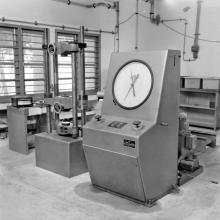
A machine that appears to be a Weather-ometer at the FRP Centre
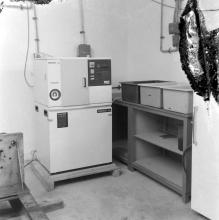
- Photographs , Equipment, Academic Facilities, Campus Facilities , 1970s
The Composite Structures (FRP) Research Centre, also known as the Fibre Reinforced Plastics (FRP) Centre was started at IIT Madras in March 1974. It was started due to the increased use of FRP, on a global scale, for advanced technology applications as well as for commercial and domestic applications. Prior to the formation of the Centre, in 1960, research and development activities in this area was initiated by the Department of Aeronautical Engineering (IIT Madras) because of the possible and increasing applications of FRP in the Aerospace field in India. In 1971, Prof. K. A. V. Pandalai…
Press machines at the FRP Centre
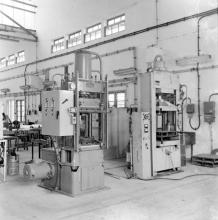
- Photographs , Equipment, Academic Facilities, Campus Facilities , 1970s
The Composite Structures (FRP) Research Centre, also known as the Fibre Reinforced Plastics (FRP) Centre was started at IIT Madras in March 1974. It was started due to the increased use of FRP, on a global scale, for advanced technology applications as well as for commercial and domestic applications. Prior to the formation of the Centre, in 1960, research and development activities in this area was initiated by the Department of Aeronautical Engineering (IIT Madras) because of the possible and increasing applications of FRP in the Aerospace field in India. In 1971, Prof. K. A. V. Pandalai…
A Strain Gauge at the FRP Centre
- Photographs , Equipment, Academic Facilities, Campus Facilities , 1970s
The Composite Structures (FRP) Research Centre, also known as the Fibre Reinforced Plastics (FRP) Centre was started at IIT Madras in March 1974. It was started due to the increased use of FRP, on a global scale, for advanced technology applications as well as for commercial and domestic applications. Prior to the formation of the Centre, in 1960, research and development activities in this area was initiated by the Department of Aeronautical Engineering (IIT Madras) because of the possible and increasing applications of FRP in the Aerospace field in India. In 1971, Prof. K. A. V. Pandalai…
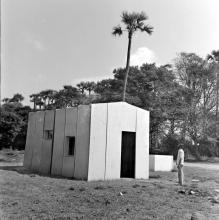
A building/cabin structure that was fabricated at the FRP Centre
- Photographs , Equipment, Academic Facilities, Campus Facilities , 1970s
IIT Madras set up six centres in the year 1973. The Composite Structures (FRP) Research Centre, also known as the Fibre Reinforced Plastics (FRP) Centre, was one of them. The Centre was officially opened in March 1974 and it aimed at co-ordinating and utilising its expertise and resources to advance the special areas of technology that was of national importance. It also aimed at providing technical advice and leadership to the FRP industry in the country. The key objectives of the Centre and services offered included: Research and development of raw materials and composites, process design…
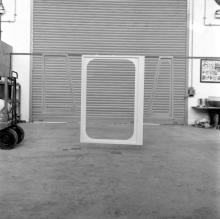
Parts of a vehicle fabricated at the FRP Centre
- Photographs , Equipment, Academic Facilities, Campus Facilities , 1970s
IIT Madras set up six centres in the year 1973. The Composite Structures (FRP) Research Centre, also known as the Fibre Reinforced Plastics (FRP) Centre, was one of them. The Centre was officially opened in March 1974 and it aimed at co-ordinating and utilising its expertise and resources to advance the special areas of technology that was of national importance. It also aimed at providing technical advice and leadership to the FRP industry in the country. The key objectives of the Centre and services offered included: Research and development of raw materials and composites, process design…
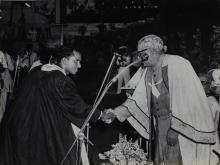
Mr. Basu John Vetteth receives the Governor's Prize for the year 1965 from Mr. M. C. Chagla
- Photographs , Convocations, Institute Events, Students , 1960s
The Governor’s Prize was a silver medal of the value of Rs. 25 given to the best all-round student of the B. Tech. Degree Course (curricular and extra-curricular). It was handed to Mr. Vetteth by chief guest and Union Minister for Education Mr. M. C. Chagla at the second convocation. Vetteth (Mechanical Engineering Department) was called a "bustling aggressive player in the forward line" by K. Shashi Rao in an article 'Seven Years to Hockey Glory' in the blog ‘Chennai 36’. Vetteth ran a popular photo studio in Chennai later in his life. An identical photograph can be found in the…
Prof. Lt. G. V. N. Rayudu receives Mr. M. C. Chagla at the second convocation, 1965
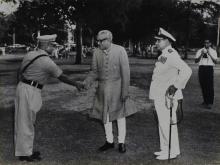
- Photographs , Convocations, Institute Events , 1960s
Prof. Lt. G. V. N. Rayudu was a faculty member of the Mechanical Engineering Department. To Mr. Chagla’s left is Commodore Commodore Jimmy D. Modi (Director, Directorate of NCC Tamil Nadu in white uniform) (Identification by Cmdr. M. D. Menon). An identical photograph can be found in the Gourishankar Collection in Album 0242 under the ID: 001/0242/IMG_0020
Mr. R. Natarajan and Prof. B. Sengupto standing at the microphones while faculty members and distinguished guests are seated behind them, 1965
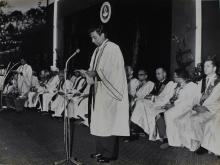
- Photographs , Convocations, Institute Events, Faculty , 1960s
Mr. R. Natarajan was the first Registrar of IIT Madras. He served his term from 1959 to 1965. Natarajan would complete his term in a few days after this event. Prof. B. Sengupto was the first Director of IIT Madras. He is also seen standing at a microphone. Seated at the stage, from left, Mr. M. C. Chagla (chief guest and Union Minister for Education), Dr. A. L. Mudaliar (Chairman, Board of Governors), a gentleman (yet to be identified), Dr. Y. Nayudamma (Director, Central Leather Research Institute), Prof. P. Venkata Rao (Electrical Engineering Department), Prof. N. Klein (…
Second Convocation of IIT Madras: Invitation and programme
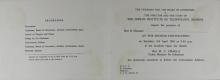
- Photographs , Convocations, Institute Events, Students , 1960s
The event programme. The guests were requested to be seated by 5:15 p.m., while the event was set to start at 5:45 p.m. The invitation has been issued by the Registrar R. Natarajan.
Mr. M. C. Chagla is received by Mr. R. Natarajan, 1965
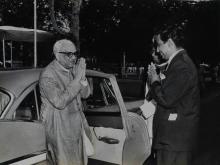
- Photographs , Convocations, Institute Events, Administrators , 1960s
In the photograph, Mr. Chagla (chief guest and Union Minister for Education, left) is received by the Registrar of IIT Madras, Mr. R. Natarajan. This was Mr. Chagla's first ever visit to IIT Madras, as Dr. Mudaliar (Chairman, Board of Governors) mentioned in his welcome speech at the event. Mr. Chagla praised the staff and students for the well organised convocation ceremony. The car in the picture appears to be a Plymouth of the 1950s. Plymouth cars were produced and distributed by the Chrysler Corporation in the United States. They ran from 1928 up until 2001, after which the…
A graduate bows down to distinguished guests and faculty of the Institute after receiving a degree at the second convocation, 1965
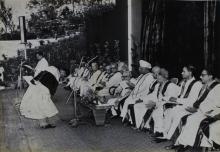
- Photographs , Convocations, Institute Events, Faculty , 1960s
Mr. M. C. Chagla (chief guest and Union Minister for Education) is seen in the middle, and to his left hand side, Dr. A. L. Mudaliar (Chairman, Board of Governors), Dr. Rajah Sir Muthaiah Chettiar (Pro-Chancellor, Annamalai University), Mr. Akbar Alikhan (Member of Parliament, Andhra Pradesh), Dr. Y. Nayudamma (Director, Central Leather Research Institute, Madras) and Mr. A. A. Rahim (M.L.A.). A total of 115 B.Tech. degrees and 3 Ph.D. degrees were awarded at the Second Convocation. The first Ph.D. degrees of IIT Madras were awarded at this convocation. An identical photograph can…
Mr. M. C. Chagla delivers the convocation address, 1965
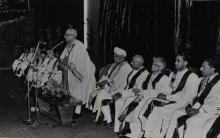
- Photographs , Convocations, Institute Events, Faculty , 1960s
In his address at the second convocation of IIT Madras, Mr. Chagla (chief guest and Union Minister for Education) spoke about the need for a large body of teachers in engineering and technology. He encouraged graduates to enter the field of teaching. He identified several issues that needed to be dealt with on a national level such as the need to use technology for production on a larger scale to counter the problem of scarcity and dependence on other countries. He said that the convocation was "one of the most imposing convocations I have ever addressed". Seated to Mr. Chagla’s left…
German faculty members in their convocation robes, 1965
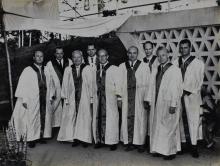
- Photographs , Convocations, Institute Events, Faculty , 1960s
German professors played a key role in the initial stages of the development of IIT Madras. They brought their practical experience and skills to IIT Madras, paving the way for a bright future. From left: Dr. F. W. Lohr (Mechanical Engineering Department), Dr. N. Klein (Humanities Department), Dr. W. Koch (Physics Department), Dr. W. Lutz (Mechanical Engineering Department), Dr. H. Heitland (Mechanical Engineering Department), Dr. G. Stahl (Mechanical Engineering Department), Dr. W. Scheer (Mechanical Engineering Department), Dr. E. Hohmann (Chemical Engineering Department) and Dr. G.…
Mr. M. C. Chagla inspects the guard of honour, 1965
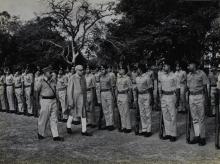
- Photographs , Convocations, Institute Events, Students , 1960s
Mr. M. C. Chagla (chief guest and Union Minister for Education) inspects the guard of honour by N.C.C. cadets before he enters the Open Air Theatre. He is being escorted by Prof. Lt. G. V. N. Rayudu. After inspecting the guard of honour, the Minister drove to the robing room at the entrance to the Open Air Theatre (OAT) where Dr. A. L. Mudaliar (Chairman, Board of Governors) received him. An identical photograph can be found in the Gourishankar Collection in Album 0242 under the ID: 001/0242/IMG_0019
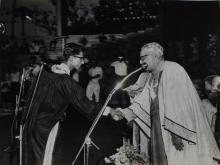
Mr. M. C. Chagla gives away the Siemens Prize for the year 1965 to Mr. Kanianthra Mani Chandy
- Photographs , Convocations, Institute Events, Students , 1960s
The Siemens Prize consisted of a bronze medal and a National Savings Certificate of the value of Rs. 75, which were given to the best student in electrical engineering. It was awarded to Mr. Kanianthra Mani Chandy (Electrical Engineering Department) by Mr. M. C. Chagla (chief guest and Union Minister for Education). Chandy went on to do his Masters from New York University and Ph.D. from Massachusetts Institute of Technology, and went on to serve in the field of academics for over 40 years, having won several awards in the field and also from the University of Texas and Caltech, where he…


- Contribute
to the Centre -
 Monetary
Support  Digital
Material
