
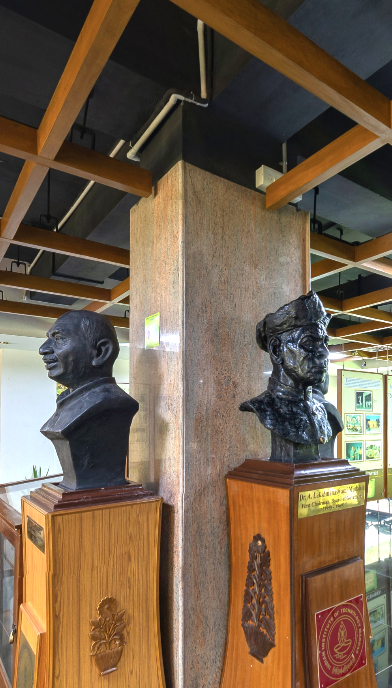
Prof. V.M.K. Sastry in conversation with Prof. Ajit Kolar and Mr. Kumaran Sathasivam
Prof. Ajit Kumar Kolar: Greetings from IIT Madras Heritage Centre.
Today at the Centre we are in conversation
with Professor Vedantam Murali Krishna Sastry
known as Professor V. M. K. Sastry
who was here in IIT Madras
as a faculty member from 1970 to 1998.
I will give you a brief introduction, and then
we will have a conversation about the
history of IIT Madras as Professor
Sastry looks at it during his tenure in this institute.
Professor V. M. K. Sastry graduated from the first
IIT which is at Kharagpur,
then he did his Master's in Indian Institute of Science
Bangalore, then his Ph.D. from
University of Illinois at Chicago Circle Campus, Chicago
in the area of Heat Transfer
he worked with Professor James Hartnett:
highly reputed Heat Transfer researchers of those times.
He worked in IIT Kanpur for some time,
he joined IIT Madras in 1970
in the Department of Mechanical Engineering.
Particularly, he was associated with the Heat
Transfer and Thermal Power Laboratory.
He went on to become the Head of the Department
of Mechanical Engineering from 1986 to 1990.
Later, he was the Dean of Academic Research
and he was the member of Board of Governors
when he retired in 1998.
He also is the Founder Professor
of ETC that is a Educational Technology Centre
which is now a very big part of the IIT Madras outreach,
especially through the NPTEL Programme.
He was Chairman of the Vanavani Committee,
and also he was Warden of Cauvery Hostel.
So, Professor Sastry has tremendous...
A long and vast experience in the IIT system,
first as a student, undergraduate student in IIT Kharagpur,
and then ending up as the member of
the Board of Governors at IIT Madras.
So he has seen the IITM...IIT system grow
from its initial...almost the beginning of the 1950s
up to '98, but then even now, although he is
officially outside the IIT system for the last 20 years,
he has been a very keen observer,
external observer of the growth of the IIT system,
IIT Madras. So, it is our pleasure to have Professor Sastry today,
to get his perspective of the IIT Madras
and IIT system in general. Welcome, Professor Sastry.
Thank You. We are very happy that you are here...
Prof. V. M. K. Sastry: Thank you, Professor Kolar. Prof. Kolar: today.
I would like to start by
asking you what were the circumstances under which you
came to IIT Madras from United States,
especially you joined the
Heat Transfer and Thermal Power Lab,
the academic and research environment,
especially also with respect to Heat Transfer subject,
kindly say few words about it.
Prof. Sastry: First of all, after graduating from IISc Bangalore
that is my Master's,
I was quite...deeply influenced by Dr. Ramachandran,
because though I was doing my
Master's Degree in Foundry Engineering,
he was actually handling the subject of Heat Transfer to us.
So I did his project work under him
and then I worked in an industry for a year,
but then I wanted to shift it to teaching line.
So I thought teaching line if I want to
really contribute, I must have a Ph.D.
So I was in search of a guide for Ph.D.,
and in that process I went first of all to
IIT Kharagpur as a lecturer.
So I was not very successful in finding a Ph.D. guide.
So I shifted to IIT Kanpur.
So there, one Professor Richard Zimmerman from Ohio...
Ohio State University, he actually accepted me to work under him.
But because of some policy issues involving
both Indian side as well as American side,
you know unlike Germany,
the assistance from United States was basically a private
affair; not from the government,
it is what is called an IIT...the...the...the University Consortium
of about 9 universities joining together,
and because of that, there was policy differences,
and the American side objected
that until the entire B.Tech. programme is in place,
you cannot have even faculty members working part-time for Ph.D.
Prof. Kolar: This was in the early 1960s. Prof. Sastry: This was in 1962.
So after a year, the American Professor said,
"Sastry, if you want to really get a Ph.D.,
go abroad." That is how I ended up in the United States.
So after my Ph.D., I joined the faculty of the University of Illinois also,
and when I was there working, 1969,
I got a letter from Professor Ramachandran
who was already by that time, the Director of IIT Madras.
So he said, "Why don't you come and join the
Mechanical Engineering Department?" So I said "Yes, I can do,
but I am now working on a NASA project,
so one more year I need,
so can I have a joining time of one year?"
With his, you know, very broad minded outlook.
He said, "Why not?"
So that is how I...
Basically, in those days you know, the people who went abroad,
they were not willing to settle down there,
they just wanted to increa...improve their qualifications and then get back.
That means basically Bharat Mata calling back.
So that is how the situation was, and I returned.
So I...was supposed to come
and join this '70 academic session, July,
but then my professor and guide,
Dr. Hartnett, he said that
"Now you are going to India,
and we don't really see..."
He was actually the...the very prominent...
International Journal of Heat and Mass Transfer, that is
the international journal, he was the editor.
So he said, "We are not really receiving many
articles...research articles in the
area of Heat Transfer from India.
So, for you to really work in this area,
it may be a good idea, if you meet several of the
international experts in Heat Transfer."
So they said...that's why in
August of 1970, the...there was the Paris
Fourth International Heat Transfer Conference.
So he said, "I will introduce you to a lot of
people there, why don't you come and..."
Because our paper also was there.
So, present it and then go.
So I requested Dr. Ramachandran,
"Is it ok if I join instead of the
beginning of the academic year,
in the middle of the year if I join, is it ok?"
He jumped at the opportunity and he really,
you know that shows actually the vision of Dr. Ramachandran.
Prof. Kolar: And he himself was a Heat Transfer person, basically. Prof. Sastry: He was himself a Heat Transfer person.
So he said, “That's a very good idea,
you come and join, after attending those things.”
So I came here, and because it was in the middle of the
academic session, I had not much teaching work to do.
So, in fact, it was a tremendous experience
for me to interact with him because,
on the first day when I met him in his office,
he said, “Sastry, this lab used to be called a Steam Lab.”
So after I came here, I changed the name
to ‘Heat Transfer and Thermal Power.’
This is very important from the history of the Heat
Transfer research in the country and in IIT Madras,
it was called a ‘Steam Power Lab,’
Prof. Sastry: Steam Power Lab. Prof. Kolar: Under Professor Narjes
But Professor Ramachandran, because
he was a Heat Transfer person,
he said, “We should have a Heat Transfer specialization.”
So he changed the name,
Professor Narjes was the head
and then ’70, Professor Sastry came in.
Prof. Sastry: So, I… Mr. Kumaran Sathasivam: But when had the lab been set up, sir?
Mr. Sathasivam: How many years had it been running? Prof. Sastry: It was set up in the beginning itself.
In fact, there was one
Professor from University of Stuttgart, Professor [indistinct].
He was also a member of the
German Committee which established IIT.
So, he actually was working in…the…in…in
Stuttgart, it was basically a Steam Lab, you know.
Mr. Sathasivam: It was a replica of… Prof. Sastry: Replica of that one
Mr. Sathasivam: The Stuttgart lab. Yes.
So, I…I came and then Dr. Ramachandran said,
“Though I changed the name,
whatever facilities you want, we will try to provide.
Can you, at least after 4 or 5 years,
make this Heat Transfer Lab
a real good Heat Transfer Lab
which is really doing reasonably good work in…in the area.”
Sir, excuse me, was Heat Transfer
being taught as a subject in any IIT or
other institutions in the country at that time?
To my knowledge there was…Heat
Transfer was not being taught at all
in any institution. Maybe,
I may be wrong, maybe Professor Sukhatme in IIT Bombay,
might have started, but I doubt it because as
undergraduate curriculum, it was not part of that.
So in fact, that is the one of the reasons why
Dr. Ramachandran particularly said,
“First of all let us develop a
Master's degree programme in Heat Transfer.”
So, now, that you don't have any teaching load,
why don't you design a 2 year
programme…M.Tech. programme,
in the area…in the subject of Heat Transfer.”
So, I worked on it for a couple of months.
So I made a detailed programme,
the curriculum was completely finalized,
then Dr. Ramachandran looked at it,
he approved, and he said that…until that time,
the Master’s Degree programme in Mechanical Engineering,
was…was only involving I think two or three areas:
One is Advanced Thermal Power,
Machine Design and probably Manufacturing.
I am not very sure.
So he said, “Let us have a regular programme.”
And then when he was quite certain that
there should be a 2 year programme
Master’s degree programme in several areas,
he asked the Department of Mechanical Engineering staff
there are almost about 10 labs
in the Mechanical Engineering.
So he said, “Each lab, each special area,
you should have a similar programme.”
So that's why by 1971, Prof. Kolar: Yes.
You know all the labs of Mechanical Engineering Department,
each department for example,
the M.Tech. programme in Combustion
M.Tech. programme in Refrigeration and Air-Conditioning…like that
all these 10 programmes actually were developed
and that's how it started in 1971.
But more importantly, what
Dr. Ramachandran suggested is that Heat…
Heat Transfer is an engineering science,
it was neither engineering nor science.
That…it used to be taught in Mechanic…Chemical Engineering also
as a more of…as a practical thing rather than
providing theoretical basis for it.
So, Dr. Ramachandran suggested
that we should also see that institutions like
Guindy Engineering College and other
engineering colleges in the country,
they also adopt this particular thing.
So he…I called actually, I arranged a
summer programme for 4 weeks
for teachers in the particular Thermal area.
So, 50 institutions actually participated for this 4…
So for that, what we did was, we actually
had this 4-week summer programme for these teachers,
along with that, we also tried to help them
by developing a lab manual.
For example, ‘How many experiments you can
conduct in Heat Transfer Lab.’
And that was quite a success because,
for the next 4-5 years, because in most of these
colleges you know, they have to go through a…
long drawn out procedure
to have any syllabus changes occurring,
because there should be a university level and all that.
So that is the reason why it took some time,
but eventually, a large number of institutions in the country
started teaching Heat Transfer as a
subject in the undergraduate programme.
I remember this very well sir because I
joined in ‘71 with you
and I was part of that first M.Tech. course specialization.
So, the point here is that
the…Heat Transfer for teaching undergraduate students
and bringing that into the Master’s programme,
actually was done by IIT Madras,
with the encouragement of Professor Ramachandran, and
Professor Sastry was there and Professor M. V. Krishnamurthy Prof. Sastry: Yes.
Prof. Kolar: was in the Refrigeration Lab. Prof. Sastry: Refrigeration Lab.
That's how Heat Transfer took routes
probably Professor Sukhatme who was a
Prof. Kolar: student of Professor [indistinct]. Prof. Sastry: [Indistinct] of.
And then…he is a Heat Transfer man, he had…
also was…sir, how about Professor A. K. Mohanty,
did he participate in this…from IIT Kharagpur?
Prof. Sastry: At that time he did not, but Prof. Kolar: Okay
basically what Mohanty was doing was,
he was in the…of course, Mechanical Engineering Department
in IIT Kharagpur, but when we…to actually
go ahead with this…1971 when we had this,
Dr. Ramachandran…you know, he is a…
in fact, I greatly respect him because he had Prof. Kolar: Yeah.
tremendous vision of so many things. Prof. Kolar: Yes.
One thing is this ‘Introduction of Heat Transfer’ as a
basic core course in the undergraduate programme
all across the country that is number 1.
Number 2, he said, that…“How about research?”
And I am really quite
surprised that he called me and he said,
“Now we will take admission for Ph.D. students,
so, take some.” Then
Dr. Kolar was one of the first ones.
So there are 3 students.
In 1972, again there was a batch of students and I took
3 students already…under me
and I was thinking that. you know, it is
too much for me because,
he said…he comes and says, “Take two more.
Take two more.” He said, “That is because…”
You know, my problem was, I worked actually
for my Ph.D. programme in a Space Research, Space Heat Transfer.
In India we were very much on…on the ground. Mr. Sathasivam: Yeah.
Prof. Sastry: Nowhere near space. Mr. Sathasivam: That’s right.
So therefore, what happened was that,
I myself was not really experienced in
several areas of applications of the Theory of Heat Transfer.
So he said, “Take two more.”
His idea was, if I take five students
in five different aspects of Heat Transfer,
some initiation of research can take place.
That…later on I found out the wisdom in that
because I think we have tried to develop
a Heat Transfer Lab very nicely because of his guidance.
Mr. Sathasivam: Sir, did Professor Ramachandran also initiate
these outreach programmes that you mentioned,
the Teacher Training Programmes that you conducted in summer,
in other branches in other labs and so on?
Actually this summer programme that I conducted
was not initiated by him
it was the so called Ministry of…you know
HRD the…the other… Prof. Kolar: Ministry of Education.
Prof. Sastry: So called Quality Improvement Programme. Prof. Kolar: Quality.
Quality Improvement Programme. They wanted to
actually have this for the…because this is for the teachers,
for the quality improvement.
So that is how it actually started.
But then, his vision was,
how to make this particular subject
very important and prominent one in the country,
because it actually…Heat Transfer is the subject
that cuts across several disciplines.
Aerospace it is there, in Chemical Engineering it is there, in…
of course, Mechanical Engineering obviously.
so because of that he wanted…
but…that it should develop actually quite well
all across, and so, he wanted to…say,
“Why don't we have a…
because you have now international contacts,”
Prof. Kolar: Yeah. Prof. Sastry: “Why don't you invite these
people from abroad, and then
we will have an international conference?”
But then finally, we decided, first of all let us
find out what is the extent of research that is
being done in the country,
before we take this international step.
So we wanted to have the First
National Heat Transfer Conference Prof. Kolar: Yes.
in 1972. And he wanted us to organize this one and
Dr. Krishnamurthy and myself, we were the organizing secretaries. Prof. Kolar: Yes sir.
Prof. Sastry: And we start a Mr. Sathasivam: Dr. M. V. Krishnamurthy.
Prof. Kolar: M. V. Krishnamurthy Mr. Sathasivam: Right.
Prof. Kolar: So it was in…during the Bangladesh War.
Prof. Kolar: 1971 December 1st to 3rd in CLT. Mr. Sathasivam: Ah, yes.
And big names, Professor Hartnett
Prof. Kolar: Professor [indistinct]. Prof. Sastry: Spalding
Professor Spalding from U.K.,
Professor Kadambi from IIT Kanpur,
Prof. Kolar: [Indistinct] from Uni…Russia. Prof. Sastry: Russia.
For us…we had just then joined for research, it was a
big thing that…we had not heard of Heat Transfer as a topic.
I am dwelling a little bit on this because
we started Heat Transfer research,
not only teaching, but research. This conference brought together
all the research community.
Sir and I am very happy to tell you, it is running
very successfully, the next one is being held
in the December of…every 2 years it changes.
So, Professor Ramachandran's vision. Prof. Sastry: Vision.
And the hard work that you and others…Professor
M. V. Krishnamurthy and others put in, has…really [Inaudible]
In fact, 1972 when we had…’71 we had this conference,
and ’73, we had the second conference in IIT Kanpur. Prof. Kolar: Kanpur.
Kanpur. And then, Dr. Ramachandran said,
“Now look…it looks like
we have a reasonably good work that is being done
both in the research laboratories,
education institutions and as well as industry to some extent.
So, why don't we have a society?” Prof. Kolar: Yes.
So, he said that, “We will have a…
we will…we will form an Indian Heat Transfer Society.”
So he gave me the task of
memorandum of association… Prof. Kolar: Following the constitution for the…
Constitution, and all that.
So we worked on it, and then 1974 we
established the Indian Society for Heat and Mass Transfer. Prof. Kolar: Yes.
Prof. Sastry: Heat and Mass Transfer. Prof. Kolar: With our Heat Transfer Lab as the headquarters.
Prof. Sastry: As the headquarters. Prof. Kolar: Even…even today it is so, sir.
Yeah, actually, 1974 onwards, until 1991, I had the
responsibility of being the secretary.
So for 17 years…
because there is nobody else that is willing to take.
Prof. Kolar: Yeah. Mr. Sathasivam: You would have been the Founder Secretary.
Prof. Sastry: Founder Secretary that's right. Prof. Kolar: Yeah yeah.
So, how about that Regional Centre?
This also connected with Heat Transfer and Energy, actually. Prof. Sastry: Yes.
See by that time, Dr. Ramachandran left actually in
1973, to take over as
Secretary, Department of Science and Technology.
In fact, that's what
I…another thing that I…aspect of Dr. Ramachandran:
he is a an institution builder.
He went and established the DST:
Department of Science and Technology. Prof. Kolar: Yes.
And afterwards of course, he…from
there he shifted to United Nations, and he
established the United Nations Centre for Human Settlements.
Prof. Kolar: In…in Nairobi. Mr. Sathasivam: Yes, yes.
Prof. Sastry: In Nairobi. Mr. Sathasivam: Yes.
So, in that sense he is actually a creator of institutions,
because of his visionary outlook.
So, after he went to DST,
there was actually an International Centre for
Heat and Mass Transfer in Yugoslavia
that was established with the assistance of UNESCO.
So, several of my international colleagues in the area,
they were associated with that Centre,
they said, “Now that…” because these people
have attended the conferences in 1971, ‘73 and
‘75 in IIT Bombay, they saw
the kind of work that is being done.
So what they said is, “Why don't we have…
not only India, but in the entire Asian Region, we will do it.”
So the…UNESCO actually sent a delegation
to tour various countries, of which actually Dr. Ramachandran was
a part of…that delegation.
And then the Yugoslavian Centre's Secretary
General was another member,
and of course, my former advisor
in Chicago, he was also another member.
They toured these countries and then they said,
“Yeah, it is time for us to have actually a
Centre for Asian countries, Asia and Pacific countries.
Prof. Kolar: Yeah Pacific. Prof. Sastry: Again, Dr. Ramachandran had the responsibility,
and by that time he was already in the DST, very busy and all that.
So he asked me to create that Centre.
So, I again drafted the constitution, and also
had several representatives from
Bangladesh and Indonesia and other places.
So we formed the Executive Committee and the
Board of Directors from Japan, for example.
So we created that Centre,
and then Dr. Ramachandran said, “Why don't we
start actually publishing a journal, Prof. Kolar: Journal.
taking into consideration the articles from these things.”
So, I also became the first editor of the
journal, he is the editor, and of course, the Prof. Kolar: Yeah.
Scientific Secretary of that (clears throat) that Centre.
He said, “Once we start this one, we have to do it
immediately.” He is…he is quite
impatient about getting things done.
So, first journal, should come out by December of 1978.
So we started this Regional Centre
in 1977, [indistinct] approved.
So the first journal should come actually in ’79…‘78 December.
We got it, but in those days as you know very well,
the printing and all that is…the words should be arranged in the
Mr. Sathasivam: Manual typesetting. Prof. Kolar: Yeah yeah yeah.
Mr. Sathasivam: That’s right. Prof. Kolar: Oh
Prof. Kolar: The First Heat Transfer Conference, we were all research scholars,
every day used to go to the printing press for proofreading,
we looked at the equations and said, “What
are all these equations? We don't understand whatever.”
All the research scholars, we had a fantastic
experience of those times. Prof. Sastry: And the printing
press was actually in the old Shopping Centre. Prof. Kolar: Shopping Centre.
Mr. Sathasivam: Yes. Prof. Sastry: In our
Mr. Sathasivam: Yeah. Prof. Sastry: Campus
Prof. Kolar: So this is very nice to hear
from you directly the… Prof. C. S. Swamy: I have one…
Prof. Kolar: Yeah please go ahead, go ahead, yeah.
Prof. Swamy: Now you said that Professor Ramachandran
Prof. Swamy: was interested in starting Heat Transfer,
Prof. Swamy: [Inaudible] to do with his being
Chairman of the Research Council of Defence Laboratory
You know he was Chairman of the Research Council DMR.
In fact, again I want to ask you, ‘72 I think
the Director of [indistinct] Narayanan
came with the delegation, and they wanted the IIT to
sub…submit projects. Prof. Sastry: Yes.
In fact, most of the projects submitted [Inaudible]
Maybe, I had also submitted a project.
Now why I am telling this, there was something about
he was thinking of rocket cones,
and then it was getting…could not be used again, because oblation.
So he said that we can [Inaudible]
So I had proposed something.
So about a coating of ceramic,
and a ceramic metal and a metal.
I said, “The most important thing is, you have to make the [Inaudible]
and we shall have a plasma torch to do this.”
In fact, my project was submitted,
but was not funded, but I
came to know much later that the plasma
torch was purchased by the Council. Prof. Sastry: Okay.
Prof. Swamy: But what I am telling you is, did Ramachandran get
interested in Heat Transfer because of its application in…
Prof. Sastry: First of all, Dr. Ramachandran himself
was actually…he had his Ph.D. from Purdue University. Prof. Swamy: I know.
Prof. Sastry: So in the…in the subject of Heat Transfer. Prof. Kolar: Heat Transfer.
Prof. Sastry: That is number 1. And of course, he was,
you know, Head of the Department in IISc Bangalore,
but more importantly, he wanted,
in fact, now that you mentioned about the
Sponsored Research and Industrial
Collaboration. In 1972-73…
Again Dr. Ramachandran said, “Somehow you know, when we do
something, we should also interact with the industry.” Prof. Kolar: Industry.
Prof. Sastry: “Industry-Institute interaction must be there.”
There used to be what is called RDOEI. Prof. Kolar: Yes.
Research and Development Organisation for Electrical Industry
In the Ministry of Heavy Industry in Centre, at the Centre.
So, he…the…a request came from there,
saying that, “You know, our…our motors and all these
things are becoming actually very large in size,
electrically we can do all these things, but because of the
cooling problem we are not able to
reduce this size for the same capacity.
So, can you please do something.” Because
because they know that Dr. Ramachandran was…say
expert in heat transfer, and he was Director here.
So they contacted him. Then he asked me and
Dr. Krishnamurthy, V. Krishnamurthy to look into this.
So Dr. Krishnamurthy by that time he changed his interests into. Prof. Kolar: Refrigeration.
Prof. Sastry: Refrigeration and air conditioning. So, we went to Bhopal, and as usual
you know the…the they were all buying the
drawings and equipment and everything
from associate electrical industries
which was supplying the equipment to them, and
they were not really interested in collaborating,
but luckily because of Dr. Ramachandran's
personal connection, Dr. V. Krishnamurthy, at that time. Prof. Kolar: Oh yes.
Prof. Sastry: Yeah. Prof. Kolar: BHEL
Prof. Kolar: top man. Prof. Sastry: BHEL…this thing, top man.
He said, “Let them go…come and look at it.”
But even though the faculty, the staff there were not very
cooperative, there was one Mr. Walker,
a 75-year-old man coming from AEI,
he himself said it’s a good idea if the…
because we don't understand what is happening there,
so theory must be also
matching with the…our experimental work.
So, let them do this. And because of Dr. Krishnamurthy’s
help, they supplied to us
all the drawings and other things like that, then we started.
In fact, that RDOEI industry project in 1972,
that they gave us about one and half lakhs or so.
Prof. Kolar: That is large amount at that time.
Prof. Sastry: That was the probably the first major
sponsored research project that came to us.
To IIT. Prof. Swamy: I see.
Earlier, there might be…you know some…
as far as my knowledge goes, that is the first major…this thing.
That is because of the fact that
there were administrative difficulties later on,
regarding…you know, how to distribute the
money and all that kind of thing, and that is the reason why
they said, we have to make some
policy and there are certain rules.
That is the reason why I am assuming, that that is the first
sponsored research project that came from outside.
So, for 3 years that I was associated with
Dr. Ramachandran 1970 to ‘73,
he started with several different friends,
for example, he also started some interdisciplinary Prof. Kolar: Yes.
programmes, but because he was…
he is way ahead of his times,
they didn't really take off.
Prof. Kolar: It took 45 years for them to materialize.
Yeah, interdisciplinary the reason why he was saying
was, because of his intense interest…should be promoted.
Departments should not be…you know,
the walls should not be built around the departments.
There should be constant interaction and exchange of ideas
and collaborative work among the
departments. That's what his intention was.
But it started and he was actually…along with
me, you know Dr. Natarajan and T. K. Bose and Prof. Kolar: Yes.
Some others of…the people, he
actually invited them from abroad.
Prof. Kolar: Sir, Professor Natarajan also joined just a year or two after you?
Prof. Sastry: No, in fact, around the same time. Prof. Kolar: Same.
Prof. Kolar: And Professor Bose also. Prof. Sastry: Few months.
Mr. Sathasivam: Actually, who were your colleagues?
Mr. Sathasivam: So, you mentioned Professor Krishnamurthy
Mr. Sathasivam: and Professor Ramachandran himself. Prof. Sastry: Heat Transfer,
Mr. Sathasivam: Yes. Prof. Sastry: Professor…Heat Transfer actually
these are the people, and of course, in
Chemical Engineering, then Professor Gopichand,
Prof. Kolar: Professor T. Gopichand. Prof. Sastry: Gopichand was working,
Yeah, Professor Gopichand was working.
Prof. Kolar: Professor K. Subbaraj. Prof. Sastry: K. Subbaraju.
Prof. Kolar: Of Prof. Sastry: Subbaraju, Subbaraju was working
Prof. Kolar: Dr. Sathyanarayana’s father. Prof. Swamy: Yeah, yeah.
He was the Heat Transfer professor.
So…so there was basically a good group of
people working here, in various departments. Prof. Kolar: Yes.
But the question is that the interaction
he wanted to develop, and that is the reason why he was
trying his best and he did a very good job as far as I am concerned.
Prof. Kolar: Sir, now that we are in this topic of research,
Heat Transfer of course, now we have information.
When we were research scholars, we saw the…a
Solar Thermal Power Plant in BSB;
this was in the mid ‘70s.
Professor Ramachandran went to
start the department of non…no no, DST as Secretary.
I think he started the Department of Non-conventional Energy Sources. Prof. Sastry: Yeah, right.
Prof. Kolar: So, what was his role in initiating the solar energy research, here?
Prof. Sastry: He actually…as I said, Prof. Kolar: Yeah.
Prof. Sastry: even the DST when he was Secretary,
with regard to this Regional Centre for Asia and Pacific,
regarding that matter, I visited Delhi, and
I met him in his office. He was so much interested in solar energy. Prof. Kolar: Yes.
In fact, he said casually, “Sastry, do you think
that, like Atomic Energy Commission,
in this country, should we have a Solar Energy Commission?”
Mr. Sathasivam: Right. Prof. Kolar: These were in ’73
Mr. Sathasivam: Right. Prof. Kolar: ‘74.
Prof. Sastry: This was in 1974-75 time frame. Mr. Sathasivam: Yes.
He was thinking, then…I just casually of course,
because I had this freedom with him to… Prof. Kolar: Yes.
Prof. Sastry: have talk, I just…I said, “Unfortunately we should
not…we should first of all develop
a total overall plan for the energy in the entire country.”
For example, energy comes from you know, solar and of course,
from fossil fuels and hydro
and all…what are our resources available in each
one of these areas, and what is our projected
growth rate and what is the amount of
our needs, so far as energy is concerned.
I said, “Already right now, we have…”, actually
at that time, Ministry of Power, Ministry of Water is different.
Prof. Kolar: Ministry of Coal. Prof. Sastry: Coal is different, coal is different.
So, each person actually is…atomic energy of
course, anyway is different.
So, each person actually is having…
and each area is having its own empire, so to speak.
So to say solar energy, wind energy
will become another…Wind Energy Commission.
So, can we avoid that?
He said, “No no, I was just intellectually I was discussing.”
So, what I am trying to say is, Prof. Kolar: He had.
Prof. Sastry: He had that. Prof. Kolar: Absolutely.
You know he was looking into the future, and in that
context only, we also had actually solar
Prof. Kolar: Yes 10 kilo watt thermal power plant. Prof. Sastry: 10 kilo watt station
actually developed here, probably that is the first one
Prof. Kolar: I think so, it is the first one. Prof. Sastry: First one.
Prof. Kolar: Solar energy research, again, to the best of
my knowledge, started in IIT Madras.
Mr. Sathasivam: The first in the country, sir? Prof. Kolar: Yes.
Prof. Sastry: Yeah, first in the country. Mr. Sathasivam: Right.
Prof. Kolar: Definitely in the IIT system and the educational institutions,
and there was no…he started the Non-Conventional Energy Centre
which now is MNES. Professor Ramachadran started. Prof. Sastry: Yeah, he started that one.
Mr. Sathasivam: Right. Prof. Sastry: Actually, earlier, there was some…
in the area…in the…in the department under the National
Physical Laboratories and physics area,
some work was supposedly…we have done in the solar.
Mostly there were actually solar cookers, solar
water heaters and that kind of thing.
But not in terms of producing energy. Prof. Kolar: Power
Prof. Sastry: Power. Prof. Kolar: Yeah, Professor Ramachandran was a man of vision,
he initiated so many programmes for the country.
There was slightly shift focus, because you also…
for the Founder Professor of the Educational Technology Cell.
Today, this is a very big thing again
and through that cell we have the NPTEL
Programme which is extremely popular in the country and
now it’s simply expanding, but you are the originator
of that, can you say a few words about it?
Yeah, actually what happened was that…this happened
actually in 1985 or ‘86 Prof. Kolar: Professor Srin…no…
Prof. Kolar: Professor Indiresan? Prof. Sastry: That was in ‘86 and ‘87
because I took over as Head of the Department in 1986. Prof. Kolar: Yeah.
So one day, in 1987 or something,
one…suddenly just before the financial year comes to an end,
in January or so, we received suddenly a
fax message…the Director received a fax message
saying that they have got additional funds. Prof. Swamy: As usual.
Prof. Kolar: What do you will do with this?
So, we are now giving actually 2 crores
to each of the 5 IITs…to develop an Educational Technology Cell. I see.
So, it came, first meeting actually took place
in Delhi, and I think Professor Raina
from Electrical Engineering Department, he went.
They thought nothing will come out, but then a
few days later, suddenly another fax comes and says,
“Send your representative with complete plan as a fraction.”
So then, Professor Srinath, who was the Director at that time,
he asked Raina, he said, “I am not interested, nothing is
going to happen, nothing.” Unfortunately
or fortunately, I happened to be in Director’s
Office at that time, because I was trying to go
to Delhi for…in connection with my UNESCO Centre.
So, he said, “You go.” Professor Raina said, “You go.”
I said, “What do I do with it, I don’t know?”
He said, “You study, these are the materials, you just
do this. This is what they want.”
So, I worked on it for 2-3 days: tried to at least
bring up some questions, you know what
exactly is going to happen and all.
So we…I attended the meeting.
Then it appeared to be, that they are in a hurry to give funds,
and they did not have much idea,
we also did not have much idea.
So, anyway they are giving the funds,
so, let us create the infrastructure.
And other people later on you know will take it up and...
So, that is how it started.
So, as soon as I came…luckily for me
because I was heading the department,
there was space constraint you know, nobody is willing to
give any…for studio and all that.
So, because of the Mechanical Sciences Block, you know
I was the Head of the Department…under our control,
there was one 356. Prof. Kolar: MSB.
Prof. Sastry: MSB 356 room number. Prof. Kolar: Yes, yes.
Prof. Kolar: It was there for a long time since we shifted to this place. Prof. Sastry: Yeah, it was actually a drawing…this thing,
because by the time, 5 year programme
became 4 year programme, a lot of drawing
instruction was cut from the B.Tech. programme.
So, several of these drawing halls became actually… Prof. Swamy: Yeah, yeah.
vacant, and luckily for us, you know I was able to put it
in the department, and the department very
generously agreed; they did not contest, they said, “Okay,
you take that one”, and then we prepared that studio.
I remember a lot…how much time you spent on getting
the equipment from Japan, the Sony equipment.
You also had the first recruits from that.
Prof. Kolar: Our Ravindranath Mr. Sathasivam: Yes.
Prof. Kolar: was one of the first recruits at that time. Prof. Sastry: It had to go to the
board because basically what they
said is, “Okay, you are creating certain…you know, cameraman, producer
these are not names not normally not available in the IIT system.” Mr. Sathasivam: That’s right.
Prof. Sastry: IIT system. So, what is their career growth?
Supposing you take somebody else, how is he going to grow?
I said, “I don't know.” Prof. Kolar: At that time…
But that time…but with luckily because of
the you know, the generosity of the board as well as the
Director and all the people concerned,
they said…they said, “We will give you just three people:
one cameraman, producer and some other…”
Mr. Sathasivam: So, they were…were you producing videotapes of courses or? Prof. Kolar: Yes.
Prof. Sastry: Yes, courses basically. Prof. Sathasivam: Because it was pre-internet and so on.
Prof. Sastry: Yeah, basically, the idea was to Mr. Sathasivam: Yes.
Prof. Sastry: get for example, lecturers and professors from
various departments, make tapes
on the subject matter, that is basically…
take a subject, you know like a Physics.
In that you would…for example,
undergraduate programme, there is a first year or second year Physics,
the person…the professor actually gives some series of lectures.
So you, for…for a semester, let us say total
about 30-40 lectures you give.
So you make them into about 20 or so, lectures. Prof. Kolar: Yes.
So that the concepts can be explained
by the experts, and send them to various other engineering colleges
if they want to…practically for free.
Mr. Sathasivam: So, these copies were disseminated to colleges. Prof. Kolar: Colleges, yeah.
Prof. Kolar: So this was much before NPTEL came in. Prof. Sastry: That is the
before NPTEL, that is the idea. Mr. Sathasivam: I see.
Prof. Kolar: Yeah, yeah [Inaudible] Prof. Sastry: So, that is
That is how the first…I think the
Professor V. G. K. Murti, Professor Roshan and
Prof. Kolar: Lots of people. Prof. Sastry: few others started…
Prof. Swamy: …50 rupees books.
Prof. Sastry and Prof. Kolar: No no, tapes.
Prof. Sastry: Video tapes.
Prof. Kolar: This was in the…there is a studio that was there in the MSB.
Mr. Sathasivam: The legacy is still there I think.
Prof. Sastry: In fact. Mr. Sathasivam: I think there is still a studio there.
Prof. Sastry: Studio there and it also…we soundproofed it.
We have to…we had to bring experts to soundproof it. Prof. Kolar: Yes, yes sir.
Sir, now we are on this topic of Centre,
you are also aware that the Industrial
Consultancy Centre, which is now the ICSR
was started, and also there was Engineering Design Centre.
Prof. Sastry: Yes. Prof. Kolar: Today we have a Department of Engineering Design.
So, these two are ahead, I mean. Prof. Sastry: Yes.
Prof. Kolar: You started this, can you…your experience with this?
Prof. Sastry: Actually, when I was heading the Department,
the Engineering Design Centre in the…
there was an Engineering Design Centre in the
Department of Mechanical Engineering.
And I don't know the starting time,
probably, it was there for a long time,
because basically 1970…’70
when I joined it was still…it was there at that time.
It was there. What that Engineering Design Centre had was
people from Physics background
and Mechanical Engineering background
and the people from the Physics Department
are also basically in the area of optics.
Optics. So, when…1987 or so,
Professor Srinath said, “What is this,
what is this Centre doing here?”
So, let the physicist go to the Physics Department
and the other people go to Mechanical Engineering Department. Prof. Kolar: Mechanical.
There was obviously, you know, there is a
Prof. Kolar: Different opinions at that time. Prof. Sastry: Different opinion
kind of thing with the Physics Department…our department, [Inaudible]
but we…we have to put through the
Departmental Consultative Committee, we did it
and finally, with the understanding that
the each departmental staff strength
will not be affected. These people were allowed to Prof. Kolar: Yeah.
Prof. Sastry: shift two departments. Prof. Swamy: Because that is Professor Sirohi
Prof. Sastry: Professor Sirohi. Prof. Kolar: Professor R. S. Sirohi,
Prof. Kolar: then Dr. Chennabasavayya from Mechanical Department. Prof. Swamy: I know, I know, I know.
Prof. Sastry: Chennabasavayya came…Kalam Prof. Kolar: Kalam…Kalam was there.
So, these people came to Mechanical Engineering Department.
So, they joined the Machine Design group and so forth.
So, that is how the…but Engineering Design Centre
used to work for some time,
but their collaboration with the industry
in most departments, was basically very very
Prof. Kolar: Yes. Prof. Sastry: small at that time because
the culture still did not develop to that extent right,
like for example, today. Prof. Kolar: Today.
Absolutely. How about the inter…ICC
Professor Wagner was the first person. Prof. Sastry: Yeah.
Professor Wagner was the first person,
I think the second person who…to take over
from him was the…Professor Narayanamurthi.
Prof. Kolar: Narayanamurthi. So this was when Professor Ramachandran was there
Prof. Kolar: or after that? Pandalai. Prof. Sastry: Professor Pandalai. Professor Pandalai was there.
Because Pandalai took over in 1973, I think.
Prof. Kolar: Yes. December 10th. Prof. Sastry: November or December. December, December.
So, he…during his tenure only,
the Heads of Departments, you know the deanships
were created and all. They were not called ‘Dean’ at that time,
it was called ‘Professor-in-charge.’ Prof. Swamy: Yeah.
Professor-in-charge of Industrial Consultancy Centre.
Professor-in-charge of academic courses, like that. Prof. Kolar: Yes.
So, then later on it…it formally became
Prof. Kolar: Dean. Prof. Sastry: Dean. So, the
senior most Heads of Departments actually
were requested to occupy these
new Professor-in-charge positions.
And Professor Narayanamurthi became the
Prof. Kolar: He became. Prof. Sastry: Professor-in-charge at that time.
So, I think this took place around ‘75 or ‘75. Prof. Kolar: ‘5.
Prof. Kolar: Professor Pandalai was the Director at that time. Prof. Sastry: Pandalai was the Director at that time.
Now as you know it has grown into a very big Centre.
So, lots of the…the seeds for today's Prof. Sastry: Yeah.
activities of IIT Madras,
obviously, in ‘70s and ‘80s because of some
very visionary people and their efforts.
So, slightly shifting focus,
you were also Chairman of the Vanavani Committee.
Prof. Sastry: Yes. Prof. Kolar: What, what was the situation?
What were your contributions there? Prof. Sastry: Yeah, Professor Indiresan
actually…one day called me and he said,
“Will you take over the Vanavani School?” Prof. Swamy: Okay.
So, I said, “It so happened my children also were going to
Vanavani and Vanavani actually had a very good reputation
in the city at that time…was one of the best schools
because…primarily because Mrs. Peter was the principal.
The…excellent principal. So,
she brought up the reputation like anything.
So I thought, okay, but unfortunately,
the funds availability was not very high, number 1,
second thing is the employees…
there was a rule in Vanavani School
that 50 percent of the children must be from…from the IIT,
and every child must be every child
requesting admission to Vanavani from within IIT,
he or she…she should be provided.
So you cannot deny the admission.
So that was the condition.
So, usually we used to have approximately
about 1800 to 2000 children.
So about 1000 or so, used to be from
within IIT, and 1000 from outside.
So, what happened was, there was a
large demand from the Employees Association
that earlier there used to be ISC system
the Union School Certificate… Mr. Sathasivam: Yes.
Secondary Certificate System. But they wanted to
make it into a State Board.
So…so…so there was a big problem because
the State Board means, the…they said they had
alternatives: either to run it as a private school
with State Board this thing,
or hand it over to the state government,
in which case the teachers employed…
all these people will be employed.
Control will be completely only by them,
the transfer the…this thing, and second…thirdly,
more importantly, the medium of instruction should be Tamil.
And because of the nature of our
institution, lot of people were not willing to have the
Tamil-medium instruction in the school. Prof. Kolar: I see.
So therefore, what to do?
So we have to have it, and the
funds availability was not very high.
So, prior to taking over as Chairman,
I was on the Management Committee for 2 years.
So I knew the problems. So therefore,
what we tried to do is, I introduced the thing which is…
initially there was some resistance;
basically what I said was,
“For providing all this infrastructure, you know,
free electricity, free water, free furniture,
free buildings and everything from the IIT
is a perquisites that is being given for the staff of the IIT.
But why should the outsiders
enjoy these things at the same tuition fees?”
So I said, “Tuition fees we cannot
differentiate: outsider or insider.”
So what I said is, “The establishment fees
we charge the outsiders. 150 rupees per year
per year.” Prof. Swamy: I see.
So if 1000 people were there, 1.5 lakhs was coming.
So I said okay, we now… Prof. Kolar: That was a…that is a large
Prof. Kolar: amount of money at that time. Prof. Sastry: That is a large amount in those days.
So that, we can increase the infrastructure. Mr. Sathasivam: When you say
those days it is the 1980s or
What period was your association with? Prof. Sastry: It is ‘80 to ‘84.
That was when the question of the mode arose
as well. the ‘81 or so, the period when…
Prof. Sastry: Which one? The… Prof. Kolar: Mode…that problem with the
Mr. Sathasivam: The ISC or the State Board...
Prof. Sastry: Yeah, in fact, which I changed…the system only from Mr. Sathasivam: That was the time.
Prof. Sastry: this previous one to State Board. Mr. Sathasivam: Yes, yes, yes, yes.
Prof. Sastry: State Board, that means ‘plus 2’ so called plus 2. Prof. Swamy: Yeah yeah yeah
Prof. Swamy: Of course. Prof. Sastry: Plus 2. And also around the same time,
the IIT also from a 5 year programme,
It changed to 4 year programme. Mr. Sathasivam: That’s right.
So, because of that, there was some surplus
lab facilities and here I must really
thank actually Dr. R. Srinivasan who was Physics…
he was Deputy Director at that time.
Deputy Director. He was very very cooperative, very nice.
He said, “Some of these experiments and all these things…
now that there is a plus 2,
let the school kids, you know, have the
advantage of these experiments.”
So he shifted actually some of this
equipment and all that…that
for Chemistry, Physics experiments.
He allowed us to use…the…
So that way, we were able to develop the
science labs in Vanavani.
In fact, which became a…which caused tremendous envy to
a large number of external examiners
Prof. Kolar: Yes. Prof. Sastry: Who were coming to examine our…our students.
Mr. Sathasivam: Yes. Prof. Sastry: Because each student was given actually one particular lab,
I mean, table, experiment, 48 students were there
in each section and each person actually had a…
under the table there is a shelf and everything,
they can put their stuff there.
We created that one.
So the establishment charges are 150,
what we tried to do was to…
how to…how to I wanted to
separate the primary school, secondary school,
and higher secondary school, in three units.
So for that primary, we wanted to shift from the
same place to another building which was there.
So, we wanted to have a top floor to construct that one.
Luckily for me, our managing committee
had Mr. Malayalam…was the Prof. Kolar: He was the
Prof. Sastry: Executive Engineer. Prof. Kolar: Executive Engineer.
So, I requested him, “Can we borrow some
bricks and cement and sand…things like that,”
Then there used to be Centre for Rural Development.
Prof. Kolar: Yes. So, Centre for Rural Development Head,
Dr. Radhakrishna I asked him…
they were doing some research about the Fibre-reinforced
concrete: FRC. Fibre-reinforced concrete,
which is a cheap material,
relatively speaking, compared to Portland cement.
So they were actually…
So they said, “Okay, why don't you use it?”
In that, the chicken mesh
you know, is the reinforcement, not the steel.
So, using that, we constructed. I think
today, still it is standing.
So, that we constructed, made rooms,
and the primary section was shifted there.
Mr. Sathasivam: Now this is within Vanavani, sir? Prof. Sastry: Within Vanavani.
Mr. Sathasivam: Right. Prof. Sastry: So basically, we borrowed the material from IIT,
Mr. Sathasivam: Yes. Prof. Sastry: Money, so far as these establishment charges
from the outsiders. With that, we were able to
bring the financial health of the school
Mr. Sathasivam: Yes. Prof. Sastry: to a reasonably good level.
Mr. Sathasivam: Yeah. Prof. Kolar: Sir, it’s interesting you mentioned CRD
because we were also there at that time.
Professor Indiresan started. Prof. Sastry: Yes.
You mentioned Dr. Radhakrishnan. He…you were…you were
talking about this son of Professor Bhagavantham Prof. Sastry: Son of
Professor Bhagavantham, yes. Prof. Kolar: who was in charge of the CR…
Prof. Sastry: He was Physics professor here.
Prof. Swamy: Hostel. Prof. Kolar: Yes. So, can you say something about the Centre?
The idea was… Prof. Sastry: The idea…
Prof. Kolar: From from Professor Indiresan at that time. Prof. Sastry: Yeah.
Prof. Sastry: Basically, the reason is that, you know
the…the national political situation
was such that you know, people wanted to have
always something connected to rural, rural, rural, rural area.
So, Professor Indiresan wanted to have a Centre
for Rural Development in the…in the there,
how to use for example,
whether for cooking purposes, or for
house building purposes, or whatever.
What kind of experts in our technology…
technological institutions? How they can actually
help the rural people
using the local substances and materials?
How we can improve their living conditions?
So as a part of that, they were taking several projects.
In fact, the energy also they were doing
something…wind energy also later on came because of that. Prof. Kolar: Yes.
And then they were trying to
have this for cheap construction.
They were developing this particular
Fibre-reinforced concrete. They were doing some experiments.
And Dr. Radhakrishna said, “You know, it…it…it
stands and there is…we have already experimented, it is okay,
so you can certainly use this.
and… Mr. Sathasivam: It was also known as ferrocement...I und…I remember, yes, yes.
Prof. Kolar: So we will come to academics and research.
I see that you were associated with 7 Directors
starting from Professor Ramachandran
up to Professor Natarajan, Prof. Sastry: Natarajan.
Prof. Kolar: during your stay here.
And quite a few changes happened in academics and research.
As you recall, in your experience, what would you say
in the…from the academics point of view?
Some important developments took place?
The…the academic side, basically as I was telling the
the…the creation of the deanships.
For example, the…the academic courses and research. Prof. Kolar: Yes.
So, there is a Board of Academic Research,
and Board of Academic Courses.
So therefore, there is a…every department actually
is represented in each of these boards.
And they determine what will be the kind of…
the curriculum or the research material
that you can have; research atmosphere.
For example, when I became Dean of Research,
Prof. Kolar: That was 1990. Prof. Sastry: 1990. ‘90 to ’93.
During that period, the…
for one of the first things that I tried to do,
because at that time, the students were taking
a long time to complete the Ph.D. and the
reason for this long time was primarily because,
from the time of submitting the synopsis and Ph.D.,
by the time they get the reports and all that,
that used to take a long time.
So therefore, of course, because of the difficulties
of equipment and funds and all that kind of
thing, anyway some delay was taking place.
But more than that, even the processing of the work Prof. Kolar: Thesis.
Prof. Sastry: Thesis, was getting delayed.
So I tried to first of all, collect over the previous
several years, what was the time that is being
taken by each department in terms of…
because we thought, I thought the…after all the person
completes his Ph.D.
he should enter the profession as early as possible.
It’s a…it's not fair for us to keep the student for too long.
Prof. Kolar: After submitting the Ph.D. thesis. Prof. Sastry: After submitting the Ph.D. also.
So, when I did that, I found certain
lacunae in the processing.
So we tried to first of all improve that one,
and I think fairly…we were able to
do this number 1. Number 2 is the quality of the Ph.D.,
because a large number of Ph.D.s coming out at that time.
In fact, at that time the number of Ph.D.s coming out
was itself very small. Prof. Kolar: Yeah.
For example, in mechanic…in…in the entire engineering areas,
it was only 29 or 30 per year.
Whereas, much more…much larger number in the…
from the Science and the Mathematics Departments. Prof. Kolar: Science, yeah sciences.
So, the question is, what about the quality?
So the quality is…one way of determining the
quality is the…out of the thesis,
how many papers are being published, Prof. Swamy: Yeah.
in refereed journals. So I found that
that number was not very great.
So we tried to propose Prof. Kolar: Sir, in fact, some Ph.D. thesis went…
passed without any publications also. Prof. Sastry: Without any…
Prof. Sastry: there are several, in fact. Prof. Kolar: No it is very important because today there are
many…big guidelines for theses pub…even submission.
So, it…it started at that time. Prof. Sastry: At that time.
Because basically what I proposed was,
I discussed it extensively in the Board of Academic Research
and then we tried to find out, okay,
when you submit the thesis, the synopsis,
by that time, you should have published:
two journal papers, whether international or national
doesn’t matter, should publish.
In the Board of Academic Research,
they said, “It’s too tough.”
So we said, “Okay, one journal publication
and one conference paper.” Prof. Swamy: Yeah.
So finally, the Board of Academic Research agreed,
So we put it before the…and I…
we…I went to the…Professor N. V. C. Swamy who was Director. Prof. Kolar: Yeah.
He said, “It’s a good thing, we should…
but it…when it came to the Senate, Prof. Kolar: Yes.
It ran into opposition and they said, “No, no”
because a large number of cases in engineering particularly
the…the data collection itself will take a long time
to prepare the unit itself,
the experimental unit itself in the
fabrication and all that, it takes a long time.
So it's not possible to do this, but anyway,
finally, what was decided was,
at least one paper in a journal or a conference,
internat…refereed conference, Prof. Kolar: Yeah.
it should be published.
So that is how it started.
So the quality improvement of the thesis,
we tried to at least introduce,
but I think nowadays, I think it is very common…
lot of…nowadays and moreover the
availability of resources also is much more now,
compared to…at that time.
Prof. Kolar: Also, earlier times, if you send a paper,
it would be take two weeks to reach. Prof. Sastry: Yeah.
And they would take months for…you know
peer review, and then we have to again go back
to them. It could take even year or even more than that.
Why, for example, in our subject, the Heat Transfer,
the International Journal of Heat Transfer
used to cost 125 dollars per year.
But the…just imagine, in those days,
if you submit in an United States, for example,
if you submit a paper, by the time it is reviewed
and all this kind of a thing and it see…it comes in
the print, it used to take about 9 months to 1 year.
Prof. Kolar: Oh even there, in those days. Prof. Sastry: Even there, in those days.
Now, that particular journal comes by sea mail.
Mr. Sathasivam: Yes. So it used to take 4 months or 5 months sometimes.
And first of all, this is one journal; international journal.
They are not enough funds here, because I was
Dean of Research, I was also in charge of the library. Prof. Kolar: Oh I see.
Mr. Sathasivam: The library committee was trying to
Mr. Sathasivam: you know economize some of the. Prof. Sastry: Economize.
Mr. Sathasivam: Yes, I remember that Prof. Sastry: In fact, I was
Prof. Sastry: I was the Mr. Sathasivam: Yes, that’s right.
Prof. Sastry: Chairman of that committee: Library Committee.
Departments were asked to prioritize
the journals, if I remember right. Prof. Sastry: Prioritize
Prof. Sastry: prioritize for example, Mr. Sathasivam: Yes, that’s right.
even the…the…what is that…chemical index or something.
Prof. Kolar: Yes, yes, engineering index. Engineering…engineering index.
Prof. Kolar: We are…all the journals. Some of those things
you know, they said, you know,
“Why don't you have this one?”
Consequently, what I am trying to say is,
the funds availability was low,
in addition to that, even if for example,
I submit in…in…in…in Heat Transfer
let us say there half a dozen,
I can submit only…I can only subscribe
only to one journal; this one.
This also comes after one and a half years.
In other words, the…the subject
if I am looking at, in the journal,
is actually one and a half years old. Prof. Kolar: Old. Mr. Sathasivam: Yes, yes.
So, these are the practical difficulties
in research, and we were trying to somehow, you know…
but the idea was there that
we recognize these problems,
and we were trying to find some solutions.
And in that sense I think
there was a lot of cooperation.
Occasionally there will be some
difference of opinions. Prof. Kolar: Yes, yes.
But generally speaking, we had very good cooperation
in terms of…for example, the…the library.
The alumni said, at that time,
“We will construct a diff...library.
We will give you for construction.”
I tried to argue with the Professor…
Director at that time, Professor Swamy.
Library is not the building, it is the books inside.
Now as Library Committee Chairman,
I am cutting down the…
what is the point in having a big building?
Prof. Kolar: And there is no money to buy the books. When there is no money.
So is it possible, please consider
whether you can have a fund
that the alumni gives,
out of which you know, you can
spend for the journals.
But of course, for the…it could not materialize,
but what I am trying to say is that,
that used to be the difficulties Prof. Kolar: Yes.
in…in…in Prof. Kolar: Absolutely.
in conducting research or…
these are the difficulties.
So…but anyway, it was basically,
it has come a long way now.
So in terms of academics,
I remember during those times
the credit system was introduced,
‘Best Teachers’ awards were being given,
and you were…you received that,
and also student feedback. Prof. Sastry: Yes.
So could you say something about this? Prof. Sastry: Actually
the…it was not very…in an organized way,
but I think Professor Pandalai was the
first person to…to think of
some kind of a teacher evaluation.
He was the first person.
So he apparently…I don’t know
how he did it, but he collected
a lot of information from
some of the very good students
in each department. In each…at…at…at every level.
And after getting that information,
he identified some people from
each department as ‘Best Teachers.’
And he put up these names
before the board, and the board
said, “Yes, it is a good idea,
and… Prof. Kolar: Because there is no committee,
Prof. Kolar: there is no other parameters. Prof. Sastry: So, there is no committee and all that.
Prof. Sastry: No no. Prof. Kolar: We don't know about that.
But Pandalai sent individual letters
to…”Glad that you know you are…you are…you are deemed to be a…”
Prof. Kolar: It was called the ‘Best Teacher Award.’ ‘Best Teacher Award.’
‘Best Teacher Award.’ ‘Best Teacher…’
Prof. Swamy: Excuse me, this was not known to everybody.
Prof. Kolar: Everybody. That's what I am saying,
that's what I am saying.
So, I don't know. Prof. Kolar: It was an almost individual thing
Prof. Kolar: that he did Prof. Swamy: I came to know of it
Prof. Swamy: because I started reading the board minutes.
Prof. Kolar: Okay. Prof. Swamy: Otherwise, I would not have known.
See that is the…that is…
that is why I said, Prof. Kolar: That’s all
it has come actually as a…we don’t know.
So in that process for example,
people like you know, V. G. K. Murti
and…I also got one letter and all that,
but I really didn't…
but ulti…formally it was started by
Professor Indiresan. Prof. Swamy: Yeah.
Professor Indiresan used to
issue a weekly newsletter. Prof. Kolar: Yes.
It come…used to come on Friday,
and in that newsletter,
giving all the other news about the IIT,
what is happening and all that,
at the end of the semester,
at the back of that newsletter,
They used to be a list of the Prof. Swamy: Correct.
best teachers in the order of ranking,
or…but each…not ranking as such,
but these are the best teachers,
and he created a criteria;
he asked for the feedback from the students. Prof. Kolar: Oh, okay
And some 7.5 or so
out of 10, whoever gets,
only they will be recognized as good teachers.
So that kind of system he developed
and he…it ran for quite some time,
I think several years it was…
but it is…at least open and it is a feedback.
That is…it was organized,
better organized. Prof. Sastry: Organized way in a
Prof. Sastry: systematic fashion Prof. Kolar: Today also
we have, some ‘Young Teacher and Scientists Awards’,
there is endowments from…not endowments,
some alumni have contributed
to recognize the best teacher. Prof. Sastry: Yeah,
Prof. Sastry: best teacher Prof. Kolar: Couple of them.
Prof. Sastry: In fact, on Teachers’ Day,
…in fact, I was there
as a Teachers’ Day Prof. Kolar: Oh…oh…oh you are
Prof. Sastry: chief guest you know in 2012,
Prof. Sastry: so I gave…gave the awards to
Prof. Swamy: Yeah he…he came as chief guest. Prof. Kolar: Oh, okay.
Prof. Swamy: He gave the awards to… Prof. Kolar: Sir,
how about the credit system?
It was a very major change. Prof. Sastry: Credit system
also was introduced by Professor Indiresan. Prof. Kolar: Okay.
Professor Indiresan. In fact, the
so called…the time table smart slot system. Prof. Kolar: Okay.
You know, ABC slots
and the credit system was introduced by…
Professor Indiresan is you know, is a man of
you know…is a very…constantly coming up
with ideas and it's very…
that way, he is also very dynamic.
CRD also was his idea.
CRD…[Inaudible]…CRD although which did not.
Prof. Sastry: Yeah, yeah. Prof. Kolar: For a long time it didn't work,
Prof. Sastry: Yes. Prof. Kolar: but the idea was…
Because I remember, as I had just then joined only,
I think. Indiresan was leaving. Prof. Sastry: Yes.
We thought CRD was…as…resource…
I mean, young faculty members, it’s a good idea,
IIT should be developing technology for India. Prof. Sastry: Yeah.
And if the rural people require
you know I remember they were talking about
developing a cart with tyres or something like that,
so that it’s easy for the farmer to use these things.
We thought, as very new faculty,
it's a very nice Centre,
but for a period of time for several reasons,
Prof. Kolar: it was Prof. Sastry: But yeah,
Prof. Sastry: he was very conscious of the Prof. Kolar:…stopped.
you know, how to interact with the society
and rural areas, and how to transfer
this technology to the needy…
this thing…particularly using the
local resources and local materials. Prof. Swamy: Yeah
Sir, you saw the documentary
in the beginning; we talk a lot about
Indo-German cooperation,
and we take pride in saying,
“Ours is the only institute
which still continues to have good
collaborative programmes with Germany.”
What was your experience,
and…either on your own
or as a witness to some of these things?
In a way this…this…out of all this
international cooperation in the establishment of IITs,
the German experiment is the best.
Not only because that…see for example, in IIT Kanpur;
they had only a 10 year programme,
and after 10 years, they stopped. Prof. Swamy: Yeah.
Prof. Kolar: I see. Prof. Sastry: Stop…there is nothing
no further…see at a mutual level
there may be exchange of
Prof. Kolar: Based on personal contacts. Prof. Sastry: Personal contact,
but as institutionally there is none.
Whereas, as you know very well, that
after the programme of first 10 years…
then they continued for another 3 years,
but most importantly, after some time
I think it’s about…see that
next three 3 years is extended,
and one more I think…2 years or so
they extended on the basis of
Joint Research Programmes.
Prof. Swamy: So we had even in 1987…
Indo-German projects…Indo-German projects. [Inaudible]
But the thing…in that, the
basic thing is that they explicitly recognize
that a Professor from Germany,
and a Professor from IIT,
they are basically equal people,
in other words…in that sense, that is the…
Prof. Kolar: I see. Prof. Sastry: very important aspect
in other words they said, “Okay,
now IIT Madras has developed to such a level
that we can consider them as actually…” Mr. Sathasivam: Partners.
Prof. Sastry: a part. So that is a very good thing,
so in that sense it was continuing,
of course, at the individual level
there is always there…that cooperation,
but it was formalized
and continued for a long time
and that experiment only was in
in…Germany experiment. Prof. Kolar: IIT Madras
Prof. Kolar: Indo-German cooperation. Prof. Sastry: For example, as I said
earlier you know in IIT Kanpur,
the IIT Kanpur Director at
that time, Dr. Kelkar when I was there,
he was all for young faculty joining
you know, to continue their Ph.D.,
but the American side said no.
So the kind of…you know, cut and dried kind of thing
was not here, because they said
they understood what exactly needed,
and how it can be gradually transformed,
taken to a higher level,
and during all this time
they continue the cooperation.
So in that sense I think it’s a…
the most successful experiment.
Because…because of my association with
both IIT Kharagpur and Prof. Kolar: Yeah.
Prof. Sastry: Kanpur. Prof. Kolar: IIT Kanpur.
In fact, one more IIT you missed;
I also taught for some time at IIT Chicago.
[Laughter] Oh, oh I missed out on that!
Then immediately after Ph.D., you were there for
Prof. Sastry: No no, when I was a faculty member
Prof. Sastry: at the University of Illinois, Chicago,
Prof. Kolar: Oh you taught… Prof. Sastry: I was teaching evening
classes at IIT Chicago.
Prof. Kolar: So you have had experience with IIT Kharagpur,
Kanpur, IISc Bangalore, IIT Madras,
and before UICC you were in
Prof. Kolar: some other university which had been shifted Prof. Sastry: Actually I
Prof. Sastry: joined this thing only Prof. Kolar: from
Prof. Sastry: University of Delaware, so my Prof. Kolar: Yes exactly.
Ph.D. formally actually is only
from University of Delaware.
But my Ph.D., because
that is another st…that has got nothing to do with this,
because my guide Professor Dr. Hartnett,
extremely competent person, very famous person,
Prof. Kolar: Yeah. Prof. Sastry: But highly short-tempered person.
And because of a difference of opinion with him,
as Head of the Department,
and the President of the University, Prof. Kolar: Yes.
Suddenly he said, “Oh you invited me
to come to this place…
now if you are ask…you are inviting
me to go out I will go out.”
So he resigned and went.
so. And he started the energy centre in Chicago.
Prof. Sastry: Energy…no, Energy Engineering Department. Prof. Kolar: Engineering Department.
Prof. Sastry: That is another story, of course about Prof. Kolar: Yes, yes.
Prof. Sastry: the University of Illinois…this thing, Prof. Kolar: Yes.
but that is a…there were not conventional
engineering departments, there were
actually 4 departments in engineering college
at that time, that was started in 1965:
Energy Engineering, Information Engineering,
Systems Engineering and Materials Engineering.
These four were the departments.
They were all supposed to be
interdisciplinary kind of thing.
Prof. Sastry: So Energy is a…department was there. Prof. Kolar: Yes.
After some time you know, because,
like everywhere, when you have this degree
from Energy Engineering, their employability;
the graduates employability will be a problem.
So they…after a few years
Prof. Sastry: they reverted back to conventional names: Prof. Kolar: [softly] Streams.
Mechanical, Civil and Electrical and so forth.
Sir, so, I want to have an overall picture.
You started as a student in IIT Kharagpur,
and ended in IIT Madras,
but in the last 20 years also
you have kept…you are observing
how…what is happening.
So what is your overall picture of
especially research in IITs? At that time,
how they developed and what it is today?
Obviously, there is a tremendous growth
that has taken place in IIT Madras,
both in terms of quantity as well as quality.
So far as the quality is concerned,
earlier it was generally of a lower quality
mainly because of lack of resources.
Was it a…really a problem, sir?
Prof. Sastry: As I said. Prof. Kolar: Because we always complain…lack of funds.
As I said earlier, for example,
the journal that we were talking about:
it takes about one and half years to get here.
Prof. Sastry: Now, what is happening in Prof. Kolar: Yes.
Prof. Swamy: Information Prof. Sastry: anywhere else in the world
is a matter of a few minutes.
The click of a button,
you can just get the information.
Prof. Swamy: Information was not available Prof. Sastry: So information availability
So therefore, in those days, you pick up a problem primarily from
Prof. Sastry: what is happening elsewhere. Prof. Swamy: Yeah.
Prof. Sastry: And that too, that is old information. Prof. Kolar: Old information.
And that naturally affects the quality.
Whereas now, instantaneously
you can get what is happening,
you are on top of this thing, plus,
now I see that a large number of
people are returning also from abroad.
In those days when I came back from India,
In fact, when I went actually after 4 or 5 years
to America for 3 months, to spend summer,
all my friends at that time were asking me…
they wanted me to say
that I was a stupid going back.
“How could you do that kind of a thing?”
So in other words, the…that was the feeling.
But…so in other words, coming here
Prof. Sastry: was actually very rare kind of thing, Prof. Kolar: Yeah.
in fact, even large number of faculty here
and also some of the students, final year students
who are applying for universities abroad,
they used to come and say,
Prof. Sastry: “Sir what…why did you come?” Prof. Kolar: “Why did you come?”
So now, but that has
become actually much more…people are now…
less number of people are going,
and more people are also returning,
which is a very good
Prof. Kolar: So, you must be very happy that today… Prof. Sastry: So,
that also increases the quality of the work
that is being done now, compared to that.
Today IIT Madras is number 1 in the country
for the la…in our scheme of things.
So in that sense it obviously,
you know, with time things will improve,
but they are improving actually quite nicely.
at a very good rate also,
because of the changes that are occurring
in the technology itself.
Mr. Sathasivam: Now what are the factors you see
Mr. Sathasivam: driving the directions of research now,
Mr. Sathasivam: so now that everything is level as it were.
Earlier the…you mentioned that
Mr. Sathasivam: there were restrictions Prof. Sastry: Yeah.
because of the availability of
Mr. Sathasivam: information and so forth. Prof. Sastry: Yes.
So now, the things are changed…
The things have changed. For example,
right now, the…the way I understand,
because I don’t know much about
exact individual cases, but generally speaking,
there is no lack of resources.
Even at that time, there was no lack of resources.
For example, when Dr. Ramachandran took over
as Department Science and Technology Secretary…
he is a Director, Dr. Gururaja
Prof. Sastry: who was also my classmate in IISc Bangalore. Prof. Kolar: Gururaja was there.
He came one day to…he said,
“Dr. Ramachandran is asking you know,
why there was no proposal from you?
I have got 7 crores with me,
so why don’t you take some projects?”
I particularly avoided writing any proposal
mainly because, you know, people will simply say
that you know, “It’s…he’s is a very close
student of Dr. Ramachandran,
so that is how he got the…”
so I was avoiding that.
So what I am trying to say is, that
basically the resources for IITs
in those days also was not a problem.
Resources…financial resources I am talking about,
but in terms of other resources are require to do research,
whether in terms of…
for example, getting something…some…some…some
piece of equipment done.
In those days restriction was, you have to first of all
go to the Central Workshops.
Prof. Sastry: You have to get it done. Prof. Kolar: Yeah.
Nowadays for example,
you can just go out and get it any time you want.
Yes sir. That is what we did as research scholars.
Prof. Kolar: We got everything done here. Prof. Sastry: Yeah everything done here.
See, in that connection, for sake of record again,
can you say something about the Gavi scheme?
The Gavi scheme I…
Prof. Kolar: This is a Indo-German Prof. Sastry: Yeah yeah.
Prof. Kolar: scheme for buying equipment from
Prof. Kolar: Germany for Indian research scholars…IIT Madras. Prof. Sastry: For Indian research scholars.
Yeah, I don’t know much about it,
I don’t know much about it, but only thing is
that sometimes it you know, led to some unnecessary
Prof. Swamy: Yeah. Prof. Kolar: Okay, yeah.
Prof. Sastry: complications and Prof. Kolar: Yeah.
I was…I asked…I said that
because as a great benefit, me and others,
we got our Hot Wire Anemometers
through that, I got the hot wires themselves,
Prof. Kolar: lot of equipment and all those Porous Plates. Prof. Sastry: Yeah.
As a single research scholar,
I was…greatly benefited. It…
I didn’t have to go to another place for funding.
Through our lab, we applied with his signature
and it took time, but we got them.
Lot of research scholars were benefited
through that scheme. Later of course, it was…
Actually, as I was telling you earlier,
this RDOEI project that we got,
and that actually became very significant
because, not only being the first you know
major sponsored research project,
but in 1974, the BHEL Corporate R and D was established…
Prof. Kolar: In Hyderabad. Prof. Sastry: in Chennai…in Hyderabad
Prof. Sastry: Hyderabad…in Hyderabad Prof. Kolar: In Hyderabad.
And the first General Manager was T. V. Balakrishnan.
So…he actually, you know, they all
came from the manufacturing side and practical side.
So when R and D was established,
now he had lot of problems:
How to…first of all start the work and how to staff the
people who are competent researchers.
So he is found somewhere…that this RDOEI project
we made something in Heat Transfer Lab here.
So he came to me and he said,
“What is this? Can you help us?”
So, we actually made for the cooling purposes
Prof. Sastry: and all that…what is called RC network analyser, Prof. Kolar: Yes, yes.
huge thing. And he said, “Please, you know, help us in this thing.”
So we were associated with this,
Prof. Sastry: and I think 3 of our Ph.D. scholars were actually Prof. Kolar: Yes, yes.
Prof. Sastry: taken by him. Prof. Kolar: Yes.
Prof. Sastry: And… Prof. Kolar: K. V. C. Rao was the first one, maybe.
Prof. Sastry: Yeah. Prof. Kolar: He was the faculty
Prof. Kolar: He did his Ph.D. on that Prof. Sastry: Ph.D. here.
So basically, that particular thing actually continued,
that first project…sponsored research project
continued for several years even afterwards.
With BHEL Corporate R and D in…this thing.
So, those are at least some good experiences
for us in terms of interacting with the institutions outside
the educational institution and…
Sir, very nice, any…any other?
We can go on talking to Professor Sastry for a long time but
Prof. Kolar: we have covered quite a few areas. Mr. Sathasivam: Yes.
Prof. Swamy: No, no, no, I just want…we have not told why Professor Sastry always cuts jokes. [Laughter]
Well I…yeah,
Prof. Swamy: Give a chance to… Prof. Kolar: I have been greatly benefited by my association
with him for last 47 years;
I was one of his first research scholars.
I just want to add to this, sir;
when I came from IIT Kharagpur after M.Tech.
So Heat Transfer was a new area,
and we were only 2 Ph.D. scholars
that day for interview: Professor Srinivasa Murthy and myself,
and you and Professor MBK were in this MSB.
I just…I walked towards you, and Srinivasa Murthy
walked towards MBK and that was it.
It was over evening we were…we had said, “We were selected.”
And all that…but when I joined,
I was so excited about the work that was going on
in the lab. I came from Kharagpur
where it would be a lot of experimental work,
but the research environment was great.
And I was doubly blessed that
Professor Ramachandran was the Chairman of the
first Registration Committee.
All the facu…Professor Subbaraju, Professor Gopichand,
Professor T. K. Bose. It was for me, you know,
for a new…I was hardly 21.
It was a very exciting thing that
I am in the midst of these, you know, great people.
And Ramachandran, in fact, he…he suggested
an answer to me when somebody asked a question,
I was not able to answer, he said,
“Why don’t you say this”, you know, and he remembered it
after several years, he said, you know,
“How are you doing? Your free conviction Ph.D. is over.”
I was greatly…I was a great admirer of him.
I talked about him in the one of the earlier…
and you were associated with him
and with 7 Directors. You held different positions.
So, you have so much, of course, to share with us.
The small…this thing:
Dr. Ramachandran used to have a room in our laboratory,
Prof. Sastry: and that room was occupied by Kolar. Prof. Swamy: Yeah, yeah.
Prof. Kolar: I…I…yes…yeah [Laughter]
Prof. Kolar: I said that. Prof. Swamy: He has told about it.
We would…just to add to that sir,
we knew when Professor Ramachandran is visiting the lab,
there is so much of activity,
Professor Sastry running around,
Professor Natarajan will come from there
T. K. Bose will come from there,
MVK, he won't stand,
he would just walk all over the laboratory
and talk to technic…everybody, “What…what are you doing?”, you know.
Prof. Kolar: He was such a great force. Prof. Sastry: But…but
you might have got the impression, that
Dr. Ramachandran was interested only
in the Heat Transfer Lab and department,
Prof. Sastry: but actually, what he was doing was… Prof. Kolar: Yeah.
9 o’clock is the Director’s…
normally he goes to the office.
8 o’clock he starts in his own car,
Prof. Sastry: you don’t know which department he will go to. Prof. Kolar: I see Prof. Swamy: he had come to our…
Prof. Sastry: Yeah, which department? Prof. Kolar: Unannounced
Prof. Kolar: he would come Prof. Sastry: Unannounced.
So there is no question of…any show or anything.
So he comes there, and talks to people,
many of them were actually faculty members
working for their Ph.Ds.
So basically you know, lecturers and so forth.
And he under…tries to learn from them
what topic they are working and all.
Probably to go to that lab, he may get a
chance only after several months.
But then when he goes there,
Prof. Sastry: “Last time you were doing this”, you know, Prof. Kolar: Yes
He remembers. His memory was phenomenal.
Prof. Kolar: Absolutely. Prof. Swamy: He used to meet students also.
Prof. Kolar: Yes sir. Prof. Sastry: Because I had the opportunity,
lucky opportunity of working with him
Prof. Sastry: even in the United Nations. Prof. Kolar: Yeah
Prof. Kolar: We didn't cover that actually. Prof. Sastry: Yeah
…in the United Nations.
And the…the respect that he commanded
you know, with the entire staff…in the…that is unbelievable.
Even Centre for Human Settlements in Nairobi.
Prof. Sastry: So basically, he is a different kind of person. Mr. Sathasivam: Right.
Professor Sastry, sir, thank you very much
for taking your time. You are very close by,
Prof. Kolar: so whenever we want, again we will come and talk to you. Prof. Sastry: Okay.
You have shared with us, lots of important things,
which are significant aspects of the IIT Madras history,
and that has come to us with your personal experience
and your own perspective. On behalf of the Heritage Centre
here, thank you very much.
We will try to keep in touch with you,
and…you have not yet visited the Heritage…this is the first time,
so maybe we…go around. Thank you very much.
Thank you for the opportunity
and I was not really a great important player
in the…in this thing, but at the same time,
you know, whatever my experiences and personal
Prof. Sastry: feelings and perceptions, I have tried to share with you,
Prof. Sastry: and thank you very much for the opportunity.
Prof. Kolar: Thank you. Mr. Sathasivam: Thank you, Professor Sastry.


- Contribute
to the Centre -
 Monetary
Support  Digital
Material

Prof. H. Md. Roshan in conversation with Prof. B.S.Murty.
Welcome Professor Roshan.
Thanks for coming and being with us in this campus,
your own campus, I know.
And, you have been a stalwart here,
in the area of foundry.
Spent a large number of years.
I heard that, '67 you came here.
And, I would like to know, first of all, about your...
What brought you to IIT Madras? Okay,
Professor Murty, I wish to thank you very much.
I wish to thank you,
I wish to thank Mamata,
and Kumaran and Rajaraman,
for giving an opportunity to speak to you today.
I am really very happy to talk to you,
and whatever questions which you have got. Thank you.
Thank you. You asked me about
what brought me here.
I will tell you briefly about my background and how I Yes, sir
came over here. We would like to know about your
background education before coming to IIT Madras,
and then what really motivated you to come here.
and then, you did wonderful work, I know that,
we will come to that a little later. Yes, Professor.
When I completed my high school,
it was called SSLC,
now it is not, no longer there.
So, I completed my SSLC in 1957. Where was that professor?
Where, where was that, which place? In Markapur.
There is one town in Kurnool district, Markapur.
And then, my mother and my dad, they sent me
to Loyola College, Vijayawada
it is called. Andhra Loyola College. Vijayawada Loyola College.
I know.
So, I went there. Incidentally,
I studied in a college which was just adjacent to that.
There is a government polytechnic
next to Andhra Loyola College,
and I did my diploma in that polytechnic, just...
I, yeah. just for your information, that is it.
I know that, it is in Gurazala. yeah.
I know about the polytechnic also. Wonderful, I mean very
well known place, Loyola College,
everybody talks about it.
So, '57, at that time,
there was no...the plus 2 was not there.
So, it was PUC.
PUC, correct. So, that was my, the last batch of the PUC.
PUC. I did my PUC, I got.
Then, I applied for engineering colleges.
I was underaged.
So, they could, I could not get into engineering college.
So, I had to do one year of BA over there. BA, okay.
So, and then, and then, '58 I completed. Okay.
And then, I applied for engineering college.
At that time, in Tirupati,
University College of Engineering, they started. So.
S.V. University, University College. Yes.
First batch, I belonged to the first batch of
Sri Venkateswara University College of Engineering. Was that the first
engineering college in Andhra, sir? No.
Anantapur, Anantapur is another engineering college. Anantapur, okay.
It is a government engineering college. What about Vizag,
Andhra University was not there those days?
That is Andhra University, that is separate.
So, so you, you belong to Vijayawada, that area?
Correct. So, okay.
Correct. So, so, I got a seat there.
So, 1959 to 1963.
Okay, that was 4 years.
No, it was actually 5 years,
it is a 5 year programme. Okay.
And... I heard, those days it used to always
to be, always 5 years. 5 years.
What happened was, at that time
the Indo-China War was there,
so accelerated course.
We graduated, instead of in, normally in June,
we graduated in December 1963 itself. Okay.
So, we graduated in December
and then, the master’s degree, they will not open
until the next June.
Okay. Then, we went and there was a our
principal, the special officer called
sir Ram Krishnan, he said
"okay, now you have completed this one,
would you be interested in teaching?"
So, I joined immediately Wow.
as an associate lecturer in mechanical engineering
in SVU College of Engineering. Okay.
I did for about 6 months.
Then, at that time, Indian Institute of Science,
Foundry Engineering was a very, very
sought after course for the students.
Under Mechanical Engineering department. Under Mechanical Engineering department.
they have... There, people were there
you know, Professor Seshadri,
I mean, who, with
whom you were there, Professor? 100,
So, I was with Professor M. N. Srinivasan.
M. N. Srinivasan. But how I went to
Bangalore is, in those days
the admissions of master’s degree,
there was no entrance exam Gate.
no gate. No gate. Nothing was there.
The only criterion is, you should be
first rank holder in the university. Wow.
Every first rank holder
if he applies, he will get it.
Elite group of the country
sitting there, wonderful!
You are one of those.
Only 10, only 10 students.
Only 10. All 10 were toppers of some university.
All. I belong to S. V. University, then, Okay.
There was the Madras University,
two people, Osmania University, one person
Banaras...like that, we were 10 people. Wonderful, wonderful.
Wow. So, that is how I went to
Indian Institute of Science, Bangalore.
The head of the, there
the foundry science was
in Mechanical Engineering department. Mechanical.
Head of the Department is
Professor A. Ramachandran.
A. Ramachandran. So, in the first day, when you go
you go and meet the head of the department.
That is the normal protocol practice.
When you enter the room, he will say,
"come in Mr. Roshan," he will say.
We will wonder, "how does he know my name,
for the, he, he did not see me
for the first time he is, he is asking."
Before we come, he reads
everybody’s etcetera etcetera.
And then, that is how I joined the foundry.
Then, Professor Seshadri
was my... Professor Seshadri, he taught me.
So, Professor Seshadri and Professor
Malur Srinivasan from
Mandyam Srinivasan. Mandyam Srinivasan.
So, I did my the masters' work
with sir Mandyam Srinivasan.
So, 2 years were over.
After... There was also one
aluminium foundry professor, K. S. S.?
Srinivasa Murthy. Murthy.
Professor, professor he was also... Srinivasa Murthy.
He also taught us.
Professor Seshan, Professor Mandyam Srinivasan, Correct, correct, correct.
Professor Seshadri. So, Professor Seshadri was...
Yes. Although, I did not do my master's,
but still he is a,
he is a wonderful teacher so, Wonderful teacher.
I was always associated. That was a
2 year programme, Professor?
2 year programme. Okay, those days it was
now, possibly, you are aware that now
master's became one and half year.
When I did my master's, it was one and half,
then again, now it came back to 2 years.
No, no, no, it was not
one and half years, it was 2 years.
So, it was 1964 and 1966.
Then, when we take the advice of the
Head of the Department, Professor A. Ramchandran,
he says, "you are a foundry engineer,
you should work in an industry."
No, no academics?
No academics etcetera.
So, then where are the jobs?
there are no jobs in...
anywhere. So, they say,
"go to Bombay, there are jobs."
We took a ticket, just took it, sat in the train,
went to Bombay, at that time
to search for a job.
So, then what happened was, then you...
No campus interviews, nothing, those days?
No campus interviews, nothing. Okay.
So, then? Now, things are all different.
Then, you should see in the newspaper
daily, in the daily in the morning,
and then, try to find out its advertisement.
Then, first I went to die casting foundry.
So, even at Indian Institute of Science,
I passed with distinction. Distinction. '
Again, I got the first rank. First rank?
In the MTech, ME. ME.
And then, I got, one person in
die casting foundry, he offered me a job.
But, it was a small shop.
Then, there is another company called
New Standard Engineering Company in Bombay.
It is a iron foundry,
with a Polish collaboration.
and then, about 400 tonnes of gray iron
and maximum weight of the casting is 20 tonnes.
So, they also make the induction furnaces.
Tagliaferi induction furnaces
and I went there and took the interview.
And they said, "okay, we will give you a job."
So, I got the job.
So, you spent just, looks like only 1 year
was it very hard job; that is what made you
come to academics immediately?
'67 you came to IIT Madras, I know. Yeah.
So, '66 to '67 just 1 year in,
That was a... in foundry?
That was due to my personal reasons.
In the sense, when I was doing my master's,
my dad passed away.
Okay, so. Sorry to hear that.
Then, what happened was, then my mother was in.
So, she was... So, you need to take care of her.
I was to, I had to take her, so she was ill.
So, 1967 my mother passed away.
So, I had to Okay.
shift my place from Bombay.
So, you came back to, closer to Andhra.
Then, what happened was,
I came down to my Kurnool
where my mother was there.
When she passed within,
I resigned my job in, in Bombay.
But, I need a job.
That is true.
So, there are, 2 openings were there.
Indian Institute of Science, Bangalore -
a lecturers' post. Okay.
And then, Indian Institute of Technology,
was a associate lecturers' post.
I applied for both of them.
And then, what happened was,
I got an interview in
Indian Institute of Science, Bangalore.
So, I was about to go over there,
but my mother was sick.
So, I said, "I will not go."
So, I... So, you missed the interview?
I missed the interview. Okay.
But. That was the... It was, it was good for me.
That was a blessing for IIT Madras.
I mean, we got you,
and it is amazing, amazing
to hear that. It was a, it was good
for me too. And then, what happened was,
I came over here,
and I attended the interview. Okay.
And then, during the interview,
Professor E. G. Ramachandran, they were there.
So, associate lecturer, Some 500 rupees
job etcetera, then they offered.
Then, they asked me, "okay, you are qualified."
Lecturer is only master’s degree,
there is no PhD requirement in those days. Requirement in those days?
So, they said, "why did you...
we had interviews recently for
the lecturers' post, Lecturers' post.
why did you not apply?" "I did not know.
So, why don't you offer me a lecturers' post?"
"No, no, no, we cannot offer, We cannot offer you...
because we advertised only for..." Well,
IIT Madras goes by advertisement.
"No, no, no, but
when the next advertisement comes, Next
advertisement. "you apply and take your chance, okay."
So, I got in 1967 September,
I got my associate lecturers' job.
I came over here,
that was the best thing that has happened to me.
And then, Professor E. G. Ramachandran
was head of the department,
he was very nice to me.
And then, one Professor Zeurn was there.
So, at that time, Germans were there, in the...all the...
I heard that, I heard that.
So, coordinate, although he is,
Professor Zeurn belongs to welding,
but still, he was in Metallurgy department.
Okay. So, he was coordinating the
Foundry activity. foundry activities, etcetera.
So, that is how I came to IIT.
So, that is how I answer your question about
how I came to IIT. That is wonderful, wonderful.
Yeah, wonderful. Was there anybody else
along with you, in the foundry area, those days?
Professor O. Prabhakar, for example,
he joined after you or much later?
No, he joined in later,
because '70...in the '67, I joined.
Then, '68 there was again,
as I told you, there was another
advertisement for lecturers.
Okay, this wass in 6 months.
I became a lecturer in '68.
Professor Prabhakar, he joined immediately, later. Okay.
By one year, one year later. So, the foundry division or
foundry research activity, or teaching
cum research activity started with you, here.
At that time, when I joined in '67,
there was no master's programme in foundry at all.
There was nothing, no,
it was all about the physical,
very strong in physical metallurgy. Very strong.
Professor Vasudevan, Professor Vasudevan... With particularly Vasudevan.
Vasudevan, Professor
E. G. R. himself. Sreenivasa Raghavan.
Professor E. G. R. himself.
They are all physical metallurgists. Correct, correct, correct.
So, but, Professor E. G. Ramachandran, he had a vision
that industrial metallurgy is... Sure, sure, sure.
I was the only person
who had a master’s degree in foundry. Sure, sure.
So, I knew the programme of
how to write the syllabus.
It is not a simple thing,
to write the syllabus for all the...
So, we started Industrial Metallurgy.
Industrial Metallurgy? MTech in Industrial Metallurgy. With the, with the 3 different.
M.Tech. ME in... ME.
In those days, master's, ME in. Okay,
No, still they used to call it as ME here. ME.
No, here, MTech. Sorry it is MTech MTech.
So, you started MTech in... MTech.
Industrial Metallurgy. Industrial metal...metal casting,
metal joining and Metal joining.
and metal forming. So, 3 divisions.
So, I was there for... You are, you are
kind of leading the. Yeah. Yeah.
metal casting... With of course, Professor E. G. Ramachandran
was the Head of the Department also.
That is how master’s degree, MTech programme
in Industrial Metallurgy was started.
But, at the BTech level also, were you
teaching casting, those days?
Of course, there was one course
called Foundry Engineering, in BTech Okay.
and, I used to take,
as soon as I came in '67,
first job that was given to me was
to teach that course.
And also, there was...industrial design also was there.
Okay, okay. So, I used to give the projects and...
But usually, in IISc you see that the
foundry area is under mechanical.
Why did that not happen here,
in IIT Madras, any...you have some ideas?
That I do not know.
Because, material science it can be, see,
So, somehow. It is a Metallurgy for some...
Metallurgy for some reason or other in
BHU or everywhere.
Even, even in Indian Institute of Science,
there is a Metallurgy department.
But, that was more academic oriented. Yeah.
Possibly, Yeah.
They thought that foundry is a
typically an industrial kind of a thing.
So. That could possibly.
Yeah mostly. Whereas,
Yeah, but is. Here it is
mostly, you know, there was a
lot of emphasis on industry
from the beginning, I heard here,
particularly, as you said,
industrial metallurgy as an MTech starting,
that itself would be
something which I...I do not think in IISC,
you can hear something of that nature.
It is all about the vision of the
heads of the department.
Because Professor A. Ramchandran
he was a heat transfer person. Ok.
So, in those days;
in those days to visualize,
so, he was always about industry.
Yes. He was always telling, "okay,
if you have a master’s degree, it's better to
serve the industry, to get... Industry.
to get the experience. Correct.
So, when I came over here,
So, '66 to '67 there was a faculty can register
as a PhD programme. PhD student.
So, I registered with Professor E. G. Ramachandran.
So, Professor A. Ramachandran was the director,
but still he used to help me.
Because, he is a heat transfer person.
My problem was, for the PhD,
thermal properties of mould materials
using the Shell moulding process. Thermal property, Shell moulding.
you will appreciate, even today,
determination of thermal properties is
extremely useful for solidification of
simulation softwares. Definitely, definitely.
So, in those days, he could visualize it.
And, Professor Seshadri,
Professor E. G. Ramachandran was my guide.
Yeah. So, he gave me a
lot of The whole microstructure
evolution depends on the
thermal properties, right. Thermal properties.
How, how fast it is cooling.
Yeah, Professor...Professor E. G. Ramachandran
really helped me with all my
PhD work etcetera. Good, good.
So, that I submitted my thesis in '71,
and then, all the... Were you, were you kind of first
PhD from the department?
Yes. I heard this.
I am the first PhD from the Metallurgy,
Metallurgy department. Wow.
You have so many distinctions.
And then, then what happened was, in '71. Wonderful.
So, there is an opportunity to...all the
faculty will be sent to Germany. Germany, okay.
So, in Germany, Geyser Institute, Aachen,
Aachen. is the premier institute in.
Correct. in Europe.
Before the second World War,
there were only two institutions,
Geyser Institute, Aachen in Germany
and Geyser Institute, Krakow in Poland.
Okay. These are the,
the best foundry research institutes.
So, It is easy from... You went there.
because it is a German collaboration,
So, I got an...it was called DAAD. DAAD.
So, German academic exchange service. DAAD correct, correct.
So, I got a this one, so.
How long was that about year or? 2 years.
2 years. It is, it is a 2 year...
Were you married by then, Professor?
I will tell you about that one also.
What happened was, '71 I went there.
Because, I submitted the thesis and left immediately.
So, my viva voce was not there.
So, you had to come back.
What happened was, in '72 my reports came,
I have to take the viva
and the same... No skype those days.
No, no skype, not only that one...
There was an advertisement for an
assistant professors' post.
Okay. You cannot apply for assistance professor post
unless you have a PhD.
Submission of a thesis
is not equivalent of a PhD. So, you have to Is not equivalent.
complete your viva, okay. I have to complete my viva.
Then only I will be considered. You can apply for a PhD.
I can be considered, it can be absentia.
You do not have to be. You can be absentia. Yeah, it can be in absentia.
So, what I did was, I flew.
from Germany. Yeah.
Just to take the viva voce
examination. Just for a week. Just for a week or so.
At that time I met my wife. Good.
So, we had our engagement at that time. Wonderful. Wonderful.
Then, '72. It was '72
Then, I went back again. Went back again.
There was a, there was a...
the interview for the assistant professors',
I was promoted to be
assistant professor. So, no, not even a telephonic interview?
No. It was just in absentia?
they just looked at your CV.
Yeah. And then, based on the CV.
Yeah, because I was already there
so there is, so, I became an assistant professor. So. Okay.
I became an associate professor in a similar fashion.
Yeah. At IIT Kharagpur.
Ok. So, in absentia, I was in Japan
doing something there.
Ok, nice to hear, Professor.
And then, then '73, I came back. '73
you came back. We got married in
in '73. '73.
And the next day, was my convocation.
My marriage was there on 9th,
10th was the convocation here. Okay.
So, we flew.
So, you both flew, okay.
And then. Then, I got the... Okay.
At that time, Professor Pandalai was the
Ok, so you got your PhD degree.
Director and then, Wonderful.
She was also there. Wonderful.
So, '73 I got my PhD. Then, I was busy because
I learnt quite a lot.
My experience in Aachen. In Aachen.
Very good. Was so...sand, there...
there I worked with the sand. Sand?
So, Professor Zeurn helped me.
Professor E. G. Ramachandran and Professor Zeurn, they helped
to set up a laboratory, so. Okay.
My laboratories in sand testing were the best
People always talk about you. Yeah so
in those days. When somebody talks about
Professor Roshan, it is sand.
Sand, so I was a consultant, so. You were seem to be a
stalwart in sand. Yeah.
Sand, because I learnt quite a lot
about sand. Yeah.
So, I was knowing
very much about sand. Sand is a...
sand also is a basic raw material for making the castings. Okay.
So, sand has to be extremely
pure in order to make those things.
So, I started my PhD students.
Okat, that is my start of PhD students, because
Okay. you cannot guide a student unless
you have a PhD. You have a PhD.
So, '73 obviously, I have PhD. Okay.
Then I had some...later on about 20 people
got their PhDs and did their... Did they Professor O.P. also
do PHD with you? No.
No, no, both of us did with
Professor E. G. Ramachandran, okay. Professor E. G. R. Okay, good.
So, then the '73, '73 to
'77, I was very busy working.
My wife looked after my house.
So, I was with my students.
So, my students were extremely good.
Day and night we were working etcetera.
So, quite a number of papers were
getting published and the students got them.
'77, there were again
interviews for the professors', professors' post.
Professors' post. Must be very young by that time, 35?
34, I was the youngest. 34, youngest professor.
I was the youngest.
Yes. One of the youngest professors.
Wonderful wonderful. Maybe the youngest professor.
Now, it is tough.
34 is not easy to become a professor here,
usually it happens between 40 and 45, or so.
I was 39 when I became a professor,
that itself was considered, in Kharagpur, very early.
Yeah. Good to hear that. So, 34.
And then, what happened was I applied for
the Alexander von Humboldt Fellowship.
Wonderful. So, I got a junior.
very, very prestigious fellowship.
fellowship I got and I had to go.
And then, my interviews are there.
So, I got my letter of professorship
In June. That you are selected for the ?
And next week I left for Germany.
And because of, I was, I am a professor,
so, they gave me senior fellowship; they upgraded.
Upgraded. My fellowship from
this one... Junior to senior.
Senior fellow, alexander.
Where were you, you are again in Aachen? University of Karlsruhe, here.
Karlsruhe, yeah. No I went to University of
Karlsruhe. Karlsruhe with Professor Makarav.
So, '77 to '78, I was there.
One and half years, although, 2 years, I came back.
So, '78 we came back.
As soon as I came back, Professor Narayanmurthi
was the director. Headship is waiting for you, I heard.
So, he called me one day, "you want to
take the headship?" "Of course."
Then, Professor Srinivas Raghavan was the
Head of the Department. Previous Head of the Department?
So, I became in '78.
And, '78 to '82, it was a pleasure.
It was a pleasure. Wonderful.
Not that is it was a...
wonderful experience for me
Correct. to lead the department.
and Head of the Departments'
job is very interesting.
You have got...you can do quite a lot of
Correct, correct. contribution.
So, that is the period. Can you can you just
recall a few major contributions that came
from you as the Head of the Department,
in the department?
We organized several seminars.
One of the seminars was an international seminar
Very good. with Professor Krishna Shastri on solidification
heat transfer, so.
Very good. We invited from all over the world.
Good.
There was a
metal processing seminar,
that is one of the contributions.
And I also, I feel very glad, one of my contribution is
Metallurgy seminar hall.
I just heard of that. Metallurgy seminar hall was
I believe, was my...
I did, I took a good decision to convert.
Yeah. Because, the ground floor
we had to, there was no seminar hall, we used to
True, true, true. organize any meetings
etcetera. Any meeting, any lectures for
visitors. So, Head of the Department,
Major contribution, very important
contribution. Head of the Department has the resources.
And then, he had the power, so True.
one lecture hall was converted.
It is a good decision, I believe.
So, that Yeah, we are all really enjoying that.
Yeah. Of course, you may be possibly aware
that, soon in about four, five months from now,
most probably March - April,
we will be moving
from the Mechanical Sciences block
to a new academic complex,
where we have been provided with
two floors. It is a five storey building,
where two floors are dedicated to Metallurgy.
So, all the, most of the facilities
from MSB, we will be moving there
including all the faculty members.
We have about thirty faculty rooms there,
four visiting faculty rooms,
things like that and
seminar hall, we may have to part with.
So, just...s,o next year if you
come, you would come to another seminar hall,
not to MSB 104 anymore.
That would belong to Applied Mechanics now.
So, Applied Mechanics do not have
enough space and they are also
growing in a big way.
So, the institute decided that MSB, that
part they will give it to Applied Mechanics
and then, we move to a new building.
Another contribution is,
ability to attract good faculty
to the department - Professor Padmanabhan.
He joined during your time? Yeah.
When I was the... Wonderful.
Who are the other faculty during your time?
Who joined as faculty?
S. K. Seshadri
Okay. Another Stalwart.
Yeah, yeah. Corrosion.
Yeah, yeah. Everybody knows.
Yeah he was, he was there.
Very good. So,
so, we had... it was a good this one -
attracting the good faculty and
then provide and also,
the building...the
infrastructure inside the True, true.
Department. You used to also work with a lot of
foundry industries here?
Another contribution, I believe is,
we had a system of external registration from industry.
Okay. So, I had
one Dr. Seshadri, M. S. Seshadri
From India Pistons. India pistons.
So, he is the chief metallurgist, so, Correct, correct.
he did his PhD with me.
And then, when I was
doing my master's, my engineering...
How I went to Indian Institute of Science is,
my metallurgy...the the person who taught me
metallurgy, Professor Rangaswami,
he did his master's in
Indian Institute of Science. Indian Institute of Science.
He only told us. Correct.
It is very difficult to get into this.
So, our interest was...that is how
I went to Indian Institute of Science. True, true, true.
And, Professor Rangaswami. That was my dream, when I was
doing my undergrad also.
And, Professor Rangaswami, he was a;
he was a professor, but he
wanted to become a head of the...the PhD.
So, he did his PhD with me.
My teacher, Okay.
became my student. Your
teacher became your student, very strange. So,
that was... Yeah, very unique
opportunity you had.
That was very nice. And later on, That is great, that is great.
another two of my classmates from
Your BTech Engineering. University College of Engineering,
they also got their PhD with me. With you.
And then, from Ennore Foundries.
Ennore Foundries. Now, I think, it is called Hinduja Foundry.
Correct. Ennore Foundries, so
there... one of my student, is now working there. Yeah.
Two people, Dr. Venkoba Rao,
so, he did his PhD with me.
Very good, very good .And, Dr. Janagan,
so, he did his PhD. Totally about 20 people
did their PhD with me. Wonderful, wonderful.
So, that was a good industrial
That's true, that's true. relationship.
Yeah. I heard, So.
for quite some time, people used to say
that you brought a very good industrial
phase to the department.
Yeah. Particularly in the foundry area.
Yeah. That is amazing.
Another major contribution is...
it is very difficult to deal with magnesium.
So. So, my student from...we had a
very good relationship with the DRDL,
Defence Research and Development. Correct.
So, one of my student, Dr. Sundarajan,
who was the who did his master's here.
He did his project work with me.
He became a scientist in DRDL. DRDL.
So, he wanted to do his PhD, PhD.
on a magnesium alloys. Very good.
At that time, Dr. Abdul Kalam
was the director of Okay.
DRDL. DRDL.
Later on, of course, a Air Vice
Marshal. Narayanan, also Ok
was there. They were all interested in
magnesium, because Wonderful, wonderful.
it is very difficult to import
Very good. magnesium
alloys. Plus, Very good. True.
at that time, they were developing Prithvi.
Prithvi, they wanted
Prithvi. a lighter one.
It is a magnesium...
Correct. case is a magnesium casting.
So, I was a consultant to DRDL.
So, they took me to...
Incidentally, Sunderajan, later
became director of NIT Trichy. I know, I know.
I am in touch, I am in touch.
Now, recently actually, Dr. C. G. K. Nayar,
who was also a student from here,
who was the chairman of HAL, he is talking of
starting a big, you know,
initiative on magnesium,
because magnesium, somehow,
slowly died down in India.
So, the particularly, not just the
casting of magnesium,
but the extractive metallurgy of magnesium,
and then taking it in a big way because,
both aerospace and also automotive industry are
thinking in a big way
to bring magnesium into their, you know, components.
So, so, I think, your initial contributions
are going to be useful now. Yeah.
So, I was very happy.
Good, good . One day,
I stayed in Hyderabad
for 10 days. At DRDL,
in the in their campus until Very good.
the casting is poured and
everything, so. Very good, very good.
That, I believe is
my, I was very happy to be associated Wonderful, wonderful.
with that project for the Prithvi.
So, that was the... Okay,
but at some stage you moved to US, I heard?
Yeah. Okay.
So, when was this, Professor?
What happened was,
I knew for the industry to be, this one,
ISO 9000 is very important.
So, I had
an Industrial Consultants Centre.
So, at that time, Professor Raju was the
Dean of the Okay.
Industrial Consultancy also.
So, to get a auditor certification,
So, you have to
pay about 20000 rupees in those days, okay. Okay.
So, I requested whether I can use my
industrial consultancy money...my own this...
So, he said, "you can go to Delhi."
So, I went there, to Delhi
to get certified
Certified. as an ISO 9000 auditor.
Auditor. Okay, I am, I am a lead auditor.
So, you are a lead auditor. Lead auditor course.
So, that is this one.
Okay. Plus, I also had,
at that time, solidification simulation,
I had my small packages etcetera.
So, I used to go to US
to present my papers etcetera. Yeah, in conferences.
So, one of my friends,
when he came over here,
just gave me a resume,
just to see whether there is an opportunity.
Before that, actually, I
applied to one University in Canada.
Okay. I had an offer, okay, to go,
but, meanwhile, Maynard Steel Casting Company,
they were looking for a person
Okay. Who is familiar with solidification
simulation software. Simulation
Plus, they have also wanted
an ISO 9000 auditor skills.
I had both of them. Okay.
So, just I, so I took 2 years of sabbatical,
Okay. in those days. So, I took the sabbatical
and... Which year was that?
1993. So, '93, okay.
1993, we went there
and then, So, 26 years after you joined here.
Yeah. Okay.
And then, after I went there,
so, my children were there...
so, they wanted to stay over there. Stay, yeah.
So, then. So, I retired So.
so, in 1995. Okay.
I retired. And then, so, After 2 years of sabbatical.
stay...stay put over there in the...
I was a director of quality.
Now, I have been the chief metallurgist
for the last 5 years. Yeah.
My wife also works with me.
Okay. So, and so, she develops
all the documentation for
So now, it is about 25 years ISO 9000.
Yeah, yeah . you have been there?
So, what was the major difference
that you found when compared to the industry
here and the industry there? Yeah,
what I notice is,
the industries remain the same, but
from the academic if you want to see,
especially in steel...
Here, metal casting and metal joining. Steel
metal joining is a part of casting.
Yes. There is nothing like metal joining
separate and metal casting.
So, and heat treatment. Heat treatment.
So, as a chief metallurgist, my job is...
one third is to specifications.
Specification, specification, specifications, that is it.
The second one is, metal joining.
Metal joining. Even, how to get a
qualified procedure.
That itself is a... Correct.
we do not teach in academic. Today, True, true.
if I were to be a professor,
I believe, it will be slightly...I will design a
programme in such a way,
ideally suited for the industry.
So, metal casting programme. Metal casting.
So, incorporate metal joining
Metal joining. and teach specifications.
Specifications, ASTM specifications. Sure.
They didn't specifications...it is all about specifications.
And then, heat treatment.
Heat treatment here is a as a separate, as a
Metal casting. Heat treatment is a separate,
it is all about heat treatments. Steel is nothing but
Obviously, obviously. heat treatment.
So, that is the. And of course, now
now with the industry in
US, the only thing is,
we have to make money, thats it. Yeah.
They do not care
who you are, what, as long as you generate
wealth. Correct, correct.
You generate wealth only if you can
help the company to make money. Make money.
So, you should have the skills of Of
how to help the company... Making quality product.
good quality products. And then, less defects.
Less defects. More productivity, yeah,
and more like that.
You raised this...
that is one of the things -
productivity is the key.
Key, productivity and... Obviously.
You may not know, many people, many industries,
do not even have the metrics of
how to define the productivity, okay.
Many people just - man hours per tonne.
So, that itself, there is a
quite a lot of scope. You may not believe,
that on average,
US industry or any industry lose
about 5 to 10 percent of their revenue
in quality cost. Quality cost, yeah.
It is a enormous amount.
In a 30 billion dollar industry, it is about Correct.
three billion per year. Three billion per year.
that is amazing. So, I made a
presentations and publications etcetera,
how to improve the productivity?
So, I am also, I used to teach
Six Sigma... You are also associated with
some academic institutions there in US?
I am an adjunct professor in
University of Wisconsin, Milwaukee. Okay.
Okay, I work one day in a week. I work
4 days in this one, 4 days in the industry.
So. And, 1 day in...
So, so what happened was,
the MagmaSoft, I have been using
for the last 25 years.
So, the president of MagmaSoft said,
"I will give 5 licences, each."
Licence cost 80000 dollars.
So, he gave 5 licences to UWM,
and said, "Roshan, teach us
the solidification." Okay.
So, that is how I went there.
So, I teach solidification simulation
for the graduate students
and undergraduate students and also,
the software, I maintain. Simulation software.
and then, I also assist the students for...
advisor for PhD students.
So, I have a student working on
fracture toughness of low alloy steels
using in mining industry.
Wonderful. There is another project also,
I help is, surface alloying.
Laser surface alloying,
particularly? No, it is not a laser surface.
See, the valve bodies
are generally WCV castings, plain carbon steel.
But, when a water flows,
corrosion is a major issue.
Stainless steel is very expensive. Very expensive.
So, is it possible to surface alloy?
Surface alloy. So, we are
working with...almost we are successful,
using casting process. Oh, okay.
In the sense, we take a course
and then apply,
taking a regular wash
and put nickel powder, chromium powder
and those things etcetera, Alloys.
and then cast it.
Cast. So, it will absorb only on the surface.
It is only on the surface, very good.
So hydro, how to change the
hydrophobicity of this one?
Very good. So Botany, so I asked,
because, how to create a hydrophobic surface. Surface.
So, I asked my wife one day this one etcetera.
So, you know the leaves? Yeah, yeah
Lotus leaves etcetera? Now, it is a big,
Nanotechnology that is a big thing. Yeah.
People talk of self cleaning.
For example, on these glasses
people do what is called, we work
to some extent, Nano Titania coatings
for bringing super hydrophobicity
on surfaces. This is the another new area.
Yeah. Good.
So, another contribution which I
made to US foundry industry is,
when I went there,
my daughter is a
Lotus nNotes specialist.
So, before going itself,
I was working on expert systems over here.
Okay. I had my students working on expert systems.
So, then I went to American foundry society,
I used my expert system using Lotus Notes.
And then, they were very much impressed.
So, in 2001, they gave me
award of scientific merit
based upon my work on
Very good. expert systems. This one.
Expert systems. And, later on,
I was working, my son...
so, he is an IT.
So, he developed a
learning management system
for American Foundry Society.
Online courses, I started
using his... Ok. very good very good.
So, then, they were impressed.
So, they gave me
the go AFS gold medal, the highest
award of AFS, in 2006. Foundry Society.
Very good. As a gold medal...
And also, CMI Director’s award,
in the same year.
So, two awards I got from...so.
So, you also contributed a lot to
teaching through online courses.
Online courses. So. Very good.
They are very popular I heard. They are, so.
Good. Those are the my contributions to the
US foundry industry.
But, I believe, my
major contribution to the...
my profession, is my invention of my steel foam. Yeah.
So, I got. You were talking about
it in the morning? Yeah, I got my patent in April, 2017.
Last year, last year . Yeah.
and it has got enormous amount of applications in
both in the defence, the naval, army
True. and structures.
Having worked in aluminium foams, I know.
Everybody was waiting,
someone to make a steel foam. Yeah.
And, that is going to
really remarkably change
Yeah. the whole field. Yeah.
So now, my intent is how to see...
now, that I have got the materials,
now, how to have the components
made use of.
Correct, correct. Because, I
I would like to see this
material is extensively used in
industry for the benefit of... Ok.
it will save the millions of Particularly, defense.
lives. It is a, it's a lifesaving material. Correct, correct.
So, the only thing is, they have to use it.
So, so my students also are working.
On. Armour plates
all those things, you know. Yeah, armour plates to
Correct. using
simulation. We did some work recently,
and using a Nano, you know steel we call it as...
where you refine the microstructure
through heat treatment.
Of course, thermo mechanical processing,
bring a Nano Bainitic kind of structure,
and improve the fracture definite to such an extent,
that it becomes like,
a much better bullet proof material
in terms of shock absorption, energy absorption.
So, so, you are trying to do it with
foam, that is amazing. Yeah.
Very good. So, they there is no limitation to the
steel material. I can make in any material, Correct.
starting from the hardness of
140 BHN up to 500 BHN. Wonderful.
Wonderful. We can have up to even
50 percent of the
lighter weights. It is not only has,
people have been aiming at lightweight steel
Obviously, obviously. for the energy, but it has got
both lightweight but also energy absorption.
True. Not only energy absorption, but also the
sound, sound absorption. Yeah, yeah. And also, automotive industry is also, also...
is amazingly going to use it. Very good. Yeah.
So. And, I heard that you can also make it graded?
It is a gradient.
You can in the industry. Density also. On one side, solid.
Very good. And, in the other side, the foam.
So, we are also now trying to roll it.
Uses a lot of structural stability also. Yeah.
Yeah. That will be very good.
Anything which requires a bending strength,
because this has got a higher stiffness in bending,
so, this is a
very useful material for the
benefit of the... Now, that you have been associated for
almost 5 decades with foundry industry,
how did foundry industry change
in India and in US? How do you,
from your own eyes,
do you see a major change
the way people used to do foundry, for example?
One thing is the development of simulation
software has become,
the so called e-foundry,
now people talk about, right?
Not... Lot of softwares?
Software, but the only thing is, again,
I did my thermal properties in 1970.
Even today, that is one of the limitations.
Okay. All the softwares, there are many software companies.
You need to give inputs
to the softwares. Now, how do you know
the thermal properties? What they have?
Which they have used? So,
there, there is always a scope for improvement. Yeah.
So, there is where now. You need somebody to measure
these thermal properties, so that
you can give them as input parameters.
Input parameters. Correct.
See, even liquidous and solidous temperatures, Yeah
that is an important. New alloys, that you are developing. How do you know that they acquiring? Yeah.
How do you know the density? Correct.
In order to, just measuring the density.
So, that will be a
wonderful research programmes.
True, true, true, true. Evening, I will be telling you about
what all research can be. Energies.
Research can be...
Even surface energies. Even, all, so many things.
Surface energy is another major issue. Yeah.
Yeah So that is... But, one thing is, still, I believe,
industries still have not figured it out - how to
reduce the defects?
Defects, yeah. Because, the process variables..
Are too many. Too many possibilities. So, we have to...
Need to control measurement. Measurement.
So, the other thing is, which
I always, somehow, I work
in the in the UWM, I am a
IBM industrial advisory member.
Very good. So,
there is an academic initiative member.
My daughter is IBM business partner.
So, so introduce me to IBM SBSS Modeller.
Now, all, it depends upon data.
Big data, people talk. Correct.
So, in foundry industry,
one of the weaknesses is,
we are not a data centric industry, still.
True, true, true. To the extent what is needed.
So, what we require is,
how to collect the, how to collect the data.
And then, use the data. Now, people are Use the data.
talking of artificial intelligence, neural networks.
So, that also can play a significant role in foundry also.
Exactly. How
can you predict the
properties of a material? Property correct.
Neural networks. Correct.
And the Sometime back,
decision trees. long back, one of my student worked on
grain size prediction using neural networks,
based on a lot of data that we generate.
So, when you do inoculation
for a given amount of, inoculation for a
known alloy that you are putting in,
what is the grain size? Can we predict it
without doing an experiment?
Yeah. So, that.
So, I am developing a course on
Predictive Analytics in
Manufacturing using IBM SBSS Model.
Actually, on December 23rd,
I am giving a webinar for AFS
Okay. on Predictive Analytics in
Metal Casting Industry.
Fantastic! Wonderful, wonderful. So,
that is, I believe, it's going to be the future.
In US also, this foundry industry has
changed significantly, do you think?
There is a major change?
Yeah, there is a major change
and since, they have got reduced...
If you compare the foundry is...
I will tell you my own...the
US, it is all about caster production
and selling price. Correct.
So, it is all about global economy. So,
if you find that,
somewhere else it is easier to cast
or make the component, make it cheaper, Make it cheaper.
so, you go there. If the same component,
anywhere in the world,
you can get it cheaper and same quality...
Same quality. Same quality, obviously. Same quality.
then they will go.
So, but. For example, in Chennai
you would possibly know that, we have Hyundai
plant, we have, we have Ford.
My ford car is made in Chennai.
So, like that, you have
so many of these industries coming to India
also, for one of these reasons, possibly, caster production. So,
So, in US labour costs are high.
That is okay. I heard that.
So, you cannot compete with...
so, the only thing is, you have to be
on the forefront of the technology. Technology.
So, only the.
Value addition, somehow. Value addition
especially, that is why we say, you
be good in data collection
and reduce the
reduce the quality costs, Reduce the .
then only you can make money, but. True, true.
In our company, we make
large...for the mining machinery,
large cast gears and quality etcetera.
I do not think other people
will be able to have the same amount of a skills.
Whatever said and done,
certain things cannot be learnt
only by books. It is by... True.
True, true, true, true. So, with a 100 year old company,
myself 20 - 25 years
working in steel,
we have so much amount of
personal knowledge about the materials,
so that is very difficult to have... True.
So, you may have money to buy the equipment, True.
but, you do not have the people
who have the skills or the knowledge Skills, yes.
to make the cast. Even,
if you see all the specifications,
specifications are drawn by
mechanical engineers.
Those are the people who
put the specifications.
Our job as the foundry engineer is
to make a component with defect free,
with the properties as the designer has intended.
Now, the question is,
how does the designer
put those specifications? Fracture toughness
was not a specification would bw
Earlier. put on the drawing earlier,
but now it is slowly coming up.
There is a... Now, let us comeback to IIT Madras.
You have been visiting IIT Madras,
at least once in a year, once in 2 years.
Do you see a significant change
from your time to now,
in terms of, let us say...
The only this... what I could see is,
Teaching or research...any,
any one of these fronts,
do you see a significant change?
Like, people like you, who have been
working on nano material,
I do not think, at that time
we had... Yeah, this area was not known.
we had people. So, you have at least
you have, started a new area. True, true. New areas.
For some reason, other than in India,
the foundry courses are not... Yes.
We do not know, same thing in US also.
For example, in Madison,
earlier it was one of the best, but
it is not there.
True, true, true. It depends upon the people.
So, new areas come up, old areas...
it all depends upon demand and... Demand.
Yeah. Whereas, somehow, foundry industry
has not been recruiting many people,
so, slowly, you know, it's
a little come down, that is true.
And more people are now going
more into, as I was telling you, e-foundry.
So now, we have courses where
you demonstrate or you
do through simulation do a
casting experiment rather than doing a
real casting experiment.
So, our classes also,
we introduce that to some extent.
So, that students are also excited to see.
But then, But, eventually...
what industry requires is, still, I believe,
there is enormous amount of a The skilled people?
skill is required. Skill.
How to make a good casting
with good properties? There is always a scope,
and there not many people,
there are not many people who are knowledgeable
Definitely . in steel metal cast, steel metallurgy.
True, true, true. Yeah.
Where are your students? Now, I mean,
do any of them who have become some
stalwarts anywhere like the way you are?
For example, Sundarajan is a good example. Yeah, yeah.
A wonderful example. So, he was the... Correct
And then, Dr. Venkoba Rao was there.
So, and then, Dr. Seshadri
he was and this one etcetera. Seshadri also, possibly,
He is retired now.
He was retired. Yeah, I think.
Dr. Venkoba Rao sir Dr. There is one more
gentlemen in India Pistons by name Gopal,
who keeps on talking about you and all. Yeah, yeah, yeah, yeah.
I know him very well, yeah.
He is also a very senior member Yeah, yeah, yeah.
but, he remembers you so well Yeah, yeah.
There is another Gopal was there, who was in TVS.
TVS, yeah. TVS, yes.
He also got his PhD with me, you know. Correct, correct, correct.
Even there is one
gentleman by name Mahadevan,
who also talks a lot about you. Yeah, yeah, Mahadevan also.
So, we gave them...because, when I was here,
we developed a squeeze casting...
this one, so they took the... Correct, correct, correct.
So, do you also remember your campus life here?
How was it? I was telling my wife...
We thoroughly enjoyed our campus life.
OATs on Saturdays we used to go. OAT Saturday movies, yeah.
It was very nice, yeah . Nobody can forget.
It was a very nice this... Wonderful, wonderful.
And, your children grew here or?
Mostly. I have 2, I have 2 children. My
daughter completed her...in Vanavani.
Vanavani. And,
also, I was the Chairman of the
Vanavani School School.
between '82 and '84,
after I became my.
After Headship. Head of the Department.
'82 to '84. '84.
I was the Chairman of the Vanavani School.
That is a wonderful experience. Good.
Yeah. That is an excellent school.
Good, good, good. Any message that you have
to the younger people? About foundry
or in general about academics?
Yeah, the only thing which I tell all my
students is, corporations
do not hire you for what you know,
we hire you for what we need.
Yes, definitely. So, your degree is only a necessary condition
for employment, but not a sufficient condition. Sufficient condition.
So, what you need to know is,
you need to figure it out
what we require in foundry.
In foundry. What do you...We require
just the metallurgical background, Correct.
good metallurgical background.
And, the next one is, you require the
heat treatment background
and then, you require
the industrial engineering background.
Correct. And then, even cast accounting.
Cast accounting is extremely important.
So, all the skills you need to have.
Somehow, you have to develop these.
Yeah. They may not be taught in the actual classroom,
Yeah. so, but, one has to develop
to really become successful.
In order to...so those are the skills...
So, it just not the. And then, Yeah.
why mechanical engineering better Metallurgy?
Mechanical engineers generally they will
know little more about
how to read the drawings, okay.
The drawings. Yes, that is true.
Although, now they all the CAD packages have
come. But still, Yeah.
in foundry, you should be able to read the drawing. Correct, correct.
So, those skills.
So, foundry is actually a blend of
both mechanical and metallurgical engineering.
So, it is not only either metallurgical . Yeah, yeah. Definitely, definitely.
or mechanical. Definitely, definitely.
Heat treatment is a part of this. Very good, very good.
You will be surprised, to get one
welding... it'ss extremely important,
but you cannot underestimate... Yeah, definitely, definitely.
To get one procedure qualified,
it may cost about 3000 to 5000 dollars.
Just procedure qualification.
Wonderful. And, I cannot touch my casting with a weld rod
unless, I have got a qualified procedure
Procedure for the welding. Correct. for the welding.
Thank you Professor,
it was wonderful meeting you.
And very nice that you have been able to share
your experience in, not only in IIT Madras, but also
your 25 years of experience, overseas.
And, this is amazing to talk to you,
a stalwart like you.
Thank you, Professor.
You are welcome.
I wish to thank you, Professor Murty.
No, we should thank you. I wish to thank Mamata,
and Mr.Kumaran, The whole Heritage group.
Mr. Rajaraman for giving me this opportunity
to be with you today,
thank you very much. Thank you sir.
- Contribute
to the Centre -
Monetary
Support - Digital
Material
Prof. V.S. Raju in conversation with Prof. V.G. Idichandy (Video Conference)
I was born in rural Andhra Pradesh in a very small village
and where we had only a primary school
and went to high school in the neighbouring village.
And those days you know
even to have a pair of chappals are the luxury.
Correct.
So, I tell my grandchildren that
I got my first chappals at the age of 8
and probably that was the most happiest
time, one of the most happy times of my life.
I used to a very proud with walking with those chappals.
Then, I did intermediate in the neighbouring town,
about 5 kilometers or so from our village.
So, first year intermediate I used to cycle there and
second year stayed in a rented room.
And after intermediate,
I was not qualified immediately to join engineering
because of the minimum age criteria they had.
In those days, you should have a minimum age to join
and then I was I think when I finished my
intermediate, I was only a 14, so very young.
So, then fortunately, what happen is that
Andhra University College of Engineering,
that we are only the relaxed age.
So, it was informed to me by one of my seniors
that there is an age relaxation and
I immediately applied and got admission
into College of Engineering Andhra University.
This is in Vizag?
College of Engineering Andhra University.
This is in Vizag or where is it?
It is in Vizag, it is in Vizag, it is in Vizag. Alright,
Ok, sir.
Then, my father who was a farmer,
who got educated only up to class 5,
his dream was that his son should pass high school.
So, that was his dream he could not think higher than that.
So, he put in lot of effort
in motivating me to study well in school.
For example, he used to wake me up at 4 in the morning
and with a kerosene lamp
you know it's all dark around and you are afraid,
so he used to sit next to me
and so that I can study without fear.
Ok.
So, that training
helped me to focus on studies and then it became very easy.
So, I was privileged to top my school in high,
for high school and then
then go for intermediate and then get admission to
College of Engineering Andhra University.
And then after his bachelor, my father being a farmer,
for them a irrigation supervisor, our overseer, is a big man.
Ok.
So, he was very keen that I should join the Irrigation Department.
Government. The government.
And I got an offer also
to join the Irrigation Department.
But I met one Colonel, Military Engineering Services,
who is introduced, who was introduced to me through somebody,
then when he saw my academic record
he said joining MBA or
government department is not for you.
Your academic background is very good, so you should go for a master's.
So, my father was not in agreement with that
because he and he also said he cannot support me,
with Master’s degree that would be difficult.
But then I said there are some scholarships available.
Ok.
So, anyway finally, I convinced him and
went to Indian Institute of Science, Bangalore
Yeah.
for my master's.
Then you know that time there were 3 different programmes
in structural engineering, in hydraulics and in
geotechnical or not, those days we used to call it soil mechanics.
The soil mechanics programme was to 9 months plus
6 months of practical training.
Ok.
Whereas, the other programs were 1 and a half
years plus 6 months of practical training.
So, because this is a shorter program,
Ok. So I chose soil mechanics.
Ok. And then,
but unfortunately the criterion they adopted
for scholarships was also the mean.
So, in the interview when one of the faculty
member asked me what did your father does,
If I told him in agriculture and then we own 10 acres of land I told him.
So, then he said 10 acres is a lot of land.
So, that means, you are a rich farmer.
Your father is a rich farmer.
Ok.
So, that he did'nt give me the scholarship,
so that was very hard.
Then afterwards I met the head of the department and explained to him.
Then he was very kind and then he found some
40 rupees per month scholarship
instead of 150 rupees that was a.
Ok. Anyway somehow I managed
and a friend of mine
who was on leave from Banaras Hindu University
to study the master's attaining a degrees of science,
he told me that there is a faculty position vacant,
lecturer’s position vacant in Banaras Collage.
So, I applied and then got an interview
and then afterwards got selected as lecturer.
Ok.
So, that is how I started my teaching career
at Banaras Hindu University.
And then because I finished school early by jumping classes
then I was only 19 plus when I started as a lecturer.
Yeah.
So, that was a scary experience
because I was asked to teach final year classes.
Ok.
And among the students were older than me.
So, in the class.
And then, they used to make fun of me
when I turn to the board to write,
then we had a very well-known picture
starred by Raj Kapoor in those days
and there is a very famous song, Raju mera naam.
Ok. So, they sing that song.
So, that is how I started my academic career.
Maybe I will stop here, maybe you have some
something to ask about what I have said.
Ok sir.
Sir, ok
BHU was your first teaching assignment.
Yes.
Then, you went for doctorate programme to Germany.
Yes.
As you did it in Karlsruhe the University, University of Karlsruhe you know.
Yeah, that's correct.
Ok.
Why why did you choose Germany?
Because.
Yes.
Probably that was the time U.S.
education must you know many people
you know went to U.S. ,
I think probably in your contemporary age, but why why Germany?
Yes, yes. So, is there your some
special motivation for selecting?
See, while at Banaras I saw an advertisement
in the papers about the German Government Scholarships.
Ok.
So, I said why not I apply?
I didn't know much about Germany in those days.
Ok.
But anyway I thought that
the fact that they are offering scholarships for Indian students,
so it must be interesting.
And then you know what is another interesting fact is that
I just thought that what will they ask me in the interview?
I felt that because this scholarships were open
I thought that what will they ask me,
then I felt that they will definitely ask me why I want to go to Germany.
Just like you asked why I went to Germany.
Then I was looking for an explanation for this question
and then I was looking for literature to to identify a professor
in Germany with whom I want to go on.
Then, those days Germans were not publishing in English journals,
but with great difficulty I found
the one article by a professor by name Schrute,
he is from University of Aachen.
Ok.
So, when I went for the interview
promptly they asked me why do you want to go to Germany?
So, then I said I want to work with Professor
Schrute in University of Aachen.
I could see in the face of the people especially in the German
person who was sitting there he was so happy
because he didn't expect me to know
the name of the professor and the place I want to go.
Ok.
Then, I already knew that I am
going to be selected because
from the response because they cant ask technical questions,
because there are 25 scholarships for all branches,
including science, arts, engineering, medicine, everything like that.
Ok.
So, that was an experience.
So, I got selected.
So, then I just went.
And we are all taken by a ship in those days you know.
Yes. We went from Bombay to Marseille and then from Marseille in France.
Ok.
We were driven by bus that to your place,
the way be attended as German language course.
Ok.
4 months.
That was very interesting.
So, then, so you learn German
and its a very intensive training.
So, the nobody these teachers won't speak to you in English at all,
even though they know English.
So, they make you.
So, after 4 months even though I wanted to,
I suggested, I said I want to go to Aachen, University of Aachen.
Because another person from CSR was already selected for Aachen.
Ok.
They sent me to Karlsruhe.
Ok.
Which started out because Karlsruhe Institute was bigger,
more activity and the professor was very well known
Professor Loy (Incoherent).
Later he became the German Minister for Science and Technology.
Ok.
Very famous man.
And of course, he was also the
a director or the president of the university
and he was also president of the directors conference and
president of the scientific and advisory committee to the German 216
government and so on and so forth.
He was a member of the CDU or SPD?
No, not at all.
He was very difficult to see him at the first place.
So, I went to the institute and then
the number two person, Professor Glinde,
who was literally running the institute,
he received me and then they showed me a place, a room, my room
and showed me the library and the lab and here you are.
Ok.
So, they won't tell you anything what do you do
or anything like that, you have to signify out.
So, that was a new experience for me because
in India we everybody here guided you know.
Correct that's correct.
Then everybody is busy, nobody is talking to you
and then nobody told me what are the timings.
So, then I figured out myself coming very early
to find out that the first person used to come at 6 in the morning.
Wow.
To the institute, and the last person was
probably leaving the institute by 9 in the evening.
So, those days Germany was in the process of building up
and they were really working very hard.
Actually, the week was 6 and half days a week.
So, including the Sunday mornings
we used to go out.
So, that was very good for me because there was
alot of work being done.
And then quickly to conclude always then
very important thing has happened that
in month or so, I was
allowed to see the professor.
Then, I told him in my broken German that is
saying sir I want to do Ph.D.,
then he said Mr. Raju Ph.D. it will take 6 years here.
And before you can do Ph.D., you must learn the practice of
geotechnical engineering or foundational engineering.
Then, I told him, sir, I am already on leave and have a job
and they will not give me 6 years leave that won't be possible.
Then, he took pity on me and said I will make an exception.
You find a topic for research
and convince me that the topic is worth
doing research for a Ph.D.
So, the entire responsibility was on me.
So, after 4 months, I informed the Indian that I am now
have a topic for research
and then I have written something together, first
in English and then took somebody’s help to translate it to German.
Then, they said professor is too busy to read that.
So you have to give an seminar.
Ok.
So, the seminar was arranged
and I was and that seminar was to be given in German.
So, it was very tough
and I was also not very clear about the topic.
And then I was reading instead of speaking.
Ok.
And the whole thing took one and half hours.
So, at the end of one and half hours the professor stood up and said
Mr. Raju, a seminar is given for 30 minutes
and then he walked out from the room.
So, I knew that that my seminar was a disaster.
So, I went to my room and then
literally cried because you are in a
strange country, no friends and what to do?
Then, I continued my efforts
and then looking at and the work done earlier in the institute,
the publications and all that, then I said I am
probably now ready that was about 10 months after I have been there.
Meanwhile the scholarship giver,
German Academic Exchange Service,
they said that your scholarship will be extended only
if your professor says that you can work for Ph.D.,
otherwise you have to go back.
Then, then they said even
for our own German students we cannot say that,
so how can we say that you can work for your Ph.D.
Ok. So, so give another seminar.
So, this time of course, I was well prepared.
I was clear about my topic,
and I practiced and recorded on tape recorder.
Those days we used to have these tape recorders Ok.
Several times I practiced
and then I gave a mock seminar to my
other German students who are doing Ph.D.
and then when the final seminar came,
I took 29 minutes 30 seconds
and professor discussed one and half hours on my topic.
And then they said yes.
Now, you can you can do Ph.D.
I think that was one of the most important
things that happened in my life
because now, then in the process of this 1 year, I learnt
how to be independent and how to be self-motivating
and then how to work and how to present things,
prepare slides, and so many other things I learnt.
Then there is a first you have to also learn practice
because we cant give Ph.D. without practiced well.
So, then they immediately associated me with the
consultancy projects of the professor.
So, I used to go to project sites.
And then write, the professor was also doing international projects.
So the reports have to be written in English
and hardly anybody knew English.
So, it was good that I was writing part of
those reports and giving it to the professor.
Ok.
But then to help my thesis work
there is a system of
part time students helping research scholars.
So, I had a research project funding.
Ok.
And with that funding, I used to get part time research,
part time students to help.
Sometimes I had even as many as 6 students.
is being with the experiments, preparing the samples,
running the experiment and then doing the computer analysis
and all that they used to do.
So, to cut the long story short,
I learnt lot of practical aspects
plus I was able to complete my Ph.D. in 3 years 2 months.
So, that is why that was a record for that institute
because everybody before took
as professor said 5 to 6 years.
So, probably I was the 26th or 26 Ph.D. from that institute.
So, that is how it was.
Ok. And then I returned back to Banaras.
Yeah. After my Ph.D.
During this time Germany must have been totally different
from this Germany that we see now
because you know immediately I mean almost
20 years after the war
ended and then there are lot of you know
the division of a, I mean a Germany two two halfs.
Ok. And Berlin blockade and what not.
I think they were particularly you know
the economic situations were very
bad at that time, but how do you compare
the the which is I mean the the Germany
of that time which what you see at present?
Yes.
You know what happened is that
by the time I went it was 64,
I mean 63 December I went and then
so 64 may I was in the institute.
Then, still lots of things were being rebuild,
lot of Germany was destroyed.
Ok.
For example, when we were attending the
German classes in Goethe Institute,
we were put in private houses.
And most private houses did not didn't have even a bath.
They had only a toilet.
Ok.
But bathing you have to go out to a place and then
pay money for it and then take a bath.
It was like that.
But still I think people were happy
because they were quickly forgetting the trauma of the war.
Yeah, of course.
And then there was a lot of progress,
lot of action, people had work
and they were seeing better days,
month by month, year by year, things were getting better.
So, you see human nature is that is all relative
which you are already very prosperous
then you want more prosperity, but if you are having less
than even a little more will make a greater.
So, that way I did not notice that.
Yeah. But
what I also noticed is that once
they are become they become friendly they are very friendly.
Initially, there was a distance,
but later when you are humble and then when you
go and talk to them and interact with them and then
then they will they they were very very good.
So, there were any other Indian students
during that time when you were there?
In the in the in the entire university
if I am not mistaken,
people who were doing Ph.D. there were 2 more students Indians.
I see. So, 3 of us used to meet
and there were couple of undergraduate students,
but we did not have much contact with them.
So, it was a very very that; actually
very interesting, Karlsruhe the population of 250,000.
Ok.
And when my wife joined me in 1965
and she used to move with her saree.
She was the only lady
in the whole of Karlsruhe, an Indian lady
moving around you know in a saree and then
people used to stare at her, even this tram drivers would
you know look at stop and look at it something like that.
The local newspaper wrote an article about her and because
then she started helping in a in
nursery or kindergarten that was the situation.
Ok.
But slowly slowly many people have come
and of course, now everywhere full of people.
So, then you back in BHU how long did you
work before coming into IIT Madras?
I I extent BHU in in 2006, 67
June, and then I was given an
indication that I will be made a reader
immediate after my Ph.D. because probably in those days
I was one of the very few people with the Ph.D. in the.
Ok.
Department of Engineering in BHU.
But for some reason, some getting delay
and I was selected as a reader in
Regional Engineering College Allahabad,
but then the director of the institute would say
no, no, no, you don't go to Allahabad,
we will make you reader here itself,
and all that used to say, but sill things were not happening.
Then, someone told me
that there is an advertisement from IIT Madras.
Ok.
For faculty position.
So, then I said why not I apply.
But actually that advertisement was only for the professor,
but anyway still I applied and then
Dr. A. Ramachandran was the director.
Ok.
So, then the interview also went off very well.
And then I was leaving the room,
Dr. Ramachandran called me back
and he said Dr. Raju how is it that you are still a lecturer, he asked me.
So, I didn't know what to say.
So, I didn't say anything I think I.
So, anyway then I got appointment letter.
Ok. And then I joined IIT Madras.
Ok.
That is how.
Ok.
Probably that was a time when you know there were
large number of German professors.
Yes, yes. Then also the laboratory,
you have all those I mean our lab majority employees.
So, the senior technicians of a Germany very long.
Yes.
because you know almost you know
the conditions in the German city has been
recreated in IIT Madras perhaps because of large number of countries.
Well actually.
Yeah, actually it was a a great change from
Banaras Hindu University to IIT Madras.
Banaras Hindu University also has got a beautiful campus
some 1100 or 1400 acre campus very green,
but Madras was more focused
and then the department also was small.
And then there were not many professors
and and also most of the people were working for their Ph.D.
Ok. Is still working.
But they were doing all the work of
you know building classrooms and establishing laboratories
and you know they did lot of work.
Ok.
So, I was received with some sort of a skepticism because
many were there before me who were
aspiring to become a assistant professor,
but they could not become because they don't have a Ph.D.
and then Ph.D. was getting delayed.
So, they, so they did not say so, so much openly,
but I could see that there was a certain amount of
you know reluctance to welcome me there.
But anyway then I was
fortunate to be able to interact with them
and then also help them with their Ph.D. work to some extent.
And then there was an opportunity do do consulting projects.
Professor Verghese was the head of the department.
So you, okay.
Yeah, I when I came.
Then there was no aid to
solid mechanics in those days, it was only for structures and hydraulics.
2 German staff were there in there
and then this project called fertilizer plant at Tuticorin
and there was a very there was a naughty issue to be sorted off.
So, professor Varghese asked me to handle that
and we successfully did that.
So, that gave more rapo with head of the
department and Indian department.
Ok.
And of course, I maintain contact with the German faculty because
I really liked Germany.
So, Germany it is like a second home for me even today.
So, we had very very good time, excellent friends
and learnt a lot, and
lot of changes had happened
in Germany on the positive side.
Ok.
So, at the among the whole I think it was really
very good and then along with the
activities in the department our consultancy was picking up very well.
Ok.
There was a major initiative with L&T,
L&T did not have a geotechnical engineer in that office
in those days, foundational engineer,
so, I used to go and sit half a day
in their office, but in a week.
So, like that things were getting multiplied in an appropriate.
Sir, institute are with so many German
professors here, do you see a lot of comparison between a
Technical University in Germany and IIT Madras?
Because I think there is some sort of a
you know similarity between the two, a TU and IIT Madras. Ok.
My my understanding is that
mostly the German faculty, the professors,
even though we gave them call them professors senior people,
they were more focused on developing the facilities,
building the laboratories and less of teaching.
Ok. Where as most of the teaching was done by the Indian faculty.
I am not sure whether German faculty took any regular lectures
you got an structure and then maybe there was a
one such. Professor Prem.
Alright. Professor Prem used to take classes.
That's how. That will ok.
But they were not already professors in here.
They became professors subsequently.
Professor Rouvé was in hydraulics,
later he became a professor in Aachen.
Ok.
As a full professor, chair professor.
So, that way it was very good.
And then it was also wonderful experience with Dr. A. Ramachandran.
A very outstanding director.
In 1973, I was the secretary JEE,
all India and at that time you were the
whatever it is called coordinating institute or the
Ok. main institute conducting this.
So, I used to go to him.
I would smilingly and very promptly
simply write on every paper which you take to him SAR.
You would give sir.
So, so so prompt.
It was such a pleasure.
It was really very good timing and it.
Ok.
But I think starting in Civil Engineering Department
I think within a very short time
you had a good name as a good teacher.
Yeah.
And very good consultant
and also a research, a good researcher,
help, trying to help those who are doing their Ph.D. at that time.
So, after establishing yourself as a very
senior consultant and also a good senior faculty.
Yes.
Shift to Ocean Engineering must have been a little,
I don't know how did, how did you change their decision to move on?
No, actually what was happening is that
is Civil Engineering of course, the consulting is also a team work,
everything is a everything is a team work.
We used to work in teams.
And then what happened is that
there was an opening or an interview for a
professor in the Ocean Engineering Centre.
So, the Ocean Engineering Centre was
established at one of the advanced centres.
Yes.
And each IIT got one centre and so IIT Madras got ocean engineering.
And they were not getting people with expertise an ocean engineering
because the ocean engineering was not
globally also not a well-developed subject.
It was just picking up.
So, when the interview was there then I went for the interview there
and then they offered me the professorship there.
Ok.
Then, they also said that this
is a challenge you have to build a new institution
and Professor Mithra from IIT.
Kharagpur.
Kharagpur was there in charge of the Ocean Engineering Centre.
So, but he was already retired.
Ok.
So, then I was joining as next person to him.
So, I I thought that this is a good opportunity to
extend into a new area because
foundational engineering, geotechnical engineering
also you have to deal with coastal and offshore foundations.
Correct, yeah. So, I
I took a decision to take that offer
because I didn't have the offer for the
professorship in civil engineering yet.
Ok.
Probably, it would have come after a year or 2, but anyway.
So, I went there
and then by then Professor Indiresan has come as a director.
Oh yes yes.
So, that is how an ocean engineering he supported that very well.
Then, he visited the Ocean Engineering Centre,
we had some faculty, not many.
Ok.
And, but after the meeting was over,
after he interacted with that
for some reason he looked at me I was not the head.
He told me Professor Raju you please send
me a minutes of this meeting.
I was surprised because you did not ask the
head of the department, he is asking me.
Then, I consulted the head of the department
and then I told him he said, yes, yes please prepare and I
prepared the minutes and showed to him,
and then sent it to Professor Indiresan.
And Professor Mithra retired.
Ok.
Then Professor professor Indiresan asked me
to take over at the head of the Ocean Engineering he said.
Then, we want looking looking some more people
and realize that we should take people
who are already very good in their respective fields
and ask them to reorient themselves to ocean engineering.
That how we did you know, you are a part of that.
One of the probably legendary projects was because
immediately after you came in and also with intension
taking lot of interest in those people who have,
I think you could invent the DST to support a huge project on wave energy.
Yes, yes.
I think it has logical conclusion
of establishing or installing a wave energy caisson off Trivandrum.
Right, right.
Can you can you elaborate on that I think
audience will be very very happy to listen to it because its a it is
you are one of the very successful projects had been.
Yeah.
See, what happened is
we were doing simultaneously building up the Ocean Engineering Centre,
doing the wave basin and covering the wave basin.
And then you know for example, this I want to mention before
going to wave energy project
this is very interesting, then then you know
the normal way of covering a basin of that size in those days was
to put a steel truss with AC sheeting.
Correct.
And then I felt that as a technological institute
we should do something different.
Then our good friend A. Ramakrishna
who was at the time in L&T, ECC.
I talked to him.
He said we should put a
folded plate roof concrete roof
that is it is made to span,
cost on the ground, lifted, and placed in position.
And, but that was not done in the country before.
Ok.
So, we are going to do it for the first time.
Then, I went to Professor Indiresan and said
this is the situation this has not been done before,
but he said are you confident of doing it.
I said yes.
Then, he said immediately please go ahead.
So, then we did that and I think it has come out quite well.
So, that was one instant.
Professor Indiresan also said we are also trying,
so you have to focus on some areas you cannot do everything.
Then, I then I said those days ocean energy was the fashion.
Yeah.
So, people were talking of OTEC,
then that is the ocean thermal energy,
wave energy and tidal energy. Tidal energy,
yeah.
Tidal energy was already quite advanced,
that there were already a plant in France, tidal energy plant.
Then, actually Professor Indiresan used to participate in
Saturday meetings where we had invited different
people from different departments
and we talk used to talk about OTEC and the wave energy.
At the same time the department of ocean development
was started in Government of India.
Yes.
There was also a Department of Non-Conventional Energy
in the ministry already that was before the Ocean Energy Department.
And they sponsored a project for,
but discussion then things like that.
And later ocean development came.
And then we said that we should do something substantial.
Then I was also on the sort of a Ocean Commission,
I was also a member of the Ocean Commission
and also there was a National Institute of Oceanography,
I was also member there on the governing,
I think research council they used to call it.
Ok.
Then we made a proposal for this wave energy
project, then we certainly do a pilot plants.
The best way of conditions,
relatively best way of conditions were available
of the course of Trivandrum, Kovalam.
So we proposed that.
And then they sanctioned that.
So, that is how that project started and then
many people joined, then Ravindran joined as
PSO, Principal Scientific Officer.
I don't remember when he actually joined, but he also.
So, that is how the project started.
And that was also a great experience.
He wanted to build a huge caisson and how to build this and
nobody has done it before,
not only in India anywhere in the world.
There again Mr. Ramakrishna
from L&T, he came forward.
And then our accounts people
they said how can you give the job without without
quotations and there is only single person. Yeah.
Then, I said ok, let us go to site.
So, I took the our accounts people to
Vizhinjam or Kovalam.
Yeah.
And showed him the place and said here we have to
build a something like
how many storage structure, I not exactly remember now,
but huge scale you have to pay you tell me how we can get.
Nobody is prepared to do it.
Even one person we had to persuade.
Ok.
And so they appreciated that.
In fact, they immediately said yes sir.
This is the way we should do it
and then and all of you work very hard.
So, then the project will.
Sir, Professor, Professor Indiresan and
we had a very sort of very close relation.
Yes.
That has definitely resulted in many,
not only projects, but also
for example this building itself.
Yeah, yes. Building that we are sitting
is again you know.
Yeah, actually actually this this
being this ICSR building came much later,
not during Professor Indiresan’s time.
Ok oh I see.
Yeah ok.
And then in Professor Indiresan time
many things happened.
It was very interesting how I think
he was so proactive, so supportive
and probably I think in some way we were the same on the same page.
For example, he made me chairman incident works.
Yes.
So, I wanted to see the entire campus
of course, that anyway we were doing walking.
But I wanted to walk all along the boundary of the
campus to see the boundary all, what is the condition, and then some
people were making holes in the boundary wall and then
trespassing and all that.
So, on Sunday along with
my wife I told her let us walk along the boundary
and suddenly I find Professor Indiresan
and Mrs. Indiresan doing the same thing.
So, we really met at that time.
Ok.
So, that is one thing.
And then the second instance is the SAC building,
the student activity centre.
Ok.
That was being during his time.
That was a silver jubilee occasion and the government gave
extra grants for the student activity centre.
So, next day was the inauguration,
president of India was inaugurating to him.
So, sometime around 9 O’clock
or 9:30 in the evening,
earlier we have seen all the arrangements.
So, I felt that I should see
whether everything is ok now or what is really happening
I reached there at 9:30.
Promptly I find Professor Indiresan and Mrs. Indiresan there.
So, they he was also trying to instruct them.
That every way he was very supportive.
Ok.
And that any paper I take for approval
he would immediately sign
without even reading anything looking at it.
Ok.
So, I asked him sir one day
how are you just approving it even without
reading what I have written.
Sir, there is no need because I know that
you will not ask anything unreasonable.
So, what you are asking.
So, that is. That is a confidence,
that is a confidence he had in you.
He was extremely supportive
and that's how I learned that you have to be very supportive,
later your colleagues,
you have to trust them and you have to empower them.
That is correct.
I think it helped me a lot after subsequent years.
Then, student activity centre was actually planned
subsequently and I think it was
Professor L. N. Ramamurthy’s time when he was the dean,
some planning was done.
Ok.
But then I think Professor Radhakrishna
of Mechanical Engineering also was there I think,
then then I took over as dean.
Ok.
And this was still under construction.
So, we used to visit and then made some changes
and then some developments and all that.
Professor professor Aravindan checked all the designs for that the building.
So, there was a great tradition in IIT Madras,
all of faculty would used to get involved
with a campus development and checking designs and all that.
So, that way it was very good, very.
Then the then I moved in into the
first time into the ICSR building.
Coming back to ocean engineering, I think
we had two phases of German assistance.
I think this has also been you know
during your time you know both these
assistance programmes were planned.
Yeah.
And of course, Professor Indiresan was very very supportive.
I think many in the campus perhaps
were not very happy that ocean engineering is
you know getting a lot of disability and also
a development of funds, whether it is
you know Government of India funds
or the the the assistance from Germany.
How were you able to manage the German assistance.
Actually. In fact, of all the problems.
Actually what happened was that
you know whenever these
Germans used to come
and especially from the German agency for development,
they used to visit different places
and I think they also visited ocean engineering
and I used to interact with them.
Yeah.
So, I told them that this is a new area
and Germany is also developing in this area
and we should get assistance from Germany,
but then they said that the programme of assistance is closed.
At that time they were only doing exchange of faculty.
So, some some faculty members were selected
you know to go to Germany and then
for 2 months, 3 months like that.
But then finally, they I have I convinced them
there is is you know just because
you have some time limitations you know that
Ocean Engineering Centre should not be denied
getting assistance because without that it would be very difficult.
So, because you know random wave
and wave generators for the basin and
all that it would have been very difficult for us.
And then they agreed and then they sent
a German professor from Berlin to visit us.
He came and the he gave a report he supported it
and then then finally, they agreed to fund this project hereby.
So, I think that was a very useful inputs that we got from there
and I think as far as
I know probably subsequently NSTL must have built some of
these random wave facilities and all that,
but at that time probably we were the only institute.
So, these are the.
In fact, even in Germany they were
not having a similar facility.
No. So, that was the magnanimity
of the German assistance.
That was the way we were successful.
And I think Professor Indiresan also strongly supported that.
During his period only we got the assistance.
Sir, during your time as dean, ICSR you know
I think the PIs,
coordinators were actually liberated from lot of gangly (incoherent) holes.
Yes.
The in front of the work.
Yes, yes.
I think lot of changes where have been brought in
and as you used to say that the manager should be
that should not be a power centre.
Should be a service centre.
I think that type of a culture you should
probably instill in some of the offices here.
Yes.
That was a great change.
How do you bring about, one was that
visited Trivandrum is one thing that has changed their attitude,
but you know new things which from here itself you could change.
See, when I joined IIT Madras
and that was in 1970,
then ICSR was not yet started at that time.
I think it came later, couple of years later 73 or so.
Then you know if you get a project sponsor project,
if if you want to take a scientific officer or a someone into the project,
the registrar told me that it will take an year,
the process, because we have to advertise
in the papers and then you know whatever.
It's a very long.
You know I was shocked. How can you
wait for an year to start a project.
So, anyway, then ICSR started and then they were
slowly improving the processes and then,
but still there was
it was taking some time, couple of months to recruit.
And I said what is there in recruiting a project officer.
Finally, it should be the choice of the principal investigate, PI.
So, I made a proposal these an ICSR committee, I made a proposal
that we will have a standing committee
for recruitment of the project officer,
so which will meet every Friday and Saturday.
And when in this standing committee then of course,
the PI will be also a member
and the consult head of the department may be
somebody could be a member.
So, we will give the and then
this is sort of like a walk in interview sort of a thing.
Even without advertisement people can apply or whatever they.
Ok. And then
every week we will have this standing committee meeting.
So, therefore, if somebody finds a person on a Monday,
by Saturday the appointment letter would be given
or even Friday,
Saturday appointment letter would be given
because it is only the matter of just.
Only only condition is that was he should not
be related to you and you should be qualified.
You should have minimum qualifications.
That was acceptant.
I think I should say also Professor N. V. C. Swamy
who was the director at that time
he also supported us to have this processes.
And then people were
happy and they said we will trust people,
some people may misuse, but that trust, but doesn't matter.
So, but that is better to trust.
But I must say that that time when I took over
our consulting value was about a crore
in those days, now it must be 100 crores or whatever it is.
In 5 years in it it increased by 5 times.
So, 1 crore became 5 crores in 5 years
that is a phenomenal growth.
Then, sponsor research also grew maybe
3 times or something like that.
I don't remember the figure.
And also that was a very nice experience. We had good people.
And I think it worked well.
It worked well. It worked well.
You had a very you know enormous influence
of lot of youngsters ofcourse
I am also one of them.
Many many people you know you
mentored up later on you know they are
grown in in in various areas and
how did you inculcate this culture or
supporting and trusting people like
you have a goal and you know you mentor people,
so that you know we can reach
the goal.
That that is set for yourself.
You know what I learnt from my
team my superiors or
people who mentored me was that most
important thing is trust.
And trust in empowerment,
you have to trust then you have to empower people
and that's what we did and it worked very well.
So, so therefore, I what I learnt
from my mentors, I just passed it down.
And so I already gave you the examples of Dr. A Ramachandran
and Professor Indiresan and
you know what they taught us how to go about it.
So, therefore, it was quite easy and then
then they grew afterwards by their own merit of course
and by the ofcourse, team work.
Team work are also very important.
You know you remember when we did all these
in both consulting projects and then
sponsored projects we were such big teams.
Ok. I remember that
when we were doing consulting then
doing the instrumentation part you did the instrumented,
one jetty in Paradip
I remember that very path breaking studies.
Yes. And Aravindan and
Meher Prasad and you know Velu, Gandhi.
So, this is why it was such a wonderful thing and also
number of project officers, I remember I think
maximum number we had only about 12 or so in those days.
Ok. It's all
it I think it's all teamwork and the
merit of the people by themselves.
Most people are really good.
Even today I am seeing it. Youngsters
you put them in the right place and then tell them how to go about
and then encourage them, they will learn very fast.
So, we have lot of talent in this country.
But yesterday night I was
thinking about this Paradip Port project that we have done.
Yes.
Even today I can't believe a load cell which has been put
in the soil for several months.
Yes.
Worked very well after you know we dug up everything and then
again did the measurements.
Oh really.
I did the, in fact, the load cell were designed by us,
everything was done by us.
Yes of course.
And it it it I think we went there after the
dredging was over and then about 6 months,
it took almost 6 months,
Velu and myself went and. Yes.
Our heart was beating very fast to find out
you know whether it is going to work or not because otherwise
6 months effort has already lost.
Sure, sure.
those working so well.
You should get, yeah
it has it could get exactly the type of
predicted load that was coming onto the drivers;
is it is it is a wonderful experience.
And these are all you know
many people are not even attempted to do such
such work anywhere in the world perhaps
that is why it has become an ISD publication.
Right.
See, it is a first of all
recognizing that there is a need to;
first of all recognizing that that particular system will
work in a particular way
that was the one part.
Then afterwards you have some
youngsters I think do do is
structural analysis or whatever analysis
appropriate analysis to prove it through analysis.
But finally, to prove it through measurements,
so several roads.
So, initial identification maybe I I could see is the the concept.
Then analysis was I think done by Sundaravalli Velu, this
structural analysis and then you pioneer at the
instrumentation part and did that that is
and that is how it should be.
It's always team work.
Sir, a few words about NIOT because that is again
you had a major role in bringing NIOT to
Chennai to IIT Madras and it has so it has brought
much more perhaps that.
Budget of NIOT is at least 2 to 3
times not that that was all. Right.
What was your?
Yeah.
See, it was like this that I was on the Ocean
Commission as a member
and Professor P. Rama Rao became secretary DST
as well as the secretary of DOD ocean development.
And we used to discuss
in various meetings and all that,
and then during the discussions it came on saying that
ocean development, Department of Ocean Development
needs an institution of of its own funded by them.
Much beyond the Ocean Engineering Centre.
Ocean Engineering Centre was of course,
doing this wave energy project and all that.
Correct, correct.
So, then then academic was decided to start NIOT
and I told Professor Rama Rao they desperate to start
NIOT is to locate it on campus
and I was I was also a dean ICSR.
So, we said we will put one extra floor.
Ok.
On the ICSR building
and you please pay for that that that floor
and then he immediately accepted it
and Professor Swamy also accepted the proposal.
And that is how NIOT started in our campus.
And then, then naturally they grew
to a particular size that this space was no more adequate.
Ok.
Then they moved out and they found land and
then of course, Ravindran has taken it
forward as a director of NIOT.
So, that is how.
So, that that was a good move.
Then such experiences like would replicate
later more effectively in Delhi.
Ok.
That of co-locating the facilities with an institution.
In fact, that is my next question.
From IIT Madras after you know
you went as director of IIT Delhi.
Yes.
And you had a full term there.
Of course, definitely when somebody goes
from one institute to another institute,
best practices of the previous institute will be
I will try to replicate in in the new institute because through this.
Yes.
An established institute of the. How did the faculty of IIT Delhi.
Yeah.
Receive the the changes that you try to bring about
or the best practices that you have you know
from Madras, IIT Madras you you try to
implement it with an IIT Delhi.
What was the type of reaction from
you tackled the students as well as the staffs?
You know first I would say that
I would I would never thought that I would
go to actually Delhi I mean to lecture.
This is not in my thinking or whatever it was.
At that, by the time I was
selected at IIT Delhi I I was dean ICSR
and STS as dean I used to appreciate when.
Yeah.
director was out of station.
So, then I think when I was invited,
those days you cannot apply for a directorship.
Today I think people can apply.
Then anyways, nominations were there, I think
I don't know who all nominated, but definitely Professor Indiresan
through his channels he he
he nominated me and then
then invited for an interview and of course,
there it went very well, the interview went very well.
Then, I received this invitation to at IIT Delhi.
Then, after going there obviously,
you have all the experiences at IIT Madras of
working in the Civil Engineering Department,
Ocean Engineering Centre,
chairman, Estate and Works, which I did and then dean ICSR.
So, all these things were practically you know. Then
first thing I started was to visit all the departments
and then and centres and meet all of them.
Systematically, first meet the faculty, then meet
the staff, and meet the research students
and go around the labs and see what is.
Then go around the hostels because
that was my hobby to walk,
so I used to, I have seen every nook and corner of the campus.
Then quickly realized that
there is a backlog of faculty selections.
And so simple things, then then we immediately
went through the process of faculty selections.
You know generally nowadays maybe
things have changed, but in those days
you call all the faculty, interviews will run from morning to evening,
say 9 O’clock to evening 5 O’clock or 6 O’clock, they won't tell
when your turn will come.
So, people are just waiting from 9 to 6, some of them.
As I I I just thought about it and then said
why not we give them a time slot.
So, everybody was given a time slot of 15-20 minutes.
So, they exactly know when they are
required to be there, otherwise.
Such small things made a huge impact
going to the department and talking
with the faculty in detail and asking
in the with youngsters and hearing patiently what they have to say.
You know every semester I registered every department and centre
and centre facilities,
because you know that what
and how to get rid of obsolete equipment
because at least when I went there
and we may be true with most institutions even today
and everywhere we find lot of obsolete
equipment occupying space.
So, then I said why is it lying here
and then this administration will say that
you cant write off easily, there is a big
procedures for that and all that.
Then, I said I want a very quick coalition and finally,
I told the engineering unit
they used to have cement godowns,
I said why is this godown here such a huge godown.
No sir, we supply cement because
they may not bring quality cement.
I said forget about it.
Now, there is enough quality cement available in the market.
Maybe in olden days it was different.
So, I emptied the cement godown
and said shift everything which is
not functional into the godown.
Ok, ok.
So, 30 percent of the space
which was occupied by obsolete equipment were became free.
So, suddenly imagine that you we have so much
space which is unutilized becomes useful.
So, all those things made people happy
and they cooperated very well.
There are so many issues that will crop up,
we have to think out of the box.
Ok. So, for example, the campus was not green enough
compared to Madras campus.
So, then I told them my board in first meeting
we will plant a 1000 trees every year
on the Delhi campus.
Earlier were doing maybe 100 trees a year.
And then main the board members plant trees,
started with them with the chairman of the board.
And a small committee and
told them I want your help,
we need to plant 1000 trees.
So, they planted 2200 trees in the first year.
So, then it became the norm, 2200 is the norm.
So, 5 years I think they planted about
11000 trees or something like that.
Same thing you know with bathrooms, hostels,
if you go to the kitchen you will find
that tube lights are not working,
fan is not working, exhaust fan is not there, it's all
you know, then with a vengeance you get all those
things renovated and things like that.
So, that will win a lot of friends
because people who are working in the kitchen they are happy
then then once they are happy,
they treat the students well, they cook better.
So, like that and then construction because we said
we had 2400 students
when I went in 1995 and 2200 employees
20 acres of land,
so un utilization.
So, I told them that we should
aim to double the student strength
in my period of 5 years.
So, then you need more hostel rooms.
So, I asked the engineering unit how are you building.
So, they said that building 50 rooms,
so of course, for the government hostel
for the last 2 and half years.
I said that is too slow.
We need something different.
Then, we have planned bigger hostels and then
got the bigger builders and finally,
with our friends help got L&T to do hostels.
And they build very fast.
We were building them you know.
Sometimes one has to look at the minor things,
using my experience you know
in addition to this planting saplings and trees
I used to find the cattle on campus.
Late nights, not during the day.
See, what the neighboring villages were doing,
they will connive with the security
and though we have cattle traps
in the night they will put a plank on that
and drive the cattle.
And take them away in the morning.
So, I used to come sometimes
from the late flights to the campus and see the cattle there.
So, then I told the security officer, this is very
serious and I don't want to see any cattle on campus.
Then that made a huge difference because
without cattle all the plants started growing themselves.
Ok.
That was one important thing.
The same thing also was with the toilets,
that they were not in a proper condition and then.
So, I I literally took
the institute engineer with me and then I said if
they are not fixed within the next 2 weeks,
so I will start cleaning them and then
you may not have any option to join me in doing so.
So, that worked and then they improved.
But again they go back.
So, in there were in many ways academically
also recruiting faculty in you know,
and some of the innovations we did was that
new faculty were informed immediately
after the selection, after the interview itself.
Ok.
See earlier people will be waiting
and sitting in the admissions office to find out
have I got selected, am I promoted and all that.
I told the heads of the departments
at the end of the day itself you just
call them and tell them that they are already selected
and that made a difference
because then they are not,
then they are happy and they are join you and similarly with
people who are promoted also
without waiting for the registrar to send formal letters,
I used to send letters to them,
congratulation letters saying that
I am happy to inform you and that you are being elevated.
So, and so and then the formal letter will found.
So, all those small small things I think
motivated people well.
Sir, this is my last question.
Yeah. Looking back,
what do you think is your most unique
contribution to IIT Madras?
I know it will be very difficult because
large number of contributions
that you gave to research ofcourse,
what do you think is the most unique,
a single contribution to IIT?
You mean to say that the most
most important thing in my view?
In your view, yes.
What I what what I feel is that
I mean on the whole being open minded
and yeah they said already
mutual trust and common good and such things,
they were helped.
Certainly, I think Ocean Engineering Centre
is certainly a very good
you know example of creating a great facility.
Probably, one of the best of its kind in this part of the world,
that is one one one contribution.
And I think also
the number of colleagues who have really
done well and reach in
to higher levels and then to higher contributions.
So, I would say human resource I will put first;
you know what we have been able to create.
Then, establishing the facilities,
than building you know that create you know,
even I feel that what we have achieved together
and the consultancy friends and
sponsor research fund also is quite substantial.
Nothing when the wave project,
wave energy project was given
probably at that time that was the biggest projects.
Sir, in conclusion would you like to
because this will be viewed by many people.
Yes.
This is a part of an audio book
on IIT Madras that was published by Heritage Centre.
Yeah.
Do you have any concluding remarks to make?
I think I have already said that thing in the previous,
last point I think what I said and I think.
what I I have I have experienced is
that human tendencies to think
that what we got is taken for granted
and what we did not get looks very big.
Ok.
You know and then we always expect things to
happen faster than what they happen.
But I think the wisdom lies in
accepting things as they are and then
trying to improve and
focus on teamwork and then mutual mutual benefits,
and and the common good as I said already.
And also finally, at the good of the nation,
I mean that should be uppermost in our mind.
Sir, one one thing which I did not
ask you it's about a about your 3 children.
Yes.
I think you should tell something about them.
Ok. Yeah.
Actually, it made a great difference for
them to grow up in the campus.
Really, I think
you know, one of the important
things for us as seniors is to get faculty.
So, I used to tell the people
if you join as the faculty you have
all the freedom, number one.
And your children will get good education
and carrier and which are both
you know very important.
Ok.
So, that way we were fortunate that
we have 3 children, son and 2 daughters.
Son and elder daughter both did undergraduate
IIT Madras which is quite thing
and this the younger one did masters in Mathematics at IIT
and all of them are doing well.
So, I think definitely the campus education in the
campus living has made a
significant contribution for their for their growth.
And also, the impact the value systems
that we follow in the campus.
And I think it has been a great experience.
So, I can't think of a better place for children to grow.
Yeah, yes, yes
A campus like IIT Madras.
Thank you very much sir.
I think.
Thank you thank you Chandy.
Time we give together.
Yeah, it's it is so so nice that after a long time
we are sitting and then talking.
Yeah, we will continue to keep in touch.
Yeah, sure.
Thank you and all the best to you and your family.
Thank you. Thank you and bye.
- Contribute
to the Centre -
Monetary
Support - Digital
Material
Dr. Siegfried Seinecke in conversation with Prof. V. Jagadeesh Kumar
We have with us Professor Sienecke who was one of the
founding professors of IIT Madras. Welcome sir.
Thank you. So, when was your first visit to IIT Madras?
It was around the 1st July of the year 1963.
Oh, You are you you really came very early in the .
We we we came we came by boat from Genova to
Bombay. Ok.
Then, we were received by
some government persons. We were taken,
we were taken into the railway over the night,
and we have reached; we have reached here
in the morning. On the early in the morning and
all the guests, all the colleagues of, they came to the airport.
Now, they came to the railway station. Railway station.
And we had a series of cars you know.
Going from the railway station here.
So, we have been the first family, wife and two children
and myself to go into a ready-made house, 2nd crossroad.
Ok. Even the beds were prepared.
Ok. And all the colleagues, they had to live in town for some years.
Ok. You know.
So, we were the
first family you know starting here,
fresh it was very surprising, and the worst was there were some,
some animals you know climbing up like this you know.
I thought they were snakes you know. Lizards.
Geckos ye snakes, small snakes geckos you know. Geckos yes.
Geckos were surprising. And next morning around 9 o'clock
Professor Venkatarao came to our house. Ok.
With this cars, and I was called to sit in his car.
So, he was you know he was
taking me over to his department. Department.
No, no breakfast, I had to come. Ok.
To his department and till the end, he was my father here.
Ok yes. You know he was very old, very old,
he was my father here like my father
because in the second year,
I had some success and you know the main aim was
to introduce German methods. Ok.
That means the education should be more practical. Yes.
So, I started to develop experiments for the students.
40 experiments within 2 years
Oh. And each of them had to go through the experiments you know.
This was my main topic.
But the assistant professor didn't liked it.
Ok. Because I try to engage
them you know to supervise, they didn't like
so, they didn't like
because they only kept to make paperwork.
Ok. They had textbooks and put the results into the,
Board And so on.
They did not like me.
They told they put a rour in the in the in the town.
Ok. Saying we have got a young boy from Germany and
he calls himself professor. Ok.
Venkatarao. Come on boy, come on boy. Yeah ok.
Take your take your hair and do not mention, go on.
Ok. You are good like a father you know.
Yes. so, in fact Professor Venkatarao was the He was great.
Head of the Department for a very long-time .
He was great. He went to Africa then. Yes.
So, who were all the other German professors
who worked with you at the time?
Professor Lutz. Lutz.
He came shortly after me so.
Steam machines. Ok.
He was from Damstra.
Then Heitland. He came from Caltech.
And, Scheer he was here
long time earlier. Mechanical engineering
A tall fellow, he was he leaving
IIT later and went to Ethiopia.
And he got married there also.
So, I met him a few years ago,
he was spending the the largest portion
of his life in Ethiopia.
Ok. So, a very experienced you know worker.
Then, Doctor Koch in physics.
you know running the workshop,
Dr. Klein, he was in charge of languages, I guess.
I mean it was a a group of very different persons.
Ok. Very different you know.
We were the only young family.
I was only 30. Ok.
But it worked,
it worked no problem and from the beginning,
I had friends in in Germany. Trainees
who came to my institute in Germany to be trained,
even to do do their doctorate work. It was. Yes yes
Dr. Garud you know, he did his doctorate work
in my department and I also helped him.
Dr. Banerjee also Yes.
was here. So, when I came here
the first Sunday, I went to Adyar,
and I found the family of Padmanabhan.
Ok. Padmanabhan, I found his family on the first weekend
imagine, and from that time,
I visited this family nearly every week once.
Ok. Even now, I saw his sister Vasantha.
Ok. He returned to Germany; he worked for IBM.
Yes. Precision mechanic was his subject.
So, this was you know. Amazingly
I came in contact with those trainees,
and they took me over,
invited my wife and then,
they told me why don't you come with us?
So, I was I had my doctorate work ready so, I was open
to leave the Institute in Brunswick
and so, I decided to go. Ok.
So, I went to Bonn, I recontract, and waited and then,
Professor Klaus came, he came to see the trainees. Ok.
And they introduced me to Professor Klaus.
He was a project leader. Ok.
And they told him, my dear professor,
this is the chap who will go with us to Madras.
Then, he replied, which fool has influenced you to go over there?
Which fool? It was a joke you know. Yeah.
But this was this kind of joking.
So, you know I was shifted and prepared to go here.
Ok. By those friends.
Good. When I, when I came back to
Germany 2 years later, some of them were still there.
So, I was received again, and
I was honored saying 'foreign return'.
Ok. That means, he comes back,
he has a new car, he is rich now you know.
Foreign return. Foreign return.
You know that word?
Professor Mayer’s also came from Brunswick?
He came. Much later.
Yeah, yeah he came after me. Ok.
Shortly after, yeah yeah, he was from Brunswick
and he was here for a long time.
So, you have been coming here regularly,
how do you feel that IIT has progressed?
Now, you know I came here in; I came here in 18
1989, 91, 93, 2009, 2013, I guess in 2017 now.
You know you can judge about
development only after having a distance.
A distance of looking at it and knowing so, this time
I had a distance of 4 years. Ok.
And I found it has developed well.
It has been it has become larger and more students
and more whatever complex devices. I am really
happy about this development,
and I think you know after the first two years here,
it was declared that there had been four IIT’s.
Yes. This was number 1.
Number 1. And I hope this is still number 1.
It is number 1 in 2016. Yeah, Yeah.
Among all the 20 IIT’s.
Yeah, it is number 1 among the 23 IIT’s,
among all the colleges in the country
and the we hope to keep that number one in 2017.
It it was declared number 1 in 2016
and we hope to get it in 2017 also.
Ok. You know I am I am in a position to support India you know
because this is part part of my home,
it is in your home country
so, I like it as it is now,
but nobody will believe this is is this is
institution in India because
in the opinion of the majority of European,
India is a lousy country, you know.
Full of trouble and poverty and so on,
misusing girls you know in the newspaper. Newspaper, yes sir.
So, they won't believe,
but I I am convinced it is a country
where you have proper developments like this
and I will defend it, I will defend it
and say this is my truth about the country.
So, how were the classes held? What was the starting time?
Starting time? Yeah, for the classes?
I started to begin the to install equipment. Ok.
You know you had the buildings, empty rooms, the equipment
from Germany was in the store,
nobody had opened the boxes. Nobody.
So, I put them out, started to have early experiments,
then I had a large room to be installed with tables
and switching boards and whatever.
So, I had to go to the Director.
And ask him how should we do it, this way, this way,
he would always say no, no. This was his answer: no.
So, I left him and did it in my way. That means,
I had a long long room. Ok.
And I had two chambers, two chambers here, here
two of them and had the switching board above,
had the tables in the wall
and those tables were made of Bangkok Teak.
Oh. You cannot afford now.
Yes, we cannot afford. You have to buy Bangkok Teak.
Ok. Is Bangkok is in the next country?
Yeah Thailand, it is in Thailand.
Thailand no. Yeah.
No Thailand, Bangkok is in Thailand.
Marvelous, it they were built in the workshop here.
So, the workshop was run by an
an elderly people also, he also
like he was like my father. So, once I went to him
to have something and it was delayed.
He tried to help me and explained
you know boy like that you know.
You my boy, I must apology you
for not you know getting ready,
I did not know what is the word apology.
ok. Apologize .
Yeah. Apologize those you know old people,
there were like my father, it was so nice you know,
I was the youngest here, I was active and then,
this laboratory was ready, let us say 10 tables you know
2, 4, 6 and 10
ready-made and we we covered the the cables with with
thick face plywood. All were expensive.
So, then I called the Director, what happened?
All my mechanic would come. They would come,
they would they would hide themselves
behind the pillar you know. Waiting, waiting, waiting,
the Director came in looking at this this
room he never came back. He never came back. Came back.
So, we had to accept it, the it was against his own plans. Ok good.
He never came back.
So, do you recollect any of the Indian professors
at that time who joined along with you?
Remember you mean?
Other other Indian professors
who joined the electrical department?
Venkata, G. V. K. Murthy.
Oh, V. G. K. Murthy yes. Was in a nice, he was in
measurement technology. Yes.
He was very polite and very good staff .
Achyuthan was bad. Achyuthan.
Achyuthan was arrogant. Ok.
Really, he did not like me at all. Yeah.
So, the many of them. Banerjee was there?
Banerjee was there. And Narayan Rao?
Narayan rao. He did his PhD in high voltage
from Erlangen, I think.
V.G.K. Murthy was a very polite person I must say.
Ok. In your first visit, how long you were here?
I only stayed here for 2 years. 2 years ok.
But you know the appreciation of I got later during the visits.
Ok. Imagine, I came here in the year 89,
I brought my daughter with me.
My daughter was a linguist, a language
Specialist. Expert
in English and French.
she worked for the European Union in Luxembourg
in the German department.
And I took her to India for three weeks each.
We have been in Delhi and Bombay, in Nagpur and here and so on
and she she put lectures on
the aim on the purpose of the European Union.
In the age of 30 you know. Ok.
Young girl playing world policy
because Doctor Rao told me
why do not you take your daughter she would be an expert.
So, I she did , she had she posed lectures about
the European union in many places and without an official order.
It was a private talk you know with Yes.
over headphones and everybody clapped you know.
They liked it; they liked the way
how she did it, it was really great.
My daughter was number 1, I was number 2.
Ok. She was so open minded and she in all the places,
she was attracted by the by the girls you know. Ok.
She was you know among the girls
and they they took her into the girls hostel.
Oh Ok. I could; I could never enter you know.
Ok. But she she would see everything you know,
all the mess inside you know.
It was so nice to have her with me. So, when she came back,
She remembered old old times when she was here when you are young?
Did she remember? Yeah yeah.
All; all time here. She she came here in she was 4 years old.
Ok. 59, 63 yeah 4 years.
Ok. And she was so clever. Imagine
in the year 65, she was as 5 years old you know
and once, we went to Vasantha’s house in Urur, Adyar. Ok.
ok. We came there in the afternoon after the lunch
so, we came into the court behind the house and
there were some leftovers from the, from the lunch
so, what she declared: aunty Laxmi, you your house is dirty.
You must wash the crockery. Ok .
In the year of 5 you know imagine. Yes.
So, proud and safe and yes aunty Laxmi, she is right you know,
she is right yes, she is about my style somehow.
So, when you came in 1963, was there this much amount of trees
or the institute was so many trees were there or not so many?
Imagine it was still, it was unique in in in India of course,
I saw I I see for talk somebody has invited me there,
but you know this a combination of
living areas and institute and wildlife,
it is unique you know
even according to to European measures,
this is the paradise. My opinion you know. Yes.
It is a paradise in India all together,
living area, hostels, institutes nobody will believe this
in Germany. Nobody believe.
So, how many students were there in the class at the time?
There was a convocation in 64.
The first group of, batch of engineering you know.
I mean leaving the school 50 or 100 like that you know. Ok
No, when you are teaching the students,
how many students in your class?
It was a the section for on high frequency communication. Ok.
So, my lessons were for 20 people. 20 people.
Like this and I had four diploma works conducting the work. yeah.
And so, four experts decided to be with me, and
this was something new for the remaining teachers
and I had because I came from a television in Brunswick,
I had talks in in other schools in in in Madras
about the basic theory of colors you know.
The color television you you mix three elementary colors
red, blue, yellow whatever
and you then create any kind of shade
so, I explain this people here, the theory of mixing colors.
If you you know in the 65 this was new, there was no
there was no, no color television at all.
No color television in in Europe,
it was after 70 only,
it was something new even for other schools also.
So, the institute had a television laboratory at that time?
Here? Yeah,
No, no. No.
Not there. Not even no receiver here.
Ok. In Germany, we had a close relation to RCA.
Ok. In America and the RCA, they have built the first color tubes
you know huge devices like this you know, like this,
the first receivers were the tube
was flowing up and there was a mirror.
So, you should look at the mirror and down. Ok.
Very complex device.
So, this was in the year 65, this was new.
The installation of this was only later.
And I, I learnt the technology of color television
in in in in my doctorates work. So, like just to have talks,
it was nice to have, it was nice
to have something special you know
which was new, but the real,
my real basic education was in Siemens then.
Siemens. You know I joined Siemens in the year 50, 60 65
I had a good start and the the the best
education here was the language.
You know I even now, after 10 days, I start thinking
and and and sleeping and dreaming in English. English.
But how how difficult it was it was when you came from
Germany to teach in English? It was not difficult.
No, Yeah.
I was open enough. Ok.
So, the language now you know I came to Siemens,
it was the beginning of computer science.
So, all my colleagues there were educated for
you know ordinary electrical material, but not for. Computer Sciences.
To build large computers you have to speed up. Yes.
So, it is a question of the transmitting pulses, transmitting
electromagnetic waves along printed lines.
So, this was new for everybody.
But I I came from communication you know. Communication so you
I was prepared you know to to have a multilayer
boards and have really transmission of pulses
and not only 1’s and 0’s, there was a difference.
So, this I learnt in in the University of and then, my language.
I was very good in English, and this helped me a lot because
I had to go to America very often to meet other companies.
When I came there, Motorola, other companies my boss was with me
my boss was at my side so, he would talk.
When I came alone, I would talk,
and they like they liked me you know to be the guest.
Once I had to step down in Zurich
to change the plane and a chap from Motorola came from London
and he asked me where are you going?
Yes, I am going to we are going to
Phoenix, Arizona, he got pale,
and declared you are known as a tough negotiator.
Be careful he is coming again. He knows it.
This fellow he knows it not only 1’s and 0’s.
It was such a close relation
when I came the big shots came to talk to me
because I knew the details you know,
I was from communication and
once I asked him can't you
show me your equipment to test these devices you know,
can't you show me your automated testers.
So, they would look around like this and like this, you can go.
So, I was allowed to go to the lab and see it. See.
And then, I I built my own testers at home. Oh Excellent.
After learning how to do it and my own testers
were much better than those you know?
This is the way to be trusted. Ok.
So. When companies who work together,
you have to be open. Yes, I understand.
In both directions otherwise,
it is it not true. This I learnt
because it is through the language you know,
I was prepared to declare everything precisely.
So, after you went back to Brunswick, you rejoined the University of
Brunswick? No, no. No. I went to Siemens.
Oh you didn't join the.. Directly
No, it was over. It was over. It was over. Ok.
So, apart from you, who else came from Brunswick?
Meyer. Meyer, only two of you?
I I I knew Meyer from many years. Yes,
I I also know Professor Meyer . You know.
In fact, when I went to Brunswick, I stayed in his house for 1 day. Oh really?
Yes. Oh oh.
So. Now, he lived close to Hanover.
Yes. He was working in another school there
I know. he he was working in Hanover.
Yeah. As a Emeritus Professor.
So, how how was life in the evenings? Here?
Even after. you could you you have shadowed trees
from the beginning, you could you could walk.
The children they played in the in the court behind the house.
It was there, there was a tree with shadows.
They played in the sand, no infection, nothing.
You know at home, what about your how can you.
When we left Germany in the 60s,
many friends came to the railway station.
How can you be so cruel and take your small kids to India.
Oh, how can you, nothing happened. Nothing happened.
Nothing happened. There was no danger. Ok.
No, what I wanted to ask was
whether the German professors were together, you were
having some kind of an activity together at the time?
You know Rouvé was there. His wife was intelligent somehow.
And he also came I think he came from near East to Madras.
So, he was, he had worked in other countries you know before,
he was an experience you know worker for outside countries.
Rouvé was there and, but you know we we we stick to friends
outside of the IIT. Ok.
Vasanta for example, I have met her some days ago.
And we were invited to to my co-workers, there is Chester in Velachery. Yes.
He was my assistant, my foreman was Rangachari.
Ok. And he was relative of Sampath.
So, the problem was Rangachari liked me,
Sampath didn't like me. Ok.
But Rangachari was supporting me.
You got huh? Yes, I understood.
He was supporting me.
He came to Germany for training for some some months
and he came to my house also. So, these two years
they have opened my mind. Ok.
You know I have been travelling
to other countries. I have been travelling to Syria and Iran.
I came here also to see schools
to see schools in Delhi and Bombay
and Nagpur especially in Rajkot.
So, because I knew Kathiawar is a remote province
so, how to go to Rajkot, so, the message was this.
I would call in Nagpur, dear Garu (incoherent) Yes.
can't you help me, have you got a friend in Rajkot
who could was invite me. Let me think.
After two days calling back,
I talk to Balakrishna, you should come. Ok.
That's all. That's all.
This was the invitation on many places like this so, I came.
I had to go by plane from Bombay, but on that day, no flight was going.
So, what to do? I went out of the airport, domestic airport
and asked the taxi drivers how to go.
They put me to another airport in Bombay,
I used to drop the ticket,
bought a new ticket and flew over the ocean
in two hours to Rajkot. Ok.
Sitting between the propellers like this. Ok.
We landed, nobody to receive us
so, we rushed into the institute,
rushed up into the main hall,
seven professors were waiting there,
pale face telling me you should not be here.
There has been no plane today. Ok.
And then you are an experienced traveler to find another plane.
So, this was this I learnt this you know, I have been in in Pakistan also. Oh.
To see schools and to study culture. I have been in Islamabad.
And in Taxila and in Lahore of course also.
Placing electra, living in a guest house and being guided for culture
and in Islamabad, it was like that.
You cannot imagine I was in Islamabad and Tehran and
Avas in the south of Iran. So, did you visit your house again
in second cross road when you this time? Yeah, with my daughter I visited you know.
Let me explain this. A professor was taking me from the airport
and then, he drop me, within half an hour I will pick you up,
we will have dinner together. So, then, in the car, driving
what would you like to eat this and this and this,
shall we go to the hotel?
No, we will go home, we will go to my home.
So, a a door of this side was kept open,
if the car was shifted in the door was closed from the street,
lady was waiting, they had been in England for many years
so, I was taken in. There was table like white table.
And said if you now we should have the tappas first on the table here,
I told him we shall have the tappas on the ground as you take it usually.
So. So, I had to put on the ground.
Ok. Having tappas.
Then, I managed to stand up again like this. Ok.
And they came where should have the main dish at the table
in the next room, I told we should have the main dish again
on the ground. Ground ok.
So, from day one, you are the Tamilian, you you had to.
You know one has; one has to observe certain rules but.
Yes. This was the the first experience. You know
to eat like a Muslim people in. People here in Tamil Nadu.
The first experience. Yes.
It was so good. Ok.
In the morning, they they they took me from the guest house
say at 8 o'clock 8:30, they declared
and now, we shall have first,
we should have some coffee and tea,
I told we shall go to the to the lecture hall immediately
because we should not keep the
young people waiting. Student waiting.
So, it was deviating from the normal vote
you know, but they also accepted it
because it was; it was good. Yes.
These young people were my guests you know.
If you come in to those countries,
you are a unique surprise you know for people. Yes.
If the only one who ever comes to Avas in the South far South,
you have the famous David, a Saint who was supporting the rulers,
he was giving good advices, David in the lions bit.
Once another nobleman, he would declare David is a bad man
so, he was put into the lion’s pit, but the lions would
continue sleeping and go on. They would not eat him.
Ok. Because he was a good man. And that is this for I was put in lion pit.
Immediately, it was destroyed. David the advisor. Yes.
Very far south and this was before the war you know Syria was
in peace and Iran also, it was in the 90’s.
So, it was no not dangerous as it is now. When you were in here during 63 to 65?
60. Yeah.
Did you go anywhere in within India? We spent 4 weeks in Munnar.
Oh Munnar. That is close to Cochin.
Yes. This was, it was the old colonial time.
Because there were still a in Munnar, there were
still 30 British farmers.
And only 1 Indian farmer. Indian farmer.
So, it was still the old way, and we were
we were visitors and they liked to you know spoil us and and
a large guest house and so on, we had to food with them.
And especially, there was
there was on Thursday, there was a lady’s day.
So, all the ladies from farms
with their children came in with them maidens also
a lady’s day; so, we were taken to the ladies
and they told old stories from centuries ago,
they told old stories, we had to look and to listen
and there was one story there was one one lady called Mary
and she was they didn’t like Mary,
but they told us you know this Mary
once the British queen came to India
and this ugly Mary, she was;
she was she was able to be in the first row.
Ok. We were in the last row,
isn’t it a shame that Mary was in the first row close to the queen.
They told the story 4 times. Four times Each Thursday.
And the gents, Saturday being brought with their driver
in the main hall come on board so, I had to take a round,
sit there, drink beer. At my side, you would pile up in full bottles
and at their side, they would pile up empty bottles you know.
Will old time and then, bar and then, the dinner between 8 and 10
and then, at 10 o'clock closed and the drivers would take the
the boss into the car, and they would drive out hours,
many hours to far remote you know
forms every Saturday it worked.
It was the old you know the old British atmosphere
and once I I we visited the farms also with my family. Because
it was new for them you know, young family coming as friends.
So, once I went up into the Kundadri estate, it was very high,
it was the best quality of tea
and there was a golf place playing golf
and only for the manager of the institution and his friends.
So, I was put there, and they received me immediately
and took me in and the manager then had a large room and
I was placed here and used to there, there main order.
And I had to eat there and then, it was 10 o'clock
and then, we are what about your wife?
Is she is she informed about you being here, give her a ring.
So, I ring up my wife, it was far out. I my my dear wife,
they keep me here. I cannot leave immediately. Ok.
It will take some hours my wife, stay where you are.
And those steps, they declared. In my in my case,
I would do this at 10 o'clock, I would say I will come at 11,
at 12 o'clock every day, I come at 1 and so on. Good advice no.
Good advice. It was a nice time those four weeks,
a different time, but it was very nice.
So, we went through Bangalore.
We we had the priest here, Lutheran priest
and my younger daughter was
baptized there in Kilpauk. Oh ok.
But at the end, I broke my leg. Oh,
when you were here? Kuppuswami a mechanic.
Yes. He took me to his village.
Ok. In Pudukkottai so, so we were received by the Major and
taking around and then, the Major invited me
come for Pongal in January 65.
So, we went there for Pongal, we enjoyed the procession,
I came there along with aunty Laxmi from Urur and Kuppuswami.
So, I enjoyed the procession is this the bridge,
I was standing here with camera.
I had a tape recorder and the camera.
Ok. And I was following the procession and I didn't know that
there was no no more bridge. No more bridge.
I had to jump down 3 meter.
Oh. There was no water, I want to had to run down to the rocks.
Ok. So.
Was it; was it a major fracture or? Procession was over.
Ok. They came down and put me up.
Ok. 4 years ago, I was in the village.
Oh, you came went again to the village. Again.
An old farmer came
from his house and told me I have. Lift lift.
Taken you up. I tried to go to that village last week. Ok.
But we could not find the address.
Oh. Ok. So, I was taken to hospital. It was this parts, this piece here.
Yeah yeah. Broken off so, they had to fix it.
Ok. Operational of
Operation. showed me. Then, I was at home and doctor,
my wife was upset of course, you can image. Yes sir.
I came I came back, they had to take, I could not drive.
A bus driver from the next village, they came and they took me up
and we reached hospital and at 12 o'clock with the night,
I was examined full body you know next morning, examined again
and my wife was you know very sorry, but it was; this was
a very important time because I was in the general ward,
there was no private room available. There were 20 gents
on this side and 20 here. 20 here.
So, nobody could speak English except one merchant.
Ok. So, where do you come from?
Germany, Germany, Germany, Germany, Germany, Germany, Germany, Germany.
Yes. Then, how many children have you got?
Children, children, children, Children, Children. It was nice. Ok .
Behind my neck, there was a wall this side. And behind this wall,
there was a general ward for the ladies. Oh.
So, one lady had fallen from the bed. Oh.
And couldn't be cured.
So, day and night. Ok.
Soon after 4 days, my wife told the doctor,
please get my husband home. Home ok.
So, the She was staying with you there?
She was staying with you there? No, no she brought; she brought the food.
Oh. Ok. There was no kitchen.
Ok. So, I was taken home and.
So, he came every afternoon this week, had some whiskey
with my wife, then came up to checkup. So, this was again
a very impressive time you know. Yeah.
It it works nice because
when I came to Brunswick, it was done well
they used they used a sort of nail to put it back you know
it is called Kuntscher name so, it was Kuntscher nail.
Ok. It was invented by a German doctor.
Doctor. Surgeon, German surgeon and still also, I have connections
to this this family by like. Oh. Ok.
He he was living in Santhome.
But I I could not find their house.
Yeah, city has changed a lot. He had; he had a daughter and 3 3 boys,
but in the his name is Bashir Ahmad,
there are about two thousand Bashir Ahmads here in the. Yes.
So, this is the additional impression you know from India,
bad and good, interesting and whatever risky. It is the faith.
How can you know that there is no railing, I didn't know.
And I was following the procession and turning around. Procession.
I have carried you up after 50 years. That's really nice.
You know the the real basic culture is in the villages.
Even last week I went to the village of the cook here.
And they are so in their, they are so close to our villages
you know, not spoilt and in in in one generation rising from
a farmer’s boy to school teacher and next generation
rising from the school teacher to an engineer in England
or an America. So, within two steps you know from the ground,
it's fantastic. Fantastic. Ok, thank you.
It's very wonderful talking to you, right.
- Contribute
to the Centre -
Monetary
Support - Digital
Material
Prof. G. Subramanian (Retd. faculty, Aerospace Engineering) in conversation with Hari Ramachandran (student)
Good morning Professor Subramanian.
Yes.
Now, let us begin.
You joined IIT Madras in 1966
as a lecturer in the Department of Aeronautics and Applied Mechanics.
What made you join this department
that was so young and so small and just upcoming?
Yeah, I was young myself.
Yes, sir.
And, the young department where I could enter,
there was an opportunity available,
and I had just finished my master's programme
in Aerospace Engineering from IISC, Bangalore.
When the advertisement came,
it looked a good opportunity for me to join the programme. Yeah.
Another reason also is there,
I always liked to do research
and then, I found research and teaching had to go together.
So, I had to look for a teaching position in order to do research,
and this turned out to be a nice opportunity.
I was able to convince my interviewers that I was good
and so, I got it,
that is the way it was.
Yes.
So, you had completed your PhD under Dr. K. A. V. Pandalai.
Yes. So, could you could you describe him
as a teacher and as a person and some of your memorable learning experiences with him?
Yeah, Professor Pandalai was an extremely nice person,
and he was a great mentor for me,
but originally, I was not planning to do PhD with him,
because in 1966, when I joined the department,
the department was called Aeronautical Engineering and Applied Mechanics.
In fact, the German aid was not available
for the Applied Mechanics department-for the Aerospace department,
but, for the Applied Mechanics department it was available therefore,
the aerospace-that is the Aeronautical Engineering programme was
brought under the Applied Mechanics department
for the BTech Programme.
Even the BTech students started joining this programme at their 3rd year
because Mr. Shantha Kumar,
Professor Shantha Kumar, who was interviewed a few..some time back.
He was in the Civil Engineering programme and then, in his 3rd year,
he moved over to the Aerospace department-Aerospace programme.
So, likewise, a few students who liked the aerospace idea,
Aeronautical Engineering idea in that day, in those days,
they moved over to-
they moved over to the
Aerospace programme or Aeronautical Engineering programme
as it was...because, I want to make a difference between-distinction between
aerospace and aeronautical engineering.
It was started as an Aeronautical Engineering programme
later on, called as a Aerospace Engineering
with the aerospace content introduced in it.
So, in the first...about 2 or 3 years,
the Head of the Department of Applied Mechanics was Professor D. V. Reddy.
My plan was to work with him
because he was the head of the department, he was the
only available PhD scholar at that time for doing PhD.
So, I moved in with him,
and I started working in the area which was closed to him,
difference equation methods in structural mechanics.
But then, what happened was,
he for some reasons he
left the institute and then went to Canada,
and what he said was that,
he had spoken to Professor Pandalai who had joined in,
and that he could take me as a
PhD scholar.
So, that is how it happened. The transition took place
and Professor Pandalai also was an Aeronautical Engineer
from VPI - Virginia polytechnic,
and so, it all just came about that way.
So, I began working with him,
you asked me about his characteristics.
Right.
Extremely brilliant teacher.
Many things I learnt from him,
with just one course he taught on applied essentials.
And, in fact, teaching itself I started honing
when I looked at him, the way he presented.
So, that way he was good.
He also, was taking over the job of editing
aeronautical..that journal of aeronautical engineering,
we used to produce some publications for it,
I went and submitted a paper, of course, him and me as the authors.
And he said, "why are you working in exact solutions all the time?"
But, that was my favourite.
I said, "I like it." No, but in practic,e exact solutions are usually not enough,
you have to go in for even approximate solutions," that is what he said.
So, that triggered me.
Another time, what he did was
we were working with him and initially,
I was planning to work in the area of shells,
and what happened was,
some time in between, he was planning to leave and go to US for a year.
He called me and said,
"why you want to work in the area of shells?
you already have publications in your own area
which you started with Professor Reddy,
go ahead and do it, that is also structural mechanics," he said.
And so, he completely handed over the freedom to do research in this area,
I appreciate it because,
he found that I was able to do something in that area,
and that was his brilliance -
he could identify who could do what,
and that gave me so much freedom and also convenience that
before he returned,
I really came up with lot of material for PhD.
And he said, I gave it to him,
he looked at it and he is a mathematics person basically,
who became an engineer later
when he went to be VPI.
"These are all mathematics,
put in some applications-
engineering applications," he said. I took another year to do the applications.
It also happened that,
those days, computers were not available.
Some computers were available in Guindy Engineering College,
and also AC-Tech.
And whenever we wanted to do some computation,
we had to prepare decks of cards
send it through a messenger who was available in the library,
it will go there and get examined,
the output will come,
we will look at it make corrections and the next day we send.
So, this is the way.
In fact, it took me a nearly year before I completed my work,
and presented it for a PhD.
But then, he was a great person.
He also understood what I was capable of, I did not know myself.
He made me the joint secretary of the Joint Entrance Examination programme.
In fact, I became a joint secretary then, became a secretary
then completed my exercise
with the joint. In those days, the programme was,
there will be a chairman and secretary.
The chairman, at that time, when I was involved
in IIT Madras, was Professor Chandrashekhar Swami,
who became the director later.
So, we were the team,
and in 1975, I was involved with the joint entrance examination work.
He could see
that, I was able to do it, most of the time I did not see many things myself,
others started seeing many things in me.
Is it also true that
Dr. A. P. J. Abdul Kalam is a student under him at some point of time?
Yes, he...Dr. Abdul Kalam,
he did his BTech Programme at MIT -
Madras Institute of Technology.
He was doing his aerospace engineering, at that time,
Kalam was one of the students.
So, many of your early publications were based on Moire’s method.
Please tell us
how this came to be and how extensively was this method used?
I was not confining myself to only experimental work,
as it seems to look, the way you are asking me.
I did both experimental and theoretical work.
Theoretical work was, I had shifted to..
like Professor Pandalai said, I had shifted to approximate methods,
finite element method is an approximate method,
but, it has potential to give very good results,
and that was the one which was computer oriented
and I had begun working in that area.
Whereas, Moire method is the experimental one.
We had to develop the laboratory and Professor Pandalai said,
to every one of the faculty members,
"all of you must come up with
two or three experiments in the laboratory
and put up an experimental facility.
And, every one of us began planning some experiments
and so, the workshop was at our disposal,
we went in and then, started designing and putting up an experimental setup.
So, that way, I would design three,
another colleague of mine would design three,
like that about 30 experimental things were brought up, built up
and later on, when I took over as the
in charge of the laboratory-structure laboratory,
we weeded out some of the experiments which could not be really sustained
and then, selected about 8 to 10 experiments which were okay
and then, that became the basis for
the laboratory experiments for the students subsequently.
That means that, I got involved in the laboratory development.
And, there was always a talk saying that, if we purchase a photo elastic
bench or something, they say, because funds were limited in those days,
they say, it is there in the Physics lab
it is also there in the Civil Engineering department
why do you want to duplicate like that.
So, what I thought was, let us do something where
it will be different.
So, I thought up about that,
and Moire became my kind of a starting point.
So, I liked it and I also gave couple of lectures for Professor Sirohi.
Professor Sirohi is the person
who became the director of IIT Delhi subsequently.
He was in charge of the Engineering Design Centre
which was having a lot of equipment
brought in by German interaction.
And they make lenses, they have..a lot of optical work they could do,
the fine work, fine techniques, that is what it was.
He used to invite me to give lectures in the area of Moire
for his summer programmes.
So, that way I started interacting with him.
I thought, why not I develop Moire laboratory?
And, that became the basis for that.
Then, I engaged some of the BTech students and MTech students to
interact with me and also develop some things,
in the process, we started also publishing a few basic things,
that is how it began.
But, the important thing that came about in Moire method was,
one with Krishna Kumar,
MS student,
who went on later to Australia and he is a professor somewhere,
and we came up with a nondestructive testing idea
using the Moire method, which is still an unusual method
which really shows the
defects in the products
easily by an optical procedure -
reflective Moire, that is what it is called
so, that is what came up.
During the early and developing stages of the department
what difficulties did you face in your research while
the structural labs had to come up,
and where was most of the experimental work conducted
in the early few years considering that funds were low?
You see, it is true,
but, my experimental work I did in the department,
we built up the facilities,
basic facilities which were needed were not so much,
ordinary lenses
and some things like that we started working.
And, this fine techniques laboratory,
they used to supplement us with some equipment,
I mean, the small ones I needed. Really, Professor Sirohi and Kothiyal,
they were very helpful.
But the structures laboratory was coming up,
and in the initial stages,
the Department of Metallurgy and the Department of Applied Mechanics,
Civil Engineering, in those places where giving..
facility offering or
making available the facilities of their laboratories
for our students to go and do work.
So, that is the way it happen.
So, these people, when they had this laboratory work to be done,
some of the basic work
was being done in the metallurgy laboratory
for structures and things like.
So, Applied Mechanics and Metallurgy department
and Civil Engineering department,
they were able to offer facilities for the students in the initial stages
and then, we were developing our own laboratories and then bringing it up.
So, tell us about the number of projects
that came to your department during your career,
and among the projects that you were associated with
which were the more interesting and the challenging ones?
Yeah,
not many projects came about,
I mean, involving me directly.
But, there were many colleagues who were having plenty of employees.
But, during the period,
you know, the German aid was not available to the department,
but then, a French aid was available which Professor Pandalai saw through.
In fact, he was instrumental in getting the French aid
as well as certain award from the government
with which he began a setting up the FRP centre.
It is his brain child, it is his own thing,
I was not involved in that.
But, you were asking me about the
I just missed the point.
Interesting and challenging projects.
Yeah, project, challenging projects.
See, the AIRDB was starting to allot projects, allot funds for projects,
when we made a request for project funds.
It was just coming up,
even these ideas were only coming up at that time,
you know, the institute used to get some funds from the government,
institute apportion funds to the various departments,
and depending on the departments ability to grab funds,
things were coming into the to the various departments at that point.
The question of projects and things like that,
those ideas started culminating into projects,
for funds, funds for projects only later.
So,
you cannot say many projects came about during that period,
but then, later on, the trend became
rampant and then projects came about.
So, that is the way it was.
So, with, with whatever we had we started working with it,
with whatever funds we could get.
So, our experiments were done in such a manner that they required
minimum, minimum expenditure and also maximum benefit
as it were. Therefore, the fundamental work was being done
where we needed much less input in the form of funds.
So, that is a way we managed the whole issue.
So, so the FRP centre, you said it to was Professor Pandalai's brainchild.
Yes. But, who..like, how did it come about?
Was it was it purely his idea and not the other faculties associated with it,
how did it come about?
No, it was he wanted a composite centre and therefore,
he, he thought about it and then got funds for it.
The French group could give some support
and the he, what happened was,
the Department of Aerospace Engineering had its own workshop
and the facilities of the workshop were also made available to the FRP centre
because it was his centre,
and that is the way it started growing.
Then, it became somewhat independent centre subsequently.
Professor N. G. Nair was involved in that,
Dr. N. G. Nair - N. Gopalakrishnan Nair.
So, he was made in charge.
Professor Pandalai was controlling from the other side
so, that particular centre began growing up.
I didn't have much to do with that.
So, were there any special projects
that you that you worked with with other departments?
Are there any faculty members from other departments
that you remember working with?
No,
I did not have any other department faculty working directly with me,
but we had interactions, alright.
For example, Professor Sirohi and Professor Kothiyal
they were the ones who were
giving me a lot of support
when I was building up the Optics Laboratory in the department,
that is Moire Laboratory in the department.
I had a separate dark room and all those things
and then, we were working in a time
when the digital approach, digital methods were not available.
But then, slowly the Moire methods..
I started moving it into the computer applications
and now, I would say I moved over to digital image correlation techniques
from Moire methods, because they all are optical methods.
So, that is the way it started growing.
I will not say, I was directly involved
with any other faculty member in any other department seriously,
I mean you will find that.
So, that is.
Ok.
Sir, so, this is the question we ask most of the people who we interviewed,
throughout your journey here at IIT
do you have any memory
that is very close to your heart,
maybe inside the department or even outside,
that you would like to share with us?
I, really do not have such a very serious thing
that happened during my...because, I have been just going moving forward,
I was not planning anything very big,
but I was-it was happening,
most of the time it was happening,
that is the way I always felt. See, something was happening and therefore,
I was joining the stream and I was providing support.
I was provided support and that is the way I grew.
Nothing fantastic happened that I could really share with you.
All the students in Research College
that you have taught or have been acquainted with,
can you name a few who are inarguably exceptional
and what qualities did they have
that you want current or new researchers to imbibe?
Yeah, I can say the following,
Professor Shriram who is your dean administration was my student,
at the BTech level, he did his BTech project with me on Moire.
Well, he has scaled greater heights.
He is one person whom I think has got
a motivation and wants to do really very well, you know him right?
Yes, sir. P. Sriram. Professor P. Sriram, Dean Administration.
Administration. Yes, sir, we heard about him. Yeah, he was he was my student.
Then, another student who I remember very well,
I mean, only about one or two students only I want to mention,
is Krishna Kumar Shankar, who was completely involved in the Moire methods
in the initial stages when I was building up the laboratory,
and he was doing his masters by research,
and then, later on moved over to Australia
to do further research and PhD and then get into the academic line.
Day and night he used to live in the laboratory and I also used to join,
that is the way we built the whole thing, ideas were developed,
enjoyed the whole thing.
We had within the laboratory I think a dark room also.
So that, then and there we could watch the films,
see the results, print the films, everything we could do it,
because those days, it was.. that is the way it was.
Another person who I remember very well is at the PhD level,
one Mr. V. V. S. Ravindra - Varanasi V. S. Ravindra is his name,
he did his MS as well as PhD with me continuously,
and he has joined the TATA Consulting Centre
he is in one of the top positions in that place
and he is growing very fast.
Compared to others who join with him
he has grown much faster,
he is a very dedicated person.
He did many things, very serious person and unassuming person,
something like that, that is something which I like most.
So, these are the people who come to my mind immediately when I talk
about these students who worked with me.
There are many others, many, many others,
but, I think these three, I think, in particular I can mention.
So sir, how did your research work
directly or indirectly foster solutions
for the problems that were faced by the industry?
I dont know.
It's, you know,
industry grows from inputs from several directions,
any particular one research does not contribute to the growth of the industry.
So, we tried to do some research,
we try to do in a way, fortunately for us, in those days,
we could do research in an area of our own interest.
So, we could choose a topic we could work with it,
but then, that slowly changed, towards the end
when I was leaving,
the projects were dictated by the consumer,
and one had to dance to the tunes of the dictator.
So, that is the way it was.
So, that way we were working in the areas
which we liked most, where we thought we could contribute something.
So, it is in the area of fundamental work, fundamental research
where I had contributed a lot.
In fact, in mathematics, mathematical areas,
I had the difference equations I had spent a lot of time in those days,
for my PhD, it was difference equation methods,
but then, I completely left it behind.
I consider PhD is a kind of a stamp
which you get in order to say
that you are now independent, you can do independent research.
Because up till now
you are having a guide,
you are having people who are monitoring your work, saying
it's good or not good and so on,
but from that shackles you remove, you get away completely
and then, move to doing something independently.
That is a time when I started working in both Moire and finite element methods,
the numerical methods as well as the experimental methods.
I could start
dealing with
a few PhD students in this area,
a set of PhD students in the other area and things like that,
but then, we are contributing something to this research as such.
So, it manifests in the form of publications,
which in turn fosters further research,
that is the way I look at it.
Sir, according to you, what defines a a true researcher
or a true academician, give us your thoughts on that?
See, first of all one must have some motivation to do research,
I mean, you must think that there is something to do,
and you must also be willing to look at what has been already done.
He must painstakingly go through
everything that is already available in the area,
research is not something you
discover
already, and then try to say,
you are proving it.
When we try to pursue something,
you dont necessarily have to get the answer
which you are thinking is the answer,
that is not research.
See Wernher von Braun was saying this,
"basic research is what I am doing,
when I dont know what I am doing."
So, that is the way it is.
Research is something where you do not have
a final product in mind completely
for which you know everything and then, you say that you are doing research.
So, that kind of an ability must be there
and also,
failure in doing research is a stepping stone for something good,
because, when you have failed to do,
when you, when you are doing something and the result is not good,
you should find out why the result is not good. Many times,
it opens up fresh areas of research,
because it tells you
where you did not look at, therefore, it is also opening up another door.
So, it's very likely that,
you started working in one direction
and then, it tells you something else which is much more
fruitful, functional, very exhilarating, this is exciting, this is possible.
So, that is what I would like student to keep in mind.
You should be prepared to take failure
and look at the failure itself as a stepping stone for success.
So sir, as someone who shaped the department in its early years,
do you think there were things that you unable
to do at the brink of your retirement,
and you think that should be done in the future with the department?
Not really.
I was quite happy with whatever I did,
I was willing to retire too.
So, there is nothing wrong about that,
whatever was possible I tried to always do.
So, that way,
I am not thinking that it should have been done,
that should have been...I have I have no such feeling,
but, I am still willing to do many things.
In fact, I am trying to do it.
I am trying to do it in another place, another place
where I am visiting,
I have a couple of research scholars, with them I am doing it,
I am trying to do further.
If it is possible, I do it,
if I do not, if it is not possible, I do not want to feel bad about it.
Sir, what your thoughts on the flora and fauna in the campus during
your early years,
and how has that changed throughout this part of your career?
August 1, 1966,
when I was getting into the institute for joining the institute,
it was raining heavily.
In fact, I told them that one day before,
I told them that I wanted to join the department on August 1st,
I had written a letter, those days only letters
and what happened was, the previous day
was a convocation day
and the next day had been declared a holiday
and I had no place to go.
So, fortunately I had a
classmate of mine at the undergraduate years, who was an assistant warden in the hostels,
at that time he had joined Civil Engineering department and he was there.
So, I just dumped myself on him
and then, stayed with him for a couple of days
and then, on August 3rd I joined the institute
and then, immediately asked for accommodation
and they gave me accommodation in Taramani house.
Those days Taramani house
was a temporary accommodation, we joined there,
that is how it started.
Plenty of days, plenty of them,
many of them used to cross the roads regularly at nights
and the students also used to cross the roads at night very fast
and it used to be a nightmare.
So, that is used to be the...
So, how it is now I dont know, it should still be happening,
I mean, blind driving here is a very dangerous thing,
but, they dont know what they are doing, they try to escape.
The only difference is, the animals try to go only in one direction whereas,
a human being tries to go forward
and then, again go backward, this is the only thing, therefore,
you can take a good decision and then avoid the animals too.
Many things are here,
this is a forest, continues to be a forest,
and herbs and everything is there, everything is..you have to look for it.
Many things were here which you have to look for it,
you have to go and look for it, banyan trees were plenty.
In fact, I would say, Professor Sengupto was
very kind to make sure that banyan trees were not cut
when he joined as a first director
and then, made the roads turn this way and that way
so, that the banyans are really kept.
But, some my vague feeling is, apart from the banyan trees,
the entire place was just a lot of these thorny trees only.
I dont think we had such a huge beautiful campus like
what we have here with shrubs and things like that,
we have grown them subsequently, many of them we have planned.
Actually, we tried to live here better,
we also allowed the trees and other things also to grow better,
that is the way we have done; we are really doing a good job here,
that is the feeling I get.
Sir, so, as you said, the department when it started, it
did not receive German support unlike the rest of the institute,
so, what was the main source of funding the department
received and support?
The Indian government was supporting the institute anyway,
the Indian government
had planned to put up a Aerospace Aeronautical Engineering department.
So, there was always funding for the department and also,
the department was carved out of the Applied Mechanics department.
So, it was originally associated with the Applied Mechanics department;
the Applied Mechanics department was the mother department
which fostered the growth of the Aerospace department.
So, that way it grew.
But then, that was because
initially, the Aeronautics department could not exist under the
bilateral agreement between the government of Germany and India,
because it was a political reason
therefore, the German government could not afford to
consider developing an aeronautics department at that time.
But then, many things
that we needed for the Aeronautical Engineering department like
the wind tunnels and other things are already available
in the Applied Mechanics department.
Many of the students even today from the Aeronautics department
go to the Applied Mechanics department to do wind tunnel work.
Though, of course, subsonic wind tunnels and a few wind tunnel are available
which are developed by the faculty members
who joined the department subsequently.
And, the main the standard wind tunnel,
the original, one meter open floor wind tunnel was actually the German aid.
Sir, what can you tell us about
Professor Sengupto, the first director of IIT Madras?
Well, I had a very minimal, I mean, time,
when he was a director here.
I mean, he was a director for only a short time when I was there,
because I think, he became..he left the institute later
and then, the next director took over.
I only have this much impression,
he was a nice gentleman
who made sure that the
the infrastructure was built up and the Indo-German sponsorship
and the contract was established beautifully.
At that time, when I came in, there were something like
60 or 70 German professors in the department in the institute
and it was swarming with those people at that time.
So, that was the time
when Professor Sengupto was there,
and not much I can say about,
I mean, I dont have so much, so many memories about
Professor Sengupto, because I was a very young faculty member
and mostly I was concentrating on the local situation.
Sir, so, this is a, this is a question that I had.
So, when you, when you joined the institute,
how would you describe the way
the student-teacher relationship changed over the years in your career,
did you observe changes like how it all started and when you left?
Well, I started teaching Mechanical Engineering students.
First for Applied Mechanics,
there used to be about 60 students
because the Department of Mechanical Engineering had the maximum input;
even today it is. Even today, yes.
And I was asked to teach the first class to those fellows.
Well, I did not find any difficulty, I was going through it very well
and then, later on, I also was the
assistant warden in one of the hostels where they were staying,
they came to me and said,
"did you teach anywhere before?" That was the question.
I did not teach anywhere before,
I said, "no." "But, you looked like that you are teaching somewhere before,
you seemed to handle the class very well."
That probably was because their previous teachers were not that great.
So, I just turned out to be good, that is how I think about it.
Students were good, they were intelligent.
And, one of the five Srinivasans; there is J. Srinivasan, who is the
professor in mechanic engineering at IISC,
and he was the topper,
he was known as the S Grade fellow,
only S, every subject, every time, he used to be only S Grade.
So, that is the kind of person.
What I found was, in those days the students were
from various places in India.
The method of attracting students
through JEE platform was peculiar.
The only thing is that it had a slight legal setback,
but then, they were doing it in that fashion.
So, they were able to attract students from Delhi, Bombay, anywhere.
So, it was a cosmopolitan atmosphere that was there at that point.
Subsequently, I spoiled everything.
What I did was, I said,
"we have to have a programme where the nth rank student
should get the opportunity to choose what he wants
before the nth+1 rank student exercises in option.
So, that was the one which I insisted,
I think, when I started doing that the things came around,
and they said they would have a counseling and other thing...all those things
were my proposal,
and my chairman, Professor N. V. C. Swamy took it to the directors
and the chairman of the audit.
And then, subsequently in another two years the whole thing changed,
and they started asking the students to fill up the forms
and then tell what they wanted
and then, in two days they will
put together everything,
go to all the institutes, everything, pool together every information,
and then start
giving the students what they want, depending on their choice
as well as on the availability.
So, these are the things which happened.
Somebody was mentioning,
if you do like this,
people from the South will like to go to IITs in the South
and North..maybe that was happening.
So, that is the difference that started settling in here,
but I think, that is changing now.
But as far as the students are concerned,
they are good students,
but then, when the number increased,
I find that the
the brilliance of the students which I found in the previous sets,
the same kind of rewarding experience
I was not getting from the students in the later years.
It's unfair to them,
but it is what I felt about it,
but that is an honest opinion about me;
but that is a compulsion, political as well as reality,
that is due to that it is happening.
So, these things we have to live with,
we change our tactics,
we change our strategies and start meeting the situation,
and do better.
So, there is nothing wrong.
But basically, the students are students,
and IIT students are always a cut above the rest,
that is definitely issue.
Before you introduced the counseling procedure
of giving a choice, how was it before that then?
I do not want to describe it,
it's not good,
I did not think it was good. Okay.
So, where does IIT Madras stand
in terms of teaching and research in Aerospace Engineering
and why is this a good field for young researchers to get into?
Well, I'll split it into two parts.
Is the department good? Is the aeronautical engineering subject good?
Well, the Aerospace Engineering subjects are very good because
they consider leading edge research in every area,
because if an airplane has to fly, it has to meet a lot of conditions
that means, we have to be as precise as we can,
as far as the design is concerned.
Whereas, a like..a certain amount of leeway
we can give, when we come to other structures.
We can take care of,
I mean, we can increase and factor safety considerably,
and we can work with it,
because a little extra weight extra load it doesn't matter
in the others.
Whereas, in the case of aerospace structure or for example,
the aircraft itself, it has to be as light as possible and yet strong,
which means, we have to really use high end technologies,
understanding, philosophies in order to
design these things and make them work better.
So, the area of aeronautic engineering should interest
people who want to do research,
and it is not necessary that you have to only design airplanes,
you can design ships too,
you can design anything.
These aeronautical engineers are a selling product,
they can do anywhere, they can go anywhere, they can do anything they want
almost like that; because they have to learn
high end differential equations, solve Navier-Stokes equations,
and things like that,
which are pretty difficult.
The Department of Aeronautical Engineering, the faculty are good
because for the same reason,
they have to be good.
They, they just have to survive like that and therefore,
they have to learn this, they have to live with it and they will be good,
there is no question about that,
it is simply required of them and therefore,
they are dumped with that particular task, they will be good.
So, what was the last question?
Sir, where does IIT Madras stand in terms of teaching and
research in aerospace engineering?
Very good. I would say just very good.
Sir, last, last question.
Yeah, so sir we like to end the interview on the...
if, if you..if you would like to convey some words of wisdom
to the current students of IIT Madras
and the researchers here, what would you say to them?
Rote learning they should avoid, they should diversify,
they should engage in learning from others also,
they themselves wont be able to learn everything,
they should have an open mind.
So, these are the things which are essential.
So, once they do that,
intrinsically they are good, that is how IITs draw them
and therefore, they can make use of it.
I always say to students, "use your head."
So, that is my rule of thumb.
"Use your head."
Thank you.
Thank you so much sir.
- Contribute
to the Centre -
Monetary
Support - Digital
Material
Prof. V. Balakrishnan in conversation with Prof. Suresh Govindarajan
On behalf of the Heritage Centre, Professor Balakrishnan,
I would like to welcome you to this informal chat.
[Prof. Balakrishnan] Thank you. [Prof. S. Govindarajan] And, the idea is that we go over the history,
your history and your association with IIT Madras.
And so, we'll start with your life before IIT Madras.
So, maybe you can tell us something about
where you lived, where you studied and worked.
Well, I went to school at, primarily in Bombay and Pune.
After matriculation, I had a year of pre-university science
at the University of Pune
and then my father got transferred to Delhi.
So, I joined Delhi university in the Physics Honours Programme
in 1960 and '63, I finished my Physics Honours.
And, in '65 M.Sc. programme and then went abroad
to Brandeis University for a Ph.D.,
returned to India in late 1970
and then spent 3 years at Tata Institute in Bombay
and then joined the then new Reactor Research Centre at Kalpakkam
in the Materials Science division,
I mean what was then the Materials Science lab.
And, after 6 years there, I moved to IIT
and joined in 1980, and then of course,
[Prof. S. Govindarajan] So, RRC is now called IGCAR right?
[Prof. Balakrishnan] RRC is now called IGCAR;
after Indira Gandhi passed away, the name was changed
and it's the second research arm of
the atomic energy department after BARC.
Since you actually had a permanent job
at IGCAR or RRC as it was called,
how did you end up at IIT Madras?
Well, a combination of circumstances,
some intentional, some accidental,
happy accidents in some sense for me.
I always wanted to teach and in fact, in 1976
Professor R. Srinivasan
who was the Head of the Physics Department
invited me to come over here from Kalpakkam 3 days a week
and give a new course on the quantum theory of solids,
which I did during the January to April semester.
And the next year he repeated the experiment.
So, I realized that I really liked teaching.
So, when the opportunity arose I thought.
I would apply and I did and then I came here.
So ... it's true that I did spend
the first decade in a pure research institution,
but I felt always that something was missing, a crucial ingredient.
And then after coming here I realized
it was the presence of young students -
that's generally missing in research institutes
except for a few research scholars or very young scientists.
But being in an institution with
undergraduates and postgraduate students
and a large number of them is a different feeling altogether.
[Prof. S. Govindarajan] So, in 1982 which is probably a year or two after you joined IIT Madras,
I joined IIT Madras as an undergraduate
and by then you were already a legendary teacher.
And I mean it was my great regret that you were not teaching my class
because you were teaching alternate batches.
So, the odd years had you and your team teaching,
but how did you be ... I mean, have such a huge impact
in, I think a year or two?
I don't know if it was an impact,
but you have to remember that in 1980,
'81, the first 4-year batch - B.Tech batch - started,
till then it was a 5-year stream.
So, after I came over, there was this effort to rewrite the Physics curriculum
to compress all Physics so, to speak in 3 semesters.
Professor Indiresan was the Director
who recruited me and I remember even asking him
saying, because, I had been told by people in the Physics Department
that prior to that in the 5-year
stream they actually had Physics for 10 semesters.
So, I even asked him:
how do you expect all of Physics to be compressed in 3 semesters?
And his reply was: that's the mandate, you have to do it;
now everything else depends on how you do it
and surely you can communicate the essentials of a subject
to potential engineers in 3 semesters,
if you can't, it means something is wrong.
So, he was categorical about it, he said you should be able to do it.
So, a team of us: Professor R. Srinivasan who was taking the lead
and then Dr. Swaminathan, Ramabadran and myself,
we handled the first few batches of the new 4-year stream.
And, we wrote out the syllabus,
a curriculum which was used for many years
and we - our philosophy was roughly to say,
we avoid details and focus on principles
and we talk about single particle
or small number of degrees of freedom systems
in the first semester along with ... vector calculus.
So, essentially you are doing mechanics in vectorial form.
In the second semester, we went on to fields
electromagnetism specifically, with a little bit of optics
and in the third semester we looked at
a very large number of degrees of freedom.
So, after a brief introduction to Hamiltonian, Lagrangian mechanics
we did elementary statistical mechanics and ended up with
the fundamentals of quantum physics.
So, that was a very neat package
indeed, in 3 semesters
which kind of summarized what Physics was all about.
And, I must say that the students,
a much smaller number in those days,
I believe that in the early '80s the number was only about 240 or 260.
[Prof. Balakrishnan] Even less - 220 to 230, I think. [Prof. Balakrishnan] Yes.
And then it, of course, has grown since then
but they were split into 4 batches and the 4 of us handled these batches
more or less in synchrony.
And in - in fact, I would say in strong synchrony
because we discussed things beforehand.
And the students were deeply interested, many of them;
as you know very well, including yourself, many people went on
to form in - to careers in science and mathematics.
So, it did make some difference.
Even though I did not have you as a lecturer,
[Prof. S. Govindarajan] I got access to you know cyclostyle notes. [Prof. Balakrishnan] Yeah.
Your legendary cyclostyle notes
and can you tell us something about that?
Well, I - when I joined here, I had a room, an office room
which clearly was a temporary room because
it had a cyclostyling machine at one end of it which was not used
and it had apparently been junked or whatever
and it was still in working condition as far as I know
and there was a technician who would occasionally run things off on it.
And after a while I got this idea that
we could do this stencilling and type and cyclostyling ourselves.
And question papers in those days were cyclostyle,
220 copies made for the quizzes,
for the final exam and so on, and stapled.
So, we set up a kind of assembly line to do this
and I had an old typewriter with me.
So, we'd type on those old stencils, fill out all the equations
using those stencils and then run off;
I even learnt how to use that cyclostyling machine, how to run it off.
And then once that happened, it became easy to
you know distribute handouts, notes, and so on;
because things are much easier,
now we do it by just forming an email group and then
sending out PDF files or whatever.
But...those early days I think it did help
that students had access to notes
because we didn't, in this curriculum it was so mixed
that we didn't really use a single textbook
[Prof. Balakrishnan] and that caused - [Prof. S. Govindarajan] Actually, there isn’t one till today.
And, that caused a lot of difficulty because a lot of complaints
that there wasn't a single textbook from which we were teaching;
unlike the other IITs, I - I guess.
And we insisted that this course was so broad-based
that a single textbook couldn't do justice to it,
it was certainly at a much higher level than
Resnick and Halliday for instance or Bizer or anything like that.
And ... years later, I had opportunity to
compare this syllabus that we had laid out with
corresponding syllabus at Caltech and Cornell and so on
and to a great surprise it was -
there was a very very high degree of overlap.
So in that sense, we had actually modernized the physics curriculum
well before many other places did.
[Prof. S. Govindarajan] One of the funny things is
that with regard to laboratory duty it’s sort of
in - in the Physics Department - as you know most people are assigned
1 session or 2 sessions of lab.
And ... I mean you were assigned a few times,
but then it was decided that it was better not to give you lab duty.
[Prof. S. Govindarajan] Can you tell us what happened? [Prof. Balakrishnan] Might be
you know, realistic assessment of my talents as an
experimentalist which is less than negligible.
But I think for many years through the '80s,
I actually handled 2 theory courses every semester.
And one memorable semester in 1984,
I had 3 and with a little bit of - for a few lectures
I also handled a few lectures of, you know, 4th course
in the same semester.
I wouldn't want to repeat that experience again.
[Prof. Balakrishnan] Because it was a very heavy load. [Prof. S. Govindarajan] Yes.
But 2 was fairly routine and so on
[Prof. Balakrishnan] and then - [Prof. S. Govindarajan] Which is definitely more than most people
because it's usually 1 lab.
[Prof. Balakrishnan] Yeah, 2 and [Prof. S. Govindarajan] And 1 course.
one of them a 4 credit course - it takes takes away some time,
but towards the end in the late '90s,
I did get assigned lab courses, etcetera.
But... I think they found me more useful,
they found it more useful if I gave lectures on error analysis
and statistics and how to analyse data than to
actually go there and supervise experiments,
which I could do, you know, no differently from anyone else.
And one of the big surprises for me at least
is that you know a lot of stuff about materials science
and it is not something you work on day to day,
but I know that you know so much.
Oh. When I - my - my thesis is on elementary particle physics,
theoretical high energy physics of those days
S-matrix theory and field theory, trying to bring them together.
So, that is as abstract as you could have got in those days,
but then when I moved to TIFR, I slowly shifted
to many body theory and did work on the Heisenberg ferromagnet
and statistical physics and so on.
And then when I got this job at Kalpakkam,
it was specifically in the materials science lab.
So, the mandate was to try to understand
from a physical point of view,
fundamental properties of materials, specifically metals.
So I had to learn a little bit of metallurgy
and materials science to be able to work there
and contribute to the research programme.
So, that - my - initially I felt, I mean
this is a subject which would be totally uninteresting to me.
But as I got into it, I realized that it is
a fascinating subject and that sort of ... interest,
cultural interest has stayed with me, you know.
And among the many things you already mentioned that
you were very actively involved in setting up the
physics curriculum for the new 4-year programme in the '80 -'81,
but - but you kept introducing new courses.
So, can you tell us something about the course
called Classical Mechanics II which became Classical Field Theory?
Oh. That was again a bit of an accident,
the very first course that I taught here was in the January -
apart from the '76, '77 brief interlude.
This was a course on Classical Mechanics II
as it was in the M.Sc. syllabus then
and it was from January to J - April or May of 1981.
The class was small and what I didn't realize then was that
it had some exceptionally good students
including some B.Tech. students who were sitting in on the course.
And in all my innocence I went and asked them
what textbook they'd used for Classical Mechanics I
and they said Goldstein.
And I said how much of Goldstein?
And they said all of it
and I was surprised by this
that they had actually covered this entire course,
I found out later that that was a little bit of a hyperbole.
But...I decided that if they had done all of Goldstein,
then the next thing to do was to do - start practically at the last
chapter of Goldstein which is continuum mechanics
and then I looked at it
and said: continuum mechanics is kind of boring;
so, let us make it relativistic.
And then I gave this course on classical field theory.
One of the great advantages of academic freedom is that you could kind of
distort the syllabus in this fashion as you pleased,
the students seemed to like it.
So, I introduced special relativity and tensor calculus
and then did classical field theory.
It went down well, I even wrote a set of notes on it
and distributed it and then in the next few years
occasionally one would come back and give this.
I think it got formalized as classical field theory only much much
later after all of you came in and then
introduced a lot of general relativity and
really made it a proper course on classical field theory.
But I was happy to be able to do things
like spontaneous symmetry breaking
and the Higgs mechanism and so on,
way back then in the context of basic classical field theory.
And ... one course at least for me it’s memorable by its name
and it gave, I - I did not know what that was about;
it was called synergetics.
Can you tell us?
Oh. In the '80s,
when people were beginning to look at complex systems,
what today known as complex systems,
specifically Hermann Haken in Germany, he coined,
I think he coined the name 'synergetics' for this course;
where you have a large number of
effects coming together to produce -
causes coming together to produce an effect,
something like what we would call emergent phenomena
or complex dynamics and so on, today.
And there was a whole series of monographs published on
synergetics with collections of articles in by Springer.
And, I found that one of the lacunae in our M.Sc. syllabus
curriculum was that there was no room for critical phenomena
or phase transitions, the modern period of critical phenomena
nor was there any nonequilibrium statistical mechanics.
And...there was nothing on dynamical systems per se,
although chaos and non-linear dynamics had become quite
popular and they were very very actively
being pursued in the late '70s and '80s
and I thought why not put these together and offer an elective for it?
Strictly speaking it should have been 3 electives,
but the hassle of going through the Board of Academic Courses,
getting permission for all the courses would have been too much
and 3 would have been too much to float at one - one shot.
So, I put the 3 together into 1 syllabus in a little bit of
sleight of hand and called it synergetics.
And, it was approved by the departmental committee and the Board
of Academic Courses and then the course was floated as an M.Sc. elective.
So, for several years to successive batches of M.Sc. students as well as
senior B.Tech. students who'd opted for this course,
I ran this course by focusing on one of these three main topics.
So, it was three kind of different courses but under one umbrella.
Then of course, today we have separate courses on all these subjects.
So, I mean, actually, you have been involved in
creation of dynamical systems.
[Prof. S. Govindarajan] Now, that's two courses, there is advance. [Prof. Balakrishnan] Yeah, there is an advance.
And, then more recently you added two more courses, you know,
which in some sense, seems to have its origins in synergetics;
[Prof. S. Govindarajan] one is Physical Applications of Stochastic Processes... [Prof. Balakrishnan] Yes. Yes.
And Nonequilibrium Stat Mech.
[Prof. S. Govindarajan] And - and in fact, you have actually given NPTEL courses on this. [Prof. Balakrishnan] Right. Right.
So, can you tell us how your NPTEL courses came about,
especially the first two which I think are
wildly popular, I mean to say the least.
For entirely accidental reasons, as usual,
this was around the time that I was actually retiring from the department
formally, a little later in fact, when I was already on ...
[Prof. S. Govindarajan] But your classical physics and quantum physics was given to a real class.
[Prof. Balakrishnan] Yes. [Prof. S. Govindarajan] You were still. They were all.
Yes, they were given as courses
as you know we had a minor stream
which Professor Ananth had proposed early
and the minor stream started off by saying
the physics minor stream, the proposal was 4 courses;
all 4 generally M.Sc. electives.
So, for a few years it was a little chaotic
because different people who would take
different courses or float different courses among the electives,
depending on the interest of whoever taught the course.
And the course wasn't receiving its
due attention from the undergraduates,
it wasn't being opted for as a leading preference.
So, the department decided to do something about it
and then they revamped it,
there were only 3 courses, I think, now...
[Prof. S. Govindarajan] Now, it is 3 but it started off as 4 [Prof. Balakrishnan] Right.
[Prof. S. Govindarajan] with 2 core. [Prof. Balakrishnan] Right.
So, my suggestion at that stage was
to formulate two new courses altogether for the minor stream
and then have the remaining course of two courses
taken from the list of M.Sc. electives.
And the two basic courses would be an overview of classical physics
and an overview of quantum physics, that was agreed to.
And, then I wrote - helped write the curriculum,
the syllabus for these courses
and then it was suggested that they could perhaps be recorded,
that I could give the courses for the - when they were given the first time
and they could be recorded and that was done.
And that was intended entirely as a recording for the local area network,
for internal circulation alone.
They got recorded and I get these series every day and then I decided
just give it to the student representative
which was done and I forgot about it.
And, then when NPTEL came along a few years later,
I was asked whether these courses could be put under part of NPTEL
and I readily agreed because, I didn't see why they shouldn't be.
The only thing is I didn't edit them in any way because, I realized
that to edit an hour of lectures takes 4 hours of work
and that was too much.
So, I said warts and all, let it be there and then, of course,
if there are mistakes in it, it will be detected by the students
and kind of self-corrected and that is how it's remained.
I did do one or two more courses of that kind and then
the last few were recorded, even them -
all the courses I have given there have been
[Prof. Balakrishnan] courses to actual classes. [Prof. S. Govindarajan] Yes.
They happened to have been NPTEL courses which were recorded,
[Prof. Balakrishnan] but they... [Prof. S. Govindarajan] Except for the series you have for high school students
[Prof. S. Govindarajan] Yes. [Prof. Balakrishnan] which is different in character.
[Prof. Balakrishnan] Can you tell us something about it? [Prof. S. Govindarajan] [inaudible] together.
The mandate there was to do half-hour modules on 11th standard physics
and on 12th standard physics in two different courses
and they were supposed to be half-hour modules.
Hm...I was able to do the 11th standard,
but I still haven't been able to do the 12th, yeah.
And ... you started writing articles for this
nice journal of education called Resonance
which is started by the Indian Academy of Sciences
and I really like this series called What Can The Answer
Be and I think of it as vintage Balakrishnan.
In some sense can you tell us a little bit about What Can The Answer Be?
Well, Resonance started in 1996
and they were looking for articles at that time
and one of the thoughts I had was supposed to be pedagogical articles,
supposed to interest students in science and mathematics.
And ... I was on the editorial board at that time
and one of the thoughts I had was why not
put down some of the useful tricks
that one uses in teaching these courses,
kind of heuristic arguments which could be made rigorous subsequently
after you guess the answer into a systematic set of articles on this.
So, I started by writing 1 and then it grew to 2 and 3 and then 4
and then went on for a few more and I titled it What Can The Answer Be?
The idea being - the philosophy being that you
[Prof. Balakrishnan] use very general arguments such as linearity, superposition, [Prof. S. Govindarajan] Isotropy.
scaling, isotropy, homogeneity, dimensional analysis,
order of magnitude estimates and so on;
all the tricks of the trade of a professional scientist
trying to guess the answers to questions.
And then show that it is indeed the the rigorous answer or whatever.
You can move this up to a point, but I found to my great surprise that
you could illustrate fairly sophisticated concepts like
the reciprocal basis for crystallography
not just in 2 and 3, but in n dimensions.
You could then go on to infinite dimensional
Hilbert spaces, vector spaces,
you could talk about basis sets and change of basis
and the idea of completeness and over-completeness, etcetera.
So, fairly sophisticated concepts could be brought in
from very elementary considerations and that's how this series grew.
I must say I regret not having contributed
more towards that set of articles
but they are sort of time-consuming.
Though, I must admit that some of my lectures
now are titled What Can The Answer
Be and the lecture ... proceeds in
[Prof. Balakrishnan] I - I - don't know where I got that - [Prof. S. Govindarajan] a fashion imitating yours.
I don't know where I got that title from - it may not -
it may not be an original thought at all.
So, I always tell them we are going to imitate 'Professor Balki' as you are called,
we are going to imitate Professor Balki today,
[Prof. S. Govindarajan] we are going to say What Can The Answer Be? [Prof. Balakrishnan] Of course, the greats in Physics have always used such arguments.
[Prof. S. Govindarajan] Yeah. [Prof. Balakrishnan] As you know, the Feyn - Feynman and Fermi and so on are legendary
figures who have used such arguments.
Fermi is famous - back of the envelope calculations -
and Feynman’s heuristic way of arguing even complex ... problems...
[Prof. S. Govindarajan] Yeah. [Prof. Balakrishnan] problems out, their object lessons and how to do this.
So, can you tell us a little bit about your family?
I know that your - both your kids, your son and daughter, studied at IITM
and so, I would like your -
you to tell us a little bit about your family and your
influence in them getting into IIT, influence or lack of influence.
Well, my wife is a theoretical physicist.
We were students together at Delhi university
and then at graduate school at Brandeis
and she worked at IMSC till her retirement.
And when our children grew up,
we have a son who is 7 years older than our daughter -
and when he grew up, well, he went to KV IIT here.
One of the things I realized very early on is that
I simply didn't have the patience to be able to teach him anything.
It's just that I think many parents have this problem
with at least the first child.
They think they can download all their information and experience
at several Tera-whatever-it-is -
TeraFLOPS per second into their children instantaneously
and get impatient if they don't absorb all of this at once,
that doesn't work.
It doesn't work that way at all.
So, my wife was very sane about it and she said, well,
let’s give inputs to the kids only when they ask for it
which of course, was not very often
and this this turned out to be very helpful.
So, we really didn't, you know, interfere in any way or
pressure in anyway: as long as they were doing ok, it was fine with us.
It’s only when Hari- that's my son’s name - when he got to about
maybe the 10th standard or something, that he
showed some interest in problem solving in mathematics and so on.
He got into these various quizzes and
then these Olympiad kind of
problem solving with some friends, he had some very good friends.
And so, he wrote the IIT entrance exam and got in here
into the Computer Science programme.
Long after he graduated, my daughter who went to a State Board school,
and we didn't expect that she would be interested in anything scientific at all.
So, she said - she - one fine morning, she told my wife that
she would like to take the IIT entrance exam.
And then - mean - by this time long before, this promise
had been extracted from me that I won't interfere in any way whatsoever
which I was all the more true in her case.
No, but I remember one legendary story
is that you came proudly and announced
to me and Professor Lakshmi Bala
over a tea that you taught -
tried to teach your daughter complex analysis.
[Prof. Balakrishnan] Well - [Prof. S. Govindarajan] and you should tell us your wife’s reaction to that.
[Prof. Balakrishnan] Yes, I - I must say that residue theorem, residue theorem [Prof. S. Govindarajan] Yeah.
it was - it was a mistake because I felt that -
she was probably in her 7th or 8th or something like that -
I felt that talking about real numbers was meaningless without
introducing complex variables.
So, I tried to do that geometrically
and the poor child was totally confused.
[Prof. S. Govindarajan] To do, yeah, equation of a circle in ... in polar coordinates. [Prof. Balakrishnan] Yeah. Right.
So, I said the equations of common curves in
in terms of a complex variable become very simple.
For example, a circle becomes mod z equal to a
very obvious and then of course,
this totally went over her head and it was a disaster.
So, then, I decided to follow my wife’s advice
and not interfere in this matter at all.
I think she told you to stick to being her chauffeur.
Yes. Indeed.
So, I think it's a good - good idea not to interfere till help is asked for
and then to stick to just that.
The other thing I learnt by
getting involved with them was you shouldn't...
it's true you should explain the basics,
but very often they want an instant answer to
whatever the problem is at that moment.
And if you start going too far back and starting from their basics
then they feel their foundations are shaken completely
and then they don't know which way to move,
they don't have a mooring,
so, it's important not to destroy that, you know.
One more thing which I would like to discuss now
is the evolution of the Physics Department.
So, around the time you joined, I remember it was mostly
a department of experimental solid-state physics.
And, today it's evolved to being one of the largest departments in
IIT Madras and having a wide spectrum
of - of topics, I mean it's probably, one couldn't even argue
that it's one of the better Physics Departments among all IITs.
[Prof. S. Govindarajan] So, could you just - [Prof. Balakrishnan] I - I'd go further and say it's the best.
Okay. So - but I know that you were also involved in this
sort of slow but sure shift.
So, could you tell us something?
Well, clearly, historically, the department started with
emphasis in experimental solid-state physics
or what was then solid-state physics of a particular kind;
specifically, things like colour centres and
you know conventional band structure calculations and so on
and Professor Srinivasan had set up very early on
an extremely successful low-temperature physics programme;
cryogenics and low-temperature physics experimental programme
that must - it must be said that
that was one of the country’s first such programmes.
[Prof. S. Govindarajan] That we had a helium plant, right? [Prof. Balakrishnan] There was the helium plant
[Prof. S. Govindarajan] Working helium. [Prof. Balakrishnan] which arrived here, I believe in 1970 or '71
and which was a kind of one-of-a-kind facility
in this part of the country at that time,
apart from maybe BRC or TIFR.
So, that was a very significant achievement of the physics department,
but after that, it focused essentially on one subject,
one part of one subject.
And it was not even geared to
other developments in condense metaphysics such as
the whole theory of critical phenomena and
even the experimental study of critical phenomena and stuff like that.
But then over the years it started slowly expanding
as it should, as it must, inevitably,
and more and more people came in very slowly at first
and then a little faster later on in recent years.
Till today, I think we have a reasonably healthy balance,
certainly the experiment to theory balance was skewed in the early days.
No one knows what the ideal balance is in the Physics Department,
but certainly 2 to 1 ratio would not be too bad.
Which is what it’s roughly now I think.
Which perhaps is what it is now 2 to 1 or even maybe,
you know, 5 to 2 or something like that would be alright.
But that wasn't attained in those days and it did
it - it was a luck, you know, and that I am very happy to say that -
see that it's been kind of addressed.
We have very good people now
and I think the institute as a whole of course,
and then the department in particular is certainly on an upward trajectory.
I would go so far as to - I said this to the review committee when they
came and of course, I'd retired by then
but I said so, I could say this in a very
casual and irresponsible way and perhaps the review committee felt
a little taken aback by this, they smiled.
When they said the department was a good one,
I said it's the best one among the IITs
and then of course, maybe that is arguable.
But I - I would say that we certainly have today
an extremely vibrant department which is extremely
active both research and teaching-wise, yeah.
You are very well known as a teacher but
personally, I think you are even more remarkable as a scientist.
And so, let us just talk a little bit about your research,
I also know that it's not like you be - you worked on one topic,
your thesis was on S-matrix theory high - you know,
theoretical high energy physics.
And, then promptly in your first post-doc you were doing many body theory
and it evolved over the years.
So, could you tell us a little bit of the kind of problems you worked on
and the evolution of your research?
It - I kind of fell into these problems out of curiosity
... more or less by chance, in some sense.
So, when I ... was in TIFR, I slowly shifted out of high energy physics
which had gone in a different direction then
and the reason was that the gauge theories had just come in,
electroweak unification had just been demonstrated,
't Hooft's papers had just come in.
And I didn't have enough field theory
background to be able to follow this
and contribute in terms of research
but by that time I had also found an interest
in many body theory and statistical physics.
So, I did some work on the Heisenberg ferromagnet
Green's functions for it, low temperature properties and so on
and then slowly moved out. When I went to Kalpakkam,
the shift was to materials science
and we set ourselves the task of doing something new
which is to understand mechanical relaxation
using linear response theory.
[Prof. S. Govindarajan] So, that's how you got into linear response theory. [Prof. Balakrishnan] That's right.
[Prof. S. Govindarajan] Through mechanical relaxation. [Prof. Balakrishnan] Through mechanical relaxation,
because there's a well-established
theory of dielectric relaxation and magnetic relaxation
and the idea was there should be a parallel in mechanics and there is
except that it is for very low strains
and it's things like anelasticity and linear viscoelasticity
which are not of direct interest to metallurgists.
It didn't take long for me to realize that the really hard problems in
metallurgy are non-linear,
intrinsically extremely complicated non-linear complex systems.
But as a baby step, one could look at the linear regime,
the time-dependent elasticity in the linear regime.
And sure enough it turned out
that if you looked at the dynamics of defects
using stochastic as well as statistical methods,
you could formulate ... an approach to mechanical relaxation,
things like anelastic creep and stress relaxation and so on
on the same footing as that for dielectric and magnetic relaxation
and you had the same role played by fluctuation, dissipation theorems
in both the first and second ones in this.
So, we developed that for a few years,
that kind of got me interested in random processes
and stochastic processes
and after coming here I looked at the
problem of hydrogen diffusion in metals
which is a very complicated diffusion problem,
its got mixing of classical and quantum properties here, diffusion here.
And that led me to looking at random box
and random box has stayed a kind of recurring interest for the last
35, 40 years now, many years now.
So, that's one aspect of it.
My first students here we did things on random box
and diffusion and generalized diffusion, anomalous diffusion,
continuous time random box, first passage times and so on
for several years through the decades in the '80s and into the early '90s.
So, you were actually being very productive
at a time when you were teaching 2 to 3 theory courses.
Yeah, surprisingly the semesters
I had the maximum teaching load, I also felt
obliged to do the maximum amount of research
because I felt guilty that I wasn't, you know, spending enough time on that.
So, yes, I think when you're kept busy, then you tend to work harder,
when you when you have a lot of things to do.
Then in the '90s, I slowly switched to dynamical systems
and had a few papers on non-linear dynamics,
got into chaos and stuff like that.
And then a little later into - back to quantum physics
to isospectral oscillators, generalized coherent states, things like...
These were all tailored toward students were on at the time and
what their thesis topics would be like.
[Prof. S. Govindarajan] And, now you are working on quantum dynamics. [Prof. Balakrishnan] on quantum dynamics
because there's this fascinating world of quantum optics
and atom optics and kind of coming together of
fundamental quantum mechanics, operator theory
in the behaviour of -
in a nutshell the behaviour of quantum mechanical systems
which show all the normal complexities of quantum physics
like entanglement and multipartite systems interacting with each other,
along with the fact that classically, these are chaotic systems.
So, signatures of chaos as they translate into these systems,
signatures of non classicality
in mainly in photonic systems, etcetera.
So, it’s a hotchpotch of many things,
but there's an underlying method in the madness -
is a theme which Professor Lakshmi Bala
and I have been exploring for many years
which is to understand using expectation values
of physical observables and their higher moments
and the expectation values of - and correlators
and things like that in quantum systems
And your ideas of recurrence from the early days
is coming back in some sense.
Yes, yes, there are deep connections between
revival phenomena in quantum physics,
wave packet revival phenomena,
fractional revivals, full revivals on the one hand,
and recurrences in the Poincaré sense in classical dynamical system.
So, I have got some papers on recurrence statistics,
recurrence time statistics and different kinds of chaotic systems
including intermittent systems and then
ranging all the way from quasiperiodic
to chaotic fully developed chaotic systems.
And, each of them has their own peculiarities
for the recurrence time distributions
and the idea was to explore if
there are connections with revivals and fractional revivals
in the corresponding quantum counterparts to this
and we have some interesting results.
So, the whole idea is to see to what extent
phase-space descriptions can play a role in quantum mechanics.
As you know on the one side,
you have the Wigner distribution and its generalizations,
but on the other side you could also take a more naive approach
and look at expectation values
of observables and their higher powers and cross correlators and so on,
treat them as dynamical variables in some effective phase space
and see what the plots look like
and what signatures of quantum physics they carry here.
That’s been a kind of general programme,
ongoing programme for about 2 decades now.
One feature of your research which I personally
like a lot is the fact that
you come up with exact solutions,
exact by mean there are no approximations
to ... to illustrate non trivial behaviour.
And maybe you can tell us about a couple of them so that -
Well, I think it's just a personal
like in some sense because I'm not very strong in numerics
or in computation - the students are
and I rely on them entirely for this purpose -
but at the same time, I've always felt that if you have a model
which captures some of the essential features that you want to explain
for more complicated systems,
then it’s worth solving the model as exactly as possible
because any reliability that you place on the
results from this model
shouldn’t be dependent on the approximations that you made.
On the other hand, if you start with a model
which is already a caricature of reality,
or a real physical system,
and then you make further approximations to it and they get uncontrolled,
then any results that you get you have no way of deciding
whether it's an artifact of the approximations
or whether the model has captured whatever you wanted to do.
There's this uncertainty and it's difficult to decide
what to do in such a case.
So, it - it would be good to have analytic solutions to simple models
but of course, what happens in most cases is that
these analytic solutions occur for models
are possible only for models which are extremely simple
and oversimplify the real situation.
So, the trick is to find systems which are not oversimplified,
but which at the same time can be analytically solved
like one dimensional models, for example, very often are solvable
but they may not have real features that you may want to capture.
Just to give you an instance, not something I worked on,
even if you know that the one-dimensional Ising model
does not have a phase transition in the standard sense,
you'd still like to understand correlation functions
or the renormalization decimation procedure
from these one-dimensional models,
where it can be implemented exactly.
So, they still have valuable lessons to give
for more complicated systems.
Ok. So, the last part we will just...you've been writing books over the years.
In fact, your first book was written when you were at ... in Kalpakkam.
So, can you just tell us
something about the various books that you've written?
The first book was not written - it was written with -
[Prof. S. Govindarajan] You were already in IIT Madras. [Prof. Balakrishnan] I was already in IIT Madras when it was published,
it was a Springer for book on the Solid-State Sciences.
We had, in Kalpakkam, looked at topological defects in condensed matter
a little bit, didn’t do much original research on it,
but we looked at what kind of arrangements could -
how you could understand the structure of glass.
So, it was basically a disordered system
and there were ideas floating around at that time
due to the French school particularly,
that maybe there are regular tilings in curved spaces and when
projected onto Euclidean space, they looked disordered the way they do.
That’s an oversimplified idea
but in that connection there were proposition,
there were suggestions to have
quote unquote Gauge Theory of Glass,
using the Gauge theory of defects and
dislocations and disclinations which had been developed
by people in continuum mechanics.
Now, that programme didn't really go too far at that time
but we decided to write a short monograph
explaining in very simple terms, the notions of symmetry, broken symmetry,
broken ergodicity
and then give an introduction to gauge theories in this context
and that was the Springer book which came out in '89,
it's called Beyond the Crystalline State,
because it dealt with things beyond the normal lattice dynamics of crystals.
We even included a little bit about quasiperiodicity,
incommensurate phases, Penrose tiling and so on.
Later on, much later, I wrote this book on Nonequilibrium Statistical Mechanics
based on the courses I have given here, basically [inaudible].
[Prof. S. Govindarajan] This was after retirement or - [Prof. Balakrishnan] Book was published in 2008,
but I had the, yeah, in the last year or two of retirement,
I had already started collecting material on this.
It was a set of notes that I had written when I was in Kalpakkam
as a report and then that got elaborated
and the book should have been written earlier but I just didn’t do it.
And then after 2010, I started collecting material
which I had been giving in earlier courses in Mathematical Physics
and it was - that book has been published this year,
late last year - early this year, that was a major effort.
It took me more years than I thought it would,
I thought I'd finish it in 2 years, it took me 4 times as long
or three and a half times as long.
And I know that you are working on
many more book projects and
so, what is your - what are you currently working on?
... When I started this Math Physics book seriously
I put on the backburner a book on problems
and solutions and non-Linear dynamics
which in all these books I wanted to have a - a point of view
before one would start writing a book.
And in the case of this Non-Linear Dynamics book,
the point of view is that I'd like to lay equal emphasis on
Hamiltonian or conservative systems as on dissipative systems
and equal emphasis on discrete time dynamics
as on continuous time dynamics.
So, maps and flows - with that view, I have several chapters already;
I'm well into the book I'd say about - it’s about two-thirds complete
and I hope to finish it fairly soon.
And what are the other projects in the annual?
Well, there are several research problems
which I should pay more attention to,
for which every now and then I get scattered away from it,
there's a kind of desire to write another book of problems and
solutions on conventional statistical physics.
I have the material ready, it's just got to be [inaudible]
I haven’t done that and then it has to be expanded
and that would be one thing which I...
I have a couple more distant dreams
but I am not sure whether - one at a time I think.
[Prof. C. S. Swamy, off-camera] Excuse me, by the time you joined, the Physics Department had
stopped doing demonstrations [inaudible] the first year students.
[Prof. S. Govindarajan] No. [Prof. C. S. Swamy, off-camera] The Physics Lecture Theatre, Chemistry Lecture Theatre,
they used to conduct the
[Prof. C. S. Swamy, off-camera] first year class because they had to show the demonstrations. [Prof. Balakrishnan] Oh yes, yes, oh yes.
[Prof. Balakrishnan] Well, even after I joined, this went on for many years and [Prof. S. Govindarajan] Even in 2014.
[Prof. S. Govindarajan] I actually had demonstrations. [Prof. Balakrishnan] Yeah.
[Prof. C. S. Swamy, off-camera] You had, is it? [Prof. S. Govindarajan] Yeah.
[Prof. C. S. Swamy, off-camera] Ah, because professor - from the time of Prof. Koch, [Prof. Balakrishnan] Yeah.
[Prof. C. S. Swamy, off-camera] And [inaudible], it had started. [Prof. Balakrishnan] Yeah, they...
[Prof. Balakrishnan] And in fact, they used to have the classes only in those days, that's the thing. [Prof. Balakrishnan] Yes.
the - the Lecture Theatre was built specifically
so that they could actually illustrate mechanics.
They had a lot of very beautiful demonstrations equipment,
piece of equipment from Germany
and in particular, they had this huge turntable
on which you could place 2 chairs
and then you could have a rotating frame of reference, illustrate
[Prof. Balakrishnan] all the non - inertial forces and angular momentum. [Prof. S. Govindarajan] Rotating wheel.
Yes, it’s a pity that these went out
partly because I think the curriculum got abbreviated,
got foreshortened; it was assumed.
I remember distinctly that in the '80s,
it was specifically stated almost that
students had already read those who got into IIT had already absorbed
what was in Resnick and Halliday.
And therefore, there was no reason to repeat
elementary mechanics anymore
and it got an early - you know, it - it - it was discouraged to some extent,
the curriculum didn't have space for this and then
[Prof. Balakrishnan] gradually the number of... [Prof. S. Govindarajan] But still there were demonstrations.
We still have and I think it -
[Prof. S. Govindarajan] Few times. [Prof. Balakrishnan] wherever it's possible it should be revived,
but in the presence of - in the availability of
[Prof. Balakrishnan] very good animation and things on - [Prof. S. Govindarajan] And YouTube.
On YouTube, this has become a little per se
but I still think that a live demonstration - nothing like it, I mean.
I remember not too many years ago going to a school and then
they had issues with understanding
the 12th standard electromagnetic waves:
the idea that you have transverse waves
with electric and magnetic fields in perpendicular directions
oscillating and then a propagation in the third direction.
We have a beautiful piece of equipment where you have rods in
two perpendicular directions coloured differently and you rotate a
wheel and there's this beautiful wave
motion which appears to propagate
and that single piece of equipment is worth
dozens of pages in textbooks and explanations,
because all you have to do is to rotate this wheel
and students understand instantaneously
what polarization is and what transverse waves are.
So, in that sense, I think that these demonstrations should be
to the extent possible, revived;
unfortunately, the classes are extremely large now.
And also my experience from 2014
was that we had 850 students
and so, PHLT can hold 200.
So, what we did -
we broke them up into 4 batches
and turns out that many of them were not interested because
attendance was not compulsory.
And ... the - when I mentioned this to
students who graduated maybe you know
6, 7 years ago; they said: sir, we used - may have bunked classes
[Prof. S. Govindarajan] but we never missed the demonstration. [Prof. Balakrishnan] Yeah.
Also you get chocolates, you are asked questions
and you you get chocolates and that was you know they said
you know I remember PHLT would be filled
and people sitting in the stairs,
you know not just - seats were not enough.
And ... but times have changed in some sense.
[Prof. C. S. Swamy, off-camera] I have another question, your notes for the NPTEL.
This is meant at the - for M.Sc. standard, Master's standard
or is it at the - the engineering students only,
the books - I mean, the lectures you are doing under NPTEL.
The courses on overview of classical physics
and overview of quantum physics
were specifically undergraduate courses,
they were part of the minor stream.
On the other hand, I did introduce topics especially
in the second course on quantum mechanics
in - in the course on quantum physics.
I did introduce some topics which were little more advanced
and the notes do contain some material which
is more advanced on operator theory and so on.
The courses on Mathematical Physics and Stochastic Processes.
[Prof. S. Govindarajan] Non-Equilibrium. [Prof. Balakrishnan] Non-Equilibrium Statistical Physics,
these are M.Sc. courses.
Those are M.Sc.-level courses.
Although in all the courses that I have taught throughout my career at IIT,
they've always been open to undergraduates,
I've always given consent of teacher for whatever
to whoever wants to attend these courses.
Although, undergraduates maybe in the first
year or two may not be able to -
wouldn’t have enough background material to take these courses.
But in the third and fourth years I have had large numbers of undergrads
taking these courses as electives.
[Prof. C. S. Swamy, off-camera] The reason I asked you was, you know, Ramakrishnan, Venki.
He talks about the Berkeley lectures which
[Prof. C. S. Swamy, off-camera] he learnt in Baroda University. [Prof. Balakrishnan] Yes.
And of course, IIT Kanpur they were talking about Richard Feynman’s lectures.
And two volumes you know.
So, those are meant for the Bachelor’s level or at the Master’s level?
[Prof. C. S. Swamy] Feynman’s or. [Prof. Balakrishnan] Ok.
[Prof. C. S. Swamy] The Berkeley lectures. [Prof. Balakrishnan] Yeah. Let me take the Feynman lectures first,
he gave them in the early '60s to undergraduates.
But, as is well known from what he has said in - in the book itself,
as the lectures went on, more and more undergraduates dropped out
and more and more graduate students
and faculty members attended the lectures.
So, they were learning.
So, clearly Feynman’s viewpoint was so original
and things were so beautifully meshed together and brought in,
that it's only people who already had a knowledge of
the subject at some basic level could appreciate this.
So, it's like you know an exquisite music concert
and the lectures themselves apart from the
first volume's initial lectures reflect this
because the topics are absolutely eclectic.
Everything is brought together,
you see this incredible unity of the subject,
but it's not a textbook for beginners, certainly.
On the other hand, the Berkeley physics course was a deliberate effort
to have a 5 volume set of books
accessible to undergraduates
and it's my personal opinion that to this day, they remain the very best
set of textbooks for undergraduate physics.
Book 1 is on Mechanics, book 2 is on Electricity and Magnetism,
book 3 is on Waves and Oscillations.
4 is on quantum physics, 4 is on statistical physics
and 5 is on quantum physics or vice versa.
They're all written by extremely competent people,
very very good people and the textbooks are brilliant in their own way
[Prof. Balakrishnan] and they are at a lower level. [Prof. S. Govindarajan] Purcell's introduction.
[Prof. Balakrishnan] Purcell's introduction ... absolutely. [Prof. S. Govindarajan] of magnetism is.
So, each of the books is a gem
[Prof. Balakrishnan] Reif’s book on Statistics Physics is an absolute gem; [Prof. S. Govindarajan] Statistical Physics.
if a student reads - goes through those books,
he or she doesn't need anything else for undergraduate physics.
I would say B.Sc. Physics Theory you have.
Absolutely and I would say good part of the Master's too,
except for specialized subjects.
And in that sense I think the Berkeley Physics Course
which is available in an inexpensive edition in India today
is a great help and you know I very strongly recommend it to colleges,
to students everywhere in the country.
[Mr. Kumaran Sathasivam, off-camera] Professor Balakrishnan, can I ask you about the connection. [Prof. Balakrishnan] Yes.
that you mentioned with Professor Srinivasan, which brought you to IIT.
Can you tell us about that?
How did you brief [inaudible] about that?
I'm not very sure exactly, I don't recall exactly when I met him first.
There was in this of course, I came here in '76 and '77 as I mentioned
and Professor Srinivasan by that time already was well-known
to be the leading expert in lower temperature physics.
So, people in Kalpakkam were interested in this year.
And, on trips to Madras I have visited IIT during that time,
we'd come in a minibus to do various things in - in Chennai.
And, I've spent days in IIT and looked at the lower temperature lab
and got to know him then, we have a working helium plant, I mean.
It was fascinating absolutely.
And I got to know him then and Professor Srinivasan and my old
boss at Kalpakkam, Dr. G Venkatraman, a very well known
physicist from the Atomic Energy Department, they were close friends.
They are contemporaries and close friends,
I believe they were even college mates
maybe not...within a year or two of each other I guess, Presidency College.
And they knew each other very well.
So, I got to know Professor Srinivasan through Dr. G. V. as we call him.
And then he suggested that a course on Quantum Theory of Solids
kind of modernizing solid-state physics be framed
and taught in IIT and I think Dr. G. V. suggested my name for it.
[Mr. Sathasivam, off-camera] Was that for the - I mean, there were only M.Sc. students right?
There were only M.Sc. students in that course.
So, I started giving that course here,
I would come 3 days a week in the minibus
and then give the course and spend the day here and go back in the evening.
And, as the course got given, it - I - I had a full room
of people and they were not all the M.Sc. students,
there were many research scholars here
and there were students from the theoretical Physics Department
at I - at the University of Madras
because Professor Matthews heard that this course was being given
and he suggested I [inaudible].
It was not a credited course.
It was an M.Sc. elective.
So, I didn’t take care of the administrative part of the course,
since I was not a faculty member here. Yes.
So, I do not know who graded the course and who gave, you know,
who gave the grades and so on,
but it was an M.Sc. elective at that time... Oh, it was.
and... But you mentioned university students, how did they
how did the university students - Professor Matthews,
he is a contemporary of Professor Srinivasan and G. V.’s.
So, he heard about this course, I guess
and then he suggested that some of his students attend it here.
[Prof. S. Govindarajan] Just auditing, I guess. [Prof. Balakrishnan] They they would audit, they audited the course.
So, the notes that I made for this course, I did a lot of reading up and so on,
I wrote as a reactor research centre report, a big report
and sent it out to various people.
And I didn't take their suggestion,
people suggested that I should make it into a little book
and I should have done it at that stage, of course.
But the notes, the - the report was quite popular; many
copies were distributed to people and so on.
And then, in the second year in '77, Professor Srinivasan said
I should repeat it since people - it had been favourably received the first time.
And after that...he was - he expressed interest in my coming to IIT.
He said I should really come here and you know teach
and the opportunity didn't present itself till 1980 or so,
and then when I did, I did take his advice and applied.
It’s good for IIT sir,
I - I would like to also ask you about the colleagues
you had in those early years, in the 1980s
and about the facilities of the department at that time.
I'm pretty sure the facilities were nowhere near what they have now,
that's very obvious... As far as
I was concerned since the only facilities I needed were
[Prof. S. Govindarajan] Cyclostyling machine. [Prof. Balakrishnan] Paper and pencil and a waste basket.
So, I didn't feel the need for, you know, I didn't feel any lack of facility,
there was plenty of academic freedom here.
And... Professor Indiresan was the Director
and he essentially I think
had a lot to do with the the credit-based semester system here,
in this institute and he gave complete academic freedom to people
and... he introduced - I think he introduced relative grading,
I wouldn’t know because I don’t know
what the system was before I came here
but the very first courses that I taught in Physics-I, I still remember
we had to fit a Gaussian to it and then there was a...you gave
[Prof. C. S. Swamy, off-camera] Yeah, Gaussian. [Prof. Balakrishnan] You - you put cut-offs and then those who had
[Prof. Balakrishnan] full attendance were shifted into... [Prof. Swamy] Yeah, yeah.
[Prof. S. Govindarajan] That extra marks you had, right, [Prof. Balakrishnan] they were given a little extra thing
[Prof. S. Govindarajan] if you had at- [Prof. Balakrishnan] to move them to - if you were within a certain range.
So, it was an elaborate exercise.
I have one story to tell about
may not - my memory may not be totally accurate
to tell about the grading: the very first course that I taught
in in the undergraduate programme in '81.
It was Physics-I in the semester July to December of 1981
and out of the total number of students who took Physics-I,
the grades in those days were not S, A...
[Prof. S. Govindarajan] Just A B C D E. A B C D U. [Prof. Balakrishnan] A B C D E.
[Prof. Balakrishnan] There was A B C D and F. [Prof. S. Govindarajan] U
[Prof. S. Govindarajan] U for fail. [Prof. Balakrishnan] For fail if I remember correctly.
Yeah, there was an F for fail
and we drew this - I drew this histogram, there were four of us teaching it
and myself, Professor Srinivasan, Ramabhadran and Swaminathan
and we went strictly by the book.
We drew this graph, it was a beautiful Gaussian,
there were 240 students in the class and we gave this.
[Prof. Swamy] It was very difficult to get the Gaussian in this [Prof. Balakrishnan] Yes but the number of days
[Prof. Swamy] Small number. [Prof. Balakrishnan] given in the course was a handful,
like 6 or 7 out of 240 -
this created some comment because they said
I still remember being told this: they said,
well, the number's much larger in Chemistry,
it's much larger in Computer Science,
much larger in Mathematics.
How come it’s so hard in Physics? It’s impossible.
So, I...you know, I kind of shrugged my shoulders and said that’s what the
that’s what it says here, because if you did
1.2 times the standard deviation and you went beyond it
and gave A grades, that's the number and you,
by definition you've said A is outstanding or excellent,
B is very good, C is fair and D is marginal and E...F is fail.
So, I take that literally and the matter was taken up
and then I had to explain that...
I was asked whether physics was different in any way
to which I kind of said maybe intemperately I said: yes, it’s different.
And I was asked how, how it's, why is it so different?
Then I kind of tried to explain that while Mathematics was
something which, there was a set of rules
of calculus or whatever they were teaching, Real Analysis,
and if you mastered those rules, you mastered the subject.
Chemistry likewise, Chemistry they did not try to
explain the Quantum Theory of valence which is very hard.
They said there is this element, has this valence
and this valence and so on and that was the end of it
and Computer Science also was a set of rules.
But Physics was a situation where according to the syllabus we had,
you took a physical system and you changed,
you formulated a physical phenomenon in mathematical terms,
solved the equations that arose using mathematical tools
which the students who were just learning
and then reinterpreted the solution back in physical terms
and this two way translation is hard enough for professionals,
much harder for young students.
So, that's why Physics at that level is more difficult
than Chemistry or Mathematics or Computer Science;
at least so I thought, that is how I felt.
And in any case, this apparently had reached Professor Indiresan’s ears.
[Prof. S. Govindarajan] Wasn’t his daughter part of that class? [Prof. Balakrishnan] Pardon me.
[Prof. S. Govindarajan] His daughter. [Prof. Balakrishnan] I am not sure if she was also in that class.
She was. She was. She was in that class.
[Prof. Balakrishnan] Might have been. [Prof. S. Govindarajan] She is 1 year my senior so,
But in any case the grades
fell where they fell and
Professor Indiresan casually met me one day near the Ad Block
and by this time I realized post facto that it had gone to him
and so on because you know I stuck to the grades
and we - we as a team stuck to the grades and so on.
So, he said: it appears that you are very harsh in grading.
I said - I was taken aback and then he added as he passed by, he kind of said, "but fair."
So, it's ok and then he went off.
I still remember that and...
[Prof. S. Govindarajan] So, Professor Balakrishnan, thank you so much. [Prof. Balakrishnan] Thank you.
For giving the Heritage Centre your time.
[Prof. S. Govindarajan] Thank you very much again. [Prof. Balakrishnan] My pleasure, thank you.
- Contribute
to the Centre -
Monetary
Support - Digital
Material
Prof. P.T Manoharan in conversation with Prof. S. Subramanian
Ok. How are you Professor Subramaniam?
Oh I'm doing fine.
Ok. See for the general information
let me state that I am actually from Madras University
with an MA MS degree and Master’s Degree
with the second rank. Then of course, I was debating
what to do for some time then I decided to go abroad
for higher studies even though I was also selected
for the Air Force to be very surprisingly.
But I decided to go abroad.
So, I went to Columbia University with the help of the
Fulbright Fellowship which was given by the United States
Education Foundation. USA.
In India and also a scholarship
from Columbia University itself
that that was my Ph.D. that's where I did my Ph.D.
with the famous Professor by name famous,
but very young professor by name Professor Harry B. Gray.
It's a kind of a new field in which was beginning
to work crystal field theory and spectroscopy.
Then of course, after getting my degree in 1966,
I moved to Michigan State University
to work as a you know research associate cum
assistant professor for a period of about 3 years.
Ok. Meanwhile I just went came here.
In those days you cannot come to.
Very often. India quite often. So, I went home
only after 4 years of stay at Columbia University.
So, I stayed for 3 years there we learn
new spectroscopic techniques compared to what
I had done in the I have I have done
in Columbia University then of course,
from there I was directly recruited by
IIT Kanpur for for an assistant professorship post.
So, I went to IIT Kanpur as my first stay.
subsequently I decided to not I decided
other people decided my fate that's both
Professor A. Ramachandran there in director
of the director of IIT Madras.
And probably the one who really brought in
the experts from various faculty into the institute
and with the compulsion from C.N.R. Rao
I landed up at IIT Madras in the year 1972
February month. That was what I specifically remember.
Thereafter of course, I was part of the chemistry department,
but at the same time one-day
Professor Ramachandran called me and said; now
as I already requested you without telling others
that you are going to be in charge of the
special instruments laboratory.
And then he asked me I wanted to
take in two more people who could just
go with you for higher things
and I said ok, sure of course,
I do know there are couple of guys who can
join me and I turned out to be I said
see my basic interest was quantum mechanic,
quantum chemistry and spectroscopy.
So, I have to rely on similar people
in order to develop a big laboratory.
So, then of course, I chose Professor
Sardar Surjit Singh as well as Professor Subramaniam.
And both of them have similar expertise only
thing there are small differences in our expertise.
So, for example, they join and then we three
became what is it called leaders.
Some people you know he wants to say some people
call us three musketeers outside,
but doesn't matter, but I was the leader leader of the team
and then of course, we created from specially first took
charge of the special instruments laboratory
which was originally a gift by the Indo German project.
Is by the Germans. It was a very fantastic project,
but unfortunately when I went through the instruments
I found it lagging its lagging in sophistication
and I was accustomed to you know
I was talking to you on my way
I had already used an expand EPS spectrometer
the cube and and that what liquid and liquid helium temperatures.
So, I cannot I cannot accept it.
So, I wanted more and that was the starting
of the regional sophisticated instrumentation.
Before you chapter. Center concept
that you know no I. Let me come to that point.
That was initiated actually
Professor A. Ramachandran. Alright.
So, now, I am going to up to that point.
Sure sure. Then we can go on together.
So, I am actually from the Tamilnadu state,
but my father was working in a place called
Kottayam in Kerala and so, I shifted from
Tamilnadu after my school for college
education to a place called CMS College, Kottayam
that is the oldest one of the oldest
colleges in the country celebrated
its 200th year earlier this year with
the chief guest was the former
former President Pranab Mukherjee.
So, that institute had was starting
postgraduate degrees in Chemistry.
So, I did my Master's in CMS College, Kottayam
and then probably the Atomic Energy used to
pick up the top rankers for Bombay Atomic Energy.
So, I attended the interview in Trivandrum
they selected me as a scientist for Atomic Energy
went to Bombay probably Atomic Energy Commission
started working on isotopes and isotopic separations
and started using isotopes in agriculture
and Mõssbauer Sources and many things I did.
And then it was slowly turning out to be
there the atomic energy is not probably the place
for persons who want to do really
interesting research work, its more like conforming
to what atomic energy wants because there are
when narrow, but really important projects
that you have to work on,
but you cannot do anything you want.
So, I decided it was time for me to quit, there was a 3-year bond
so, after about two and half years
I started applying for scholarship to outside.
I got a Fellowship and Boston University
and went to the head of the department
Professor VK Iya. Sir, I have a scholarship
I want to go to Boston, can you give me
3 years long leave without pay?
Are you kidding? There are so many people on the
queue, you go to USA and I got scholarship
we cannot give, you wait for atleast 4 or 5 years
then I went to the second head Deshpande
he is a Maharashtrian, I told him sir I wanted leave
and they are not giving me. Can you suggest
one interesting way? You go home
on a leave and don't come back.
But what about my bond?
Nobody was worry about you already done 2 years
and 9 months. So, 3-year bond.
So, no problem let you go.
So, by then the Boston Fellowship expired.
They had given me 3 months and I was corresponding
with the Atomic Energy and by that time they said
no, it was more than 5 months.
So, I was frustrated and lo and behold another scholarship
offer came from UK. I had applied it through a
advertisement nature last page.
A Simmons place. Simmons.
So, Let's tell. Young man I have a scholarship
for you, you just tell me when you want to come.
Bolt from the blue. So, I went to England, did my Ph.D. in
the field which was just emerging. It's called
electron paramagnetic resonance and this Martin Simmons
the professor was one of the pioneers in the field globally.
So, he took me and trained me and
we had lovely time. I even remember that
I got down at the airport in London.
And he was waiting at the passengers arrival
and he asked me you are yes you must be
because this the only Indian coming out this flight is you.
So, you must be can you tell your name?
I said my name is Sankaran Subramanian.
Oh my God, that is too long. From today I
christen you Subbu. You will be called Subbu.
I said fine that really stuck even today he calls me
Subbu. Subbu. All the students call me Subbu.
So, I did my Ph.D. there, this was another
I can't usually people take 3 to 4 years for a Ph.D.,
I have finished it in 23 months my Ph.D. At the end of the Ph.D.
I went to the registrar, little bit of a personal story,
I went to the registrar told them I want to submit with thesis.
Young man you have done only 23 months,
you know the rules, minimum two and a half years before
you submit the thesis and then what am I supposed to do?
Go and wait for another 6 months.
So, I went to my professor he says submit the thesis
and go on leave. We can take the viva voce later. Go home
go to India and comeback. Subbu on other hand
at Columbia, we had their thorough grinding.
The first year is it only for doing.
Course work. Course work.
Only for course work and then you have to give a seminar.
Yes. At the end of the seminar they decide
whether you are going to stick on in the
at Columbia University or going to be thrown out.
If they throw out a person if they have little
reasonable record they give up some kind of a
Master’s degree and throw them out. Yes.
Comfortably, the rest of them are retained.
Yeah. So, and it takes minimum four and a half years
there, but there is no such only, you can do it earlier its ok.
In UK there are no strict coursework,
but you can audit all the coursework,
but then by the time I finished 23 months
I already have 10 publications in very good journals.
So, actually there is no justification
for denying me my degree.
So, anyway I came to India, spent a couple of months
went back and got my Ph.D. in in the university
its called University of Leicester, written as Leicester.
And after my Ph.D. I did one-year post with the same
professor and started looking for jobs in India.
Applied to Tata Institute for Fundamental Research,
they call me for an interview, took another leave,
came Tata Institute for Fundamental Research,
Professor Balu Venkataraman was a chairman was the chief of
spectroscopy. He also asked me.
He interviewed me after sometime
hey, are you interviewing
you are you are interviewing us?
I started asking too many questions
I said sir I just wanted curiosity because
what I will be doing I was just looking at.
So, he said you are sir you are taken no problem,
but we are going to give you only a visiting position.
I said sir I don't want a visiting position in India.
If I was an American if you give me a visiting position
I will accept that. Why do you give me a visiting position
when I am an Indian? But that is rule here,
you have to be a visiting man and then after
3 4 years we will think about it.
I said sorry sir, I don't want it.
So, I came back and there was a
Postdoc Fellowship waiting from Michigan State University.
Lo and behold I just understood later on he had just.
I had just left I was the same. Professor professor.
There was a Canadian there called Professor Max Rogers. Then I joined the Michigan State.
It was very productive year because he was
a magnanimous guy this professor.
So, Subbu and I somewhat you know not
overlapped, but of course, we followed it. He
Yes. followed me and I followed him
and similarly I followed him at IIT Madras
that's what the. Yes. So, I I joined the IIT Madras
about three months earlier than he came from IIT Kanpur.
So, after my Postdoc Fellowship at Michigan,
I went to the Embassy in Washington looking for
jobs in the newly emerging IITs.
So, there was an education secretary he said
Professor Ramachandran IIT Madras director
will be here. So, he would like to visit engineers
and scientist who are interested in coming back to India.
So, you can go and meet him.
So, actually I didn't have any chance to talk to him
because there was a lot of engineers were waiting to
get to India. So, I was in the back bench of that room
and then at the end of the thing he said anybody
who is interested in this new IIT Madras,
if you have a good recommendation from your professor
just contact us. So, I went back to my professor and told him
Sir, I want to go to my native place.
I am from India from South India
there is an institute coming.
So, he said ok, I will send a recommendation
Sent a letter. He must have written a super letter
recommendation letter because normally we wait
for 6 months nothing happens you know from India.
I waited for 3 months. There was a Western
Union Telegram signed by registrar of IIT Madras
Sethunathan was the registrar at that time. Yeah.
Appointed as assistant professor, we shall
provide money towards your travel to India
and also accommodation will be provided on campus
and what else you want to come back to India?
I jumped on it. At the time I already had
a position in Texas Tech. I told the professor sir I got
something in my own home country, I am going back.
He said no no go back. Similarly.
If you are not happy you can always come back
to Texas what you told me. So, I came and joined here
and met Ramachandran, I was just really so
happy that I am coming back to India number 1,
number 2 to an IIT which is just about
10 years old at the time. I joined in 1971
79 it started. 79, yes.
And. You joined in you joined in 71.
Yes 71 November. I have actually.
And he joins 72 February. I have gone to IIT Kanpur in 69 end.
And then of course, I left in 72 very early 72.
Right. So, that is because of two different reasons.
One is Ramachandran wanted me to have have me there.
So, they didn't tell me, but of course,
C.N.R. Rao was pushing me hey come
let's go to Madras you just meet the director of IIT Madras.
I also came and of course, there was a huge
set of people all from the top round like
Professor C. R. Kanekar from Kanekar.
TIFR. from TIFR and our Naidu who was in the.
CL. Director general of CL I mean director
of the same later he became the director general of CSIR
and so on and so forth; 9 people were interviewing me.
So, I was just looking at them answering all their questions,
I went away immediately I was called in only person
oh one person they had an interview and the they called me
he called me and said I am offering you the position
of professorship you want to come you must join.
I said you said you want me to come here
I C.N.R. Rao told me only to go for an interview,
now you are calling me to come and join.
Then, if you want to come me then I have to
have few conditions to belay I told you very bluntly,
I have a few conditions because I know
about the department here and I have to
survive on my own model. I am an independent person.
So, I should have lot of independence to work with.
So, I need this this this this you are giving too much of
list how am I going to give it, but I will give it
you come anyway. So. There was Ramachandran.
Ramachandran come anyway and within
2 months and they forced me to come C.N.R. Rao said
you go there you will prosper that's what I I still remember.
So, finally, I landed up here and as Subbu was
they already for 3 months ago even little earlier
Surjit Singh has join. So, when Ramachandran
at the time he said you are going to be in charge of
Special Instruments Laboratory which was given as a gift
by the Germans. Ok. I will take care of it.
I said you are going to be in charge, but
you need two more people because its a big place
and I want you to develop it as a big place bigger place.
So, whom do you want? I looked around and of course,
by that time I know most of the people here their interests,
there are two peoples interests were coinciding with mine
quantum chemistry and spectroscopy.
Only thing is he and I are believing in
magnetic resonance more ok. He is more of a
magnetic resonant than me, but I involved in all form
of spectroscopy and Professor Surjit Singh is a
molecular spectroscopy’s involved in you know
what's called optical as well as optical IR and Raman.
So, people thought putting together
its a fantastic gang to do this spectroscopic investigation.
So, then of course, we had a chance what to do next ok.
We cannot stop here and of course, by the time
Professor Ramachandran you know I I never
seen an administrator like him. You go to him with a problem
even before when he gives a appointment
he already knows what for he has come
what for I have got I gone to him
and he gives you the solution also.
So, within 5 within 2 to 5 minutes
he interviews and if the problem is taken
care and you come back and then one day
totally different you think about something developing
the bigger lab. And ESD has a programme like this
you apply for it. So, that's how I started
I I wrote the programme with the help of
these two guys programme I am creating the first
and premier Regional Sophisticated Instrumentation Centre.
A new concept in in what is called sharing the
the kind of equipment that we have
for our benefit as well as the benefit of the entire nation.
I nobody has ever thought about
a centre like this from which will serve from
Kanyakumari to Kashmir the whole country.
So, that's was that was the bet
and that happened in 1974
and Subbu will tell you how we got the first equipment.
Because in India creating sophisticate equipment is itself
is very expensive everything is imported from foreign exchange,
foreign exchange was a tough thing during the 70s.
You know we do not have the. Tough thing yeah, there was
Nothing you have to ask for special permit. Yes.
And foreign exchange was given even
when that such a difficult equipment is imported
and given to your professor, the professor will hover
over it and use it only for himself. He won't give it to anybody else.
None of is to none of the students even in the same
institute will have the benefit of the equipment.
Therefore, this possessiveness really prevented a
quite lot of number of people not having access
to this although they were there within the same premises
they could not get their hands onto it.
Plus they are not able to
come accross that. So, the idea of importing very expensive
sophisticated equipment and willing to share it
whoever come first come first serve
that concept was highly appreciated by Ramachandran.
The idea was from PT and myself we wrote the
whole idea of how we are going to do it
and then he he said lot we submitted the
project correct me if I am wrong
submit the project waiting for 3 months
about two and half months. Then suddenly
we got a phone call saying that there is a guy
called Mr. Santhanam, he was a secretary. Secretary
in the Railway Department. Unbelievable.
And he is being deputed to discuss with you
and Manoharan and the director about the project
which we are really interested.
So, we are very happy something is going to happen.
Santhanam comes research to Manoharan and
me and Surjit for about 15 minutes
I think the project is granted you will get
Granted all the money you want. Tell me what do you want now.
Now this thing. even though the listing never happened in the history of India
you write the project it go through projects reviewing
and you go on reminding for 3 months 6 months 9 months
and finally, something comes and you ask for 20 lakhs
you get 3.3 lakhs something like this, this kind of ratio.
See at that time. Here he says they just granted
its a grand idea, we love it,
we are especially happy because it is an IIT campus
where the infrastructure is fantastic
and we told them then even if
the most sophistic equipment you import
you will make sure an electronics person
is trained in the factory of that particular company.
So, that you will be able to do troubleshooting
without much delaying. So, that was the concept. What is.
Santhanam went back and we got the grant
first grant, I think about 20 or 30 lakhs
I don't remember. 30 lakhs 30 lakhs which.
micronic resonance spectrometer. No no.
In NMR. 30 lakhs was granted.
Out of which 20 lakhs which is an Irish grant.
Yes. Dedicated to the purchase of the first
NMR big NMR 100 NMR. Pulse spectrometer.
Pulse spectrometer the first of its kind
to come to an India. They didn't have in IIT Bombay
They didn't had it. They never had it in atomic energy, nobody.
but IIT Madras had it. They had a they had a big
some dirty equipment in IIT Kanpur its not comparable to
ours because ours is a pulse fourier transform. NMR instrument.
100 megahertz NMR the first of its kind.
The kind of work that I I did what I remember is
you have to get so much permission.
They have to go to Director General of Technical Development
and there is an office called Director General of Technical
there you have to go talk to the guys get the necessary.
Justify the import. And you know that justify the import
and what not and finally, prepare local preparation. Yes.
But I must tell you there is one important concept
that we have developed which was ahead of everyone (incoherent speech)
as he is already party pointed it out that is
we had two sets of technical staff.
The one set up technical staff is nothing
but an operating technical staff.
He knew the science behind it
he knew how to operate the instrument.
He is someone who will collaborate with
or otherwise he will discuss with the consumers
or users, including our students.
And then of course, there is a second set of
technical assistance who are electronics personnel
and this is something that is special.
The most important advantage of it
ours is the only centre of that kind
which is importing a foreign equipment,
but no service is expected from them.
We never send a annual maintenance
contract with any company. So it remained internal.
We have beautiful people we have such great people.
Yes. Shantanu, Devasahayam, Palani Swami and so on and so forth.
Yes. Some of them were trained initially at the
Central Electronic Centre, then it was Mr. Rakha
the German profession who was in charge who was in charge. Yeah yeah.
And he liked our style of operation. Yes.
He and his boss liked our style of operation
he said who do you want from the
Central Electronics and I will bring them.
So, I said give me about three people.
So, initial set up three people came.
Yes. And one of them is Palaniswami Palaniswami, Devasahayam and Kamala Anand.
Kamala Anand etcetera etcetera so. In fact, these people
are so, good in electronic troubleshooting then
we will send them to Agarwal Eye Clinic
to repair the de-coagulator for the cataract operation. Yeah.
They were sent into Sankara Nethralaya for repairing equipment
because they didn't have any expertise and to get
somebody from UK or USA they come and
repair is too expensive they just give a call to IIT Madras
we send a technician we don't charge them because
its a charitable institution. But you know all this is
stupid on our part now it should have cost
a lot of money by way industrial consultancy
and we didn't do that it was all free
we did the service came back
probably with a cup of cup of tea.
ICSR did not exist at that time, ,
later on only the Industrial Consultancy
Sponsor Research started that way you know.
And the expansion took place that's what is
very important the expansion took place.
Now, we got almost all the sophisticated equipment.
I am telling really sophisticated equipment
not available to anybody in most of the institutions
even Indian Institution of Science did not have
what we wanted. We we brought imported you see
what's called X-band and Q-band spectrometers.
Right. Spectrometers.
and also we have the system which can go down to
liquid nitrogen temperature later
also with the Euclidean temperatures and so on
and then laser on and spectrometer and then of course
Fourier IR you name it and and then
turned out one of my interest is crystallography.
So, we decided to go in also for crystallography. Crystallography yeah.
Right across our road in the Guindy Centre
for the for Madras University there was a
Crystallography Centre which was once headed by
Professor. G. N. Ramachandran. G N. Ramachandran.
So, now, they thought that we are competing with them
and not only that and we did much better results
than them in one of the conferences somebody said
if you want to get any crystal structure,
you know structure made you go to IIT Madras
he said no no go to IIT University of Madras
to that extent we have been servicing the
people. The service is to be extend of
40 to 45 percent for local people including us
and the remaining is for all people outside
and Subramanian has already mentioned it
that unites on first come first serve basis.
Yeah. Occasionally so happens.
Then, the mandate once we have been borrowing
such a lot of money from the government and even an IIT
and there are large number of colleges and universities
where there are teachers teaching subjects without
the knowledge behind it without any hands on experience
behind it especially teachers who teach post graduate
chemistry and physics. So, we started every summer
two or three summer schools. A summer school
on X-ray crystallography, currently there is one is running now.
Now, the first principle if you remember first one is on
quantum mechanic quantum chemistry in spectroscopy. Spectroscopy yes.
Its a three week intensive course. Yes.
Unbelievable thing. Lot of senior professors came
we wrote all the lecture notes and two kind of
bible like big books were made
and we gave everyone a book and
they are using even today some of them are using
for teaching the post graduate classes. Yeah. Yeah.
So, the summer schools on all subjects
take a particular subject of importance,
run it for three or four days for post post graduate students,
college teachers throughout the region
as well as throughout the world the country
people will come, give them accommodation,
give them travel sometimes give them food and give them Yeah, that money is provided by.
lectures and many people benefited from them. Right.
Some of them are now retiring from the
professorship. The DST actually provided
subsequent fund. Funds also.
For education purposes. Yes.
So, that also we did, not just operating
the instruments and of course,
you know we are also getting benefit.
So, one thing the even though we were having a
centre they never last sight of our own academic
performance. The most important thing is teaching
on behalf of the Chemistry Department,
sometimes even the physicists used to come and
sit in our courses like Master of Spectroscopy
and then of course, what happened is
that we designed a new courses in fact,
near the systematically we designed a syllabus.
Yeah. New courses.
New courses and then of course, we proceeded for that
in the sense and what to do?
Then of course, we begin the conduct on specific subjects. Yes.
Like you know spectroscopy. The advanced level process.
Advanced level. Yeah.
All these things. So, we were and we never lost sight of
none of us lost never lost sight of the
you know what's called teaching. Teaching.
And research research. Yes.
We were doing not only teaching, administering this place Yes.
and also you know what is called we are doing lot of research.
And we as the largest. The professors published more than about 600 papers.
They are together, yeah. During the tenure here.
Several books were written by the faculty
and. And several Ph.D.s were put in
we produced the maximum number of Ph.D.s. Yes
although it’s a small department, department
we we work for the Chemistry Department.
Of course, the Chemistry Department
was quite happy when we joined all the three of us joined,
then it turns out when Professor Ramachandran
and the director called as you three people
manage all the German equipment
the Chemistry Department starts to getting worried
Will we have access to this?
and these three guys new guys have come
and suddenly all the instrument has been handed over
to them. What happens to us
in the Chemistry we got all the German equipment
at that time Professor N.V.C. Sastry was the
head of the department, who is also responsible
for constructing the Applied Chemistry Block.
Block at that time yes. And he got money from
government, he got a lot of equipment from
Germany and work day and night to construct
their Chemistry Department and became one of the
top Chemistry Department in the country
and they were a little bit worried so,
they thought these three are kind of
first class citizens and we are
second class citizens these are the thing
what is happening? Then we told them
just assured these equipments are as
easily accessible to you as it is to outsiders
because definitely its more accessible to you
it is in the neighbour next room.
So, slowly and steadily that little difficulty vanished.
And also we gave some what's called a
separate urgent appointments for some other faculty
like Professor V. Viswanathan. Yes.
And then we even bought a special equipment like
fluorescence spectrometer for to satisfy another
faculty member by name Ramakrishnan. Yes.
Whatever possible help they could give to the department. See we could help them
Yeah. In addition to helping ourselves.
Yeah So, we did that.
So, that was now they realized ok
we are we are here only to help them
rather than you know its a take away that prestige
to us the its went on very well. So,
that way it was going on well and by and large
it was working well until we retired.
So Surjit Singh passed away and Manoharan became
Vice Chancellor of Madras University. that's in the
but even before that there are many things to say
for example, Then I took a voluntary retirement after 28 years,
I took a voluntary retirement to go to United States
to work on imaging of cancer tissues
and so, the institute had some not really
correct policy by way in my way of appointing
temporary heads of department for this centre.
So, for 2 years it will be a mechanical engineer
there won't be any. Subbu before there is many more
things that we have to say about RSIC itself.
RSIC was functioning very well without any problem
not only that we are responsible for the opening
of the RSIC in four other places. Yes.
Bombay, Shillong I have personally went to Shillong
and told them how to do that. Lucknow.
And they come they used to come Lucknow and
also Chandigarh. This, but nobody could beat us
Yes. with respect to performance they even the DST used
to say everything is happening here
you are only advising them what can we do
how to make it better, but of course,
I did told them that we would do that,
but within the institute immediately
there was a realization of course,
Ramachandran went away
Professor Pandalai took over for some time
and then Professor Narayan put then afterwards
Professor Indiresan came in. Yes.
As the director there was a new activity
when Indiresan came in I think that's
that's your time ok, there was a new kind of an act.
Indiresan realize there are a few guys in this place
you know who can do things.
So, I went to him first I asked him
I want a new building for myself.
He said you want a new building for yourself
yes because I have so many equipment
that are lying down here there etc.
its all scattered I want to come to my own place.
So, he said ok, here you are given the money
go build it. So, first two floors came up.
Behind CLT. And the behind CLT that's what the
Regional Sophisticate Instrumentation sign was there
until some time back, then you know
what happened they also found out
that we have good administrators we can get
along with people and so on and so forth.
So, one day he asked me,
why don't you become a warden?
That's not my territory I told him.
No no I am going to subqueue for
something else ok, you are going to be the
chief warden no no that's also I don't want
no I said. You are going to do this Common.
because there is a lot of problem in that
in that place. Wardens, hostel warden.
Hostel sector there was a big problem
between the workers and students.
So, first he wanted me to meet the student committee.
I went there I was actually perplexed to see
100 people sitting down there like in a Senate hall.
We have a lesser Senate members
than they have in that committee.
I said how do you manage with this committee.
We cannot, I want this be reduced to 13 or 14.
Even it is the student were how can you do that?
I will do it if you do that I will continue to
work for you otherwise I am just going away
I have my beautiful place to do research and
teaching I will do it then they thought ok then of course,
they gave me the permission and cut down that committee,
committee number and we acted upon it
the hostels should became better and of course,
the relationship was established then he
post me dean of students for a couple of years
and that was my I mean what I call as a most
stressful time. These took my friends
they went out of the country sabbatical.
Right at the same time. Yes.
And I must here alone manning the
manning the RSIC as well as the dean of
students position. It was a tough time,
but we had also the most interesting thing
was what was called open house concept.
Professor Indiresan said why don't you have
open house for every. Everybody
knows about IIT, they don't know what is inside.
So, you should bring them in.
That is still happening now, everyday. I did that for the first time,
first open house was done by me.
And then when they were; why I am saying is
finally, when they went through the gate
went through the RSIC, they were amazed wow, from that
you know you have seen on those books that is the sketchbook
is that the everybody has written they don't understand
a big big equipment. So, expensive
and people are operating with these.
So, this is a this this this this one aspect of it
that should not be forgotten that man,
but there is one thing I must say about the
character of the faculty of IIT Madras.
I am a junior faculty compared to most of the
senior professors here, but still
when I told them the open house is going to be
conducted with my chairmanship
all of them came. People like very senior
people like you know Varghese and
Professor E.G. Ramachandran they came
gave advice and then of course, they listened to my
way of conducting things etc. they
it was a great success. Of course, cooperation
among the faculty it is extremely. Faculties unbelievable.
Incredible good, yeah. That time I found out why IITs are like this,
this is because when time demands
when occasion demands they will always come together.
We put a really unified face effort
inside that they will little little little difficulties and
differences, but it does not show on then.
And similarly for example, we conducted for example,
myself or Subramanian will conduct several conferences,
international conferences in here
we brought some other stalwarts from various subjects
you know people came from Russia like Bersuker.
Yes. Liechtenstein.
Yes. And then from the U.S. I have Solomon
and many other people and similarly he brought some people around.
Klaus Mobius, Klaus Mobius. Klaus Mobius from Berlin.
He brought. So, like this. And
He used to bring a large number of. John Bilbrough from.
John Bilbrough from John. Quit a number of top people
I says in this field.
They were very happy to come to the campus and
they enjoyed the campus of course,
they did enjoy the RSIC, but they
looked at the deers and the monkeys and and the campus
they were very happy to be in the camp
I think two or three Germans came here and stayed for a month.
Yeah. Gave a series of lectures.
Of course, we have put them in you know overnight trains to Kerala
and other places for sightseeing and all that.
It was it was nice and then let us talk about the
department and also. Ok.
Talk about extracurricular activities. Ok.
and things like that. Ok.
Extra academic activities. Regarding the RSIC,
though RSIC is a separate centre
both budgetary as well as the management
operation wise. We were also effectively involved
with the department effectively involved with the department.
In fact, Professor Sastry before he left
initially he fought with me because I wanted independence
he didn't like it, but later he found out
that I can support him.
So, he said you are in charge of seminars
you are in charge of that you are in charge.
So, he additionally loaded us
similarly for example, Subramaniam was asked to
do certain jobs etc.
whatever is given build in it. So,
the three of us that's why they call us
you know three musketeers
and I would like to tell you in the in terms of recognitions
three Indiresan was Indiresan was very close to us
the the all the three of us. Yeah.
And he also made me sports advisor
because we are not being building the inter IIT
continuously for 6 or 7 years
then by luck when I took over a sports advisor
it was at that time IIT Bombay
and we came with the trophy
came back and Indiresan was very happy
a big party was thrown in Indiresan’s
director's house's lawn, it was fabulous.
And also Indiresan for the first time. And Indiresan always he is very very close to students
students very reacting yeah.
For the first time in my capacity as the dean of students
he told me in fact, I can't say its mine,
he told me, Manoharan how about
calling teacher evaluation. I told him I have no problem,
but there may be some people who may find it a
problem, what do I do?
Then he said you start it.
So, I started as a dean of students that's my work.
Its its actually partly it should be
due to the dean of academics. Yes, dean of academics of course.
But but he said ok you do this work.
So, I took it over genuinely
and then consulted some other things like in
the United States how they do it
and then I prepared a questionnaire
I I questionnaire. Students will answer.
For the students also students were given a chance to
you know chance to address this institute. Evaluate.
They were very good. Unfortunately, I caught
the wrath of some of the faculty.
So, he wants boosting himself.
So, he wants to create this and all his questions are
designed that way, no if you want to give more questions
I am ready to include. But, I included and of course,
the best teachers were selected on the basis of
the input from the students and of course,
the best input came from the first year B.Tech. students. Yes.
And M.Sc. student first year,
but that was continued and so.
I I have been attending the prize
ceremony for first in the last two years
I have been attending here, they are giving 10,000 rupees
or 20,000 rupees. I was best teacher three times
they gave you a slip of paper.
But he might as what he said
the first two years. Computer output came,
you got the top rank in best teaching, congratulations Indiresan.
But in my case its of course I wanted this director you know
if you want call back the old best teachers and
give them some special price. I said no So, again, if you look at it
not only the open house, but also this
they teach that teacher evaluations.
First he initially opposed, but then everybody found out
there must be something to in this because
we get a kind of a ragging etc.
So, then you will be finally, within about 2 years
or 100 percent of the faculty fell in line to
Yeah yeah self-evaluations only for our own good.
So, that we can improve.
Because its not only self-evaluation its course evaluation also
they can also give Another thing I love in this institute
is teaching first B.Tech students.
Because they are creme de la creme
From all India basis you have really the top creme coming
to IIT Madras. So, to teach them is not only a pleasures
its a challenge they will ask you more difficult questions
and they are very attentive and I remember
I was teaching first year engineering
chemistry, quantum chemistry, molecular structure
things like that people get interested.
They will come one or two of them will
come and sit by M.Sc. classes
to see what I am teaching then come with a
night because I am one of those workaholics
during my first 10-20 years, so they will go home for a cup of
coffee at 5 o'clock. 8 o'clock I have my dinner,
8:30 I am back in RSIC and
all my research scholars will have to come
because the professor is here. So, we might also work.
Thats it. So, students are working
up to 12 o’clock in the night 1 o’clock RSIC
will always be lit up in the night.
RSIC will be always lit. Always lit up with the his student.
The director comes and say. My students Surjit's students
20 of them at all times working late at night.
With they. They also sometimes daytime you will not see them,
but 7 o'clock 8 o'clock after the dinner
they all be there discussing among themselves
doing some book club you know take a new book
and then start reading each other so, like that.
So, the B.Tech. students especially I love
them because they will come to my room in the night,
with the new question sir they say you are
doing MRA magnetic resonance tell us all about it.
Hey its not your syllabus no no I want to know about it
some two other students will come then I will go
to the black board explaining things to them
that way a bunch of undergraduate students
became very close to me. They were the people said sir
can you conduct a quiz programme for us
on the next morning. I said sure I can do that.
Let me see. So, two or three students
who are extremely quiz nuts will keep
all sorts of bizarre facts. They will keep
also they will go to various quiz programmes in various
festivals and then keep track of the questions
they got and then they have created some booklets of
quizzes and all that. I said these things are work
which is I will do it myself. I have an Encyclopedia Britannica
at home. When there is nothing else do I go through a
think really some curious bizarre out of this fact.
So, at the question when it is put everybody will
struggle hard to answer that kind of a thing.
So, I started doing it the first one was
done in 1972 January,
after one year after joining here
we started it in CLT, I also had
some music question some movie questions
even had a players from
Madras Players come at act a play in the
stage and ask question some that.
I did that. CLT can get only 300 people inside
if you pack them. All the 1000 people wanted to
go inside CLT they broke the door and really
damaged the CLT. So, that year the quiz programme
was good, but lot of damage to the CLT.
So, director said take it away, don't do it anymore in
CLT. And then the Television Lab said we will provide you big
monitors 12 of them or 6 of them
around the OAT so, we can ask questions on
videos and use the stage and then we will project
everything onto the big screen and have quiz
programme. Next year the quiz programme was attended by
3000 people all the city students were there
then I also started making it longer starting at 7
go to 11. Next year started 7 went up to 12,
by the time we reach the sixth year, it was something like
midnight of around to 1:30 it will go,
lot of interesting questions, who will be sitting in the first row?
Indiresan during his time, Natarajan during his time
all then even Narayana Murthy will be sitting in the front
row asking those many of them will answer
the questions which is not answered by the students
ultimately and so, we had all the directors
very much interested in the quiz programme and
it was fun, it was lot of fun during those days.
And there is. I I enjoyed doing that up to about
1979 or 1989. Even during your period
quiz and then they wanted to bring Siddhartha Roy
from Calcutta to do a quiz programme. They want to
bring it even more. So, Siddhartha Roy said
yeah I can come and do it, but I need first class
airfare from Calcutta to Madras for me and my wife
and stay in five-star hotel and now they look at the
calculations, it was too expensive.
I think they actually next time.
And then came to me I said sorry
you guys went to Siddhartha and get Siddhartha
you know I have done for 18 years
I would have became stay also, get a new face
and it will be good for you. Yeah.
So, they started managing themselves afterwards
yeah and then, it went on very well. Natarajan was
a quizmaster. Professor N.V.C. Swamy was a
quiz master before me. Then because
quiz is always an interesting subject for everybody
because its science, general knowledge
everything comes into it. So,
There is a. and even the quiz programme for the Best Teacher Award
at the end of the award I will have a 12 question quiz
last year and year before last.
But in the in the most important thing
at this point is to say, how others
decide about our our only excellence.
Other from outside. Yeah.
We should well prepared. That's a very important point that's a very
important point because of the faculty
we are doing though we are doing teaching
and we are doing research how much of us
are being recognised outside?
It can easily see by means of two or three
facts; one is of course Fellowship.
I am the first fellowship of the Indian Academy
of Sciences and then I am the first FNA
to become become the fellow of the National
Indian National Science Academy followed by
my two friends who also got the FNA as
well as FASC as well as FNA.
This is the only section of you know
what is called of an institute where everybody
is a fellow of the academy. So, what happens?
There is something in this group.
So, we are academically strong not only
teaching in administration, but also in
what is called knowledge creation.
It is true that we have not created anything
like for consultancy which I did very late
even after retirement I did some consultancy work.
On this process I just Our research and equipmentation was so sophisticated
that none of the industry did not really find something which is
immediately useful for them. They used to come to us.
So, they they have become that's one thing.
Secondly, large number of foreign visitors came here
some of us some of the people are mentioned here,
but at a certain cases for example,
getting certain professors from U.S.A., USSR
was very difficult, but we got them.
Liechtenstein is a good example of how he. Yeah Liechtenstein, Bershov. Bershov.
Bershov. Yeah. Bersuker. Bersuker came. They all came.
These are really stalwarts in their field
and sometimes its very difficult to get visa for them
from the India Embassy in Russia,
then we write letters get letters written by DST
from the Government of India and all that and
get the visa. It was nice its got of difficult days See.
then travel was not very easy especially
from Russia to India and China to India and all that yeah.
Also our recognition also goes beyond the border of
the country. For example,
we have been visiting professor for example,
I have been a I have been a visiting professor to
Netherlands University for one and a half years
and similarly I been to Australia. Right.
And then of course, the National Institutes
that has become my main stay for a long time,
but he went there permanently after. Yeah I went
I went for a sabbatical one year
which is one institute in the world which is
takes care of finding drugs and cure for
all parts of the various diseases. There is a
National Heart and Lung Institute, National Cancer Institute,
National Institute for Arthritis, National Institute for Digestive Diseases
like that 36 institutions are in one campus
very close to Washington DC.
In these institutions now at the moment last
year there are seven noble laureates on duty
within one campus and the quality of work they do is
just simply impeccable because the facilities
and the money that is provided by the U.S. Government
is just enormous. You ask for something you get it
you don't have to write a project and complete,
you have very important thing working on it
you get the money allocated right away without sweating.
So, I had gone in 1994 for
a sabbatical from here, then I told them
that you know this MRI people are doing is for
diagnostic radiology looking inside the heart
and things like that. We can also use the electron
to do an imaging, but then it is
very difficult to capture electron together
very fast dynamics relaxation times of
microseconds nanosecond.
So, we have to develop very good expertise
in equipmentation before we can capture
electron image in the body and we also need
injectable free radicals inside the body
and while we were discussing that a company in
Sweden came up with a nontoxic free radical
which can be injected into animals and still
we can see the flow of it in the blood vessels and tissue
with that collaboration with them
I started working on an animal model equipment
and for the electronic spot a bit lo and behold
who helps me one of the engineers from RSIC.
Yeah, I know he has the best engineer. I know that I got the best
engineer even better than anybody I can
grab in the United States. So, I called him
take a sabbatical come here and the work with me.
So, he came. we developed a prototype equipment
for imaging free electrons in animal bodies.
The beauty of it is free electrons give image contrast
dependent upon oxygen concentration in the body.
So, you can map out indirectly quantitatively oxygen.
This very important for cancer cure, radiation cancer cure
drug users and various what you call
chemotherapeutic agents all work in presence of
oxygen don't work when there is no oxygen hypoxic zones
are not very resistant to radiations.
So, people wanted to look at quantitatively
the oxygen in cancers they had no way.
And this became such an important because
I know about 12 patents on oxygen imaging
working with; I just went on a sabbatical in 94
proved that it is possible do imaging of tissue and came back
came back in 94. 95 onwards
every other week late night at 1 o’clock,
it will be only the evening there,
there will be a call from the Director of NAIC
Director of the Cancer Institute saying that
when are you coming back for longer time.
I see you know I have lot of students to finish
you know give me another year.
Then every three months there will be a call
saying that we want you to enlarge that
particular machine so, that it can finally, become
directly useful for humans.
So, finally, the pressure was so much
I went and Natarajan, R. Natarajan saying
sir I will take a voluntary retirement.
Why do you want to go?
I said sorry sir health thing because I am
doing work here spectroscopy
I am very happy with my work,
but if something relates to human health
and curing human health I think it will be more
humane to do that job. So, let me go
he said ok. So, I called them
ok after I finish all my students next year I will come,
they processed for me and for my wife and children
green card and the embassy from
Germany circle calls me
sir your visa's are ready, when are you picking it up,
this is fantastic kind of you know inviting you
on a platter. So, I went to embassy picked up the
visa and then said goodbye to IIT Madras,
there was a meeting at CLT of course, RSIC
people was so, attached to me
they for for the two or three weeks before I left
nobody was happy. This guy is going to go away
what are we going to do and things like that.
Unlike him I I basically retired from here,
but even before the retirement
we have been I have been also associate
I have been associated with the also the National Institute,
but that's not in. 18.
In the main campus, but in the 18 campus mainly to Yeah.
haemoglobin and without me
the boss cannot work. Yes.
You know always wants me to come there Yeah.
to solve that problems etc. I used to
we accomplished a very very interesting papers in journals of
high impact factor like the journal. Yeah.
And Chemical Society at least four of them
and then of course, Journal of Molecular Physics and so on
and so forth. So, its only publications etc.
Knowledge creation that's it. They are not applied,
its true its not applied.
However he said he with. But the most most important thing
interesting thing is having been an IIT
IIT campus that was really. That is that is
That really makes us different from the rest of the world.
You are an IITian whether you are professor or the student
its something unique. Yeah.
So, we also wanted to contribute to the
society and social things inside here. So,
I was a warden and many times the hostel employees
will come to me saying that, sir I got temporary job
and I will go and what I don't know what I am going to do,
its after 6 months my job is over, it cannot be returned
like that several people. So, I went and talked to
the then director was R. Natarajan at that time. Sir,
some of these people work for temporarily for 16 years,
temporarily for 12 years and that's not fair.
We have to kind of make them regular.
Where is the money for it?
You know when they become permanent
we have to give the medical facility,
we have to give the pension, we have to give this,
there is no money in the kitty
I said sir there are 1000 people including class 3 class 4 employers
in the institute were temporary. They are so called NMR or something.
Actually frankly speaking things were even worse.
Yeah. In 1984 or 85 when you were when he joined this institute,
at that time and that's only the the trouble started
between the students and and the workers. Yes.
So, the workers have to be I formalised their first first one.
I formally made them workers and there is a small document
which we wrote its a kind of a document they can use. Yeah, I remember
yeah. Formally
that that only with that thing most of them are become permanent
and part of the some of them will get the
children admitted into Vana Vani School. Yes.
Earlier it was not possible.
So, all those facilities were given
and the salaries were salary there was a salary
what is it called pay. Scale.
Pay scale was given that was the first time.
So, they still remember whenever I go.
I am the first one to do that and it so happened
the second also he has to do that
its on the people. Came to me and then we.
From the RSIC. We found out that the
you know we have a division Yeah.
None of them have a permanent job
we are all coming working, they don't even
many of them don't have birth certificate.
You call them you do what is your age?
What is it? I don't know sir.
I don't know my date of birth. That was the big problem.
So, Shanmugam the Former Registrar of IIT.
Myself, Professor Narayanan of Applied Mechanics Department,
S. Narayanan and one other person I remember
we all sat and told Natarajan, sir
let us take a few of them and give them some permanency
otherwise you know they are really going crazy,
they don't know what to do after the job terminates.
Many of them have their children’s studying here
they house in Velachery they have
they are not eligible for any quarters inside
because they are temporary employees and all that.
So, Natarajan ultimately ok, is this job which
you are not going to be happy to do. Its .
Sir we will sit every Saturday from morning 8 to evening 4,
in the Administration Building and take groups of
24-30 everyday interview them, see whether they are
qualified enough and they are doing the job enough
and we ascertain we had actually the Medical
Officer Ganeshan to come look at the teeth
to estimate their age. Like people do in a
market of cows and bulls. When you buy bulls
they open the mouth look at the teeth
and say this is likely to be 12 year old or 13 year old.
So, Ganeshan looked at the mouth of all the maalis and.
class 3 and class 4. No, but these there is a method of doing that.
And they estimated the age approximately
because we had write something in the appointment
this day date of birth rough date of birth
almost most of them were born on 1-1 something
they have faster and then we regularize the
overnight their salaries got tripled
because they were getting a very very puny job
always borrowing borrowing most of the time from me
if I am the warden and it will never come back. So.
Anyway some of us. they did that and then
Natarajan was happy, registrar was happy
that we had done it. Later on the audit highly objected it.
How come you suddenly make an expenditure
so much all of a sudden and you you have to
be censured by the audit and things like
that they started really making trouble
for Natarajan. Natarajan called me he said
they are censuring me, I am censuring you.
Why did you do this in a big scale as a
once we are interviewing we have to treat it
equally for everybody. So, it turned out
that we have to regularize 300 people.
Finally, it went through and everything was done
no problem there. So, after that when I
after I went away to U.S.A. in 98
after the voluntary retirement whenever I enter
because during that regularization on 20 security
people also were regularized.
So, when I go there invariably a couple of
guys will be standing in the gate, 'salaam'
Sir because of you we were still here
like that they will say.
So, I had I had enjoyed helping people
inside the campus. The campus is
as good as we keep the rest of the people happy.
So, that you know security people should be happy
class 3 class 4 people should be happy.
So, my partly trying to help them made me feel good.
Yeah, but at the same time you know there is a
there is always a process you know we are
still continuing to be associated with the department.
For example, take me. I I retired basically in 1995.
But then of course, I continued because I have
a Department of Science and Technology
Ramanna Fellowship was there
and subsequently in the INSA Senior Scientists and so on
and so forth, but in between in between these two
things I became a Vice Chancellor for the University of Madras,
that is mainly because for
what is it called credentials that are established
with IIT Madras. There is no doubt about it
because one of the so called member of that
search committee said nobody but him
shall adopt the position of the things
and he will make it make the university again become
similar to what it was under the headship of A.L. Mudaliar.
But of course, I did my best to completely modernize
the system introducing new academic systems
making new administrative setups and so on
and so forth, but some of them could not like it
and for political reasons I left
but doesn't matter I don't regret it.
I came back to the institute and of course,
Natarajan was there. Natarajan immediately said
he made me the first institute professor for some time.
So, I became a emeritus in emeritus professor here.
And subsequently of course, I have been having
different other positions. Now, I have a distinguished
fellowship which was given by the IIT Madras.
So, the action using which I was able to bring some
research funds and continue to do the research
and I must tell you both of us and including Surjit Singh,
we obtained a large number of individual research
grants in addition to what we get for the what we get.
So, most of the students worked in RSIC were supported
by us. Were supported by us.
We didn't Basically.
get any money from the institute. There was always project
and funding for the project association. Some of them
spend more time than they should, but then of course. Right.
We have to go to their support.
So, basic support we were always
taking good care of our students,
that's one thing. There was only one laboratory
in the entire I would say very honestly
I say that work for a minimum of
18 hours per day. Yes.
To 24 hours because our students are also
having the same habit of working late
probably coming late we nobody questions.
That because the campus was just nearby
we were living inside the campus
and Madras city is not a great place to go out to.
So, go home and then go back to the campus
and nothing like that it was good.
Another thing that you gave me as a
thing is what is your look on the campus
then and now. The campus in 1971
when I entered was lush
green it was November, it just rained and
all these sprouting of the trees had happened
lush green lots of monkeys
so, many monkeys that even they will come inside
our home and open the refrigerator and pick up. Yeah
that's why we began to get a key to the refrigerators. Yes.
So, monkeys, deers, the blackbucks.
My I had a big. And sometimes
I was in wardens squads number 8 for 3 years
the first 3 years. I think an anecdote comes
I tell you this. I was given a telegram
by the Western Union saying that
you are selected as an assistant professor
you can join with the next 6 months,
we will provide you with some assistance
with respect to travel and campus accommodation
will be provided. So, I come here
give my certificate to A. Subramanian who was
assistant registrar in that administration building.
He noted everything. Ok. Very good.
It turns out that his grandfather
and my grandfather are from the same place
I think the world is very small I told him
and I said I have joined and I said for courtesy
I will go and see the director and registrar and go to
Chemistry Department. So, I went and saw the director
he was there as usual with his jacket and suit and tie always.
Always always Ramachandran is always.
So, you are Subramanian yeah, I remember.
Yes yes very good I glad you come back
as everything ok. Sir only one thing in the Telegram
you said, I will get campus accommodation.
So, what should I do? No problem go and see the
Estate and Work Department
tell them that you have been promised an accommodation
by the director show your letter to them
they will make arrangements I am sure
you will get an accommodation very soon.
So, I said thank you very much sir and then
went and saw the registrar. Registrar had this
vibhuti here shaking his hands.
Sethunathan. So, oh, you are the new guy
who came from U.S.A. Yeah, I am the new guy who came from U.S.A.
So, what can I do for you?
Sir, this is the telegram, this is the letter,
they said they will give me a accommodation
you know how many people are without accommodation
in the campus? Sir I don't know that.
You are a young man joining Chemistry Department
now you are you know the junior
most faculty in the Chemistry Department
and you expect accommodation on the campus?
Do you think its a joke?
I said it is not a joke.
I am asking if it is not there I can't do anything about it,
but there is a letter, I talked to director
he says go and see the registrar I have seen you.
Sorry no such thing as accommodation for another
5 years you will get no accommodation to campus
go and get the accommodation in Taramani or Adyar
somewhere there are plenty of house available in Adyar.
Sir that I can enquire, but accommodation in the campus
if it is available please let me know. Ok ok.
Then I went down he was I think,
registrar was in the third floor, director was in the fifth floor.
So, I went up to the fifth floor sir I met the Registrar
and he says I don't get any accommodation for 5 years
because I am the junior most faculty
in the Chemistry Department. Is that what he said?
Ok, sit down. Call the registrar.
So, Sethunathan comes, sir,
you know as a director of the institute
I have promised a person
I have invited him to join us from U.S.A.
he already had a job in U.S.A., he did not take it up.
He honoured my request and he has come
and I have given a promise that I will give a job
accommodation and you see there is no accommodation
for 5 years. Ok. Let me ask you a simple question.
What is happening to wardens quarters number 8
he has walked around and found out what accommodations
are being locked up or not.
Sir that is kept for broken furniture.
Tomorrow take all the broken furnitures
throw it to the workshop or carpentry section
I don't care that has to be repaired cleaned,
whitewashed and given to Dr. Subramanian
within the next 5 or 6 days.
This is an order of the director.
You know I have goose pimple. Ramachandran.
Here is a director which says I have promised this young man
you give it. If you are a registrar
you are supposed to make things possible.
Its always easy to say, its not possible
that is a auditors will say audit objection.
Registrar would say statutory objection
I don't want to be people to object
you have to enable the director to get things done.
So, I promise this young man accommodation
he gets it by hook or crook.
He will get it because you know you just now said
there is a house be kept for broken furniture.
We don't build houses of broken furniture
in the campus because accommodation is so costly
in Madras. So, you should give it to him.
Yes sir yes sir yes sir,
The same thing. came down I have I have first he say
yes sir, he was waiting for me outside.
So, you went and complained the registrar
I didn't complain. I told him that
I will not get anything for 5 years.
So, I was just informing him that's not information
that's a complaint against registrar
you think. No I had my own.
You think you do you going to be comfortable
in this institute Sir I don't
know sir. I had I had my own with you.
Ok alright. Ok. You will get your accommodation ok
don't worry alright He wanted to prove
is he he has a little problem. Because he said
he cannot take that complaint
in front of me. say that he has a kind of.
The director told him so. he is the only one.
But Sethunathan was always like that rough and tough.
Not only Sethunathan that's what you take anybody
you ask anyone they will tell you the story about
Sethunathans reaction. This is an interesting anecdote I remember.
He is a nice person he is a very nice
person and he is very good registrar. Otherwise
he will do the job. But he has got his own personality
have to deal with. But anyway,
but that's all part of the things,
even I had the little quarrel with him.
Once by the unwittingly I signed it with the green ink
because that was one there is lying there.
So, I signed it to send the letter
he called me and said
sir began to the later began to respectively. So,
sir you have signed in green ink. Green ink.
That's my privilege. What your privilege?
Where is it? Give me the your statutory
only you can sign it. Then he came down
and said you know sir that is the practice,
whenever there is a green ink,
it is the registrar. Oh if you say that if you have told me
please refrain from here after you you
sign it in black ink or whatever ink,
but don't sign it in green ink I would have
agreed it to you, but you said you are
demanding that don't do that.
Kept quit I am sorry please sir
dont sign in. Don't sign in green ink.
So, I think we are going to conclude
in next 5-6 minutes. Before I conclude
you know I have one of my most wonderful
time of 30 years as a assistant professor,
professor, head of the RSIC things in the campus
and I was internally a little bit sad
when I told Natarajan that I am
taking voluntary retirement going away I was sad.
I went away, but all the time kept in
touch with my students and the faculty here
and every year or two when I drop in
in India it would be for IIT campus.
And definitely see my professors, colleagues
and things like that. It was going on and then
when I finally decided to quit my job in the U.S.A.,
God has given me great place
in this campus because I came
none of the door of Bhaskar Ramamurthi,
he jumped up from his door
are you not Subramanian yes
you taught me chemistry. I was in 77
batch or something like that. Oh, you remember that? Of course,
you are our best teacher.
So, you are going to be you are going to be in the
campus again I said how.
Welcome to chemistry, become an adjunct professor in chemistry.
You go on talk to the head of the department chemistry
and RSIC I am sure they can find a room for you in RSIC.
So, I went to RSIC they got the room ready
the Chemistry Department told me gave me an adjunct professorship.
And its kind of the whole story turned
back again and I am back in the campus
seeing my colleagues, seeing the deer, you know the monkeys
it just incredible, its like a dream
dream its really like a dream.
I am so, happy then
I came back and I am still associated
with IIT Madras that is just
an incredible great blessing of God. The name RSIC
did not sustain after 95 because for some reason
some reasons of financial allocation
etc. etc. It was converted into
Sophisticated Analytical Instrument Facility
which is in nomenclature wise it is little bit lower than
Regional Sophisticated Instrumentation Centre.
However, the one thing that I would say is
the the worst thing that has happened to
RSIC then now its called SAIF
is there is no permanent kind of factor. Dedicated.
No no Subramaniam there is no permanent
faculty associated with that. Yeah.
Because we have totally four faculty subsequently
one Dr. T.K.K. Srinivasan, four of us
and we could divide the work
and we will do in the academics
as well as administrations. Yes.
But here its only they are we coming
to the centre they are only doing the administration. Yes.
Whatever is signing papers etc. etc.
they do, but any administration of the centre
without an academic involvement
it will be a failure.
So, now, you don't use RSIC was projected
so much as a national entity and that's completely lost.
That's what I mean to say. For example, if an equipment is
not working my work will suffer. That's what I hate with myself, ok.
So, I have a vested interest in keeping things going.
Yeah. In getting things going.
Yeah. So, if four of my faculties have such
vested interest and keep everything working Yeah.
Then the institute the particular central
will really flourish and that was the story
in the yesteryears. Now, there is a little bit of slack,
but its its functioning ok because
Functioning if the IIT is functioning had this been in an
university set up. Everything would have decide
Every thing would have been closed to the plastic
you know cover and would have become bag or.
Anyway with. Still along,
still we are getting money last year we got
23 crores for a new equipment
and things like slowly RS DST also has woken up
initially somewhere in between there were some
kind of a story that why should you put this
money in various institutions and
then profit will go. Let the institution get their
machines let them these centres can be closed down
somebody came up with such a suggestion. Yeah.
And we were worried that someday its going to be
closed down. Then the new DST Secretary Ashutosh Mukherjee
took over 2 years ago and I was there in
DST presenting our progress
he said I think this wonderful concept
there is no question of closing down all this
we will in fact, boost these centres.
So, that they are extremely helpful for the
young people who are doing research
in rural area they are not exposed to anything
they will be able to come and do some work.
So, therefore, we shall make sure
that these centres will still continue to be funded
that's where the new DST centre designed.
It was a really a nice positive statement from
the Department of Science and Technology.
I think you know it will carry on. Only thing is
there are some dedicated faculty at that Institute Centre. There must be academic involvement.
Then I think it will even even flourish
better and more productive and more effective Ok, now
what then we say. Yeah I think thanks We should thank you for inviting us
for this opportunity from Heritage. into this programme.
Whatever we we could think of. Sometimes you might have
found there is more personal projection in this talk.
But then it sometimes becomes inevitable. Not all of.
because when you talk you usually talk about yourself you know
people are so happy to blow their own trumpets. Not.
So, sometimes it happens. In our case not everything has.
But basically the idea is to reminisce our time here and to really
complete and closure then this one of the best place to be
completely the best place to be.
Thank you very much. Thank you.
Thanks.
- Contribute
to the Centre -
Monetary
Support - Digital
Material
Prof. R. Vasudevan in conversation with Prof. B.S. Murty
Good morning, Professor Vasudevan.
Thank you.
Thanks for coming and then giving us a chance to interact with you
and to listen to you about those days, the golden days
that everyone talks about when you were here,
for quite some time. I heard that, you came here
in '63 and stayed here until '97?
So, we want to hear more from you -n
how did you join IIT Madras, what did you do
before joining IIT Madras, and then your days at IIT Madras,
your academics and also otherwise.
So, we would like to listen from you
about your whole experience at IIT Madras.
Well, you could call it the musings of a Methuselah, you know,
I will try to make it as brief as possible.
I am nudging 83,
so, I have to cover a great deal of ground.
Since, you asked about my early days,
I came to Madras as a boy of 8 in the year 1943.
You must permit me to use the term Madras
with regard to Chennai, because that was the
name of the city all the time that we stayed here.
It's the name of the institute also sir, it is still IIT Madras.
It is still IIT Madras. Whenever, somebody tells me IIT Chennai,
Exactly. I correct them.
It's IIT Madras in general. Yes. Correct, by act of parliament, it's only IIT Madras.
Sir, sir, please, go ahead. Yeah.
So, for me, it will always remain Madras only. Okay.
So, I came to Madras in the year 1943,
when the 2nd World War was still raging.
I still remember going to school,
and my mother was warning me. In those days,
the Japanese were bombing; Madras was bombed by the Japanese.
And my mother had told me...in those days,
while going to school - I had to walk about 2
miles to go to my school -
she told me what to do when there is a siren.
There was a siren mounted in those days on all the
metro stations. There was only one line from Beach to Tambaram, Okay.
and there was a siren mounted on each of those.
And, the siren would go off at the time a plane was coming.
So, my mother had warned me - the moment a siren
comes on, run into the nearest place;
if you are sitting in a classroom, run to one edge of
the classroom, don't be at the center,
and have a pencil between your
teeth, so that no explosive sound would lead you to bite
your tongue and all that.
So, these were my earliest memories.
There were air raid shelters all around Madras,
and these were removed only in the year 1944,
actually, by my father, who was a retired PWD officer,
who was charged, at that time, to remove all the air raid shelters.
There was one air raid shelter removing something...looking like a
hard stone cylinder, that’s what they would look like.
And, immediately opposite Kodambakkam railway station,
it was there...these things were removed.
So, that is my earliest recollection of Madras city.
I remember the end of the war in 1945,
when the symbol V was flashed on the sky from
Meenambakkam Aerodrome in 1945, when Germany surrendered.
I remember, when India got independence in 1947.
I was at school and we were all marched off to the
playground and each of us were given one packet of sweets. Wow.
Yeah. That is all.
So, I completed my schooling in the year
1949. And, I was under aged. In
those days, you know, unless you are had a
minimum 14 years 6 months, you could not join college. Okay.
So, I had to waste one year. I spent my time learning...
time learning short hand and typewriting.
1950, in keeping with our family practice,
I joined the Madras Christian College.
Madras Christian College for us, was a family tradition;
my elder sister studied there,
my elder brother studied there,
my cousin studied there, even my grandfather
studied in Madras Christian College. Okay.
So, I took my intermediate there. All your family college.
Yeah, it was.
So, I took my intermediate degree in the year 1950.
The intermediate in those days was like the 12th standard now.
The schools were giving only up to SSLC, that is 10th standard.
In Andhra Pradesh, which I belong to, we still call it as intermediate.
You still call it intermediate.
So, this is what it was like that. And, following that,
I branched off into physics; my background is actually physics.
I took an honours degree in physics from...
Most of the people I know, who have
done metallurgy, they are all chemists. Yeah.
This is something unique. No, not necessarily.
Your own guide, Professor Ranganathan...
Professor Ranganathan was a chemist.
Chemistry sir, I know he was a chemist. Chemistry back ground? I thought that he was a physics background.
Well, anyway, Professor K. S. Raghavan, my colleague and Professor... But anyway...
No, sir... Professor E. G. Ramachandran, also physics.
So, I took physics honors, in which, my demonstrator
there was Mr. T. N. Seshan, the celebrated
Chief Election Commissioner of later days.
Before he wrote the IAS, you know, he also took physics honors. Okay.
And then, he was there at that time.
In 1955, having completed physics honors...the Advance
Centre for X-ray Diffraction here, under
Professor G. N. Ramachandran had just started. Okay.
And, they were offering an MSc degree course;
directly offered by the university not through a college. Okay.
Straight through the university. I was therefore,
the student of the celebrated biofacies Professor G. N. Ramachandran, Okay.
I was one of his direct students. And my other teacher,
there was Professor Alladi Ramakrishnan,
The director of the Institute of Mathematical Sciences.
And, at that time, way back in 195-in 1956,
for the first time, we came into contact and could use
actual X-ray diffraction equipment, Wow.
including cameras and all that.
So, it was a privilege to be connected with Professor
G. N. Ramachandran, who was a direct and if I may
mention, a favorite student of Professor C. V. Raman.
Actually, it's been my privilege to be
connected with two people connected with Sir C. V. Raman.
Professor G. N. Ramachandran was one, and the
other was Professor E. G. Ramachandran...E G Ramachandran
himself, later on. Yeah.
So, I took my MSc from the University of Madras,
specialization was x-ray crystallography; that’s my background,
x-ray crystallography.
At that time, my desire was not to become a teacher
or even to go to the IAS, but to join the Indian Air Force. Oh!
I appeared for the interview-for the interview for
Indian Air Force at Dehradun, all the way. There was only
one centre where they used to conduct the interviews.
It was 4 days of hard interviews, you had a lot of
tough tests and psychological examinations and all that.
Four people from all over India were selected, one of them was myself.
Wow! Good.
Having been selected from Dehradun, we were sent to Delhi,
to the Armed Forces Medical Centre there for medical checkup.
In those days, they were not so keen to recruit people, nearly
50 percent of people selected, would be rejected medically.
On the very first day, I was selected.
So, I thought I had my commission on hand,
but unfortunately, the next day the whole thing was
overturned and they said "you are disqualified."
So, it's really the slip between the cup and the lip.
This time the cup was almost, at the lip.
So, it fell. So, so that was really a shattering
experience for me, because that was my greatest ambition.
You know, in those days there were not many options open to people.
Either you had to go into the defense forces or
you have to join the IAS, these were the only
Class One kind of jobs available.
But right then, in the '50s, the steel plants were coming up. Okay.
And someone told me, that a study of metallurgy
would also give you a fairly good career.
In those days, the only centre giving education in metallurgy
in South India was the Indian Institution of Science. Okay.
The total number of students selected from
all over India was 16; there is a quota system, and
the number limited to Tamilnadu was 3.
Although the basic requirement was only
a BSc degree, you could never hope to get the BSc degree from
Tamilnadu there, you must have had an honors degree or an MSc degree
with a university rank, otherwise you wouldn't get it.
Anyway, I managed to get into it.
And, I was privileged to be a student of Professor T. R. Anantharaman. Wow, wow.
Few may have heard of him.
He had one of the most distinguished academic careers, Okay.
anyone could wish for. Yeah.
From school onwards, he was throughout first,
in the stated University. He was a Rhodes fellow.
In those days the Rhodes fellowship was offered to
only two people, annually, all over India.
Professor Anantharaman...and it was a pleasure to listen to him.
So, he was our role model.
And, with my background in physics,
and he was teaching his physical metallurgy,
My love for physical metallurgy grew. Well.
So, I became a physical metallurgist from that time onwards.
So, having completed the diploma course in metallurgy,
there were the usual options for me,
I could join Hindustan Steels,
I could join atomic energy commission;
I had an offer from both of these. Okay.
The IIT Madras was just starting.
So, I appeared for an interview,
I was selected for a faculty position at that time, Wow.
in the year 1959. '59.
But, the engineering classes were yet to begin after 2 or 3 years.
So, they shunted some of us off to Germany,
for an advanced technological training.
So, there were only 3 centres in those days
giving advanced technological training in metallurgy;
one was Berlin,
one was Clausthal, the third thing was Aachen. Aachen.
There was one Professor T. Ramachandran,
who served for a short time here.
He later on became a head of the
department and the principal at Surathkal. Okay.
Professor T. Ramachandran was already at Clausthal. Okay.
And, when we corresponded with him,
he said, "there is no place for you here."
And at that time, Berlin,
there was a little bit of a problem, if you will remember.
That was a time when Germany was divided into two parts,
and you could approach West Berlin only through East Germany.
Through East Germany.
So, I did not opt for it.
So, I came to Aachen.
Incidentally, I met a later colleague
who was to work here also, Mr. Dasgupta. Dasgupta.
Professor E. G. R. must have mentioned about him.
Mr. Somshankar Dasgupta was also there at
Aachen at that time, he came a little earlier.
I started my research work at the Technical University
of Aachen in the same area in which
Professor Anantharaman was working, namely,
stacking for parameter determination
and then, its effect on work hardening.
Very recently, I should tell you, sir, IIT Madras
and Aachenn have a strategic partnership, okay,
with a lot money pumped into between
the two institutions and lot of work is going on.
Much better, exactly. Lot of student exchanges are going on
between the two institutions.
That's what I said.
So, I started doing...but maybe at this time
I should interject with a few of my other experiences
as part of the narrative.
I mentioned already that, in those days, it was more
or less always common to have a ship journey
only from India to anywhere, whether it's
America or Germany and all that.
So, Professor Kraus who was coordinating the
IIT Madras activities from Germany,
he suggested, we take a boat from India
and he would reimburse our travel from there.
There was some confusion in those days between Bonn, Delhi and madras.
So, when we left from here, I checked with
Mr. Natarajan, "where I should go?"
He said, "you take the boat, you go to Bonn,
you meet the education officer in Bonn,
who will then tell you where you have to go."
This was supposed to be a
technological training preceded by a language course
- to pick up the language - it's given in a
different place, small place.
So, when we had all booked together, that Professor Ramanujam,
he was also along with me.
Professor Y. B. G. Verma,
both of these people, they were also...
Then, there was one, Dr. Garud,
who later on became principal at Nagpur.
VNIT, Nagpur. Yeah.
Well, when I studied there, he was the principal. Yeah.
Yeah, we all went together by the same boat. Okay.
And, there was one Raju also. Four of us had
booked a cabin in by boat.
Just a few days before we were leaving, there was a
telegram from the DAAD saying, "your tickets
have been booked by plane."
This is created another confusion because
we had already booked it by boat.
Anyway, I managed to contact the people,
they said, "okay, you can go by boat."
So, we took the boat from Bombay. It was a 14 day
journey from Bombay to Genoa and from Genoa
we were to take a train and this train would take us through Italy,
through Switzerland into Germany.
So, when I was going, its pretty interesting, that time,
the Suez Canal had just been reopened.
In 1956, you would have heard, there was a problem in the Suez Canal;
Gamal Abdel Nasser had blocked it.
So, people had to go all the way around Africa,
like Vasco da Gama in the old days.
At our time, it had been opened.
So, the interesting point that I want to mention
to you was that, Suez Canal is a very
narrow channel, like this, and there are two terminal points;
one is called Suez the other is called Port Side.
For those of the ship passengers, who want to
have a look at Cairo and have a look at the pyramids of Egypt,
they used to organize a one day journey. We would
get off the ship at one end, be taken through
Cairo where we could see the museum, to
the pyramids of Egypt, the Sphinx and all that...
and they would bring us back and put us on boat,
the ship at the other end of the Suez Canal, right.
So, we were taken and had the pleasure of
seeing the Sphinx, a short ride over a camel in the desert,
and also, going down one of the pyramids;
this is one of the interesting things there.
So, we were brought back after that and
when we are reached Suez, unfortunately,
the agent had taken too much time,
so, the main ship was already in motion.
So, we were on a motor launch and
they were telling us, "from the motor launch
you can climb up to the ship,
the ship will throw you a rope ladder."
So, the ship was moving, the motor launch was
moving alongside and a rope ladder was
thrown and underneath, if you have missed,
you are there in the Suez Canal.
So, all other people preceded me, and I was the very last person
Yeah to climb up the rope ladder.
Okay. Somehow, I came up in one whole piece into the ship.
So, from there we went all the way. They stop for a day in
Naples and from Naples you could see Vesuvius at a distance.
Wow. Yeah.
After, then, we dropped off at Genoa,
from Genoa, I had to take the train.
Now, what happened was, when we were on board
the ship, there was another confusion which arose -
there was an instruction from the Indian Embassy
that, we should not have anywhere else except to go
to our respective places where we could get language training.
All of us were not getting at the same place, at different places.
The ships' captain, who had earlier told us that
he had our ticket to Bonn, came
and said, "your tickets have been changed."
He mentioned me the name of a small town which
I had not even heard, there is a ticket which you are going to get.
I told him, "this is not my understanding, because
the registrar at IIT Madras told me to go to Bonn,
I have to follow only his instructions.
The captain was very angry, you are giving me a lot of work now,
I said, "go back,
I had asked you to book my ticket to Bonn, I will go to Bonn."
So, we got off, we took the train.
Now, they had another bit of experience. When our
train was passing through Switzerland,
we were brought down at midnight at Switzerland because,
by the Swiss police, on doubts that our passports were bogus. Okay.
All of us, 6 or 8, they brought us down from the train,
they checked our passports. By the time they
found out that the passports were genuine, the train had already left.
I had already told the education officer that
we are coming by this train, we were to reach on a Sunday.
So, when we finally took another train and reached
Bonn, there was nobody to receive us.
I didn’t know a word of German, none of us knew,
we didn’t know where to go. Then, someone who knew
the area came, he was good enough, a good samaritan,
he said, "I will telephone
Dr. Baliga, the name of the education officer.
He telephoned. When the education officer came,
he was very wild with us, "why did you come?"
I said, "I had been told by the registrar to come to Bonn."
"I had already given instructions, you should go to other places, you know, go."
He immediately brought us tickets and
said, "two of you will go, four of you will go here,
two of you will go there," like that.
So, from there I went to the place where I learnt German.
So, that is a very very small village called Blaubeuren.
Its population was only 4000.
Now, the Goethe Institute had deliberately selected
these places because they wanted
the people who want to learn the language, to go to
a place where no one speaks any language other than German. Any language other than German.
It is just like throwing a baby into the water to learn swimming.
I remember, sir, when I was in Japan my teacher used to teach
Japanese without using any other language. Exactly.
He says, "you should learn a language through that language only." Through, exactly.
Not through some other language. Exactly, exactly.
You are right.
So, now, this was actually the peak of winter. Actually,
December 1st I started,
there was snow and my accommodation was on top of a mount.
So, when I used to come down, I used to slip on the snow.
Oftentimes, my book will go
in one direction, I will go in another direction.
The classes used to start with morning breakfast at 7 o' clock,
along with the teachers, complete classes,
then lunch along with the teachers, because food habits were different.
There were some who were vegetarian, there were
some who wouldn’t take beef and all, among our students.
So, in a small place like that, you had to make special
arrangements. They would go with us and after lunch, back to class,
classes till the evening.
In Germany, you have a very early dinner 6 o’clock
back, dinner, and then homework.
So, this. Very hardwork.
Yes, but this was really very good because,
I didn’t know a word of German when I first went there,
but within 10 days I could manage. That was the level of
the training at the...as Professor Murthy correctly point
out, one of our teachers once wanted to give the
meaning for the word 'fallen.' 'Fallen' in German
means to fall in English.
There were people who didn’t know English also
in those places. And actually went, he actually went
upon on top of a table and fell down,
he said, "this is 'fallen.'"
So, that was very good and we were particularly
happy to note that there were people from various
countries there and the first thing which gave us
confidence was that Professor Ramanujam and myself
were continuously on the top of the class,
to such an extent that when we finished the first two courses,
we were required to finish only the first two courses,
we were continuously getting the 'Sehr Gut' note, that’s the
highest note that they would give, they offered only for the
two of us the option you could take the middle course,
middle course, the double promotion, you could take the next one.
Now, I didn’t want to take it because
I was not too sure what note I would get.
So, I told them, "I have been all along getting the highest note,
but you ask me to take a bigger examination,
I am not sure." They said, "it's up to you,
but we are sure you will clear it,
but whether you will get the highest note, we don't know."
I said, "I will go along with the usual one." Professor Ramajunam
took the higher examination
and cleared it.
We were the only two people who were offered that kind of option.
So, following that I went to the University of Aachen
and very...started work on the stacking port parameter studies.
Now, it was when I was there
that I came to hear that Professor E. G. Ramachandran
had taken over as the
first professor and head of the department here.
Now, while at University of Aachen, I had a boss
whom I will remember as one of, probably, the
finest persons I have ever met.
What should I say? He was more than a gentleman.
I found him a nobleman, he was extraordinarily kind to me,
extraordinarily kind, considerate.
So, I was very happy to work under him.
And therefore, I also took advantage. Sometimes,
I would go on the journey. I as a doctorate student,
he gave me the privilege of having some
Diplomarbiet students. People were doing the diploma
in Germany, which is equivalent to the master's degree in Germany.
They had also do a project work.
So, that could be a part of my project work and he said,
"you can pass it on to them."
So, I used pass on some work to them and take off myself,
to look around France, here, there, the places, like that.
So, one of the things I want to mention to you again,
which is part of what you have mentioned here was,
a camping trip I undertook all the way to the North Cape.
The North Cape is the northernmost point of Europe;
northernmost point of Europe. I am referring to the year 1961.
So, there was a German colleague and his fiancé,
and myself. There was a German Dauphine, a
Renault Dauphine car; I had taken my driving licence in Germany.
So, rented through to drive.
And, my other friend was also entitled to drive.
So, the two of us we went camping.
So, we had take tent accommodation with us,
we had to cook all this, because it involved a
round trip of 8000 kilometres
to be completed in 30 days, less than 30 days.
And, we were not so rich that we could afford more than 800 marks;
the old currency in the days those days was the
German mark. In those days, the German mark was
about one and a quarter Indian Rupee.
That was...that was all we could afford.
So, we could go only by camping.
So, we did take a car and I told him that,
"I would prefer to take the highway, it's easier for me to drive,
you take the city driving, I was like..." Was there any the speed limits those days?
People say, Germany is the place where
there are no speed limits, okay?
What about those days?
Yeah, actually I will mention this to you, when we were...
I remember, '96, my host drove me. Yeah.
A car at 250 kilometres per hour. Yes.
Until I saw the speedometer, I cant make out that it is actually 250. Yeah it.
So, it was.
Auto ball It was Autobahn., So smooth drive. Autobahn.
And, if it is Mercedes, you will never feel it.
They will say, they will always say, "the Mercedes engine is
absolutely silent, at whatever speed you will go."
Yeah. Now, I want to mention about the speed in some other connection,
I had mentioned this earlier.
It's a very small car, it could not go very much beyond
90 or 100 kilometres, the small car only.
So, we had taken this car and we were at...there is
camping places, all over Europe you have that. In the evening,
we will get down, pitch our tent over there, cook
on a small kerosene stove heat and then, take a look and go around.
So, we went through-through Germany,
then into Denmark and then, from there into
Sweden, and then, from there into Norway.
In the upper regions of Norway, you have the lap...laps there,
Lapland and then, from there, you go to the North Cape,
which are the northernmost point there.
Now, driving in those regions is, was extremely
dangerous in those days. Although we went in July,
there was still some snow over there and believe me,
the width of a road was probably half this, that
you are seeing. Only one car would pass. On one side was an abysmal fall.
On the other side, were mountains with lot of
crags, that kind of thing, we could easily pick up a
scratch and all that on the car; you have to be very careful.
Now, when I was driving there, at that time,
I negotiated a curve at, what you today say was not a
very high speed, somewhere between 80 and 90 kilometres.
For some unknown reason, the car sprang away from
the road, crossed a ditch. Fortunately, where we were
going, there was little expanse, jumped along the ditch,
and came, fortunately, rightside up on the other side.
That shook us to no end,
but, we came out in one whole piece, we got out.
Now, there was a ditch and there was a road here.
So, the the problem was, how to get the car across a ditch?
Yeah, yeah.
Fortunately, it was a small car and there were
friendly passersby. They halted their car, hefty chaps,
all of them physically lifted the car
and brought it back. I mention this for that speed only.
Because, there were regions there,
where you could not really go too fast.
Norway, in those days, were
not so rich, they had not struck oil in those days.
So, in the summer when we went, there used to be
terrible stench of fish, because they would be
drying fish all the way around the river.
So, we went all the way to the North Cape.
On the way, I could read a newspaper at 2 o' clock
in the night, because the it was land of the midnight sun.
It was still so bright.
So, I reached there, and there is a very small shop there, and
then, the North Cape itself is nothing more than
just a stone and then, an arrow pointing towards a North Pole.
From that point onwards, it's water. Okay.
So, I went there and they had a
small register in which the names of all people
Who? who had come from
various countries that entered. Entered.
I thumbed through it, maybe, I did not look into it carefully,
but, I did not see any other Indian name
before my...was very happy.
One of the first Indian to land there.
I don’t know.
May...maybe it's not correct, there could have been other people.
I said one of... I might not have seen it.
One of the person... I might not have seen it.
So, we came back, but what you mentioned.
We had another problem language problem.
When we were coming down through Finland,
Finnish and Hungarian belong to a different group of languages.
These have nothing to do with Indo-
German languages, absolutely different.
The other languages are not far about. For example,
in Swedish, the word for bread is Broder,
It is Brot in German, Brod in Swedish;
you could somehow get along, but when you coming to Finland,
absolutely, the language is totally different, only sign language.
But, we managed to somehow come. Then,
we completed all the, the entire journey, 8000 kilometres
in 30 days and we reached Aachen. And, the cost including
repairs to the car, each of us paid only 800 marks. Wow.
So, that was one of the interesting... So, you could
I undertook in 1963 .
What aspects of metallurgy you have, kind of, got
the expertise during your stay in Germany?
Well, actually I was mentioned,
I concentrated well, I did go and attend classes.
Stacking falls, you mentioned. Yeah, my area which I concentrated,
but I attended lectures also, in other areas - extraction metallurgy,
general physical metallurgy and all that, they were not very different.
But, you were also allowed to operate some machines, for example, microscope?. Yeah!
X-ray diffractometer was the first thing. It like,
the whole thing was...what should I say...
very, looked like predestined and all that. Okay.
When I went to that place, my boss had just ordered
for an X-ray diffractometer, he had not worked on that himself. Okay.
And, he had nobody to work with it. Alright.
But, with my background under Professor G. N. Ramachandran,
I was familiar. The still...the diffractometer was new at that time there.
So, I started working with that.
There was an electron microscope there.
Yeah, that’s what I wanted to know whether you would have...
Misses Butanuth, was a lady.
She also came here later on,
she didn’t stay long enough here. Mrs. Edith Butanuth.
That was the electron microscope,
but, those..those days, you know, we couldn’t go and touch
or operate any of those.
Whereas, the as far as the X-ray laboratory was concerned, everything..
in fact, we had also got an x-ray fluorescence spectrometer,
at that time.
My boss asked me, "can you look after both of these?"
I said, "no, that’s not possible."
So, it was, later on, passed on to a Hungarian colleague.
So, I stuck only to this,
I used to don’t only my studies concerned with the X ray diffraction, but
there were people coming from other...
who wanted x-ray diffraction pictures taken.
So, I used to do their work also,
but, I did attend lectures in other subjects also.
Well, I had to mention this...the
this standard was not very different from what-from what,
You are want here.
It was there at, maybe, at one or two places,
it might have been a little deeper, that’s all.
19... '63 you returned here.
'63 I returned. This time, I took a cargo boat,
because, I had a lot of luggage with me. Okay.
So, I couldn’t come, so I.
I bargained with Mrs. Marga Schmitz of DAAD.
She said, "I will pay only the fare for a normal boat,
you pay the extra difference." I said, "Okay."
I took a cargo boat. And so, we had a very interesting journey.
While we were coming back, we passed by the side of Italy.
Some of you have might have heard of this name of the cinema
Stromboli in which Ingrid Bergman starred.
Stromboli is the name of a volcano, still active.
Still active, and our boat was just
passing by this side of Stromboli.
It has got a...it's a volcano, you know?"
And, the crater mouth is like this...
So, in the night, we could still see red hot lava flowing down.
There were fishermen on the other side.
So, in the night, it was a beautiful sight as our ship was coming,
to see an active volcano in operation.
Then, from there we came
under the monsoon quarters somewhere.
So, this is very interesting because the ship was oscillating violently.
Now, in a cargo boat, passenger accommodation is like first class accommodation.
Okay. So, I had a cabin all to myself.
Now, it was some kind of a, what they call Klappbett in German,
folding bed, and there was a ring on the wall;
this was to allow for the fact
that you dont fall down during tossing of the ship.
So, I had to hook my hand
through the ring on the wall, so I should not fall down.
It was really oscillating by about,
a minimum of 45 to 50 degrees.
Oh. Because you are in the middle of a monsoon.
The more embarrassing thing was that,
when I came down for lunch, we were only a few people.
So, we were sitting like this, you know, our plates were all there.
So, when the ship was taking a toss,
I was often seen eating out of my neighbours plate,
so, of course, which displeased him.
So, I reached India back
in late July 1963 and joined duty on 1st August 1963.
We were all put up in a few rooms in the metallurgy workshop,
the MSB was not yet completed.
Professor Ramachandran was sitting on top, we were also sitting over there.
My colleagues at that time,
Dr. T. Ramachandran had already retired; Professor L. S. Dasgupta,
and Mr. Ramakrishna Iyer,
who was there at that time; Ragunatha Rao,
he was also there; there was one Venkataraman.
So, far as it's not too many people.
So, metallurgy was all in one building, the workshop.
Practically there only.
So, the... The crates were still being opened.
forming did not come up.
No, the crates were still being opened, you won’t believe it,
the very first batch which graduated out of IIT Madras in 1964,
they graduated in the year January not in July because,
following the Chinese invasion
there was an acceleration of the courses. Okay.
And, all the courses are required to be complete by January.
So, with the effect that, the very first batch graduated
without ever having taken a peak
into an optical microscope.
Oh not even. The crates were still being... the crates were still being opened.
Okay. The crates...and unfortunately the
the Metallurgy department was planned by
a few people who belonged to mechanical engineering.
So, they were not all really familiar.
Okay. So, we did not get the kind of equipment we needed.
The only X-ray unit we got was the outmoded ciphered x-ray unit,
An unstabilised unit, 57.3 millimetre camera.
That was all that we had on the camera.
You couldn’t do any kind of research work with that kind of thing.
So, I felt really lost.
After cosming back here,
I couldn’t do any work in the area of x-ray diffraction
until we got the X-ray defractometer.
This we got, thanks to Dr. A. Ramachandran.
Dr. A. Ramachandran came as a breath of fresh air. 1968,
he brought research into IIT, at that time.
So, we were to get some x-ray facilities
and I had gone on a Humboldt.
So, I was one of the first go on a Humboldt, myself and
the Professor B. V. Rao from IIT Madras.
So, Professor Ramachandran knew
about this I was working in x-ray diffraction.
When I came back in 1969, he said,
"we have an arrangement with Germany,
about two hundred thousand
German marks worth of equipment to come.
But, we want to have a centralized facility because, you can use it,
metallurgy, chemistry, can use it,
physics can use it, we cannot have separate.
So, we will have one central x-ray facility."
So, our Central XRD came that way.
Right, came that way.
So, he asked me, "you plan it out."
Okay. So, I planned out.
So, this was '69 - '70. '69 - '70.
But, the equipment had not yet come, Okay.
we had to place an order.
Professor Zeurn had come from Germany,
he was helping us in getting all this equipment.
So, we had planned this kind of thing,
I had worked with the Philips unit there,
So, I said, "I prefer Philips unit, Philips diffractometer"
Professor Zeurn helped us, otherwise we might have got other units.
So, he constituted a committee of which I was the convenor.
And, there was Professor Aravamudhan of Chemistry,
Professor Ramanamurthi of Physics, these were my other two people,
this was a... and myself as a convenor.
Now, he said, "you have to get it started and going immediately on its arrival."
By the time we came to know that everything has been
shipped, it was '73 January, also it was coming...no place.
So, the faculty association was, those days,
located in those small rooms,
where we now have a Central XRD lab.
So, we requested that they vacate to another place,
and otherwise, construction would have taken more time.
Okay. And, we had do it.
So, the equipment landed in Madras port,
and the Philips people were very helpful
and within 1 month flat
of the equipment landing in Madras port,
we had the laboratory going.
Completely. Completely.
X-ray diffractometer and then, small scale, small angle scattering
and, you know, other associated things also going and...
But then, were there any efforts to do texture those days, x-ray texture?
No, at that time what happened was,
I was not actually in the area of texture. Texture.
I understand, Mrs. Mahalakshmi Seshasayee, later on also, was working on texture.
Dr. T. Ramachandran was working on texture. Okay. Earlier.
Yeah, yeah. But, he was not here at the time, when this came.
I think we did get some attachments, I am not too sure about that.
But primarily, the interest was in powder diffraction. Powder diffraction.
Ozone powder diffraction. I understand.
So, this was the main thing.
So, professor... I got excellent cooperation from
Dr. Aravamudhan and Dr. Ramanamurthi,
both of them they pitched in. But more importantly,
not only did we not have any space for me at that time,
I had to move to whatever space was available,
I had no staff, nobody, nothing.
Get started working, I was one man who was trained in that area.
So, at that time, I had the great good fortune
of getting two outstanding students;
one was Professor Kesavan Nair. Oh! Okay.
Who graduated from IIT,
And was my MS student also,
and there is Dr. Pathiraj, who is now in Holland. Okay.
These two people joined me at the right time.
Professor A. Ramachandran told me that,
"I want the laboratory to function; function means function."
so. When I actually joined here in 2004, Professor Nair was not there,
So, I was made XRD incharge.
So, I was central XRD incharge for some time.
So, what we did was, we also agreed that no student should be turned back.
So, Dr. Kesavan Nair, who started working,
that time, fortunately, we also had the service of
Professor Macherauch from Germany.
Professor Macherauch, is a very well known person
in the area of residual stress analysis,
,that’s how we started under residual stress. Yeah, sure.
He came for a one month stay here.
So, he came to our XRD laboratory,
at the same time, Nair was there, Prathiraj was there.
So, he instructed, he personally used to spend time here, night and day,
and set up the facility, trained them and all that.
Subsequently, residual stress measurements from here, passed on to BHEL.
Building Research Institute. Even now, sir, lot of industries, Ashok Leyland,
and a number of industries come for residual stress analysis.
Yeah, from here, yeah.
After that only, we got the Rigaku.
Rigaku yeah. The x-ray diffraction unit and all that.
Now, Mr. Varadachari joined us, at about that time Yes.
I was alone once again, I had practically no staff.
Varadachari. Nair fortunately, Nair, my MS student,
got the job as an STA. Okay.
That is something. Pathiraj still continuity as a PhD student.
Then, there was one Miss Meenakshi, I dont know if you remember her,
she was loaned to me by Professor Aravamudhan
as a ah technical assistant.
She is, now, in America also.
Then, Chandrashekar was there.
Like birds of passage...and when they left,
I didn't know what to do. I met Professor V. S. Raju,
he said, "I have a man working with me,
do you think you can train him, I have no need for him."
I said, "give him to me." That's how Varadachari joined us. Vardachari came.
He stayed with us and Just about
2 years back he retired.
He left.
So, actually, the laboratory, I must say,
I was in charge and general fashion...
but the real development, I must
openly conceid, was due to Professor
Kesanvan Nair who was my student, and ah Dr. Prathiraj.
Dr. Prathiraj, subsequently went to Holland,
where our work done here was recognised
and Professor Kolster from the University of Twente,
he was taking people from here.
So, Profesor Kesavan Nair had gone there,
I also, was invited twice, he had a centre for advanced physical metallurgy there.
They were working on residual stress.
So, But, that time, did any electron microscope coming to IIT?
Yes, electron microscopy actually had come a
little earlier. Professor Sreenivasa Raghavan was in charge of that.
And, Dr... Any other facility...?
Dr. Butenuth...no these
were the things. The scanning electron microscope
was still coming a little later.
I think Dr. Gokul Rathan subsequently
came too, later, little later.
But, you know, I had my hands full with
XRD itself. XRD, I did not want
anything else. And, I was also getting interested
in some of the areas at - some other areas at that time,
I wanted to go into development and technology.
So, so x-ray diffraction and residual stress analysis is one aspect of it.
Then, I wanted to develop some other
areas also, fairly unfamiliar areas,
because I have always been thinking that there is a great difference between
fashionable science and relevant science.
And, I am a person who
goes in strongly for relevant science, that is where the
the, you must have tangible results,
for whatever money you Correct.
put into it. Correct.
It's my personal point of view that,
if you put into 10 crores of money and then get
3 papers published,
however, exalted the journal...
Maybe, it's my personal view, I am wrong,
it's possible, but it's my personal view.
I personally believe that, rather than that,
if you can spend doing some work
on improving any aspect of technology by 10 percent,
guaranteed 10 percent,
with a marginal input of money, public money,
that is really, the kind of
development meant for this country. Anyway, this is a personal opinion.
Okay, to come back to our thing.
So, 1968, we started our postgraduate
programme in metallurgy. That was the first
postgraduate programme was physical metallurgy,
1968, we started.
Year after that, Professor E. G. R.
was always very keen on industrial metallurgy.
So, he said, "physical metallurgy we are there, for industrial
metallurgy, we will get the people from Germany."
So, Professor Zeurn came in for welding,
there was one Professor Bandow who also came in
for welding, Professor Wagener came for metal forming.
And, there was Dr. Panchanathan, Dr. Roshan etcetera,
Dr. Prabhakar, they were all taking care of foundry.
Foundry, and Prabhakar was also looking
after non-destructive testing at the same time. Non-destructive, correct.
So, this way, it was being developed and
I did feel that the demand for physical metallurgy was
coming down because there was a feeling
among many people that the MTech in
physical metallurgy does not really fetch you jobs.
So, I did try to bring in a practical emphasis to physical metallurgy.
So, bringing in some kind of, you know,
real cases of a courses and fracture analysis,
real case of fracture and things like that.
So, we did change the
ah the title from physical metallurgy to materials technology,
to indicate their support.
So, this is how..
So, when I joined, 2004, I can say
those days casting, I mean casting was
going down, welding, forming and materials technology
was enlarging. Materials technology.
Of course, a big boost came when,
Professor Padmanabhan
joined metal forming. He was
an outstanding person and
today he is going to give, He is going
give the lecture today.
he came from Banaras to join us,
and, it was a very good acquisition by the
department to get Professor Padmanabhan.
So, that's how it started.
So, afterwards, subsequently, I had been making some visits to
Foreign countries periodically.
I was spent a year as a Humboldt fellow,
'68 to '69, I told you. I was
at the Max Planck Institute of Stuttgart,
where the person sitting at the table next
to me was Professor Anantharaman himself.
We were together to take the work under Professor Gerold.
And actually, I had gone to Professor Gerold only as
Professor Anantharaman suggested that.
So, Professor Anantharaman and I were
working together for 1 year at
the Max Planck Institute.
Then, 1977 I was given a Max Planck
Society Senior Fellowship. I went
on a sabbatical, this time to the Max Planck
Institute for metals research
at Dusseldorf. At that time, I did
some work which incidentally
got me a invited membership
into the ICDD. I didn't remember or
know at that time, that this work is going to lead to that.
I was doing it as an aside, actually.
Very different from what I was going to do there.
So, '77 - '78, I was there and I came back.
'82 I again went, this
time there to the Institute for Refractory Research at Bonn.
I wanted to work with my old boss Professor Maddox there.
I was put along with a geologist
but what we had in common was
x-ray diffraction. Okay.
So, we were working with that one.
'87 there was, once again I visit
there was a INSA and KNAW,
KNAW is the Royal Dutch Academy of Sciences
and the Indian National Science Academy, there was an exchange programme.
So, he went visiting Holland
because Professor Kolster wanted me to come out,
Professor Kolster had come and visited us here.
He was very impressed and he said, "I want
to take your people here and build up."
He went there and he again, called me in 1989.
I spent 3 months there, at which
time he even asked me to deliver some
lectures to his students,
which I understand, was well received by the students.
So, after that I had...
he had wanted me to come
every year, if possible,
for a few months there, but that wouldn't work out because
we had rules in those days, you know.
I had to spend 3 years, I had to be under a bond here. Okay.
Whenever I used to go, that was not possible.
Nowadays, in principle, every summer you can go if you are
Exactly. willing to.
Exactly. That's possible.
Now, the all this was not possible, in
those days. Yeah, yeah.
So, in 1995, I were superannuated. Okay.
And, at that time, the emeritus fellowship was just
coming in. Not by the IIT,
but the All India Council of Technical Education. Okay.
So, I was one of the first to get that, only for a period of 2 years.
2 years. '95 to '97.
So, in that period of time, I want
to come to this aspect now,
towards the end of my stay, I was getting
interested in the area of developmental technology.
Now, I was always interested to know how
Russians had pulled themselves up with their bootstrap,
they did not have have money enough money
and still, they were doing research work
comparable to what the Americans were doing.
We used to get translations of the
Russian research work here.
So, I used to spend a lot of time in the library here,
looking into the Russian research papers.
What interested me there was,
very often, the papers were very short,
2 pages or 3 pages - this is what we have done and this is the result.
They would not necessarily go into the thermodynamics behind it,
they would not go into the theoretical
studies behind it, this is what you have done
and this is what you have obtained.
I was wondering whether there was anything behind it.
One such thing which interested me
was, this principle underlying the
thermocouple welding gadget,
it is mentioned as an Yasno Bogorodsky effect.
This name Yasno Bogorodsky
is not known anywhere outside of Russia.
It is mentioned in a few Russian books.
The interesting thing is that, this is a
form of electrolysis.
Under certain conditions,
with electrolytes of a specific concentration
and specific voltages, you don't have
the usual kind of electrolytic heating
which is only resistance heating.
The fall of voltage between the anode and cathode
is not uniform there, normally it is uniform.
And, you will find the usual thing, discharge
of hydrogen at the cathode and things like that.
Now, with some electrolytes
and with certain voltage ranges,
you have some kind of a pseudo-anode,
it is not really a metallic anode
building up very close to the cathode.
So, the potential drop
is not uniform, it is very steep. Steep.
Over a small area and then gradual.
This steep is so strong
that it can give rise to a spark discharge
and the spark discharge will produce tremendous heating
at the cathode; tremendous heating at the cathode.
So, the whole idea was,
the right concentration
and the right...I could not get information from the old books here.
At that time, Professor Indiresan had sent me as part of a
Government of India delegation to the then USSR,
for studying corrosion, a joint research in the area of corrosion.
So, we visited several parts of the old USSR.
So, when I was in Moscow,
I requested the people there, those days, you know,
the commissioner, so, everything there,
they could dictate and call a professor like this.
So, I said, "such and such a professors written a book,
I was wondering whether I
could talk to him?"
We will summon him here.
So, he was there.
So, I said what is it
I said, "sir, you have written this..
I have been trying something here, I did not
quite succeed, do you remember?"
"No, no, I got the information somewhere else also,
I dont exactly remember it."
So, I came back,
but then, subsequently a
student working with me here, at that time,
I think, his name was Rajia,
he found out,
after lot of experimentation
one day he just walked into my room and said,
"sir, I have got it."
I couldn’t believe it, there it was.
Then, we immediately thought,
this kind of concentrated heating
in a small area, you will understand,
we could melt copper,
We could melt copper,
under the cathode it will drop down,
and, if you touch the electorate it will be at ambient temperature.
So, almost the entire heat was concentrated now.
Because of this, there was no energy loss. Okay!
So, I got one of my students
Pampa Rao to do actually these
specific measurements in the
electrical engineering department
with regard to power consumption.
We, first of all, took a very large transformer,
that was found to be a wastage.
They said, "this is not necessary, this is not necessary."
You wont believe, it when we finally built
the thermocable building gadget,
it was only 17 watts transformer, just 17 watts.
The time taken for a thermocouple weld
time taken, it was working from a 5 ampere outlet,
please understand,
a welding working from a 5 ampere outlet.
Not heard of ususally! You cant.
We had thermocouple welding gadgets here, imported from there.
The cost of manufacture was only 500 rupees. Wow.
And the cost of one weld
was less than one tenth of one paisa.
There was a time when. Did you did you kind of try to patent?
Yes, yes, yes, we didn’t really get very far,
but, one thing I was very happy about,
at that time, a large number of students
doing research in many places, who wanted to
you know weld thermocouples,
they used to come in large numbers. Our Murugesan,
I dont know if you remember, Oh.
he was a technical assistant.
He was the one who I kept
in charge of this equipment.
There was one Ashokan who was working.. Murugesan
used to handle physical metallurgy
lab Physical metallurgy lab.
he was also in charge of this, I asked him.
There was one Ashokan,
who was working with me and another project with Sri Raman
this another thing which he developed
that was ultrasonic fatigue testing.
This is extremely rapid fatigue testing
which will produce high cycle fatigue
that is more than a million cycles.
The time taken would be only two to three minutes,
because the stretches were generated
by ultrasonic means,
ultrasonic waves or elastic stress waves
and these are a 20,000 cycles per second,
your regular fatigue machine
works at about 50 cycles per minute.
So, you can imagine
a high cycled fatigue testing,
I could complete in a matter of
2 to 3 minutes,
what would take you for months.
The only problem was the power
Power. required for the unit.
We had to have very very small samples.
And, we had to design this,
you could not use the usual barium titanate crystals
that you are using for the normal ultrasonic clearing,
you had to go in and prepare
a special facility with nickel transducer.
I needed a special fine grained
nickel sheet for this
purpose which was given to me by a
friendly professor from England.
So, with Sri Raman, we developed from scratch,
a high cycled fatigue testing machine
the samples used to be only so small.
And, what astonished many people was,
I mean, I will come back to thermo couple welding
agent in a moment,
you would screw the sample
from one end;
the sample will be screwed from one end,
it will be free at the other end,
it is standing vertical...
Please understand it's
screwed at one end,
it is not held at the other end,
it is not held this way,
what is the stress acting on it?
There is no stress
because there is nothing which is pulling it from this side. Okay.
So, you dont even have
a cantilever force because I am not holding it this way.
The whole thing was because we had..
under specific conditions,
we could produce nodes and antinodes.
So, we could produce antinodes at
one portion and node
at the other portion.
We had to concentrate the stresses at the central portion only.
So, in order to get this we had to have only very very
small samples we had took,
but then, the advantage was that
we could fabricate such samples
and, we did demonstrate it to many people,
including Dr. V. Ramachandran
of National Aeronautical Laboratory. Okay.
Many people who would not believe
that fatigue would come out like this,
we showed them, the sample would be held like this
and after about 2 minutes, it would fall down
as if an axe along its neck, right in the middle.
Now, we did enter it for a competition,
I dont want to go into the details behind
that, there was some jealousy
because we didn’t get finally, because
the people who opposed it, opposed us on one score
can you compare the SN cycles
here with the regular SN cycle.
He said, "that’s not the purpose
behind which this is constructed,
please understand why I am doing it,
I don’t know whether its a 1 to 1 correspondence
between ultrasonic fatigue testing
and the normal fatigue testing. Normal fatigue.
But, the results were like this."
Suppose you have a number of options
with regard to a material,
either with regard to welding
or with regard to composition or heat treatment,
the question is,
which is the best option?
So, I said, "if you can do the welding,
according to various
procedures, whatever it is that you think is.. then as
change the composite etcetera...
bring me these samples,
I will check these samples and tell you
which is the optimum among this, which is the best. Okay.
This result will be the same
as what you will get from the other one,
but that will take you months to..."
In this.. This way how we put it,
but, they wouldn’t see it like that.
They said, "unless you are able to
tell us the connection
between the actual SN cycle and this, we wont do it.
This was at the fag end of my stay.
So, I left. I just stayed enough to
connect contact with Sriraman,
who was doing his PhD with me,
to complete that work.
Very other..many other interesting... Some of your students,
where are there now? I mean..
Nobody is there, I am very sorry to say that.
You see, the other people went into other areas also.
This..there are other angles to this.
Actually, even the unit has been dismantled,
I am very sorry because
we did find some other things there.
Martensitic transformations
in austenitic stainless steel,
you dont get it at room temperature.
You will get it only at subsidiary temperatures.
Now, what happens is,
if you, this is with regard to MS,
but you have MD also,
when you go in for defamation,
it will be at higher term. Higher term.
So, the stress for this will have to be very high.
Now, you will understand here,
when there are ultrasonic waves
produced with this kind of power,
my unit had something like, I think,
some like 700 watts power,
not like the barium
titanate which works with about 40 or 50 watts;
tremendous force.
So, if you had a sample like that and dipped it under the water,
it was subjected to cavitation bombardment. Cavitation.
The cavitation bombardment was so high,
that we produced martensite on the surface,
confirmed by x-ray diffraction studies. Okay.
At room temperature At room temperature.
and, above room temperature;
above room temperature.
More interestingly,
subjective correlation, now I am speaking from memory,
22 years ago,
we produced not one, but
two types of martensite.
And, these 2 types of martensite, you know,
when we reheated them,
they vanished at different temperatures.
Another aspect of this was,
because of this tremendous amount of
bombardment in a very thin area,
you could produce surface hardening. Okay.
Shot peening kind of. Shot, like
shot peening.
Like shot peening. Yes, yes.
Over very thin area
only, but the... How people use the word splat..
Yes. Okay,
surface modification. Yeah yeah.
Through this kind of thing
So, this I was a thing, which I felt
we could use for many things.
So, anyway this is one side of it, I still believe that
we could do a lot of work in this area.
One point which I mentioned to them was,
India was getting into missiles,
in those areas.
So, my disagreement with some of these people who,
I said, "look here,
you say ultrasonic fatigue testing has no.."
at least they couldn’t see the importance.
I said, "the missile is flying through space at that speed,
the flutter is there,
are they at 50 cycles,
or are they more likely to be at 20,000 cycles?"
That’s true.
Well it carried no weight.
So, anyway I was stepping down, that
is over, anyway..
these are all the areas where I want to get in.
Interesting. Another I...
another point I want to mention, similarly this RPM,
the electrolytic heating,
you will understand,
you could produce the induction heating in steel,
but then, only steel
which is ferromagnetic. Yeah.
Above the Curie Temperature, Correct.
steel cannot be heated,
then, only gets heated through conduction. Correct.
So, the initial heating at the surface
is only until you come to the Curie Temperature,
not thereafter.
After that, it's only heating from the bottom. Okay.
Now, this could heat..
this is not dependent
on the ferromagnetic effects.
So, not depending on, you could also heat aluminium.
But, it has to be a conducting material.
It had to be a metal.
Correct, metal. It had to be a metal.
It has to be a metal. It had to be a metal.
Cannot be a... Please understand
the beauty behind this.
We produced with two pieces of wire,
close to each other, copper and zinc.
The idea was, as I told you,
there is a very thin film of hydrogen surrounding it.
This film of hydrogen is also a sheath,
is also the cause for the heating.
So, when we melt it and we produce separately,
please understand, from a single container
separate nuggets of molten copper and zinc not brass.
Wow, wow. Not a nugget of brass,
separate. Now, what I felt was at that time,
I barely felt that, this required development,
there is a lot of wastage going on in the metallurgy workshop.
Generally any workshop,
they file things rings fall down,
copper, aluminium, steel, all of them.
If its possible for us to build a gadget
whereby these could be remelted
and obtained in the form of small nodules,
you could use them in the foundries
for additions. Now, this is a place where
you could melt them from the same container,
and get them as separate things,
only you need a gun.
So, we did also make a gun at that time.
There was one boy called Mohan who fabricated it,
he passed away in USA later.
And, you believe me or not,
we did have a gun,
and we bored through white cast iron.
White cast iron, without producing cracks.
We produced three holes Very..
next to each other because,
the heating was severely confined to that area. Okay.
There were some problems,
the area, in all these cases,
the anode to cathode area is very critical,
you must have a very large anode area
compared to your cathode area.
So, if it's thermocouple weighting gadget, no problem,
my anode was the container itself,
the cup. So, I got over it easily.
But while boring, you dont have this.
So, I was really thinking
that, what you needed was actually a spiral anode.
We didn’t do it finally,
but I do believe that if you do that one
it should be possible for us to bore through
very hard metals,
and also...these are all areas where it could go.
I mean physical metallurgstic doing a lot of applied...
I was interested. Engineering
It is amazing, which is not usual, There was.
I should say.
No, I should. Being a physical metallurical myself,
I can say this. See, based on this
I cannot produce a paper
which will come in any of the exalted journals.
But these are applications. ...we will research for a while?
The proof we are putting is in the eating.
You are right, sir,
I can agree with you.
One other..one other, let me just
mention these, two other things which I want to..
These are two areas
in which I still believe work can be done, if
only, thing is we need the combined efforts
of a mechanical engineer, Mechanical engieer.
a design engineer...
Am I overshooting my time?
Please tell me if I am... You go ahead.
A design engineer,
an electronics engineer, and all that. If you do that,
you can produce unique gadgets in this country.
Because our thermocouple welding gadget is not
paralleled by anything else outside.
There was one gadget which was
brought from America, working under..
which was costing about
20 times our gadget
and could not do any better than our gadget;
you can produce cheap ones.
This and also, you can develop it in many ways.
Ultrasonic fatigue testing, I believe,
is something which we can also develop.
Then, the third, next thing I want to mention was,
the effect of coatings.
I had noticed from East German and Russian journals
that there are certain coatings,
once again, not every coating,
which have a tremendous effect
on fatigue crack and fatigue crack propagation.
So, we did a lot of work with regard to many coatings
and we did find that some of the coatings which people are using
for paints, some of these,
have a very strong effect on crack propagation.
So, we were able to identify one or two
resins and paints
which could really, you know,
this we actually tried in our auto workshop.
They sent springs to me.
In our house, my wife and I
used to clean the leave springs.
I quote this and I have a
a letter from Mr...late Mr. Kumar,
who was the workshop superident here
saying, "sir, thank you very much,
the life of our buses
has now increased by at least 50 percent,
Wow. and our jeeps."
One to two. Now, the only thing was,
these lessons have got a very short life.
So, what you should do is
you must have, you can use this in a place, you know,
where there are large number of units to be treated.
For example, like..
like a, like a lorry production place or something like that.
All that it requires is,
it will not cost you more than 50 paise or 1 rupees if you applied,
but the minimum guaranteed life,
with specific coatings can be at least,
50 percent. read it along with the down time,
when a bus breaks down.. Bus breaks down.
this you can do within 1 rupee. 1 rupee. 1 rupee.
With an 1 rupee you can do it.
This is once again an idea which I got,
once again by going through
old Russian and East German journals. Germans and Russians were really..
They really. clean.
But then, the only thing was..
if you had said
simply this result to an american journalist,
it would have been turned back saying,
"tell us the reason why this is happening,
Workout the thermodynamics behind this" and all that...
They were not satisfied with the results only.
So, I was then I was saying, finally, about kidney stones.
So, Professor Keshava Nair had a kidney stone. Okay.
And, at that time, there was a doctor here.
He came and said, "kidney stones ah sir?"
he while he used to come to our XRD lab,
he was a good friend of Keshavan Nair.
So, we were talking, he said,
"sir, kidney stones depend very much
on heredity,
on food habits and all that."
A first generation,
Japanese-American
and a second generation Japanese-American
and a third generation Japanese-American,
they would all have the same this thing.
So, for each place, you need a data bank,
for treatment, because
we have this mistake
that we treat our patients here for all diseases
in the same way as we treat foreign patients.
Now, if this depends on a genetic trait,
I don’t know whether it is strictly correct.
So, we want to first of all find out,
there are various kinds of kidney stones..
the most common
are of course, the calcium oxalate stones
then, after that, there are the uric acid stones.
Speaking to our doctors over here,
I found out all kinds of things
which could be present in kidney stone.
And, we had at that time, the... So,
x-ray are We had the... we had the...on those books.
I had the x-ray diffraction pattern there, and I had one student there,
who although worked with me on electrolysis,
he was wizard in computer programmes.
So, I caused him to work out a software,
we have a copyright of the software.
So, the main problem here is this,
you see, you never have a single face,
what happens is, it could be a combination,
it could be calcium oxalate some proportion,
uric acid some proportion and all that..
now, it is like, for example, identifying a criminal
from his thumbprint. Thumbprint.
Now, if there is only one, there is no problem.
If 10 people are going to put, that’s a problem.
Now, therefore, we had all the patterns.
So, I asked him to work out a software,
whereby we could eliminate it and we had it. Eliminate it.
and we could really identify
and we did prepare this
and, I did at that time, I was approached
by the local doctors,
general hospital Madras
and also from Pondicherry...
they wanted to joint research programme to be started.
Unfortunately, the authorities then said,
"unless they pitch in with the funds,
we dont want to join into this."
I said, "look here, they are treating poor patients,
they dont have the money,
lets join into the.." then he said, "we will have joint guidance.
We want from you and we will
you knowm all these things, you know, it needed cooperation..
In the kidney stone, when the doctor operates
he throws away a kidney stone,
that’s not correct,
you should take it and keep it because,
you should find out the food habits of the patient. Correct.
All these things. So, you must keep it with you.
People usually do chemical analysis,
that’s a problem
because, there are many allotropic modifications
of the same chemical formula
chemisty cannot differentiate.
By XRD, we could do this one.
We did find
and we had a collaboration with the doctor from trivandrum,
99 percent of chemical analysis under XRD,
absolutely they overlap..
and in the remaining 1 percent I told him,
"your chemical analysis is wrong."
I go by XRD data.
So, now, we want to prepare a data bank,
we could not prepare the data bank.
This is only for kidney stones; Kidney stones
are always very highly crystallised.
You know, their kidney stone patterns are very sharp,
there is no problem.
But then, when you come to gallbladder stones,
these are not very well crystallised.
So, you usually get a very broad pattern.
Now, identifying them is a little difficult.
I think, if one gets into rietveld analysis..
One. for our software programme,
we didn’t have the rietveld analysis built in.
If you do that,
if you study the gallbladder stones which are not nearly
as well crystallized as kidney stones,
as well as other deposits,
I believe, this would be an area where we can go
finally, archaeometallurgy. Any any other aspects of
you are stay at IIT Madras you want to recollect?
For example, your relations with the students. Yes,
yes, I will tell you one thing. Campus life
exams. I enjoyed my life with the students.
And, I have no hesitation in stating
that, I have often learnt from my students.
I have often learnt from my students.
It's always true.
I went after about 20 - 25 years of service,
I was once asked to give lectures
on material science,
to electrical and electronic engineering students because,
nobody else wanted to take that course.
K. J. L. Iyer forced me to take that one..
that was a large part of theory of metals and things like that.
How was campus those days
when compared to the campus now?
Yes, there were, you know,
far fewer buildings than you have now. Okay.
There was a far greater,
larger share of nature itself at that time,
and all of us, as I was telling, many of us had gardens
in our houses.
So, we used to have garden competition and
you know. . When water scarcity
has now, created a problem while gardening. Yeah, yeah.
Yeah. Fewer vehicles also, in those days and..
By and large, you know, it's very very beautiful campus.
I can only put it like this,
if I have the option
to relive my life all over again,
I would like to serve again at IIT Madras. Come back.
thank you very much.
Professor Swamy, you wanted to say anything?
Excuse me, I just wanted clarification,
you know, we..
the metallurgy department was involved in teaching
BA Metallurgy to students of Anna... Yes, yes.
Madras University. Yes, yes.
Do you remember? Yes.
Did you teach any course, like '70 - '71? Yes yes yes yes.
Okay. I used to go there because
Dr. Kulandaiswamy was at that time, dean there. Yeah, yeah.
Dr. Kulandaiwamy was at that time dean
and, I was asked to go and deliver some lectures over there. Yeah.
I also, that’s why another thing is
your brother-in-law Tathacharya.
No, brother-in-law, Tathacharya, yes.
And, he was a member of the senate also,
was he a visiting professor,
your brother-in-law, Tathacharya? No, he came only for a short time.
No, no, was it for one, but he was a member at senate,
so, persons in, Right right.
did he work on anything called Kirlian photography?
Yes, yes.
Kirlian photography that’s something which,
I dont know how many of you..
you see, Kirlian photography
borders on the arcane -
can life exist
after some part is cut?
This Kirlian photography, he did demonstrate.
If the Electric Engineering department..
experiment is like this - a leaf is there,
Yeah. The leaf is excised,
a part of it is excised and cut off,
and then, this was done in our
Electric Engineering department.
Electrical radiation cast a shadow there of
including the part
which had been cut off. Oh.
It was also visible. Did this make use of
the electron microscope or how did he do? Yes.
Electron microscope which. But, I dont know the full details,
I know about this particular thing, this Kirlian,
this create a lot of sensation at that time, including the
governor of the Raj Bhavan, he was interested.
He called him,
he said, "I was interested in seeing this." Okay.
But, this was really the case,
even after a thing ceases to exist,
certain kinds of radiations can detect the absence.
Okay. In fact, why I am asking you is, I told Professor Murty also, Yeah yeah.
A doctor, Neurophysician in Medical College,
had tried to make use of this
technique in order to find out even the people who were Yes.
buried as Jivasamadhis. Jivasamadhis, they were trying to investigate. Yeah.
Actually Professor Tathachari, went back to America afterwards, So, I can.
he was very much interested in Kirlian photography, but
he was also great scholar in Sanskrit and many other things,
all sides, biophysics also..
he was a close student of Professor G. N. Ramachandran. Yeah.
He was a professor at MIT,
he was a professor at Stanford,
he contracted cancer and then, finally, he passed away.
and, he was working in this area, you are right.
Kirlian photography the... Okay. photograph was taken here,
in the Electric Engineering department
in the short time, yeah, yeah. I see, in photography said like you.
Having mentioned that, one thing I forgot to mention is,
my interest in archaeometallurgy.
I mentioned to you, India is a country where, you know,
we have iron and steel going back to periods
when the westerners were not aware of this. Correct.
And, I still believe that,
there is a lot of scope for doing
your work on archaeometallurgy here.
I'm mentioning this because, one of my students
did go to the Kodachadri hills.
At Kodachadri hills, there is a small pillar,
it was supposed to be made out of iron.
Going there is very difficult.
He told me, he went by bus,
and then he went by walk,
and he is lived under a tree,
chopped a little bit of that, came, we analysed in our laboratory.
The purity of iron was 99.5 percent.
99.5 percent iron,
2000 years back. In a piece..in a piece of pillar where,
the annual rainfall was 650 to 700 centimetres, a year.
And, we don't have radiocarbon dating,
so, we cannot tell the
how. exact date of the..
shoulb be a few centuries, at least, yeah true true true.
old. But, where we were lacking
in those days, we had done also some work,
we did not have the support of radiocarbon dating
nor thermoluminescence stating.
If we do this, at Melsiruvallur
and at other places in South India,
there are many things,
which go back easily to a 1000 year and more than that.
We could do a great deal of work
and I think, we should start archaeometallurgy.
At least, to respect our forefathers. I think.
Who were, you know...
actually, Konasamudram was the
place from which the Damascian steel went,
who made a Damascus blades and all that.
Sir, before we close,
any message that you would like to give to the
younger generations?
Well, I really dont know whether I am
qualified to give any message. I find
the younger generation also
you know, they have got much more knowledge than what I have.
The knowledge which I have is very small,
compared to the knowledge. To be, to be honest..
the kind of passion that you people had,
I think, that is something which is missing.
Maybe, they have knowledge,
they have information available,
but, but, the fire to do something is...
All I..all I want to mention was that
Try to try to. Do try to get into the area of
developmental technology.
All I mention is, this is something
which is an article of faith with me.
Do try to work with a small amount of capital,
and, try to see if you can produce definite,
that should not be arbitrary..definite results.
If you are able to produce
a 10 percent guaranteed Yeah.
improvement
n the performance of any product, Improvement.
after, let us say, investing
a few thousand or a few lacks of rupees on it,
it is worth it.
So, do go into it, there are a lot of, you know, all around you, Sure sure.
areas are available for research. Available.
And, we do a lot of fundamental research,
it's probably very good, I am not denying that. Sure.
But, there should also be a place for
developmental research.
Thank you, sir. Thank you very much.
Wonderful, thanks for coming.
Thank you so much. Thank you sir, thank you.
Okay.
- Contribute
to the Centre -
Monetary
Support - Digital
Material